
Project Name
Oracle EBS Modernisation From 18 Months to Under 6 With Backstage Golden Paths & Dagger on OCI


The client is a large manufacturing enterprise based in North America, running Oracle E-Business Suite as its core ERP across finance, supply chain, and manufacturing operations. The organisation hosts its infrastructure on Oracle Cloud Infrastructure, with OCI Kubernetes Engine as the target platform for cloud-native workloads and Oracle Database 19c as the data tier.
Decades of PL/SQL customisations had accumulated inside the EBS monolith, making feature delivery slow, risky, and tightly coupled to a single deployment pipeline.
With growing competitive pressure to accelerate digital manufacturing capabilities, leadership mandated a modular, cloud-native architecture, but without a standardised path for developers, every new microservice was a greenfield project consuming weeks of infrastructure setup before a single line of business logic was written.
An 18-month modernisation roadmap with no acceleration mechanism, no service catalog, and developers spending weeks on infrastructure before writing a line of business logic.
- 18-Month Modernisation Timeline Unacceptable to Leadership: The original plan to incrementally extract PL/SQL monolith components into OKE microservices was estimated at 18 months with no mechanism to compress it. This made the roadmap a strategic liability rather than a credible path to cloud-native manufacturing capability.
- No Standardised Path for Cloud-Native Service Creation: Every new OKE microservice required developers to manually provision OCI resources, write Helm charts, configure Oracle DB connections, and set up CI/CD pipelines from scratch. It consumed 2 to 3 weeks per service before any functional development could begin.
- Complex PL/SQL Build-and-Test Cycle With No Automation: Compiling PL/SQL packages, running integration tests against Oracle DB, building container images, and deploying to OKE was a manual, error-prone multi-step sequence with no repeatable pipeline. This caused frequent deployment failures and regression incidents across every release.
- Zero Service Catalog or Ownership Visibility: With dozens of EBS modules being extracted in parallel, no central registry tracked which services existed, who owned them, what their dependencies were, or what their deployment status was. This made making incident response and cross-team coordination chaotic and entirely dependent on tribal knowledge.
- Documentation Gap Across Legacy and Cloud-Native Services: PL/SQL extensions had minimal documentation and new microservices had none. Onboarding any new developer to any service required days of knowledge transfer, slowing team velocity and creating bus-factor risk across the entire modernisation programme.
- OCI DevOps Integration Missing From Existing Workflows: Existing deployment processes had no integration with OCI DevOps for governance, approval gates, or audit trails, leaving no audit-ready evidence of what was deployed, by whom, and when across the modernisation programme.
Ksolves, an AI-first DevOps consulting services company, designed a self-service modernisation platform anchored on Backstage as the developer portal and Dagger Go SDK as the portable pipeline engine for the EBS build cycle. The governing principle ensured developers never provision OCI infrastructure, write Helm charts, or configure Oracle DB connections manually again, every pattern is encoded once as a Backstage golden path template and executed via a self-service interface.
- Backstage Scaffolder Golden Path Templates: Three standard templates encode OCI best practices: OKE microservice with Helm + OCI Functions hybrid, OCI Functions serverless component, and Oracle DB connection service. Developers select a template, complete a guided form, and Backstage triggers provisioning and pipeline setup, reducing 2–3 weeks of manual work to under 10 minutes.
- Dagger Go SDK Pipelines for EBS Build Cycle: The PL/SQL compile, integration testing, container build, OCIR push, and OKE deployment flow was fully automated using Dagger’s Go SDK. Pipelines are locally executable, consistent across services, and auto-triggered via Backstage scaffolding, eliminating manual deployment steps and related regression issues.
- Backstage Service Catalog With Auto-Registration: Every scaffolded service is automatically registered with ownership, dependencies, environment status, and live OKE health metrics, creating a unified view of all EBS-extracted services across the modernization landscape.
- TechDocs as Docs-as-Code for Every Service: TechDocs is embedded in every golden path template, auto-generating API docs, architecture decision records, and runbooks at creation time, enabling self-serve onboarding through Backstage without manual knowledge transfer.
- OCI DevOps Integration for Governed Deployments: All OKE deployments pass through OCI DevOps for approvals, audit trails, and governance reporting. Each release is traceable from Backstage scaffolding to Dagger pipeline execution to OCIR image version, ensuring full compliance traceability.
Technology Stack
| Category | Technology |
|---|---|
| Platform | Backstage + Scaffolder + TechDocs |
| CI/CD | Dagger (Go SDK) |
| Compute | OCI Kubernetes Engine (OKE) |
| Database | Oracle Database 19c (via Oracle E-Business Suite) |
| Registry | OCI Container Registry (OCIR) |
| Infrastructure | OCI DevOps |
From an 18-month roadmap with no acceleration mechanism to a self-service modernisation platform where new services move from template to production-ready in under 10 minutes.
- Modernisation Timeline Compressed From 18 Months to Under 6: Backstage golden path templates and Dagger automation compress the EBS modernisation effort to under 6 months, with new services going from template to production-ready in under 10 minutes, replacing a roadmap that previously had no viable acceleration path.
- New Service Onboarding Cut From 2–3 Weeks to Under 10 Minutes: Backstage Scaffolder templates provision the full OCI stack, OKE resources, Helm charts, Oracle DB connections, CI/CD pipelines, and auto-register services in the catalog via a guided form, replacing weeks of manual setup per service.
- PL/SQL Deployment Failures Near-Eliminated With Automated Pipelines: Dagger Go SDK pipelines run locally and in CI with identical behavior, exposing failures early and removing the manual compile-test-build-deploy cycle that previously caused frequent regressions and delays.
- First-Time Service Ownership and Dependency Visibility Across the Programme: Backstage service catalog centralises ownership, dependencies, OKE health, and auto-generated documentation for all services, replacing fragmented incident response driven by tribal knowledge.
- Developer Onboarding Time to Any Service Reduced by Over 80%: TechDocs generated at scaffold time provides runbooks, APIs, and architecture decisions inside Backstage, enabling self-serve onboarding without dependency on knowledge-transfer sessions.
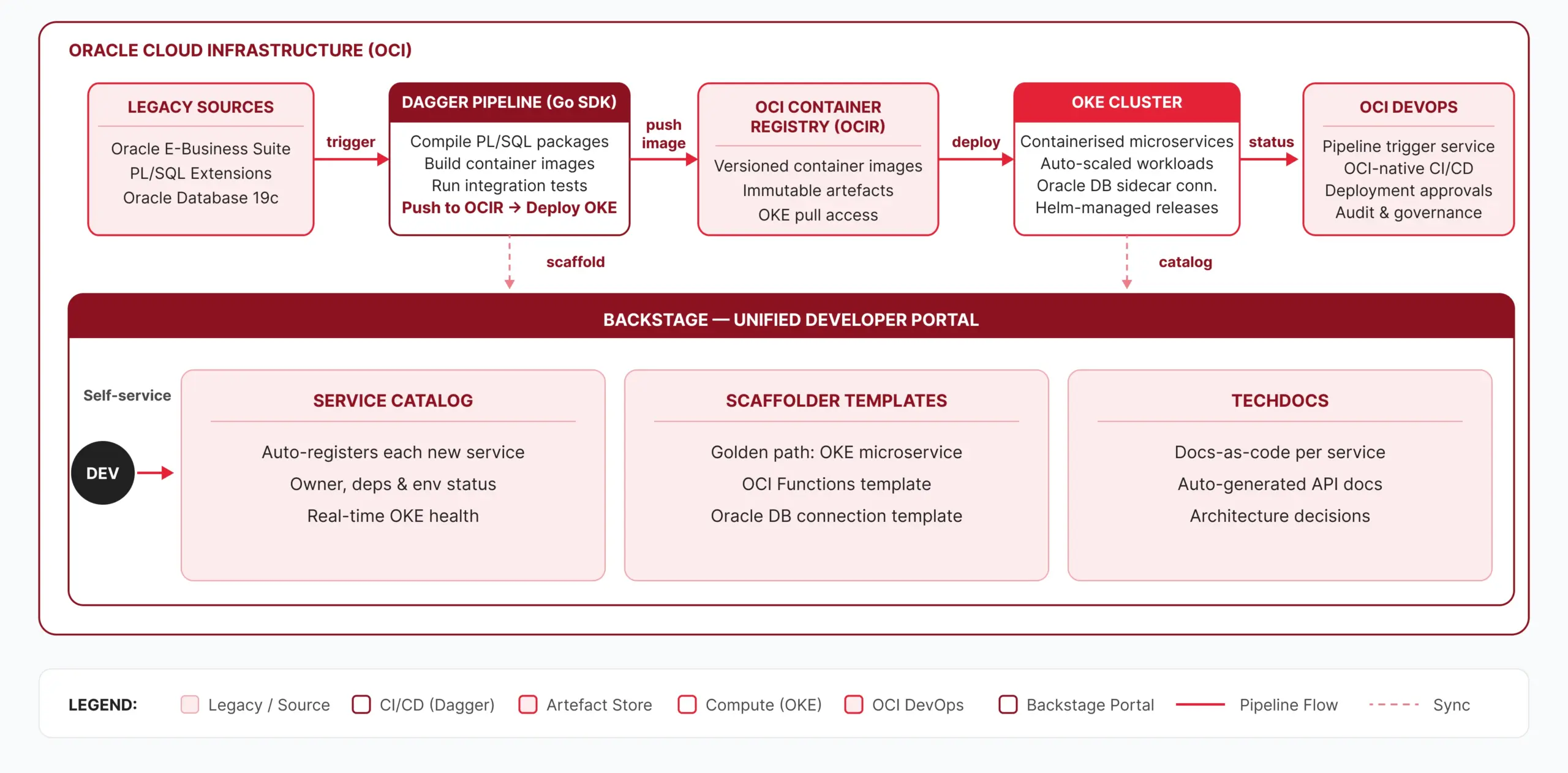
An 18-month EBS modernisation roadmap is a signal that the organisation has no repeatable path from intent to production, solving the same infrastructure problem from scratch on every new service. This manufacturing enterprise had exactly that: weeks of manual setup per service, no pipeline, no catalog, and no documentation. Ksolves encoded every best practice once and made it self-service. Developers now select a golden path template and have a fully provisioned OCI service with a working Dagger pipeline, catalog registration, and auto-generated documentation in under 10 minutes.
Is Your Oracle EBS Modernisation Roadmap Measured in Years Rather than Months?