Project Name
How a Mid-Size Staffing Firm Improved Salesforce CRM Adoption by 72% with CTI Ninja
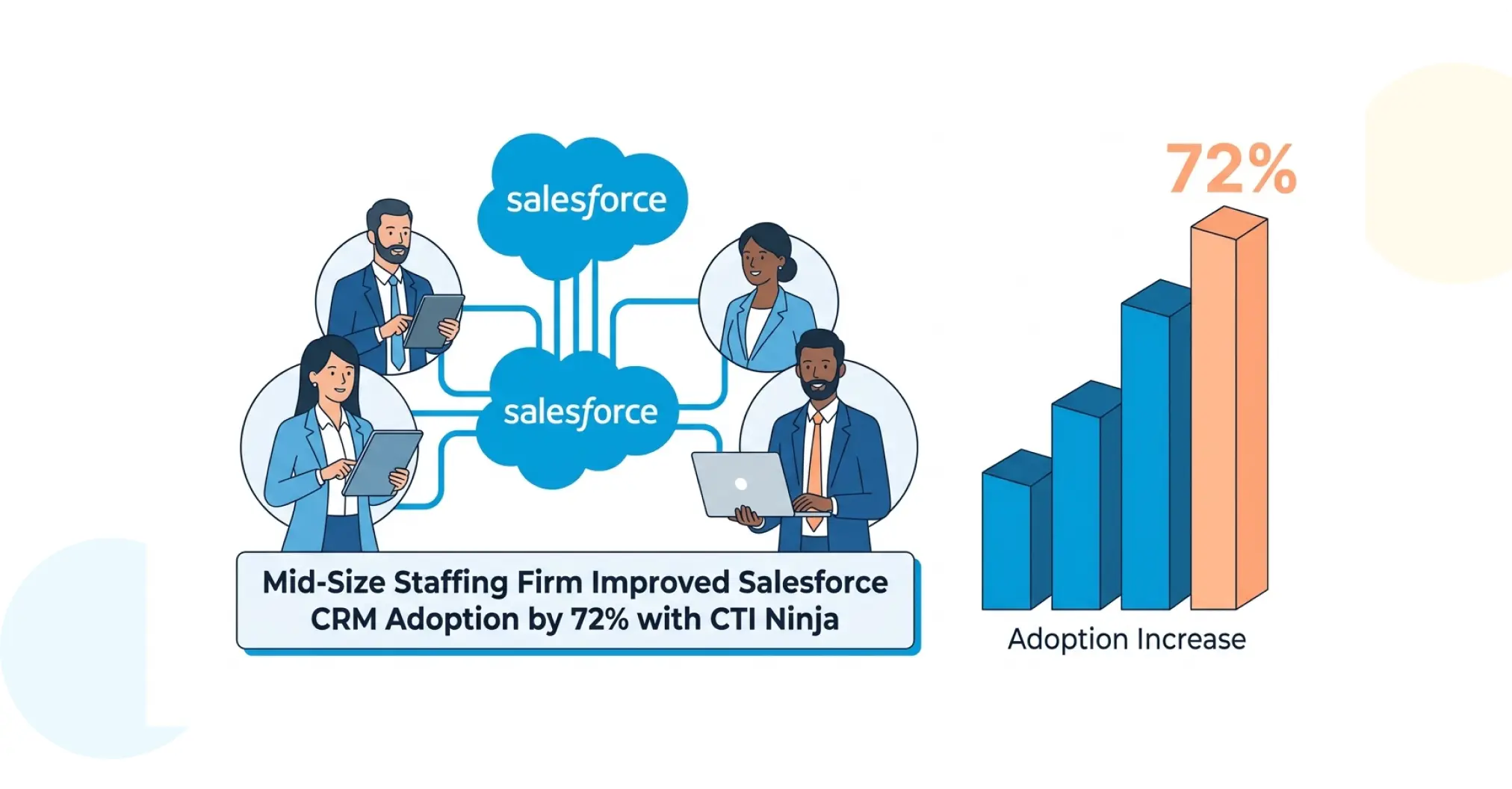

A mid-size staffing and recruitment firm with over 120 recruiters across four regional offices had been running Salesforce as its CRM for nearly two years. The investment was significant. The return was not. Fewer than half the recruiters used Salesforce consistently, and the data that did make it into the system was incomplete, outdated, or entered days after the interaction it was supposed to capture.
The root cause was straightforward: recruiters spend the majority of their working hours on the phone. Outbound calls to candidates, inbound queries from hiring managers, follow-ups on submitted profiles, reference checks. When every productive minute is spent talking, logging that activity in a separate system feels like administrative overhead that competes with the actual job.
The firm engaged Ksolves, a provider of end-to-end Salesforce consulting services, to deploy CTI Ninja, a 100% Salesforce-native Computer Telephony Integration solution, with a specific goal: make Salesforce the place where phone calls happen, not the place where phone calls get documented after the fact. The project moved from AppExchange installation to full rollout in under three weeks.
-
Low CRM Adoption Among Recruiters
At the time of assessment, the firm measured a 41% active CRM usage rate across its recruiting teams. Recruiters acknowledged that Salesforce held valuable data but described it as a reporting tool for management rather than something that helped them do their jobs. Most tracked their own call activity in personal spreadsheets, sticky notes, or memory. The CRM was treated as a box to check at the end of the week, not a daily workspace. -
Manual Call Logging and Data Entry Burden
After every call, recruiters were expected to switch from their phone system to Salesforce, locate the correct contact or lead record, and manually enter the call outcome, duration, and any notes. With recruiters averaging 40 to 60 calls per day, this meant hundreds of context switches across the team. In practice, most recruiters batched their logging at the end of the day or skipped it entirely. The result was a CRM full of gaps. -
No Real-Time Candidate Context During Calls
When a candidate or client called in, the recruiter answering had no automatic way to know who was on the line. They would ask the caller to identify themselves, then manually search Salesforce while the conversation waited. For repeat callers with active placement pipelines, this created a poor experience: the candidate expected the recruiter to already know their status, and the recruiter was scrambling to pull up the record. -
Limited Visibility into Recruiter Phone Activity
Team leads managed groups of 10 to 15 recruiters but had no reliable, real-time data on how many calls each person was making, how long those calls lasted, or whether follow-up tasks were being completed. Performance conversations relied on self-reported numbers or anecdotal observation. When a recruiter claimed to have made 50 calls in a day, there was no system-level record to confirm or contextualize that number. -
Inconsistent Follow-Up on Candidate and Client Outreach
Staffing is a timing-sensitive business. A candidate who is available today may accept another offer tomorrow. A hiring manager who requested profiles on Monday expects an update by Wednesday. Without automated reminders tied to call outcomes inside Salesforce, follow-ups depended entirely on individual recruiter discipline. Warm leads went cold. Client check-ins were missed. The firm suspected it was losing placements to slower response cycles but had no data to quantify it.
-
Salesforce-Native CTI Deployment with Installation
Ksolves deployed CTI Ninja via the Salesforce AppExchange, enabling a quick and straightforward setup with minimal admin effort. Integrated within Salesforce, the solution allowed recruiters to access a softphone interface directly within their existing workflow. As part of its Salesforce consulting services, Ksolves also configured IVR flows and call routing rules, ensuring a smooth rollout without requiring significant changes to the existing setup. -
Click-to-Call for High-Volume Outbound Recruiting
Every phone number in Salesforce became a clickable link. Recruiters initiated calls directly from candidate records, job requisitions, and client accounts without leaving the CRM. For a team averaging 40 to 60 outbound calls per day per recruiter, this eliminated manual dialing entirely and removed the friction of switching between a phone system and Salesforce. The call began in context, and the context stayed visible throughout the conversation. -
Inbound Screen Pop with Full Candidate and Client History
When an inbound call arrived, CTI Ninja automatically matched the caller ID against Salesforce records and displayed a screen pop showing the caller's name, placement history, open job requisitions they were associated with, and the most recent interaction notes. Recruiters answered the phone already knowing who was calling and what the likely topic was. For unrecognized numbers, the screen pop prompted the recruiter to create a new lead record directly from the call interface. -
Automated Call Logging Linked to Salesforce Records
Every call, inbound and outbound, was automatically logged to the relevant Salesforce record the moment it ended. The log captured call duration, timestamp, direction, and the recruiter who handled it. Recruiters could add notes in real time during the call using the built-in notes panel, and those notes were saved directly to the activity history on the contact or lead record. No post-call data entry. No end-of-day logging sessions. The record was complete before the recruiter moved on to the next call. -
Supervisor Dashboards for Recruiter Performance Tracking
CTI Ninja's real-time dashboards gave team leads and regional managers a live view of recruiter phone activity: calls made, calls received, average call duration, calls missed, and follow-up task completion rates. These dashboards operated inside Salesforce, pulling from the same automatically logged call data. Managers could identify which recruiters were below their outreach targets by mid-morning and intervene with coaching rather than waiting for end-of-week self-reports.
-
CRM Adoption Rate Increase from 41% to 72%
Within 90 days of CTI Ninja going live, active Salesforce usage among recruiters rose from 41% to 72%. The shift was not driven by a mandate or a training initiative. It happened because the phone, the recruiter's primary tool, now lived inside Salesforce. Using the CRM was no longer a separate administrative step; it was inseparable from the act of making and receiving calls. Recruiters who had previously avoided Salesforce began spending the majority of their day inside it. -
35% Reduction in Manual Data Entry Time
Automated call logging eliminated the largest single source of manual data entry for the recruiting team. The firm estimated that each recruiter saved roughly 45 minutes per day that had previously been spent on post-call documentation. Across 120 recruiters, that translated to approximately 90 hours of recovered productive time per day, time that was redirected to candidate outreach and client engagement. -
Faster Candidate Response Times
With inbound screen pops providing full caller context, recruiters no longer spent the first 30 to 60 seconds of a call searching for the relevant record. Average inbound call handling time decreased, and recruiters reported that candidates noticed the difference. Candidates who called in about their application status received immediate, informed answers rather than a callback promise. The firm tracked a measurable improvement in candidate satisfaction scores within the first quarter. -
Improved Pipeline Visibility for Recruitment Managers
For the first time, regional managers had access to accurate, real-time call activity data across their teams. Pipeline reviews shifted from being based on recruiter estimates to being grounded in system-verified data: how many candidates were contacted, how many clients received follow-ups, and where gaps existed. This visibility allowed managers to make faster decisions about resource allocation and to identify process bottlenecks before they affected placement timelines. -
Higher Placement-to-Interview Ratio
With consistent, system-triggered follow-ups replacing manual memory-based outreach, the firm saw an increase in its placement-to-interview ratio over two consecutive quarters. Candidates who had been submitted to clients were followed up on within defined time windows. Hiring managers received status updates on schedule. The compounding effect of reliable follow-up was that fewer qualified candidates fell out of the pipeline due to inattention, and clients received a more predictable service experience.
This engagement demonstrated that CRM adoption in phone-intensive teams is not primarily a training problem or a compliance problem. It is a workflow problem. When recruiters had to choose between making calls and updating Salesforce, the calls won every time. CTI Ninja removed that choice by making the phone call and the CRM record the same action.
For staffing and recruitment firms running Salesforce, CTI Ninja closes the gap between where productive work happens (the phone) and where the organization needs that work documented (the CRM). The result is cleaner data, better visibility, and recruiters who actually use the system they were given.
To explore how CTI Ninja can support your team’s Salesforce CTI integration, visit smsninja.app
Bring Your Phone Calls Inside Salesforce and Start Building a CRM Your Recruiters Actually Use.