



Top Salesforce Reporting Mistakes That Kill Revenue Forecasts
Salesforce
5 MIN READ
April 6, 2026

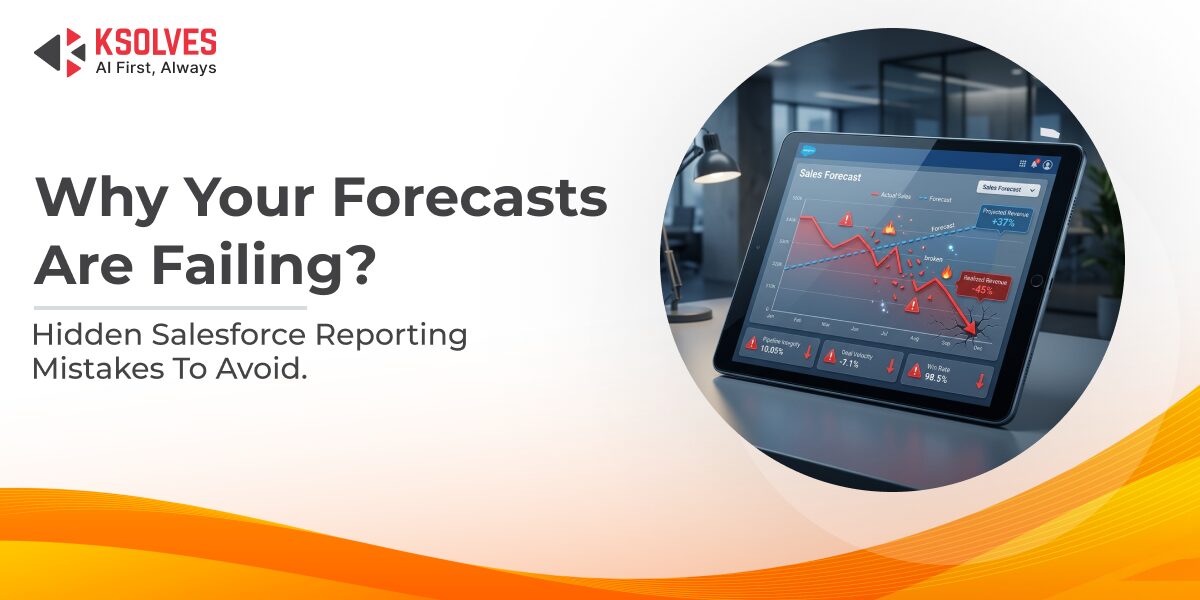
Accurate Salesforce reporting is the backbone of reliable revenue forecasting, but even the most sophisticated CRM setup can’t save you from bad reporting practices. When data is incomplete, outdated, or misaligned, forecasts become guesswork.
The result? Missed revenue targets, poor resource allocation, and a lack of confidence from leadership and investors alike.
In this article, we’ll uncover the most common Salesforce reporting mistakes that quietly derail your revenue forecasts. More importantly, we’ll show you how to fix them, so your forecasts are no longer a gamble, but a growth-driving asset.
Top Salesforce Reporting Mistakes That Undermine Forecasts
Small reporting gaps can have a big impact on forecast accuracy. Here are the most common mistakes to watch out for and why they matter.
1. Inconsistent Data Entry Across Teams
When different sales reps use their own naming conventions, skip required fields, or interpret opportunity stages differently, it leads to dirty data. Without strict validation rules or standardized input fields, reports become unreliable. What looks like a healthy pipeline may actually be full of low-quality or duplicate entries, skewing your forecasts from the start.
2. Overreliance on Default Reports and Dashboards
Salesforce’s default dashboards are a helpful starting point, but they’re not tailored to your company’s sales cycle, KPIs, or forecasting needs. Relying solely on them leaves gaps, like not tracking velocity, segment-wise performance, or product-specific conversions. Without customization, key trends go unnoticed, and forecast accuracy suffers.
3. Misaligned Opportunity Stages and Forecast Categories
Forecasting depends heavily on the correct mapping between opportunity stages and forecast categories like “Pipeline,” “Best Case,” and “Commit.” When this mapping is inconsistent or left undefined, your forecasted revenue reflects hope, not data. Reps may mark deals as “Commit” too early, creating a false sense of confidence.
4. Ignoring Historical Data Trends
Focusing only on the current pipeline without looking at historical conversion rates, average deal size, and sales cycle duration is a major blind spot. Past performance provides the context needed to evaluate whether today’s forecast is realistic. Without it, leadership may be making decisions based on optimistic assumptions rather than data-backed probabilities.
5. Poor Lead Source Attribution
When the origin of leads is incorrectly tracked, revenue gets credited to the wrong source. This misalignment leads to misleading ROI metrics for marketing campaigns and wasted budget. Worse, it hinders your ability to double down on the most effective channels, undermining future pipeline growth.
6. No Real-Time Data Updates
Forecasts are only as accurate as your data is current. When sales reps fail to update opportunity progress, or when integrated systems like CPQ or ERP don’t sync in real-time, key information is missing. This time lag can distort your understanding of what’s really going on in the pipeline.
7. Lack of Executive Visibility and Alerts
Executives need real-time visibility into pipeline health, forecast accuracy, and anomalies (like deals that have gone dark). Without automated alerts or digest reports, leadership is often flying blind until it’s too late to course-correct. Timely insights are essential for making proactive decisions that preserve revenue.
Best Practices for Accurate Salesforce Revenue Forecasting
To build forecasts you can trust, your Salesforce setup needs to combine clean data, tailored reporting, and consistent team practices. Below are essential best practices that ensure your revenue predictions are reliable and actionable.
1. Implement Validation Rules and Automation
Enforce data integrity at the source by setting up validation rules that require consistent input across opportunity stages, forecast categories, close dates, and deal values. Combine this with automation (via Flows) to reduce manual errors, trigger follow-ups, or auto-update fields based on deal progression. This ensures that your pipeline data stays clean and your forecasts are based on accurate inputs.
2. Customize Forecast Reports and Dashboards
Out-of-the-box reports rarely reflect the nuances of your sales process. Tailor your dashboards to show metrics that actually drive your business, like weighted pipeline, product-level forecasts, or historical conversion rates. Use report filters, field-level visibility, and forecast categories aligned to your internal definitions to avoid blind spots and misleading summaries.
3. Regular Training and Cross-Team Alignment
Forecasting isn’t just a sales function; it’s a company-wide discipline. Conduct regular training for reps to ensure proper opportunity updates. Align with finance and operations to define forecasting terms, planning timelines, and revenue recognition milestones. Consistent definitions and workflows across departments prevent data silos and conflicting reports.
4. Leverage Salesforce Forecasting Tools
Salesforce offers robust tools purpose-built for revenue forecasting:
- Collaborative Forecasts: Let sales leaders track committed, best-case, and pipeline deals across teams.
- Pipeline Inspection: Provides real-time visibility into changes in deal amounts, close dates, and forecast categories, so nothing slips through the cracks.
- Einstein Forecasting: Uses AI to predict forecast trends based on historical data, deal velocity, and rep behavior, adding a layer of predictive intelligence to your planning.
When these tools are properly configured and used consistently, they turn Salesforce into a forecasting powerhouse.
How Ksolves Can Help
Knowing what needs to be fixed and actually fixing it are two very different things. This is where having the right Salesforce expertise makes all the difference.
Ksolves is a trusted Salesforce consulting company that helps organizations clean up their reporting foundations, optimize forecasting configurations, and build CRM setups that deliver accurate, actionable insights at every level of the business.
From resolving data integrity issues to configuring Einstein Forecasting and building custom dashboards aligned to your sales process, Ksolves brings the technical depth and hands-on experience needed to make your Salesforce investment perform the way it was always intended to.
If your revenue forecasts are falling short of expectations, it may not be a pipeline problem. It may be a reporting problem. Let Ksolves help you find out. Reach out to the team at [email protected].
Conclusion
Revenue forecasting is only as strong as the data and reporting practices behind it. The mistakes outlined above, from inconsistent data entry and misaligned opportunity stages to poor lead attribution and lack of executive visibility, do not just create reporting headaches. They directly erode confidence in your pipeline, slow down decision-making, and ultimately cost your business revenue that it should have captured.
The good news is that none of these problems is permanent. With the right validation rules, customized dashboards, cross-functional alignment, and Salesforce’s native forecasting tools properly configured, your reports can evolve from a source of frustration into a reliable growth asset. Start by auditing your current setup, identifying where the gaps are, and taking a structured approach to fixing them. Your forecasts should be a tool for confident decision-making, not a source of doubt.
Ready to turn your Salesforce reports into a true revenue engine? Partner with Ksolves to audit, fix, and optimize your Salesforce reporting setup for forecasts you can actually trust.






























Author
About the Author Editorial Team The Ksolves Editorial Team includes certified Salesforce experts, Big Data engineers, AI/ML specialists, Zoho consultants, and experienced technology writers focused on delivering clear, actionable insights for modern businesses. With hands-on experience across Salesforce, Big Data platforms, AI/ML solutions, application development, software testing, and Zoho ERP/CRM, the team publishes practical guides, real-world use cases, and industry updates that support smarter decisions and faster growth. Every article is created to solve business challenges, guide technology adoption, and keep organizations aligned with evolving digital ecosystems.
Share with