

 AI
 5 MIN READ


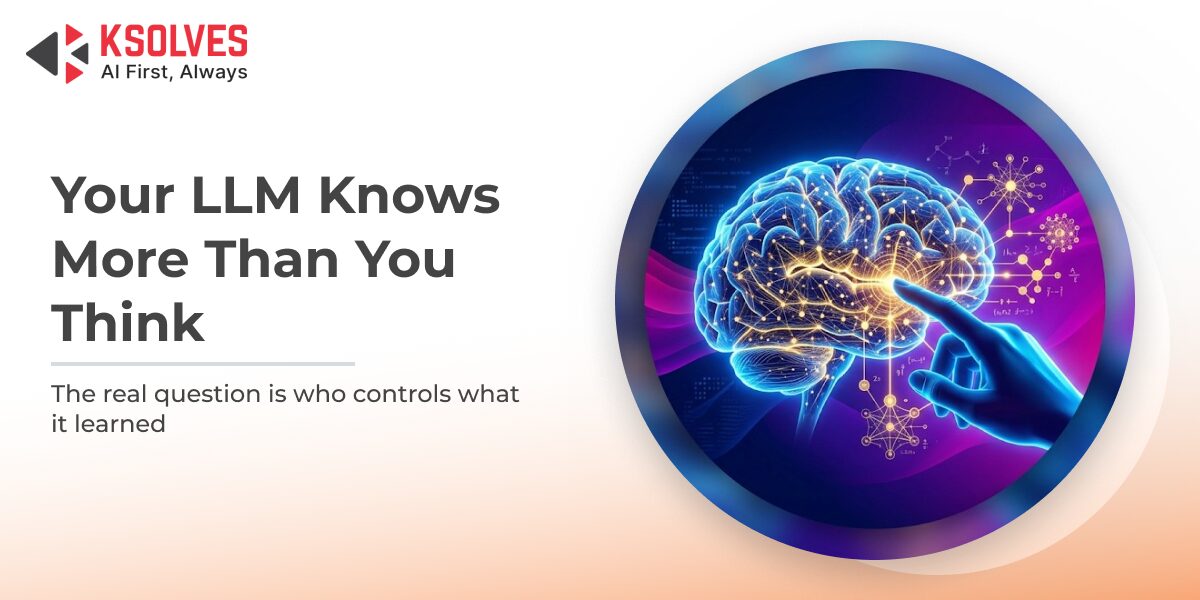
Most AI product teams obsess over benchmarks, latency, and prompt engineering. The one question that rarely makes it onto the sprint board is the one carrying the most legal, reputational, and competitive weight: Who actually owns and controls the data that trained the model?
This is not a compliance footnote. It is the structural foundation for an entire AI product. And if it cracks, everything built on top of it cracks with it. Hence, this blog is for CTOs, AI product managers, and enterprise compliance leads who want to understand why training data governance matters, where the industry is falling short on fine-tuning, and what AI-first teams are doing differently to build products that last.
The Hidden History Inside Every Foundation Model
Why Inherited Data Risk Is a Business Problem, Not Just a Legal One
Picking up a pre-trained foundation model feels straightforward. A team integrates it, fine-tunes it, wraps it in a UI, and ships. But beneath the surface, that model carries a history no one on that team wrote.
- According to industry research, AI compliance failures caused $4.4 billion in losses across organizations in 2025 alone.
- Non-compliance with frameworks like the EU AI Act can now trigger fines reaching €35 million or 7% of global annual revenue.
Every learned behavior and capability in that model was shaped by training data assembled under decisions that were never reviewed, from sources whose rights may be actively contested in court. And when a product is built on top of someone else’s model, that complexity is inherited, whether it is visible or not.
Three Data Control Layers AI Teams Routinely Ignore
Layer 1: Who Assembled the Training Corpus?
Foundation models are typically trained on a mix of web-scraped data, licensed archives, synthetic content, and human feedback gathered through contractors. Each source operates under a different rights regime. Treating the model as a finished ingredient without understanding what went into it is the equivalent of serving food without knowing where the ingredients came from. Any team building on top of a foundation model is also building on top of every unresolved question that came with it. Getting this right starts with a deliberate AI data pipeline strategy, not just a model-selection decision.
Layer 2: What Rights Were Granted, and to Whom?
Fair use arguments that looked solid a few years ago are being tested in courts globally. Some model providers include indemnification clauses. Many do not. Reading the actual terms of service, not just the summary, is the baseline expectation for any serious AI product team. What a provider says about training data provenance and what liability they accept when that provenance is contested are the two questions that matter most. Enterprises selling AI-powered features to large clients are increasingly required to answer these questions in vendor security questionnaires. Teams that cannot answer lose deals.
Layer 3: What Happens When a Team Fine-Tunes on Its Own Data?
Fine-tuning is the process of adapting a pre-trained model using an organization’s own data, whether through supervised examples, human preference feedback, or instruction tuning on proprietary documents, customer conversations, and internal knowledge bases. This is not just a technical step. It is a data governance decision. Did the organization have the right to use that data for training? What did its terms of service promise users about how their inputs would be used? These questions need answers before the first training run, not after.
For a deeper look at why data governance in machine learning is non-negotiable, Ksolves’ detailed breakdown is worth reading.
The Quiet Fine-Tuning Arms Race (And Where the Gaps Still Are)
Where the Real Differentiation Has Moved
Fine-tuning has moved from exotic to table stakes. Because every serious team is now doing it, differentiation has shifted to the quality of the process. The teams pulling ahead are winning on three fronts:
- Data curation is treated as a domain expertise task, not just a labeling task. High-quality training examples require people who understand the domain deeply enough to know what a good output looks like and why.
- Continuous production feedback loops, where real-world model behavior feeds back into future training runs. This compounds advantage over time in ways that are very difficult to replicate quickly.
- Evaluation as infrastructure, with rigorous, structured assessments covering tone, safety, consistency, and edge case behavior, not just spot-checks and intuition.
The Gaps That Even Well-Resourced Teams Have Not Solved
Despite these advances, significant gaps remain. Models still struggle with compositional generalization across novel task combinations, long-context coherence beyond a few thousand tokens, and calibrated uncertainty. Fine-tuned models tend to sound confident even when they should not, because confident-sounding outputs rate better in human preference data, creating a systematic bias.
Silent degradation under distribution shifts is another underappreciated problem: when terminology evolves, or customer behavior changes, the model does not announce it is becoming stale. It just quietly gets worse.
These are not fringe edge cases. They are real failure modes that enterprise deployments hit regularly, and they almost always trace back to gaps in data governance and evaluation discipline that were skipped during the build phase.
The Regulatory Pressure Is Already Here
What the EU AI Act and Emerging Laws Mean for AI Product Teams
The regulatory environment has shifted from theoretical to operational. The EU AI Act entered phased enforcement in 2025, requiring organizations to document the data used to train or fine-tune models they deploy. “We used a third-party API” is no longer a sufficient answer for regulators or enterprise procurement teams.
In the United States, state-level AI legislation and sectoral regulations in finance and healthcare are moving in the same direction. Financial services alone saw 157 AI-related regulatory updates in a single year.
Organizations in regulated industries, including healthcare, financial services, and legal, face a specific challenge: the better they fine-tune a model for safety and compliance, the more careful they must be about the data feeding that process. A misstep in either direction, either underinvesting in governance or over-restricting capability, creates operational and commercial risk.
The teams building governance infrastructure now are not just avoiding fines. They are building the enterprise sales credentials, the audit readiness, and the stakeholder trust that will separate durable AI products from fragile ones over the next three years.
Putting a formal AI governance framework in place before regulators ask for one is what separates prepared teams from reactive ones.
Training Data Risk by Source Type: A Practical Reference
Not all training data carries the same level of governance risk. The table below maps common data source types against their risk profile, what needs to be verified, and the recommended action before any fine-tuning run begins.
| Data Source Type | Governance Risk | What to Verify | Recommended Action |
|---|---|---|---|
| Web-scraped public data | High | Licensing terms, robots.txt compliance, and copyright ownership | Audit thoroughly; assume restricted unless proven otherwise |
| Licensed third-party datasets | Medium | Scope of license, permitted uses, expiry terms | Review the license for AI training permissions specifically |
| Synthetic data generated by another model | Medium-High | Rights over outputs from the source model, downstream use clauses | Check source model’s terms of service for generated content |
| Internal enterprise documents | Medium | Employee IP clauses, client confidentiality agreements | Legal review before including in any training pipeline |
| Customer-generated content | High | User consent, terms of service language, GDPR/CCPA obligations | Confirm explicit consent covers AI training use cases |
| Human feedback from contractors | Medium | Contractor agreements, data ownership clauses | Ensure IP rights are assigned to the organization, not the contractor |
| Open-source datasets (e.g., Common Crawl) | Medium | Known legal challenges, evolving court precedents | Monitor active litigation; do not assume safe because widely used |
| Proprietary first-party behavioral data | Low-Medium | Internal data governance policies, personal data regulations | Anonymize where required; document usage in compliance records |
This table is not exhaustive, but it provides a starting framework for any team mapping their data dependencies before a training or fine-tuning run. The act of filling it in is often more valuable than the finished document, because it forces a conversation that most teams never have until it is too late.
How Ksolves Helps Organizations Build AI Products They Can Stand Behind
Ksolves approaches AI development as an AI-first company, not as a team that bolted AI onto a pre-existing playbook. Our AI-certified experts bring end-to-end capability across data strategy, model selection, fine-tuning, evaluation infrastructure, and production governance, all working together as a cohesive practice rather than isolated tasks.
For organizations looking to build or scale AI products with confidence, our Artificial Intelligence Services are designed to address exactly the challenges covered in this blog: data provenance, responsible fine-tuning, compliance readiness, and sustainable model improvement loops. Whether an organization is building its first AI product or hardening an existing one, we bring the domain depth and technical rigor that turns good intent into durable, defensible outcomes.
Explore the full portfolio of Ksolves AI/ML case studies to see how we delivered results spanning across industries like healthcare, finance, supply chain, and more.
Conclusion
Training data governance is not a legal formality. It is the difference between an AI product that compounds in value and one that accumulates risk quietly until something breaks. Mapping data dependencies, auditing fine-tuning data before it enters the training loop, and building evaluation and feedback infrastructure from day one are not optional steps for serious AI product teams. They are the foundation.
The builders who take this seriously now will be far better positioned than those who treat it as a retroactive checkbox. To build AI with clarity and confidence, organizations can connect with our team today or send us a query at [email protected].


 Mayank Shukla