



MongoDB vs MySQL: Which Database Should You Choose in 2026?
Big Data
5 MIN READ
August 3, 2026

Storing and managing data is the backbone of any successful business. Nowadays, every organization relies heavily on data to drive critical operations, make informed decisions, and stay competitive. But with the vast amounts of data generated daily, having a reliable and efficient way to store and manage this information is non-negotiable.
This is where databases come into play. They serve as the essential infrastructure that allows businesses to capture, organize, access, and analyze data seamlessly. However, with a wide array of database technologies available, choosing the right one to suit your specific business needs can be a daunting challenge.
What is MongoDB?
MongoDB is a NoSQL, document-oriented database that stores data in flexible, JSON-like BSON documents. Its schema-less design enables developers to store complex hierarchical data without predefined structures. This flexibility has made MongoDB a favorite for modern applications requiring rapid development cycles, scalable architectures, and the ability to handle large volumes of varied data.
What is MySQL?
MySQL, on the other hand, is a mature relational database management system (RDBMS) that uses SQL (Structured Query Language) to interact with data. It stores information in structured tables and enforces strict schemas. MySQL’s adherence to ACID properties (Atomicity, Consistency, Isolation, Durability) ensures data integrity and reliable transaction processing — indispensable for applications like banking, e-commerce, and enterprise resource planning.
Core Differences Between MongoDB and MySQL
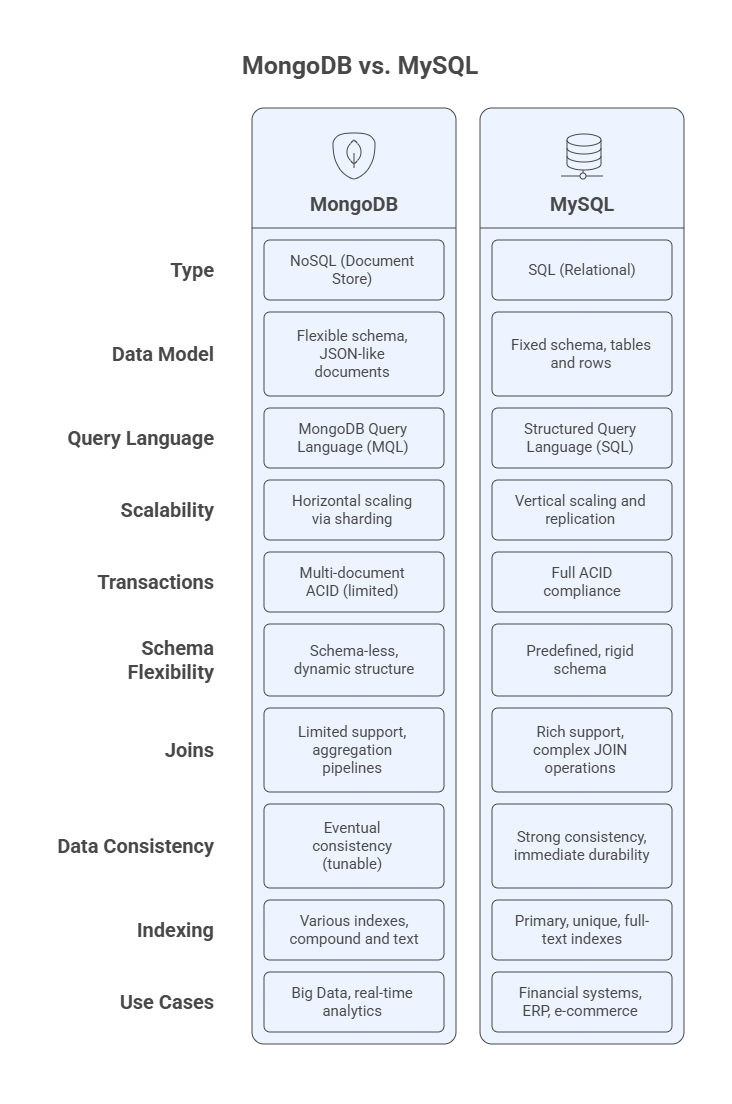
The table below highlights their key differences to help you choose the right solution. Here is the MongoDB vs MySQL comparison at a glance.
Deep Dive: MongoDB Features and Strengths
Schema Flexibility and Agility
MongoDB’s document-based model offers unparalleled flexibility by allowing documents within the same collection to have different fields. This flexibility is a boon for developers working on evolving applications or rapidly changing data structures, such as content management systems, IoT applications, and mobile apps.
Scalability and Performance
MongoDB’s design supports horizontal scaling through sharding, which partitions data across multiple servers to manage large datasets and high throughput. This makes MongoDB a go-to for big data applications and distributed systems.
Ease of Development
The JSON-like document format is intuitive for developers, especially those working with JavaScript and modern web frameworks. This alignment between application code and database reduces impedance mismatch and speeds up development.
Built-in Replication and High Availability
MongoDB uses replica sets for automatic failover and redundancy, ensuring data availability and disaster recovery.
Need Expert Help Managing Your MySQL Environment?
Deep Dive: MySQL Features and Strengths
Structured Data and ACID Compliance
MySQL enforces structured schemas, ensuring that all data conforms to a specified format. This, combined with strong ACID compliance, makes it ideal for applications where data integrity and transactional reliability are paramount, such as banking, retail, and ERP systems.
Powerful Querying and Joins
MySQL’s support for complex joins, subqueries, and transactions enables sophisticated querying that spans multiple tables. This capability is essential for relational data models with interdependencies.
Mature Ecosystem and Tooling
Being around for decades, MySQL has a vast ecosystem of tools, plugins, and integrations. It also offers proven reliability and extensive community support.
Vertical Scaling and Replication
MySQL supports vertical scaling by increasing server resources and replication strategies, such as master-slave replication, to enhance read performance and fault tolerance.
Practical Use Cases: MongoDB vs MySQL
Ideal Scenarios for MongoDB
- Content Management Systems: Flexible schema supports rich content types with varying metadata.
- Internet of Things (IoT): Handles streaming sensor data with varied formats.
- Real-time Analytics: Aggregation pipelines enable on-the-fly data analysis.
- Social Networks: Unstructured user-generated content fits naturally in BSON documents.
- E-commerce Catalogs: Product attributes vary widely and evolve frequently.
Ideal Scenarios for MySQL
- Banking Systems: Requires transactional integrity and strict data consistency.
- Enterprise Resource Planning (ERP): Complex relations and reporting needs.
- Inventory and Order Management: Transactions and relational integrity are critical.
- Legacy Applications: Many older systems and CMS platforms rely on MySQL.
Performance Comparison: MongoDB vs MySQL
Both databases perform exceptionally well when used in appropriate contexts.
- MongoDB often outperforms MySQL for write-heavy and large-volume data workloads, especially when data is semi-structured.
- MySQL excels at complex read operations involving multiple tables and transactions.
However, performance depends heavily on schema design, indexing, query optimization, and infrastructure setup.
Recent Developments and Hybrid Approaches
Both MongoDB and MySQL continue evolving to close gaps:
- MongoDB introduced multi-document ACID transactions in version 4.0, increasing its suitability for transactional workloads.
- MySQL has added JSON data type support, enabling more flexible data handling.
- Many enterprises use polyglot persistence — leveraging both databases for different parts of their systems, depending on workload and data type.
Ksolves: Your Trusted Partner for MongoDB Support Services
At Ksolves, we understand that selecting and managing a powerful database like MongoDB can be complex, especially when performance, scalability, and data integrity are on the line. That’s why we offer end-to-end MongoDB support services tailored to your business needs.
From architectural planning and seamless migrations to performance optimization, security hardening, and 24/7 technical support, our team of experienced MongoDB experts ensures that your database environment remains robust, responsive, and ready for the future.
Whether you’re just getting started or optimizing an existing setup, we’re here to help you every step of the way.
Conclusion
Both MongoDB and MySQL are powerful database solutions, each suited for different use cases. Choose MongoDB if you need flexibility, scalability, and speed for modern applications. Opt for MySQL when your data is highly structured and consistency is key.
The right choice depends on your project goals, and sometimes, a combination of both may be ideal.
Frequently Asked Questions
What is the main difference between MongoDB and MySQL?
MongoDB is a NoSQL, document-oriented database that stores data in flexible JSON-like BSON documents, while MySQL is a relational database management system that uses structured tables and SQL. MongoDB suits applications with evolving or unstructured data, whereas MySQL is built for transactional consistency and structured relationships. The right choice depends on whether your data model needs flexibility or strict schema enforcement.
What happens if I choose the wrong database for my application?
Choosing the wrong database can lead to performance bottlenecks, costly re-architecture, and data integrity issues down the line. For example, using MySQL for rapidly changing, semi-structured data can force frequent schema migrations, while using MongoDB for highly transactional systems like banking can compromise ACID guarantees. A mismatch often means re-platforming later at a much higher cost than getting the choice right upfront.
How do I migrate data from MySQL to MongoDB?
Migrating from MySQL to MongoDB typically involves mapping relational tables to document structures, then using an ETL tool like Apache NiFi to transfer and transform the data while preserving integrity. Ksolves has handled this exact migration pattern for clients, using NiFi flows to move MySQL data into MongoDB collections without disrupting live operations. Careful schema design upfront reduces rework once the data lands in MongoDB’s document model.
Is MongoDB a good alternative to MySQL for e-commerce catalogs?
Yes, MongoDB is often a strong alternative to MySQL for e-commerce catalogs because product attributes vary widely between categories and change frequently. Its schema-less document model lets you store varied product data without rigid table structures or constant schema migrations. MySQL remains a better fit when catalog data is highly structured and tied to strict inventory or order transactions.
When should a business consider using both MongoDB and MySQL together?
Businesses should consider a polyglot persistence approach when different parts of their system have fundamentally different data needs, such as transactional order data in MySQL and flexible product catalogs in MongoDB. This is common in e-commerce, IoT, and enterprise platforms where no single database fits every workload. The right time to adopt this pattern is when you notice recurring workarounds to force one database to handle data it wasn’t designed for.
Who provides MongoDB and MySQL support services?
Ksolves offers end-to-end support for both MongoDB and MySQL, covering architectural planning, migrations, performance optimization, and security hardening. Their team handles everything from initial database selection to ongoing 24/7 technical support. This makes them a practical option for businesses that need dedicated expertise across both relational and NoSQL environments.
How much does it cost to get expert help managing a MongoDB or MySQL database?
Costs for database support services vary based on environment size, workload complexity, and whether you need ongoing management or a one-time migration project. Ksolves scopes MongoDB and MySQL engagements individually after assessing your current setup and goals, rather than using flat pricing. Reaching out for a consultation is the fastest way to get an accurate estimate for your specific environment.
Have a different question? Contact our team.

































AUTHOR
Big Data
Anil Kushwaha, Technology Head at Ksolves, is an expert in Big Data. With over 11 years at Ksolves, he has been pivotal in driving innovative, high-volume data solutions with technologies like Nifi, Cassandra, Spark, Hadoop, etc. Passionate about advancing tech, he ensures smooth data warehousing for client success through tailored, cutting-edge strategies.
Share with