



Apache Cassandra 6: Cursor-Based Compaction Explained
Apache Cassandra
5 MIN READ
August 7, 2026

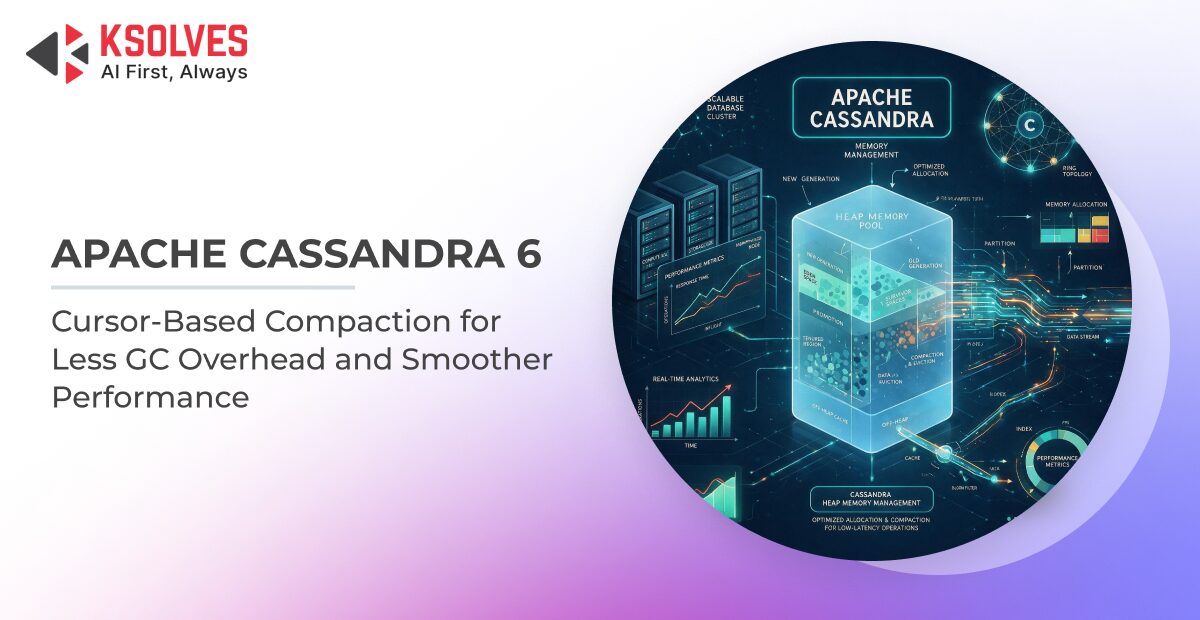
Compaction is one of Apache Cassandra’s most important background processes. It is the mechanism by which the database merges SSTables, removes tombstones, enforces TTLs, and maintains read performance over time. When compaction runs cleanly, it is invisible. When it runs badly, it shows up as GC pauses, latency spikes, and degraded throughput, often at the worst possible moment.
Cassandra 5.0 took a major step forward with Unified Compaction Strategy (UCS), which replaced the fragmented landscape of STCS, LCS, and TWCS with a single adaptive strategy. Cassandra 6 builds on this foundation with cursor-based compaction, a new internal execution path that processes SSTable data in a more streaming-oriented, low-allocation way.
The result is less heap pressure, fewer GC pauses, and smoother cluster behaviour during background compaction, especially on large datasets.
Why Compaction Creates GC Pressure in the First Place
Compaction is fundamentally a data merge operation. It reads multiple SSTables, reconciles row versions across them, drops tombstones and expired TTLs, and writes new merged SSTables. At scale, this involves processing enormous volumes of data.
In the traditional compaction model, this processing creates large numbers of short-lived in-memory objects, including row wrappers, column iterators, and merge buffers. Each of these objects is allocated on the heap and collected by the garbage collector. For clusters running large compactions on big tables, the cumulative effect is significant:
- GC pause frequency increases: the JVM spends more time reclaiming memory from short-lived compaction objects
- Heap pressure spills over: compaction competes with read and write paths for heap space, forcing more frequent full GCs
- Latency variance grows: GC stop-the-world pauses introduce unpredictable latency spikes that affect foreground query performance
- Node throughput degrades: sustained GC pressure during heavy compaction periods can noticeably reduce overall node throughput
These effects are well known in the Cassandra operator community. Tuning JVM heap settings, GC algorithms, and compaction throughput limits is a standard part of production Cassandra operations. Cursor-based compaction reduces the need for these workarounds by addressing the source of heap churn directly. Because Cassandra runs on the JVM, garbage collection behaviour is a recurring theme across different Cassandra distributions, not just the open-source project.
What Cursor-Based Compaction Does Differently
Cursor-based compaction introduces reusable, cursor-like reader and writer objects that process SSTable data in a streaming-oriented way. Instead of creating new in-memory objects for each row or column during processing, the same cursor objects are reused across the entire compaction operation.
The conceptual shift is from an allocation-heavy batch model to a streaming model:
| Aspect | Traditional Compaction Model | Cursor-Based Compaction Model |
|---|---|---|
| Object creation | New objects allocated per row/column during merge | Reusable cursor objects process rows sequentially |
| Heap allocation pattern | High allocation rate, heavy GC pressure | Low allocation rate, reduced GC pressure |
| Memory footprint | Spiky — large temporary allocations during merge | Smooth — predictable memory footprint across compaction |
| GC interaction | Frequent short-lived collections, risk of full GC | Fewer collections, more headroom for foreground work |
| Performance under load | Latency variance during heavy compaction periods | More consistent latency during background compaction |
This is a fundamentally different approach to the same operation. The output, merged SSTables with tombstones removed and TTLs enforced, is identical. The difference lies in how efficiently the database uses memory to get there.
How This Pairs with Unified Compaction Strategy
Unified Compaction Strategy (UCS, Cassandra 5.0) and cursor-based compaction are complementary improvements that address different aspects of compaction:
| Feature | What It Solves | Cassandra Version |
|---|---|---|
| Unified Compaction Strategy | Scheduling: which SSTables to compact, when, at what priority. Replaces STCS/LCS/TWCS configuration complexity. | 5.0 |
| Cursor-Based Compaction | Execution: how compaction processes data internally. Reduces heap allocation and GC overhead during active compaction. | 6.0 |
UCS decides what to compact. Cursor-based compaction decides how that compaction runs. Clusters upgrading to Cassandra 6 with UCS already enabled will get the full combined benefit of both improvements.
Read our blog to learn more about Cassandra 6 Dictionary Compression
Operational Impact: What Changes for Operators
GC Tuning Becomes Less Critical
One of the most common Cassandra operational tasks is tuning JVM GC settings to manage compaction-induced heap pressure, such as adjusting G1GC heap regions, tuning pause time targets, or increasing heap size to reduce full GC frequency. Cursor-based compaction reduces the heap allocation rate during compaction, which means these tuning parameters have less work to do. Clusters that previously needed aggressive GC tuning to handle large compaction jobs may find that their existing settings handle the load more comfortably.
More Consistent Performance on Large Datasets
The benefit of cursor-based compaction is most visible on clusters running large compactions: tables with billions of rows, heavy tombstone accumulation from delete-heavy workloads, or wide rows with many column versions. These are the compactions that previously caused the most noticeable GC pressure and latency variance. With lower allocation rates, those same compactions run with a smaller heap footprint and less GC interference.
Compaction No Longer Dominates Heap Headroom
On write-heavy clusters, compaction can consume a significant fraction of heap headroom, leaving less room for read caches, memtables, and other foreground operations. Cursor-based compaction’s reduced allocation rate means compaction takes up less of the shared heap budget, improving the memory headroom available for read and write paths during busy periods.
Better Efficiency on Memory-Constrained Nodes
For clusters running in cost-constrained environments, such as cloud instances with limited memory, edge deployments, or development clusters, cursor-based compaction’s reduced memory footprint is particularly valuable. Less heap consumption per compaction means more room to run compaction concurrently with other background tasks without the risk of an out-of-memory error.
Planning a Cassandra 6 Upgrade? Talk to Our Experts
What Has Not Changed
It is worth being precise about what cursor-based compaction does not change:
- It does not checkpoint or resume compaction. If a compaction is interrupted by a node restart, it still restarts from the beginning. Resumability is not part of this improvement.
- It does not change compaction scheduling. UCS or your configured strategy still determines what gets compacted and when.
- It does not reduce compaction I/O. The same amount of data is read and written. The improvement is in heap allocation efficiency, not I/O volume.
- It does not change output correctness. The resulting SSTables are identical to those produced by traditional compaction. This is a performance improvement, not a behavioral change.
Ksolves Guidance for Upgrade Planning
When advising clients on Cassandra 6 upgrades, we position cursor-based compaction as a performance dividend: an improvement that arrives with the upgrade without any specific action required. That said, a few areas are worth paying attention to:
- Benchmark GC metrics before and after the upgrade: Establish a baseline for GC pause frequency, GC duration, and heap utilisation during compaction on your current version. Post-upgrade, compare these metrics to quantify the improvement. This is the clearest way to demonstrate the value of cursor-based compaction to stakeholders.
- Revisit JVM heap sizing: If you previously increased heap size specifically to handle compaction-induced GC pressure, you may be able to reduce it post-upgrade. A smaller heap means smaller GC pauses and a better overall latency profile.
- Combine with UCS if not already done: If you are still running STCS or LCS, migrate to UCS as part of your Cassandra 6 upgrade. UCS and cursor-based compaction together deliver the full compaction improvement stack.
- Target high-write, high-tombstone tables first: The tables that benefit most from cursor-based compaction are those with the heaviest compaction workloads. Identify these tables before the upgrade and monitor them specifically afterward.
Conclusion
Cursor-based compaction is one of the clearest engineering wins in Apache Cassandra 6. It does not change what compaction produces or how it is scheduled, but it changes how efficiently the database gets there, with less heap churn, fewer garbage collection pauses, and more predictable performance under load.
For teams running large, delete-heavy, or memory-constrained clusters, this improvement can meaningfully reduce the operational tuning burden that has long been part of running Cassandra at scale. Paired with Unified Compaction Strategy, it gives Cassandra 6 the most complete compaction stack the project has shipped to date.
Upgrading itself requires no special preparation, but capturing before-and-after GC metrics remains the best way to see and prove the difference for your own workload.
Planning for Cassandra Upgrade?
FAQs
What is cursor-based compaction in Apache Cassandra 6?
Cursor-based compaction is a new internal execution path in Apache Cassandra 6 that processes SSTable data using reusable, streaming-oriented reader and writer objects instead of creating new objects for every row and column. It reduces heap allocation during compaction, lowering GC pause frequency without changing what compaction produces or how it is scheduled.
What happens if I skip a Cassandra 6 upgrade and keep tuning GC manually?
Clusters that stay on pre-6 versions continue to rely on aggressive JVM heap and GC tuning to manage compaction-induced pressure, especially on large, delete-heavy, or memory-constrained tables. This means more manual tuning overhead and a higher risk of latency spikes during heavy compaction periods compared to clusters running cursor-based compaction.
How do I benchmark the GC improvement after upgrading to Cassandra 6?
Capture GC pause frequency, GC duration, and heap utilisation during compaction on your current version before upgrading. After moving to Cassandra 6, compare the same metrics under a similar workload. Ksolves recommends this before-and-after benchmarking as the clearest way to quantify the improvement for stakeholders.
How is cursor-based compaction different from Unified Compaction Strategy (UCS)?
UCS, introduced in Cassandra 5.0, decides what to compact and when, replacing STCS, LCS, and TWCS with one adaptive scheduling strategy. Cursor-based compaction, introduced in Cassandra 6, decides how that compaction executes internally by reducing heap allocation. The two are complementary rather than competing improvements.
When should I plan a Cassandra 6 upgrade to get cursor-based compaction?
There is no required migration window since cursor-based compaction arrives automatically with the Cassandra 6 upgrade and needs no special configuration. Teams running large, high-tombstone, or memory-constrained clusters typically see the clearest benefit and should prioritize those tables first when scheduling the upgrade.
Who can help plan and benchmark a Cassandra 6 upgrade?
Ksolves’ Big Data engineering team provides Cassandra upgrade planning, GC benchmarking, and UCS migration support for production clusters. This includes establishing pre-upgrade baselines, validating post-upgrade heap behaviour, and prioritising high-write, high-tombstone tables for the biggest performance gains.
Does cursor-based compaction require reconfiguring how I run compaction?
No. Cursor-based compaction does not change the configuration model; UCS settings, compaction_throughput_mb_per_sec, and concurrent_compactors all remain valid. The improvement is purely in execution efficiency, so no reconfiguration effort is required to benefit from it.
Have questions about your Cassandra 6 upgrade? Contact our team.

 Anil Kushwaha
Organizations evaluating distributed NoSQL databases for high-volume, mission-critical applications frequently encounter two closely related names: Apache Cassandra and DataStax. Although […]































AUTHOR
Apache Cassandra
Anil Kushwaha, Technology Head at Ksolves, is an expert in Big Data. With over 11 years at Ksolves, he has been pivotal in driving innovative, high-volume data solutions with technologies like Nifi, Cassandra, Spark, Hadoop, etc. Passionate about advancing tech, he ensures smooth data warehousing for client success through tailored, cutting-edge strategies.
Share with