



Transforming Odoo Development with AI: From AI-Assisted Coding to Agentic Development
Odoo
5 MIN READ
September 3, 2026

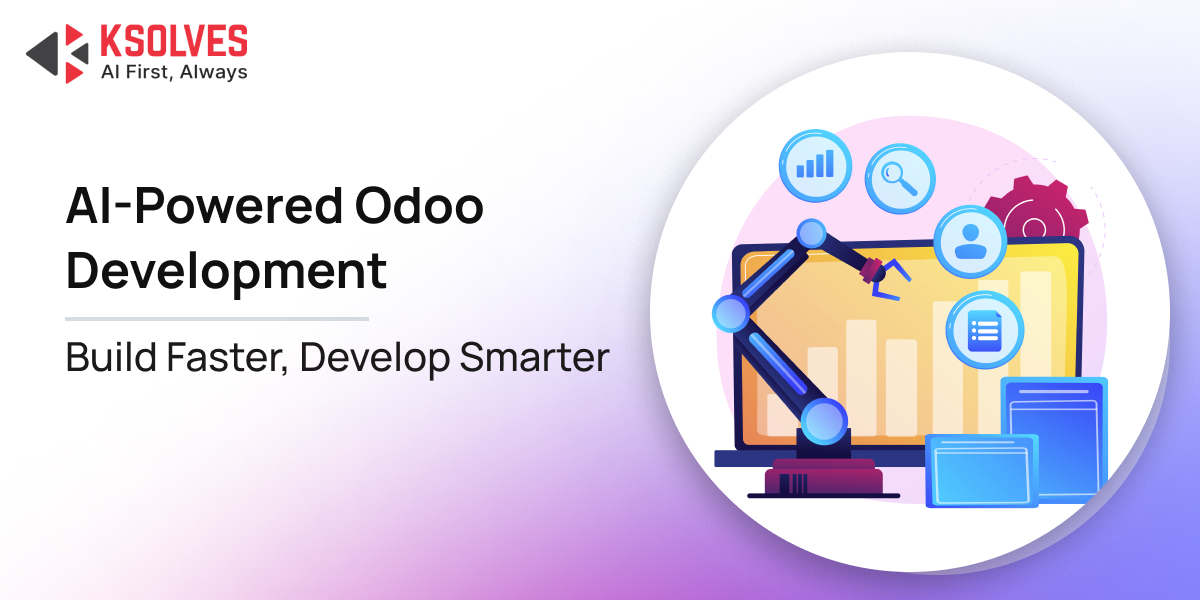
AI is changing software development from a tool that simply generates code into a technology that can understand requirements, assist with implementation, identify errors, and increasingly execute development workflows.
For Odoo development, this creates significant opportunities. From generating module boilerplate and XML views to working with the ORM, creating QWeb reports, assisting with data migration, and scaffolding modules through AI agents, developers can now accelerate several traditionally time-consuming tasks.
But AI does not eliminate the need for Odoo expertise. Odoo versions evolve, business requirements can be complex, and security and database decisions require careful validation. The real opportunity lies in combining AI’s speed with experienced human judgment.
Let’s explore how AI is transforming Odoo development and how Ksolves is utilizing AI in the entire Odoo development lifecycle.
How AI Is Transforming Odoo Development
Odoo’s modular architecture gives AI several practical areas where it can assist developers.
1. Accelerating Boilerplate Code
A developer can describe a requirement in natural language and use AI to generate the initial framework of an Odoo module, including:
- Module manifests
- Python models
- Fields and relational mappings
- Standard framework structures
This reduces repetitive coding and allows developers to focus earlier on business logic and architecture.
2. Generating XML Views and XPath
AI can also generate XML structures for Form, Tree, and Kanban views based on functional requirements.
For inherited views, it can help construct XPath expressions and the nested XML required to modify existing Odoo interfaces. However, generated XPath still needs to be checked against the actual view structure because even a syntactically valid expression may not produce the intended result.
3. Working with the Odoo ORM
AI can assist developers in structuring complex domains, filters, and read_group queries and in reasoning about how Odoo’s ORM should be used for database operations.
This is particularly useful when developers need to work with complex relational data while avoiding unnecessary use of raw SQL. ORM-first development should remain the preferred approach wherever appropriate.
4. Generating QWeb Templates
Custom invoices, delivery slips, and financial reports often require deeply nested HTML/XML structures.
AI can accelerate the creation of QWeb templates by generating the required structure and helping inject model variables into reports. Developers can then refine the generated template based on the actual reporting requirements and Odoo implementation.
5. From Code Assistance to Autonomous Scaffolding
The bigger shift comes with Agentic AI.
Instead of simply suggesting code, an AI agent can take a functional requirement, break it into development tasks, and generate an initial module structure containing directories, Python models, XML views, and security files.
This moves Odoo development from AI-assisted coding toward AI-assisted execution.
Where AI Creates the Biggest Productivity Gains
The impact of AI goes beyond typing code faster. It can reduce cognitive load and shorten several stages of the Odoo development lifecycle.
1. Documentation and QA
Documentation tasks that can take hours, such as user guides, technical architecture overviews, and docstrings, can be accelerated by allowing AI to analyze the completed codebase and generate structured documentation.
AI can also help review implementations and identify areas that deserve additional testing or validation.
2. Rapid Prototyping
Functional data models and basic views that previously required days of development can be prototyped much faster.
This allows Odoo teams to put an early working version in front of clients, gather feedback, and identify requirement gaps before significant development effort is invested.
3. Faster Error Isolation
Odoo developers frequently encounter PostgreSQL errors, registry errors, and long traceback logs.
Instead of spending hours searching forums for similar problems, developers can provide the relevant traceback and implementation context to AI and receive possible causes and remediation paths. The suggested solution still needs to be reproduced and validated in the actual development environment.
4. Legacy Code Refactoring
Older Odoo implementations can contain messy, undocumented, or inconsistent code.
AI can analyze these codebases and assist with refactoring them into cleaner, more maintainable structures, including improving code consistency and PEP 8 compliance. This can turn technical debt into a more manageable development asset.
Practical AI Use Cases in Odoo Projects
1. From Requirement to Module Skeleton
Consider a requirement such as:
“Create an Odoo module for fleet management that adds custom tire-tracking logic to fleet.vehicle.”
Traditionally, a developer would manually translate this requirement into a module structure, create the models and views, define security access, and then begin implementing the business logic.
With an AI agent, the workflow can begin with the requirement itself. The agent can create the initial directory structure, Python models, XML views, and security CSV files in seconds.
The generated skeleton is not the finished product. Developers still need to review the data model, business rules, security configuration, dependencies, and implementation before the module is considered production-ready.
2. AI-Assisted Data Migration
AI can also support Odoo migration projects.
For example, a business may have messy legacy CSV exports that need to be mapped to Odoo’s required model structure. AI can help analyze the source and target schemas, identify field mappings, generate data-cleaning logic, and assist in creating Python scripts for importing the transformed data through XML-RPC.
This can significantly reduce the manual effort involved in preparing migration scripts.
However, migration is an area where validation is critical. Data relationships, duplicates, missing values, business rules, and data integrity cannot simply be assumed to be correct because an AI-generated script runs successfully.
The Challenges: Where Human Expertise Still Matters
AI can accelerate Odoo development, but it also introduces risks when its output is accepted without review.
1. Odoo Version Confusion
Odoo’s framework evolves across versions. AI can sometimes mix older APIs and development practices with those applicable to newer releases.
For example, code patterns from Odoo 14 may be suggested for an Odoo 18 or Odoo 19 implementation.
Providing the exact Odoo version in the prompt and validating generated code against the target version is therefore essential.
2. The Black Box Trap
One of the biggest risks is blindly copying AI-generated code.
If developers do not understand the logic they are introducing, a problem that appears simple during development can become significantly harder to diagnose when the code reaches production.
AI should reduce development effort, not remove developer understanding.
3. Security Blind Spots
AI may sometimes recommend raw SQL using methods such as self.env.cr.execute() when it believes a database operation should be optimized.
Raw SQL is not automatically wrong, but inappropriate or poorly parameterized SQL can create security and maintainability risks. Access rules, record rules, database constraints, and generated code therefore require human review.
The principle is simple:
AI can generate the implementation. Experienced developers must validate the decision.
Building a Reliable AI-Assisted Odoo Development Workflow
The quality of AI-generated output depends heavily on the context and constraints provided to it.
1. Give AI the Right Context
A vague prompt can produce a generic implementation. A context-rich prompt provides the model with the boundaries it needs.
For example:
“Act as an expert Odoo v18 developer. Prioritize ORM over raw SQL. Do not use deprecated methods.”
Explicitly defining the Odoo version, architectural preferences, restrictions, and expected output can reduce errors and make the generated code more relevant.
2. Work Iteratively
Instead of asking AI to build an entire Odoo application in one prompt, break the work into logical stages:
Models → Security → Views → Business Logic → Validation
This makes the output easier to review and allows developers to catch problems earlier.
3. Keep Humans in the Loop
Human validation remains mandatory for critical areas such as:
- Security rules
- Database constraints
- Business logic
- Data migration
- Performance-sensitive operations
- Production deployment
The strongest workflow is therefore not AI versus developer. It is AI working alongside an experienced Odoo developer.
From AI-Assisted Development to Agentic Odoo
There is an important difference between an AI assistant and an AI agent.
An AI assistant may suggest a piece of code. An AI agent can potentially execute a sequence of connected tasks.
For example:
Write code → Run a linter → Identify errors → Fix the code → Run tests
This type of workflow can reduce the amount of manual coordination required between individual development tasks.
Agentic AI can also extend beyond coding. Business analysts could use AI to turn unstructured meeting transcripts into structured requirements and User Stories, giving developers a clearer starting point for implementation.
The goal is not unrestricted autonomy. Agentic Odoo development needs guardrails around permissions, code review, testing, security, and production changes.
How Ksolves is Bringing AI into Odoo Development
At Ksolves, AI is becoming part of how we approach Odoo development, not simply an additional coding tool.
As an AI-first Odoo development company, Ksolves combines Odoo expertise with AI-led methodologies across implementation, customization, development, migration, and integration. The objective is to accelerate delivery while keeping architecture, security, business logic, and validation under expert control.
Our approach is centered on building Odoo solutions around the way a business actually operates rather than forcing complex processes into a standard template.
AI can support this process by accelerating configuration, development, prototyping, documentation, and technical analysis. At the same time, experienced Odoo professionals remain responsible for translating business requirements into reliable solutions.
Ksolves also applies an AI-led Odoo implementation approach to improve configuration accuracy, reduce implementation risks, and help businesses reach value from their Odoo environment faster.
As Odoo environments evolve, the opportunity goes beyond initial implementation. AI can also support continuous optimization and the development of more intelligent business workflows.
Conclusion
AI is reshaping Odoo development by accelerating coding, prototyping, debugging, migration, and documentation. But the strongest results come when AI works alongside experienced developers who validate architecture, security, and business logic.
As AI evolves from coding assistance to agentic development and AI-powered ERP operations, businesses have an opportunity to build smarter Odoo solutions faster. With an AI-first approach and deep Odoo expertise, Ksolves helps turn that opportunity into reliable, business-focused solutions.































AUTHOR
Odoo
Neha Negi, Presales and Business Associate Head at Ksolves is a results-driven ERP consultant with over 8 years of expertise in designing and implementing tailored ERP solutions. She has a proven track record of leading successful projects from concept to completion, driving organizational efficiency and success.
Share with