



The Era of Agentic Commerce: Powering OpenAI Shopping Directly from Salesforce Commerce Cloud
Salesforce
5 MIN READ
October 14, 2026

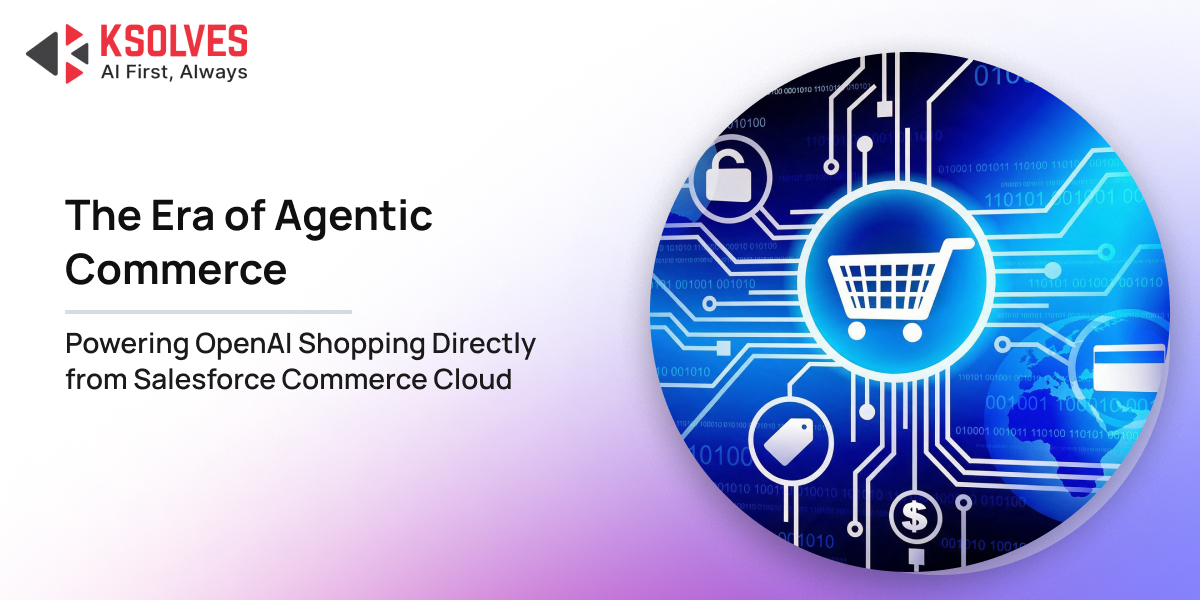
A customer can now use AI to find the right product in seconds. Why should buying it still require a traditional checkout journey?
Consider a shopper researching running shoes through ChatGPT. They share their running style, gait, budget, preferred brands, and performance needs, and AI narrows hundreds of options into a relevant shortlist.
But when they are ready to buy, the experience can become fragmented. They are redirected to a merchant website, re-enter shipping details, navigate checkout, and provide payment information. The AI-powered experience ends where conversion matters most.
AI-referred traffic has grown 393% year over year, while 48% of AI-shopping users say they are willing to let an AI agent complete a purchase on their behalf. The expectation is shifting from “help me find a product” to “help me complete the purchase.”
This is the rise of agentic commerce, where AI can move beyond discovery to orchestrate the buying journey. For retailers on Salesforce Commerce Cloud, the opportunity is to close this discovery-to-transaction gap.
By connecting OpenAI Shopping with Salesforce Commerce Cloud (Agentforce Commerce) through the Agentic Commerce Protocol (ACP), brands can enable commerce directly within an AI-led shopping experience, using their existing commerce infrastructure to power products, pricing, inventory, and transactions.
Understanding the Salesforce Commerce Cloud and OpenAI Integration
Connecting Agentforce Commerce Cloud to OpenAI is not simply a matter of switching on another marketing channel. The implementation depends on making the merchant’s catalogue structured, accessible, accurate, and suitable for AI-driven discovery.
Within Salesforce B2C Commerce Business Manager, administrators can access the OpenAI integration through: Merchant Tools → Site → AI & Social Integrations → OpenAI
The configuration includes SFTP Configuration and Business Details, supported by catalogue field mapping, product filtering, feed preview, and daily feed synchronization. Salesforce’s current documentation confirms that the OpenAI product feed uses SFTP to securely transfer catalogue data and that the daily feed sync automatically generates and uploads the feed.
A. SFTP Data Pipeline Configuration
Unlike a traditional storefront integration where an external system might crawl product pages, the B2C Commerce OpenAI integration uses a secure SFTP-based catalogue feed.
Administrators receive OpenAI SFTP credentials during merchant onboarding and enter them in the SFTP Configuration section. Salesforce stores those credentials securely and uses the connection to upload the product feed.
Once the connection is established and daily synchronization is enabled, B2C Commerce generates the catalogue feed and uploads it automatically.
This creates an important operational dependency: the quality of the AI shopping experience depends on the quality of the commerce catalogue being synchronized.
If a running shoe has an outdated description, missing size information, incorrect pricing, or incomplete product attributes in SFCC, those gaps can affect how the product is represented in AI-led discovery.
B. Contextual Business Details
AI system development needs enough structured commercial context to understand what the product is, who sells it, how it should be presented, and what price should be associated with it.
The OpenAI integration therefore includes business-level configuration such as:
- Seller Name: Defines the merchant or brand name displayed to shoppers in ChatGPT.
- List Price Book: Allows the merchant to specify the price book used for the product feed, helping maintain pricing consistency.
- Image View Type: Controls which product image representation is used from the SFCC media configuration.
Salesforce documentation confirms that the selected List Price Book can override the price field in the feed mapping, while the Seller Name is required for the OpenAI feed.
For example, if a retailer operates separate pricing structures for different commerce experiences, selecting the appropriate price book becomes important. An AI recommendation showing an outdated or incorrect price can create an immediate disconnect when the shopper reaches the merchant’s commerce environment.
2. Technical Architecture and Data Mapping Flow
The integration essentially translates Agentforce Commerce Cloud’s structured catalogue into a feed that OpenAI can use for product discovery.
|
Configuration |
Source Component | Operational Importance |
| SFTP Credentials | OpenAI Merchant Portal |
Securely authorizes catalogue feed uploads |
|
Seller Name |
B2C Commerce Business Details | Defines the merchant identity presented with products |
|
List Price Book |
SFCC Pricing Engine | Controls the price supplied to the OpenAI product feed |
| Image View Type | SFCC Media Library |
Determines the product image representation used in the feed |
|
Field Mapping |
SFCC Catalogue Attributes | Determines how product information is represented in the feed |
|
Product Filters |
SFCC Catalogue |
Controls which products are included in the AI channel |
The value comes from how much useful product context the AI can access.
3. Agentic Commerce Feeds vs. Traditional Product Feeds
Traditional product feeds often focus on matching products to predefined categories, keywords, filters, and advertising requirements. Agentic commerce introduces a more contextual discovery model.
Semantic Discovery
A traditional search query might look for “waterproof business bag” An AI shopping interaction can understand a much richer request: “Find me weather-resistant bag that can carry a 16-inch laptop and work for a three-day business trip to Seattle.”
That requires meaningful product attributes, not just a product title containing the words “waterproof” and “business.”
Price Integrity
Pricing becomes even more important when an AI agent is influencing a purchase decision. If the catalogue feed contains an outdated price while the commerce engine calculates a different price at checkout, the customer experience immediately loses credibility.
Using the appropriate SFCC price book and validating feed mappings helps reduce this risk. Salesforce specifically provides price-book configuration within the OpenAI product-feed setup.
Controlled Product Visibility
Merchants also need control over which products are exposed through AI channels. A retailer may want its entire catalogue available for traditional website search, but only selected products are exposed through a specific AI commerce channel.
Product filters and catalogue configuration therefore become part of the merchandising strategy, not just a technical setup task.
Blueprint for Preparing Salesforce Commerce Cloud for OpenAI Shopping
Salesforce Agentforce integration is only the beginning. The underlying SFCC catalogue needs to be prepared for AI-driven discovery.
Step 1: Enrich Product Attributes
AI recommendations become more useful when product data contains meaningful attributes. For example, a sports retailer should not stop at: Product: Trail Running Shoe
The catalogue should capture and include all relevant information. The more complete the structured product data, the more useful it becomes for intent-based product discovery.
Salesforce also supports custom attributes in product-feed mappings, allowing merchants to map relevant catalogue information to channel requirements.
Step 2: Isolate and Validate Pricing Structures
Verify that the selected List Price Book contains valid pricing for the products being exposed.
This matters because the price shown during AI-led discovery needs to align with the actual commerce experience. Before activating the feed, teams should therefore validate:
- Product-to-price-book relationships
- Currency configuration
- Promotional pricing
- Missing SKU prices
- Regional pricing requirements
- Checkout price calculation
Step 3: Standardize the Media Asset Pipeline
Product discovery is increasingly visual. Product images therefore need to be consistently configured, correctly mapped, and optimized for digital delivery.
A retailer selling furniture, for example, should ensure that a product such as a “Walnut Extendable Dining Table” has a high-quality primary image, appropriate alternate views, and correctly configured image URLs.
Broken image paths, missing image assignments, or inconsistent asset configurations can weaken the product presentation within conversational shopping experiences.
Salesforce’s integration supports image field configuration and global image overrides within the OpenAI product-feed setup.
Step 4: Validate the Storefront and Commerce APIs
For headless or composable implementations, product URLs and commerce APIs become particularly important.
Salesforce’s documentation notes that PWA Kit and headless storefronts may require product URL overrides so the feed points to the correct product detail page.
Beyond the feed itself, Salesforce Commerce APIs provide REST APIs for building storefronts, integrations, and commerce experiences. This creates the foundation for exposing commerce capabilities to connected applications and agentic experiences.
For example, if an AI experience identifies the right product, the underlying commerce architecture still needs to support product retrieval, availability, cart operations, authentication, and the transition towards checkout.
What Agentic Commerce Changes for Salesforce Commerce Cloud
The biggest change is not simply another channel appearing in Business Manager. It is the shift from storefront-centric commerce to commerce that can operate across AI interfaces.
- A traditional journey looks like: Search → Product Page → Cart → Checkout → Payment
- An agentic journey can look more like: Natural-Language Intent → Product Discovery → Product Comparison → Recommendation → Cart → Checkout
Salesforce’s current Agentforce Commerce strategy reflects this broader shift, with its platform designed to connect commerce across owned storefronts and external AI channels such as ChatGPT.
The Future of Autonomous Retail Starts With Commerce-Ready Data
Activating the OpenAI integration in Salesforce Commerce Cloud is not simply a configuration exercise. It is a step towards making the commerce operation AI-ready.
The retailers best positioned for agentic commerce will not necessarily be those with the largest catalogues. They will be the ones with the most accurate, structured, accessible, and actionable commerce data.
That puts a new responsibility on Salesforce Commerce Cloud teams: make the commerce engine ready for machines as well as people.
Final Thoughts
Moving towards agentic commerce requires more than enabling an OpenAI product feed. It requires the right foundation across AgentforceCommerce Cloud architecture, catalogue management, integrations, APIs, pricing, inventory, checkout, and data quality.
At Ksolves, we help businesses design, implement, integrate, and optimize Salesforce Commerce Cloud environments for evolving digital commerce requirements.
Our Salesforce Agentforce implementation services can help assess your existing architecture, strengthen commerce integrations, improve catalogue and product data readiness, and prepare your platform for AI-driven customer journeys.
Ready to make your Salesforce Commerce Cloud environment ready for agentic commerce? Connect with us to build a practical roadmap for AI-powered commerce.
FAQs
1. What is agentic commerce?
Agentic commerce uses AI agents to help shoppers discover, evaluate, and potentially complete purchases based on conversational intent rather than traditional website navigation.
2. How does OpenAI Shopping connect with Salesforce Commerce Cloud?
Salesforce B2C Commerce provides an OpenAI product-feed integration that securely synchronises catalogue information through SFTP, allowing products to be discovered through ChatGPT.
3. What Salesforce Commerce Cloud data is important for AI shopping?
Product titles, descriptions, attributes, images, pricing, product URLs, and relevant catalogue information are important for accurate AI-driven product discovery.
4. What is the Agentic Commerce Protocol?
The Agentic Commerce Protocol, developed by OpenAI and Stripe, provides a framework for AI agents and merchants to support commerce experiences and facilitate checkout. Salesforce announced support for ACP through its Agentforce Commerce strategy.
5. How can Ksolves help with Salesforce agentic commerce?
Ksolves can support Salesforce Commerce Cloud architecture, integrations, catalogue readiness, APIs, customization, data, and implementation requirements needed to prepare for AI-powered commerce.






























AUTHOR
Salesforce
Rakesh Kumar is a Salesforce Practice Lead and Application Architect at Ksolves India Limited, with over 11 years of experience in Salesforce development and enterprise solution architecture. He specializes in Salesforce Financial Services Cloud, Consumer Goods Cloud, Sales Cloud, Service Cloud, Commerce Cloud, Revenue Cloud, Data Cloud, and Agentforce. His expertise includes designing multi-cloud CRM solutions, integrating enterprise systems, developing reusable Salesforce accelerators, and implementing AI-driven workflows. A 12-time Salesforce-certified professional, Rakesh focuses on enterprise architecture, secure AI agent deployment, and transforming complex business processes into scalable, production-ready Salesforce solutions.
Share with