



How to Choose the Right ERPNext Implementation Partner
ERPNext
5 MIN READ
October 23, 2026

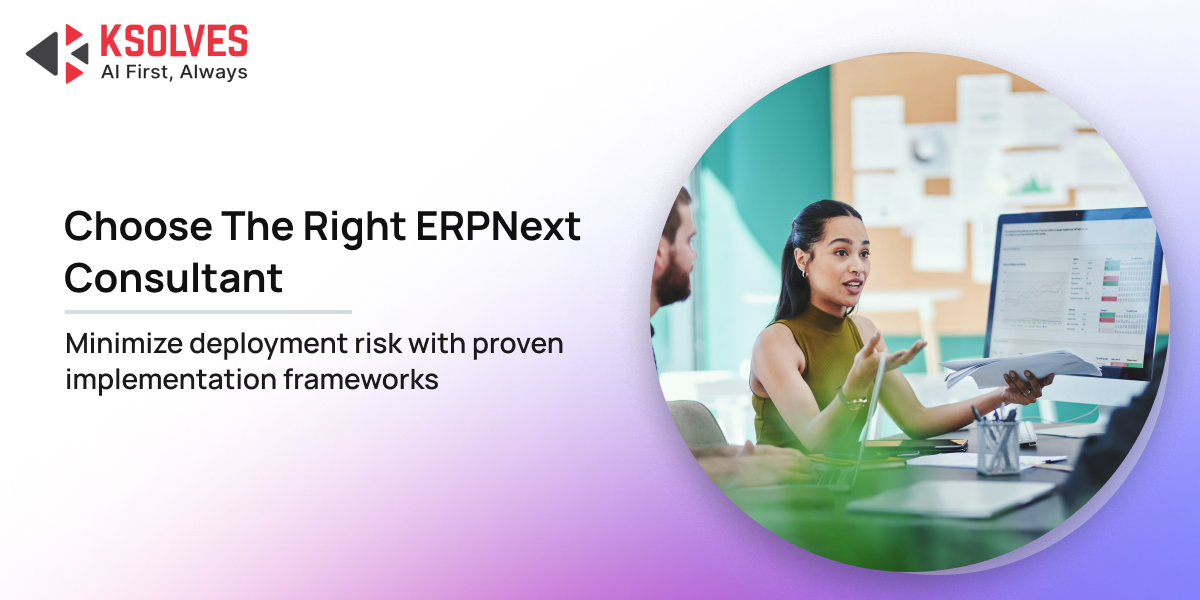
Selecting an ERPNext implementation partner is one of the most critical decisions an enterprise can make when modernizing its digital core. ERPNext provides an agile, open-source foundation, but rollout success depends on the partner’s expertise, methodology, and technical mastery.
What goes wrong with the wrong partner:
- Data migration errors
- Scope creep and budget overruns
- Low employee adoption
What you get with a proven certified specialist: business workflows translated into scalable, automated, and secure system architectures.
This guide covers selection criteria, red flags, an evaluation checklist, cost drivers, and deployment best practices to help you evaluate an ERPNext consulting partner.
What is an ERPNext Implementation Partner?
An ERPNext implementation partner is a specialized technology solution provider that designs, configures, customizes, integrates, and deploys the ERPNext platform for businesses. Instead of a standard out-of-the-box setup, the partner aligns ERPNext with your business rules, regulatory requirements, supply chain constraints, and accounting structures.
Core ERPNext implementation services a partner delivers:
- Business Process Mapping
Aligning standard ERPNext modules with custom organizational workflows. - Frappe Framework Development
Custom apps, server-side scripts, and custom doctypes built on Python and JS. - Legacy Data Migration
Cleansing, transforming, and importing historic financial, inventory, and customer data. - Third-Party Integrations
Connecting ERPNext with eCommerce engines, payment gateways, CRMs, and hardware peripherals. - Compliance & Localization
Configuring tax engines, localized e-invoicing, TDS/TCS, and payroll regulations. - Managed AMC & Support
Post-go-live maintenance, AI-assisted delivery, fast delivery, SLA support, and version upgrade management.
Why Choose a Certified Frappe Partner Over In-House Execution?
Open-source platforms permit self-deployment, but internal IT teams often lack deep knowledge of the Frappe Framework’s internal mechanics. An ERPNext certified consultant reduces implementation risk and protects architectural scalability.
| Factor | Internal Self-Rollout | Certified Partner |
|---|---|---|
| Delivery risk | High risk of failure and delays | Structured, phased methodology |
| Customization | Bottlenecks from limited Frappe depth | Frappe Framework experts |
| Data migration | Higher risk of mapping and balance errors | Documented migration and validation process |
| Architecture | Core edits that block upgrades | Upgrade-safe custom apps |
| Project Cut-Over Plan | Chances of failure and delays. | Structured, phased methodology |
| Post-go-live support | No SLA | SLA-backed AMC |
1. Architectural Integrity and Core Compatibility
- The risk:
Uncertified teams often modify the core codebase directly, creating technical debt and blocking future version upgrades. - The certified approach:
Custom features are built in dedicated custom apps using public hooks, keeping the core clean and upgradeable.
2. Multi-Industry Expertise
An established open-source ERP implementation partner has seen operational edge cases across many verticals and anticipates them before go-live. Examples:
- Manufacturing:
Complex bill of materials (BOM) routing - Healthcare:
Batch tracking - Retail:
Multi-store inventory sync
3. Faster Time to Value
Partners shorten delivery timelines compared with trial-and-error internal attempts by using:
- Structured methodologies
- Pre-built integration connectors
- Repeatable testing frameworks
- AI-assisted documentation, UAT Use case, and Development
Core Criteria for ERPNext Partner Selection
When running an ERPNext vendor selection process, rely on objective technical and operational benchmarks rather than sales pitches.
| Criterion | Key Benchmark Requirement |
|---|---|
| Engineering Capability | Certified ERPNext Consultants/Frappe Framework developers |
| Track Record | Multi-sector portfolio with references |
| System Integration | REST API, Webhooks, custom connectors |
| Data Security & Support | ISO compliance, SLAs, 24×7 coverage |
| Domain Expertise/SME | Accounting (Multi-country), Pharma Industry |
1. Verified Technical Credentials & Frappe Mastery
Confirm the vendor has certified Frappe developers on staff. Ask:
- Do they write clean custom Python scripts and Jinja print formats?
- Can they optimize MariaDB/PostgreSQL queries for high-volume transactions?
- Do they manage infrastructure via Bench CLI, Redis, and Nginx configurations?
2. Deep Integration Capability
Evaluate their ability to build real-time integrations using REST APIs and Webhooks across:
- eCommerce Platforms
Shopify, WooCommerce, Magento - CRM & Service Systems
Salesforce, HubSpot, Zendesk - Financial & Payment Portals
Stripe, Razorpay, PayPal, Bank APIs - Logistics & POS
Shipping API aggregators, field-sales mobile apps, point-of-sale hardware
For enterprise-grade integration requirements, review Ksolves ERPNext Customization Services.
3. Proven Data Migration Discipline
Data migration issues can derail an ERP rollout. The partner should show a clear migration protocol covering:
- Data extraction
- Cleansing
- Field mapping
- Staging validation
- Cutover execution
Ask for: past migration case studies, especially from Tally, QuickBooks, SAP, or legacy databases.
4. SLA-Backed Post-Go-Live AMC Support
Go-live is the start of the operational lifecycle, not the end. Your ERPNext partner evaluation should confirm the support agreement includes:
- Guaranteed response times
- Ticket-resolution SLAs
- Continuous patch updates
- Infrastructure monitoring
Explore long-term support structures via Ksolves ERPNext Consulting Services.
ERPNext Implementation Partner Evaluation Checklist
Use this ERPNext implementation checklist during vendor evaluation:
| Checkpoint | Question to Ask the Vendor |
|---|---|
| Certification Status | Are you an active, recognized Frappe partner? |
| Developer Count | Do you employ full-time, in-house Frappe developers, or outsource execution? |
| Domain Portfolio | Have you completed projects in our industry? |
| Upgrade Integrity | Do you commit to zero core code modifications? |
| Structured Framework | What implementation methodology do you follow? |
| Reference Verification | Can you share client references for past projects? |
| Support SLAs | Does the contract define resolution timelines for critical issues? |
| Credibility | Check partner track record, organizational stability, retention rate, and implementation success rate |
Major Red Flags During ERPNext Vendor Selection
At a glance, avoid vendors who:
- Propose modifying ERPNext core code
- Quote a fixed price before process discovery
- Can’t explain their data migration process
- Offer no training or change management
Direct Core Code Modification
- Warning sign:
The developer suggests altering default core files instead of building isolated custom apps. - Impact:
Breaks system stability and causes failures during platform upgrades. - Action:
End the discussion.
Fixed-Price Quotes Without Prior Process Discovery
- Warning sign:
A fixed budget is quoted before a thorough discovery phase. - Impact:
Unexpected costs later, or reduced quality when scope changes.
Vague Data Migration Protocols
- Warning sign:
Promises of fast, unvalidated data transfers. - What good looks like:
Careful mapping, trial loads, opening balance checks, and user verification.
Absence of Dedicated Change Management and Training
- Warning sign:
Technical delivery only, with no user enablement. - What good looks like:
Role-based end-user training, operational guides, and hands-on onboarding.
Breakdown of ERPNext Implementation Costs
ERPNext has no per-user license fees, so ERPNext implementation cost is driven mainly by services, infrastructure, and support.
| Cost Driver | Description |
|---|---|
| Implementation & Setup | Discovery, configuration, and basic workflows |
| Customization | Custom doctypes, apps, and dashboards |
| System Integration | REST APIs, payment, and eCommerce sync |
| Hosting & Infra | Cloud server sizing and maintenance |
| Ongoing Support/AMC | Version upgrades and SLA bug fixing |
Factors that raise or lower total cost:
- Scope of Customization
Native-module setups cost significantly less than projects needing custom apps, specialized workflows, and unique print formats. - Integration Complexity
Legacy platforms or custom external APIs require additional engineering hours. - Data Volume & History
Years of complex transactional records increase migration scope. - Hosting Architecture
Self-hosted private cloud setups need tailored security, automated backups, and continuous monitoring.
Conclusion: Build a Future-Ready ERPNext Foundation with Ksolves
The right ERPNext implementation partner decides whether your ERP becomes a growth engine or an operational bottleneck. Prioritize certified Frappe expertise, upgrade-safe development, strong integration capability, and SLA-backed support.
Ksolves meets every one of these criteria. As a publicly listed company (NSE: KSOLVES) and certified Frappe partner, Ksolves delivers enterprise-grade ERPNext implementations worldwide.
| 50+ Industries Served | 99% On-Time Delivery | 90% Client Retention | 24×7 Global Support |
How we deliver: the 6C Framework
Consult → Configure → Customize → Connect → Cutover → Continuous Support
Every engagement follows this framework. Customizations are built as independent Frappe apps with zero core code changes, so your system stays clean, scalable, and upgrade-ready.
Ready to get started? Schedule a technical discovery consultation with Ksolves’ certified ERPNext experts.
Frequently Asked Questions
Q. What is the difference between a certified partner and an uncertified freelancer?
A certified partner is recognized by Frappe, has trained in-house engineering teams, follows upgrade-safe development practices, and offers SLA-backed AMC support. Uncertified freelancers often lack multi-module depth and may edit core files directly, creating long-term maintenance risk.
Q. How long does an ERPNext implementation take?
Small to mid-sized ERPNext implementations typically take 4 to 12 weeks. Enterprise deployments with custom apps, large data migrations, and multi-system integrations take longer and follow a phased rollout.
Q. Can ERPNext handle complex manufacturing and multi-warehouse operations?
Yes. ERPNext natively supports multi-level BOMs, work orders, job cards, capacity planning, auto-reorder levels, batch/serial number tracking, and multi-location warehouse management.
Q. What happens when Frappe releases a new major version of ERPNext?
If custom features are built in independent custom apps using standard hooks, major version upgrades can be applied smoothly without breaking customizations or losing data.
Q. How does ERPNext compare to proprietary ERP systems in total cost of ownership?
ERPNext is open source, so there are no recurring per-user licensing fees. This lowers long-term cost and lets budgets focus on custom engineering, integrations, hosting, and support.
Q. How does Ksolves handle data migration from Tally or SAP?
Ksolves follows a six-step process: extraction, structural cleansing, staging load validation, trial balance checks, opening balance reconciliation, and final cutover verification before go-live.
Q. Is ERPNext suitable for multi-currency and multi-company operations?
Yes. ERPNext natively supports multi-company consolidation, inter-company transactions, multi-currency accounting, and configurable tax frameworks across jurisdictions.





























AUTHOR
ERPNext
Ankit Shridhar is an ERP Consultant at Ksolves India Limited with over 18 years of experience in ERP consulting, business transformation, and enterprise solution delivery. He specializes in implementing and optimizing enterprise resource planning solutions that streamline operations across Sales, Purchase, Inventory, Manufacturing, CRM, HR, and Finance. With expertise in ERP strategy, business process optimization, AI-enabled consulting, and digital transformation, Ankit has successfully led complex enterprise projects from requirements analysis and solution design to deployment and post-implementation support.
Share with