


Reducing Cloud DevOps Costs: An Enterprise FinOps Framework
DevOps
5 MIN READ
October 26, 2026

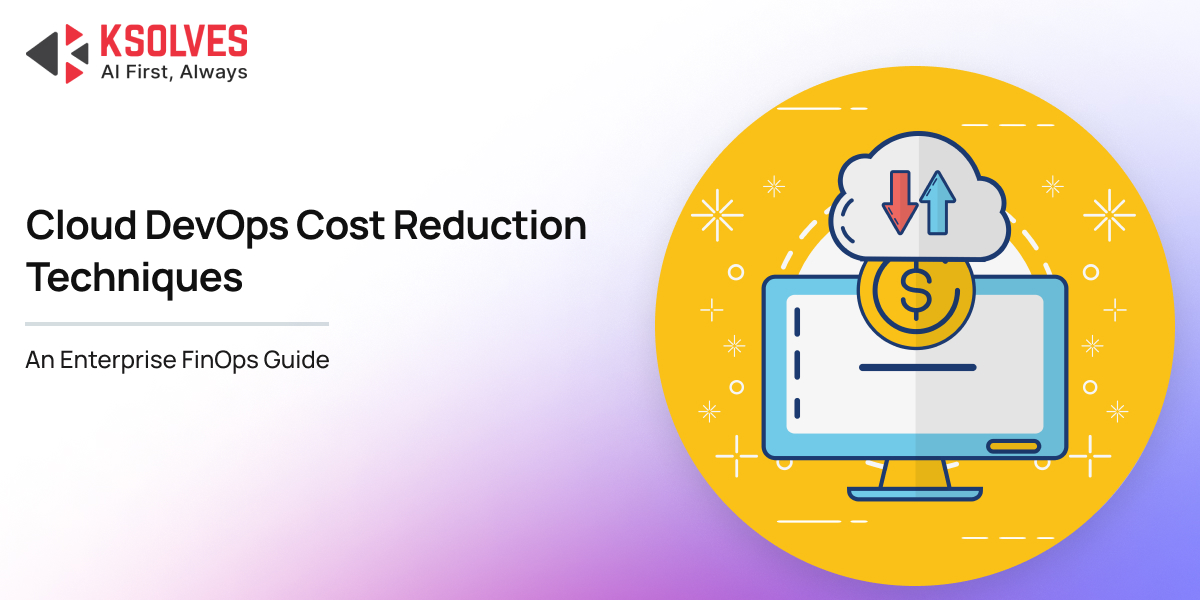
Cloud infrastructure rarely becomes expensive because of one oversized resource. In enterprise environments, costs accumulate across compute, Kubernetes clusters, CI/CD pipelines, storage, networking, observability, and increasingly, GPU-powered AI workloads.
As these environments scale across multiple accounts and business units, reviewing the monthly cloud bill is no longer enough. Enterprises need to understand where cloud spend is coming from, which workloads are driving it, who owns that spend, and whether it is aligned with business value.
This is where FinOps becomes part of the DevOps operating model. In this article, we explore the technical practices enterprises can use for cloud DevOps cost reduction, including cost visibility, automated diagnostics, Kubernetes and compute optimization, Terraform cost governance, CI/CD optimization, anomaly detection, and AI/GPU cost management, along with how Ksolves Cloud Agent helps automate AWS cost diagnostics.
The Enterprise Cloud Cost Problem
Cloud enables organizations to provision infrastructure on demand, scale applications dynamically, and release software faster. However, the same flexibility can make cloud expenditure difficult to control as environments grow.
A large enterprise may have hundreds of AWS resources distributed across production and non-production accounts, Kubernetes clusters running multiple applications, temporary environments created for testing, CI/CD runners executing thousands of builds, and shared networking and observability infrastructure. When these resources are owned and consumed by different teams, identifying the source and business justification of every cost becomes increasingly difficult.
Without consistent ownership and monitoring, several forms of cloud waste can accumulate:
- Underutilized compute continues to run.
- Development environments remain active outside business hours.
- Kubernetes resource requests exceed actual workload requirements.
- Shared infrastructure costs cannot be accurately attributed.
- CI/CD pipelines consume unnecessary compute and storage.
- Network and observability costs increase without clear ownership.
- Infrastructure changes increase monthly expenditure without being identified during development.
- Unexpected cost anomalies remain hidden until billing reviews.
Why Reducing Cloud DevOps Costs Matters
Cloud cost optimization is often approached as a cost-cutting exercise. For enterprises, that approach is too narrow. The objective is to remove unnecessary infrastructure expenditure while preserving application performance, availability, security, and delivery velocity.
This requires that cost management be part of the infrastructure lifecycle. A Terraform change that introduces additional database capacity or a larger Kubernetes node pool can affect monthly expenditure before the infrastructure is deployed. Similarly, decisions around logging volume, storage retention, data transfer, or GPU selection can create recurring costs long after the original implementation.
This is why enterprises need a cloud cost optimization framework that connects infrastructure consumption with ownership and business value.
Unit economics can strengthen this model by connecting infrastructure expenditure to measurable business activity:
| Unit Metric | What It Measures |
|---|---|
| Cost per API transaction | Application and database efficiency |
| Cost per CI/CD build | Delivery infrastructure efficiency |
| Cost per active customer | Platform scalability |
| Cost per GB processed | Data and network efficiency |
| Cost per 1M AI inference tokens | GPU and model-serving efficiency |
This gives leadership a more useful view than total monthly expenditure alone. An increase in cloud spending may be justified when it corresponds to increased customers, transactions, or workload demand; the concern is uncontrolled cost growth without corresponding business value.
How Enterprises Can Reduce Cloud DevOps Costs
1. Establish Cost Visibility and Ownership
The first step in reducing cloud costs in DevOps is making cloud expenditure traceable.
Enterprises should enforce consistent metadata such as Owner, CostCenter, Environment, Application, and Service across infrastructure. With Terraform, these requirements can be incorporated into reusable modules and validated through policy-as-code before deployment.
Shared infrastructure also requires an allocation model. NAT Gateways, transit infrastructure, security tooling, observability platforms, and shared Kubernetes resources may serve multiple teams and should therefore be distributed using consistent usage or ownership metrics.
For larger environments, organizations can combine native services such as AWS Cost Explorer and Azure Cost Management with FinOps tooling such as CloudHealth, Flexera, or Vantage for broader reporting, allocation, and governance.
2. Automate Waste Detection and Cost Anomaly Detection
Manual cloud audits do not scale with enterprise infrastructure. Automated diagnostics should continuously identify common waste patterns such as unattached EBS volumes, unassociated Elastic IPs, idle load balancers, stale snapshots, underutilized compute, and non-production infrastructure running outside required schedules.
This needs to work alongside cloud cost dashboards and cost anomaly detection. A dashboard provides historical visibility, while anomaly detection identifies unexpected changes in spending behavior—for example, a sudden increase in log ingestion, network transfer, or infrastructure consumption.
Budget forecasting and alerts provide another layer of governance by warning teams when projected expenditure approaches established thresholds. Together, these mechanisms give engineering and finance teams the visibility needed to investigate unusual spending before it becomes a persistent cost.
3. Optimize Kubernetes and Compute Around Actual Demand
Compute optimization should not simply mean selecting smaller instances. Enterprises should evaluate CPU and memory utilization, high-percentile demand, network throughput, latency, concurrency, queue depth, and scaling behavior before making rightsizing decisions.
Kubernetes introduces additional cost-management complexity because multiple applications share the underlying node infrastructure. Kubernetes cost monitoring platforms such as Kubecost or OpenCost can provide workload-level visibility into shared cluster costs, helping teams understand how resource requests and actual utilization affect infrastructure expenditure.
Resource requests are particularly important. If CPU and memory requests are significantly higher than actual consumption, Kubernetes may require additional node capacity even when workloads are not using it.
Workload-aware autoscaling policies can further improve efficiency. KEDA, for example, allows Kubernetes workloads to scale based on event-driven signals such as queue depth or other external metrics instead of relying solely on CPU utilization. This is useful for asynchronous workloads where CPU is not always a reliable measure of demand.
Karpenter can complement this at the node level by provisioning capacity according to workload requirements and improving utilization through consolidation. Enterprises can also use Spot capacity for suitable fault-tolerant workloads such as batch processing and asynchronous workers.
4. Shift Cost Governance Into Terraform and CI/CD
Cloud cost management becomes more effective when it happens before infrastructure reaches production.
Combining infrastructure as code (Terraform) and cost estimation allows teams to evaluate the financial impact of infrastructure modifications during pull-request review. Tools such as Infracost can provide estimated cost changes, making cost a visible engineering consideration alongside security, performance, and reliability.
A typical workflow can be:
The objective is not to reject every infrastructure change that increases cost. Enterprise applications often need additional capacity to support growth, availability, or compliance. Instead, significant cost changes should be visible and intentional before they become production expenditure.
CI/CD infrastructure itself should also be optimized. Ephemeral build runners, autoscaling runner pools, Docker and dependency caching, artifact lifecycle policies, and efficient test execution can reduce CI/CD pipeline costs without reducing delivery throughput.
5. Control Network, Storage, Observability, and AI Costs
Once compute waste has been addressed, secondary infrastructure costs can become significant.
Network architecture should be reviewed for unnecessary NAT processing, cross-AZ traffic, and data transfer. Where appropriate, Gateway VPC Endpoints can reduce NAT-related costs for supported AWS services.
Storage optimization should include EBS rightsizing, gp2-to-gp3 migration where appropriate, S3 lifecycle policies, snapshot retention, and removal of unused persistent storage.
Observability also requires cost governance. Excessive log ingestion, high-cardinality telemetry, unnecessary trace collection, and long retention periods can increase ingestion and storage costs. Filtering and sampling telemetry before it reaches expensive downstream analytics systems can reduce this overhead without removing the observability required for production operations.
For AI workloads, GPU/AI inference cost management is becoming another important consideration. Enterprises should measure GPU utilization, throughput, model size, precision, latency, and cost per request or token. Quantization, batching, efficient serving engines, appropriate accelerator selection, and scale-to-zero strategies can improve inference economics where workload requirements permit.
Finally, organizations should establish an optimized infrastructure baseline before purchasing long-term cloud commitments. Removing waste and rightsizing workloads first reduces the risk of committing to unnecessary capacity.
Looking to Reduce Your Cloud DevOps Costs?
DevOps Cost Management Strategy
Cloud optimization becomes sustainable when it moves beyond individual resource savings and becomes part of the enterprise DevOps cost management strategy. Instead of reviewing expenditure only after the monthly bill arrives, organizations should build cost visibility and governance into the same lifecycle used to provision, deploy, and operate infrastructure.
This requires cross-functional collaboration between engineering, finance, and operations. Engineering teams bring visibility into application and infrastructure consumption, finance provides budgeting and forecasting requirements, while operations and platform teams implement the policies, monitoring, and automation needed to control spend.
A practical strategy should focus on four areas:
| Area | Enterprise Focus |
|---|---|
| Visibility | Track costs across accounts, applications, environments, and business units |
| Governance | Enforce ownership, tagging, budgets, and infrastructure policies |
| Optimization | Continuously identify waste and improve workload efficiency |
| Accountability | Connect cloud expenditure with teams, products, and business outcomes |
Cost governance should begin before infrastructure reaches production through Terraform cost estimation and policy controls, and continue through dashboards, anomaly detection, budget forecasting, and automated diagnostics.
Why Ksolves for Enterprise Cloud Cost Optimization?
For large organizations, the challenge is rarely finding one idle resource. The difficult part is continuously identifying cost issues across multiple AWS accounts and regions, understanding their impact, and getting those findings to the teams responsible for remediation.
This is where Ksolves Cloud Agent fits into the enterprise FinOps workflow.
Ksolves Cloud Agent for AWS Cost Optimization
Ksolves Cloud Agent automates AWS infrastructure and cost diagnostics across configured accounts and regions. The agent performs recurring, non-intrusive scans to identify infrastructure conditions that can contribute to unnecessary expenditure, including long-stopped EC2 instances that continue to incur storage charges, unattached EBS volumes, unused Elastic IP addresses, and idle load balancers.
Instead of requiring platform teams to manually inspect every AWS account, Cloud Agent provides a centralized diagnostic process that helps organizations surface actionable findings and prioritize remediation based on resource impact, ownership, and potential savings.
For enterprises, the approach connects cloud monitoring with FinOps in a practical way:
AWS infrastructure → Automated diagnostics → Cost finding → Ownership → Remediation
| Cloud Agent Capability | Enterprise Value |
|---|---|
| Multi-account AWS scanning | Centralized visibility across environments |
| Automated waste detection | Reduces repetitive manual audits |
| Resource-level findings | Makes remediation more actionable |
| Cost-focused diagnostics | Helps prioritize optimization opportunities |
| Recurring monitoring | Supports continuous FinOps governance |
Ksolves can further support enterprise cloud cost initiatives through cloud audits, Kubernetes optimization, CI/CD and IaC governance, AI/GPU optimization, and FinOps consulting.
Make Cloud Cost Optimization Continuous
Cloud infrastructure changes continuously. New deployments, traffic growth, application migrations, Kubernetes scaling, additional observability, and AI workloads can all change an organization’s cost profile.
A DevOps cost management strategy therefore needs continuous monitoring and optimization rather than periodic cost-cutting exercises.
Explore Ksolves Cloud Agent to automate AWS cost diagnostics across your enterprise AWS environment.
Conclusion
Enterprise cloud DevOps cost reduction requires more than rightsizing a few instances or reviewing the monthly cloud bill. It depends on making cloud spend visible, owned, and governed across the entire infrastructure lifecycle, from Terraform and CI/CD through Kubernetes, observability, and AI workloads.
Frequently Asked Questions
What is FinOps, and how is it different from traditional cloud cost management?
FinOps is an operating model in which engineering, finance and business teams share accountability for cloud spend in near real time. Traditional cloud cost management usually means finance reviewing the bill after the month closes, while FinOps puts cost data in front of engineers while they are still making architecture and deployment decisions. The goal is spending that is visible, owned and tied to business value, not simply lower.
What happens if cloud costs are not allocated to specific teams or owners?
Unallocated cloud costs tend to grow unchecked, because no team feels responsible for idle resources, oversized clusters or forgotten environments. Shared infrastructure such as NAT Gateways, observability platforms and Kubernetes clusters becomes a large “unknown” line on the bill. This makes it hard to forecast budgets, justify spend to leadership or prioritise optimisation work.
How do I build a tagging strategy for cloud cost allocation?
A cost allocation tagging strategy starts with a small mandatory tag set, such as Owner, CostCenter, Environment, Application and Service, applied to every resource. Enforce these tags in reusable Terraform modules and policy-as-code checks so untagged resources fail before deployment. Then define an allocation rule for shared resources that cannot be tagged to one team, and review tag coverage regularly.
Should enterprises buy Savings Plans or Reserved Instances before or after rightsizing?
Enterprises should rightsize and remove waste before buying Savings Plans or Reserved Instances. Commitments lock in a level of spend for one to three years, so committing on top of oversized or idle capacity locks in that waste as well. Once a lean baseline is established, commitments can be sized to steady-state usage with far less risk.
How long does it take to see results from a cloud cost optimization program?
Quick wins from a cloud cost optimization program, such as deleting unattached volumes, unused Elastic IPs and idle load balancers, can often be realised within the first few weeks. Structural savings from Kubernetes rightsizing, CI/CD optimisation and shift-left cost governance in Terraform typically take one or more quarters. Ongoing monitoring is what keeps those savings from eroding as new workloads are deployed.
Who should own cloud costs in a DevOps organization?
In a DevOps organization, cloud cost ownership should sit with the engineering teams that provision and run the workloads, supported by finance for budgeting and a platform or FinOps function for tooling and policy. Ksolves helps enterprises set up this model through DevOps consulting, cloud audits and Kubernetes and CI/CD optimisation. Clear ownership turns cost from a monthly surprise into a routine engineering metric.
Do I need a third-party FinOps tool, or are native AWS tools enough?
Native AWS tools such as Cost Explorer, Budgets and Cost Anomaly Detection are enough for many organisations to get started with cloud cost visibility. Larger multi-account environments often add automation to find waste continuously rather than through manual console reviews. Ksolves Cloud Agent, for example, runs recurring diagnostics across configured AWS accounts and regions to surface idle and unattached resources for remediation.
Still have questions about cloud cost optimization? Contact our team.




























Author
About the Author Editorial Team The Ksolves Editorial Team includes certified Salesforce experts, Big Data engineers, AI/ML specialists, Zoho consultants, and experienced technology writers focused on delivering clear, actionable insights for modern businesses. With hands-on experience across Salesforce, Big Data platforms, AI/ML solutions, application development, software testing, and Zoho ERP/CRM, the team publishes practical guides, real-world use cases, and industry updates that support smarter decisions and faster growth. Every article is created to solve business challenges, guide technology adoption, and keep organizations aligned with evolving digital ecosystems.
Share with