


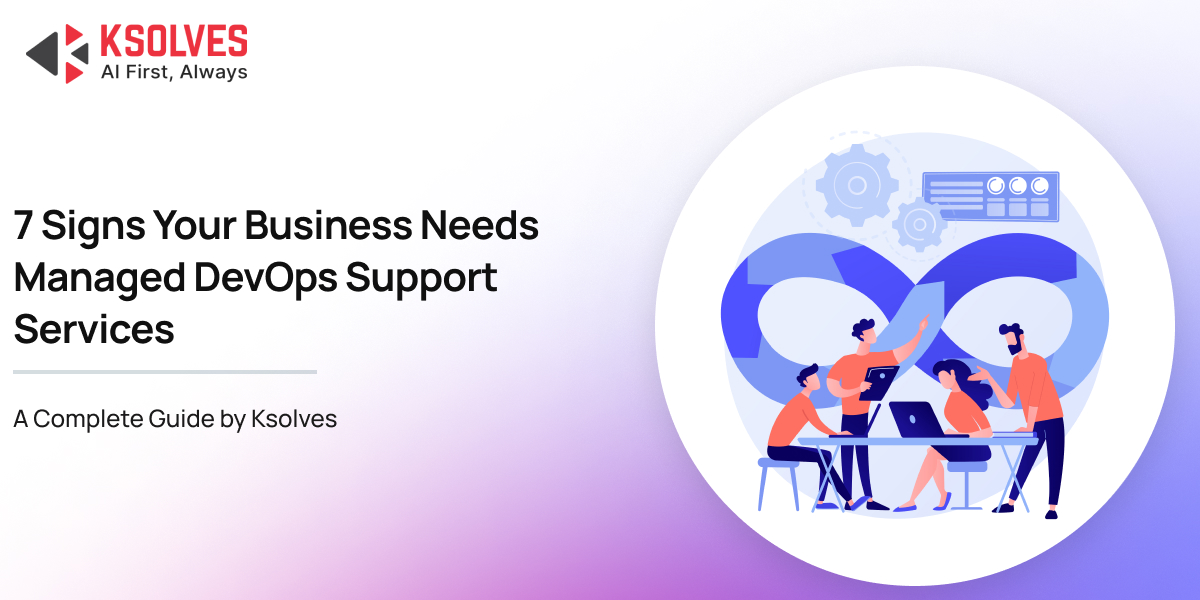
7 Critical Signs Your Business Needs Managed DevOps Support Services
DevOps
5 MIN READ
October 20, 2026

Software delivery is no longer just a functional arm of IT: it is the primary driver of business growth. Yet, as cloud-native environments scale across hybrid, multi-cloud, and microservices architectures, keeping the delivery engine running smoothly grows exponentially complex.
Many high-growth engineering organizations hit a structural wall. What started as lightweight deployment scripts degrades into fragile, highly manual delivery chains. Engineers spend more time troubleshooting environments, managing infrastructure drift, and responding to outage alerts than shipping business value.
What stands this guide apart is its focus on structural root causes across the entire delivery chain, providing clear engineering strategies to turn operational bottlenecks into high-velocity release engines.
1. Deployments Are Slow, Fragile, and Depend on Manual Execution
When pushing code into production requires late-night deployment windows, extensive manual verification checklists, and a room full of engineers on high alert, your release architecture is fundamentally flawed.
Technical Root Causes
- Brittle CI/CD Scripts: Delivery pipelines built on legacy, unmaintained shell scripts or monolithic CI controllers lack error handling, parallel step processing, and automated rollback logic.
- Absence of Immutable Infrastructure: Server configurations modified in place lead to unpredictable runtime behavior when code hits production.
- Manual QA Gates: Testing processes executed manually at the end of a sprint create artificial delivery backlogs.
The DevOps Support Fix
A dedicated DevOps partner replaces fragile scripts with declarative, container-native pipelines: GitLab CI or GitHub Actions handle build and test, while GitOps-based tools like ArgoCD manage the deployment sync into the cluster.
Pairing immutable infrastructure with progressive delivery strategies, such as Blue/Green or Canary releases, turns production deployments into predictable, zero-downtime background events. Ksolves breaks these patterns down further in its guide to DevOps principles for faster software delivery.
2. Persistent Environment Drift (“Works on My Machine” Syndrome)
One of the most expensive engineering productivity drains is environmental variance. When an application passes local unit tests and QA integration tests but throws runtime exceptions upon reaching production, environment drift is almost always the culprit.
Deep Technical Breakdown
Environment drift occurs when runtime configurations, dependency library versions, OS patches, or network topologies diverge between Development, Staging, and Production environments.
For example, running Apache 2.4.41 with Node v18.12 in Dev while Production operates on Apache 2.4.52 and Node v18.18 introduces subtle version incompatibilities.
Without declarative control over the underlying environment, debugging these micro-differences consumes hundreds of high-cost engineering hours every quarter.
The DevOps Support Fix
Managed DevOps teams implement strict Infrastructure as Code (IaC) protocols using tools like Terraform, OpenTofu, and Ansible. By codifying network topologies, IAM roles, container runtimes, and security groups into version-controlled repositories, every environment across the software development lifecycle becomes 100% reproducible on demand.
3. Reactive Outage Detection & Observability Blind Spots
If your end customers or support tickets report system latency, broken API endpoints, or database timeouts before your internal site reliability teams are aware, your monitoring stack is failing.
The Gap Between Monitoring and Observability
Basic monitoring simply tells you if a system is up or down using basic HTTP pings. Modern cloud ecosystems demand full-stack observability, which combines three core pillars:
- Metrics: Real-time numerical tracking of CPU, memory, IOPS, rate-error-duration (RED) metrics, and saturation levels.
- Logs: Centralized, structured log aggregation (e.g., OpenSearch, ELK Stack, Grafana Loki) to query stack traces across distributed services.
- Distributed Tracing: Microservices tracking (e.g., OpenTelemetry, Jaeger) to pinpoint exactly which internal API call added latency to a client transaction.
The DevOps Support Fix
DevOps support specialists build centralized observability pipelines with automated AIOps alert correlation. They set up real-time dashboards and threshold alerts that notify engineers at the first sign of memory leaks or database connection pool exhaustion long before users experience an error.
This kind of AIOps-driven correlation is one of the shifts covered in Ksolves’ rundown of DevOps trends to watch.
Fragile Releases and Blind Spots Slowing You Down?
4. Cloud Spend Volatility & Unoptimized Resource Architecture
As cloud adoption scales across platforms like AWS, Google Cloud, or Microsoft Azure, infrastructure expenses frequently outpace revenue growth.
Common FinOps Anti-Patterns
- Over-Provisioned Compute Nodes: Provisioning static, high-memory EC2 instances or VMs to handle peak traffic loads that only occur 5% of the time.
- Orphaned Cloud Assets: Unattached persistent storage volumes, unindexed database snapshots, unused load balancers, and idle staging clusters running 24/7/365.
- Lack of Multi-Tenant Resource Tagging: Inability to allocate cloud spending precisely to specific engineering projects, products, or customer tiers.
How Managed Services Restore Cost Control
By integrating cloud financial operations (FinOps), DevOps support engineers institute automated scaling policies, configure spot/ephemeral instances for non-production workloads, implement reserved instance/savings plan management, and automate scheduled shutdowns for non-production environments.
Several of the platforms behind these checks are covered in Ksolves’ roundup of top DevOps tools for 2026.
| Cost Management Layer | Traditional Internal Management | Managed DevOps Support Services |
|---|---|---|
| Provisioning Strategy | Static provisioning based on peak estimations | Elastic auto-scaling based on real-time metrics |
| Non-Prod Management | Staging/Dev servers run 24/7/365 | Automated cron-based shutdowns on nights & weekends |
| Cost Visibility | Lump-sum monthly cloud bill | Granular cost allocation by service tag & business unit |
| FinOps Auditing | Ad-hoc manual reviews (often forgotten) | Continuous cost monitoring and automated rightsizing |
5. DevSecOps Deficits and Compliance Bottlenecks
Treating security as a manual audit right before code releases stalls software delivery cycles and often results in missed vulnerabilities in production dependencies.
Technical Risks
- Unscanned third-party container images and open-source npm/python packages containing CVE vulnerabilities.
- Hardcoded API keys, database credentials, or access tokens checked into git repositories.
- Non-compliance with industry standards (e.g., SOC 2, HIPAA, ISO 27001, PCI-DSS) due to manual access policies and lack of audit logging.
The DevOps Support Fix
DevOps engineers inject automated security guardrails directly into the CI/CD pipeline (Shifting Left). This includes automated Static Application Security Testing (SAST), Software Bill of Materials (SBOM) scanning, secret detection (e.g., HashiCorp Vault integration), and Policy-as-Code enforcement (e.g., Open Policy Agent). Security checks run in seconds during pipeline execution, catching flaws immediately.
6. Single-Point-of-Failure Knowledge Silos (“Bus Factor” Risk)
A critical risk facing growing technology organizations is operational centralization around a few key individuals.
Risk Factors
- Undocumented Architecture: Infrastructure layouts, network peering rules, and emergency recovery runbooks exist solely in one or two senior developers’ heads.
- Unstructured On-Call Operations: Senior engineers suffer from alert fatigue due to non-stop, off-hours production pings, leading to high burnout and turnover rates.
- Process Paralysis: Junior and mid-level developers are terrified of pushing production updates without direct supervision from a lead architect.
The DevOps Support Fix
Partnering with a managed DevOps provider eliminates single-point-of-failure risks. Every pipeline configuration, cluster topology, and deployment procedure is codified, thoroughly documented, and supported by a continuous team of Site Reliability Engineers (SREs).
7. High-Value Developers Are Trapped Doing Low-Value Operations Work
Your core software engineering team should focus on product innovation, business logic, feature delivery, and competitive differentiation.
When high-salaried senior developers spend 30 to 50% of their sprints provisioning virtual machines, tuning Kubernetes ingress rules, updating database schemas, or debugging build nodes, your business is overpaying for operational upkeep while feature pipelines stall.
Why Choose Ksolves DevOps Support Services?
Fixing the seven problems above takes a partner who has actually configured the pipelines, not just diagrammed them. Ksolves’ DevOps support services plug into an existing AWS, Azure, GCP, or Kubernetes environment without forcing a rebuild, covering CI/CD pipeline engineering, DevSecOps, and FinOps under one engagement.
Because every Ksolves engineer uses AI as a daily working tool for code review, log triage, and configuration audits, issues get caught earlier in the pipeline and release cycles move faster without adding headcount. The result: fewer 2 a.m. pages, a cloud bill that tracks actual usage instead of peak estimates, and a development team that spends its time on product features instead of infrastructure firefighting.
Ksolves’ DevOps consulting services page walks through how a typical phased engagement runs.
Frequently Asked Questions (FAQs)
Q1: What is the main difference between internal IT operations and managed DevOps support services?
Internal IT operations typically focus on day-to-day corporate hardware, internal network access, and manual server administration. Managed DevOps support services focus on software delivery engineering: automating CI/CD pipelines, codifying cloud infrastructure (IaC), embedding security checks (DevSecOps), and ensuring continuous 24/7 availability for production applications.
Q2: How does a managed DevOps team transition into an existing infrastructure without disrupting business operations?
Experienced partners follow a phased onboarding process: first auditing current toolchains, cloud security postures, and pipeline bottlenecks; second, mapping target-state architecture while shadowing current release cycles; third, building modern IaC scripts and CI/CD pipelines in parallel; and finally, executing blue/green cuts over to automated pipelines with zero live environment downtime.
Q3: How do DevOps support services ensure cloud security and compliance?
DevOps support services integrate DevSecOps practices into the delivery lifecycle. Security is automated using Static Application Security Testing (SAST), dynamic dependency vulnerability checks, container scanning, secrets encryption, and Policy-as-Code. This guarantees that code pushed into cloud environments satisfies industry compliance rules (SOC 2, ISO 27001, HIPAA) automatically.
Q4: Can a business hire DevOps support for specific projects, or is a long-term engagement required?
DevOps support services offer flexible engagement options. Businesses can engage for short-term projects (e.g., Kubernetes migration, cloud cost-reduction audits, or CI/CD pipeline setup) or opt for long-term managed support (e.g., 24/7/365 infrastructure monitoring, continuous SRE, and ongoing security management).
Q5: What key metrics (KPIs) demonstrate a successful DevOps support implementation?
DevOps performance is primarily measured using standard DORA (DevOps Research and Assessment) metrics: Deployment Frequency, Lead Time for Changes, Mean Time to Restore (MTTR), and Change Failure Rate (CFR). Ksolves’ complete DevOps guide walks through healthy benchmark ranges for each.
Q6: Is managed DevOps support suitable for startups and SMEs, or only large enterprises?
Managed DevOps support is often more critical for startups and SMEs. Smaller teams frequently lack the budget to hire a dedicated full-time team of cloud, security, and site reliability engineers. Partnering with a managed service provider like Ksolves grants access to a multi-disciplinary team of certified experts at a fraction of the cost of full-time internal hiring.
Q7: How does DevOps support help prevent cloud bill surprises?
Through continuous FinOps management. A managed DevOps partner actively tracks cloud usage, sets up automated alerts for unusual traffic or spend spikes, removes unattached storage volumes or idle clusters, and configures auto-scaling rules so you only pay for compute capacity you actually use.
Q8: What role does AI play in modern DevOps support services?
Modern DevOps support uses AI for predictive anomaly detection, log analysis, and automated incident correlation, flagging potential hardware failures or software bottlenecks before they trigger an outage. At Ksolves, every consultant also uses AI daily for code review, testing, and configuration audits, which is part of why engagements typically run in roughly half the standard timeline.




























Author
About the Author Editorial Team The Ksolves Editorial Team includes certified Salesforce experts, Big Data engineers, AI/ML specialists, Zoho consultants, and experienced technology writers focused on delivering clear, actionable insights for modern businesses. With hands-on experience across Salesforce, Big Data platforms, AI/ML solutions, application development, software testing, and Zoho ERP/CRM, the team publishes practical guides, real-world use cases, and industry updates that support smarter decisions and faster growth. Every article is created to solve business challenges, guide technology adoption, and keep organizations aligned with evolving digital ecosystems.
Share with