



Stateful vs. Stateless Stream Processing in Apache Flink
Apache Flink
5 MIN READ
August 5, 2026

A fraud-detection system that blocks a stolen card needs to know what happened on that card seconds earlier. A log-cleaning pipeline that strips out malformed events doesn’t need to know anything at all. Both are “stream processing,” but they demand fundamentally different architectures.
This is the choice every real-time data engineer eventually has to make: should a processing node carry memory of past events, or should it treat each one as a self-contained, disposable unit of work? Get it wrong in one direction, and you bolt on checkpointing, state backends, and recovery machinery your pipeline never actually needed. Get it wrong in the other direction, and you ship metrics that are quietly inaccurate because the system never saw the bigger picture.
That distinction, stateless vs. stateful stream processing, is the architectural fork this blog walks through, using Apache Flink as the reference implementation.
In this blog, we’ll:
- Define both paradigms and explain why the distinction matters in production
- Unpack the engineering trade-offs: operational complexity, memory dynamics, and recovery mechanics
- Compare real Apache Flink code for stateless vs. stateful implementations
- Cover state backend selection, TTL, and skew, the pitfalls that actually break pipelines at scale
- Close with a decision framework you can apply to your own architecture
Key Difference Between Stateless Stream Processing and Stateful Stream Processing
Stateless Stream Processing
In a stateless architecture, each event is processed in complete isolation. The engine reads an event, applies a transformation or filter, and emits the result, with zero memory of anything that came before it.
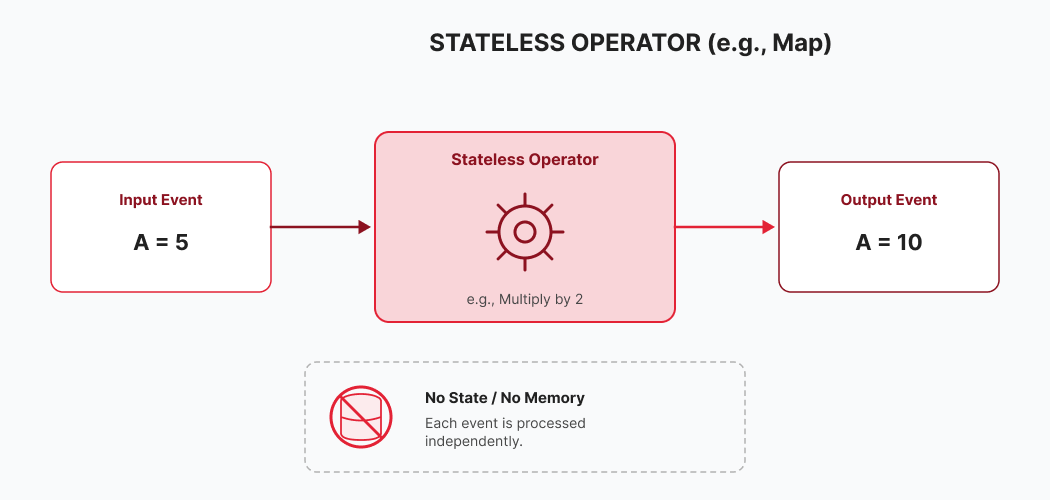
Because no operator instance depends on another, stateless pipelines scale horizontally with almost no coordination overhead. Spin up ten parallel instances, partition the data arbitrarily across them, and each instance processes its share correctly, with no cross-instance communication required.
Stateful Stream Processing
Stateful processing requires the engine to retain information across multiple events. The outcome for the current event depends on a history of prior events tied to the same key.
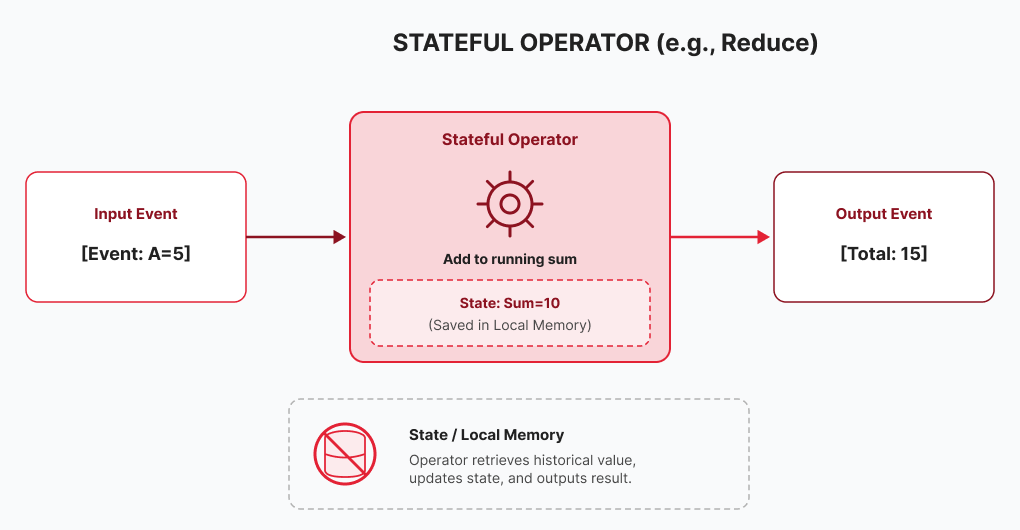
Stateful processing is what makes complex real-time analytics possible, but it comes with lifecycle management responsibilities that stateless pipelines simply don’t have.
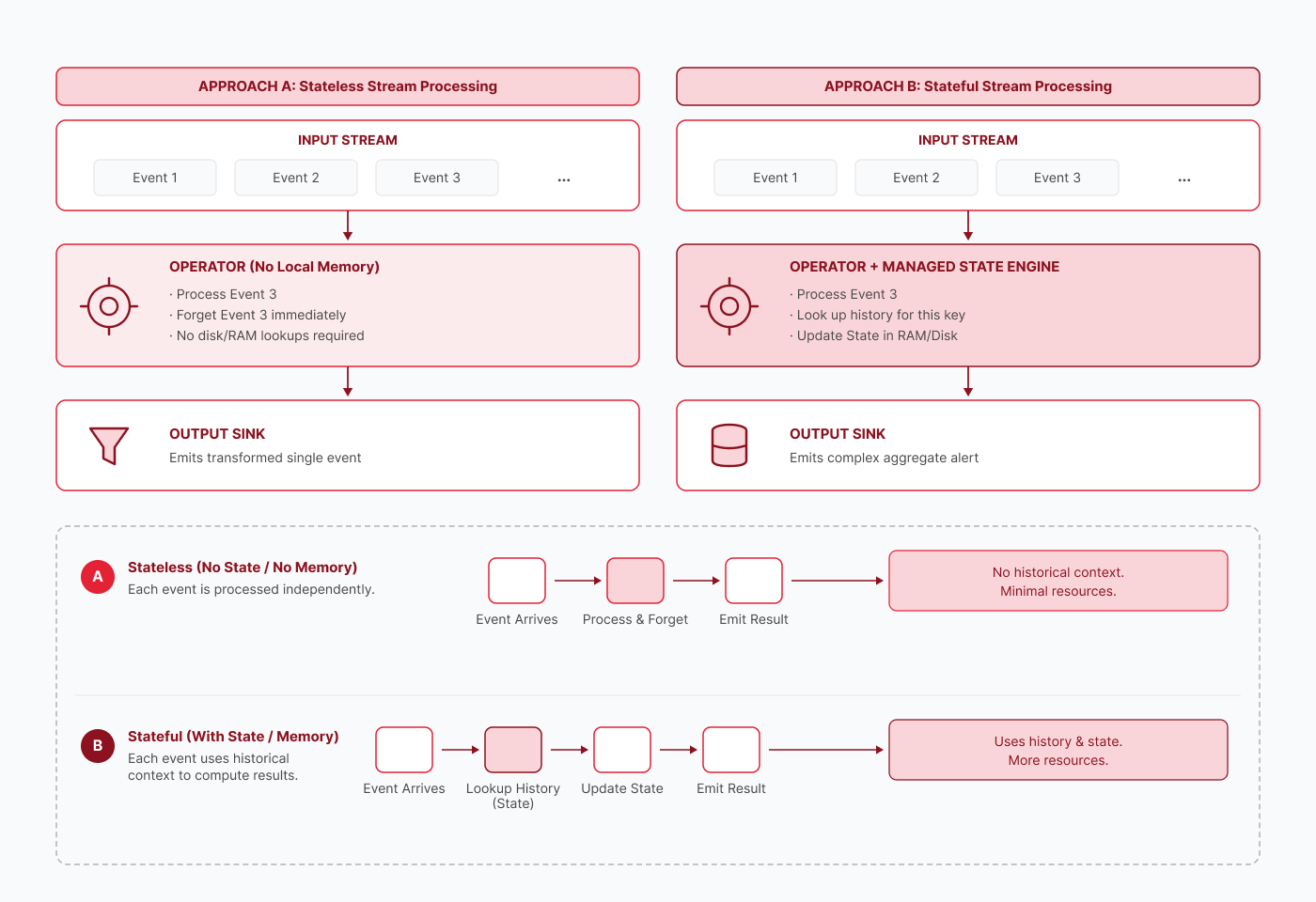
Visualizing the Memory Lifecycle
The contrast in memory management overhead between these two architectures becomes clear when you compare their layout profiles side by side.
Stateful processing is non-negotiable for use cases like:
- Calculating a moving average over a sliding time window
- Detecting a sequence of fraudulent login attempts across multiple events
- Joining two independent real-time streams on a shared key
- Deduplicating events within a defined time boundary
Architectural Trade-Offs: Operational Overhead vs. Contextual Power
This choice ripples through your infrastructure footprint, capacity planning, and disaster recovery design.
- The Stateless Profile: Minimal operational surface area. A crashed node is replaced with zero recovery orchestration, since there’s nothing to restore. Latency is the lowest achievable, since no thread ever blocks on a state-backend lookup. The trade-off: scope is limited to filtering, format conversion, enrichment from external lookups, and basic validation.
- The Stateful Profile: Unlocks real-time aggregation, windowing, joins, and pattern detection that drive operational decisions, like blocking a fraudulent transaction within milliseconds. The cost is real engineering investment: choosing and tuning a state backend (RocksDB vs. heap-based), configuring checkpointing intervals, planning for state schema evolution across deployments, and monitoring state size growth.
Code Comparison: Stateless vs. Stateful in Apache Flink
Consider a stream of sensor readings with two requirements:
- Stateless: Filter out any reading below 0°C.
- Stateful: Alert when a sensor’s temperature rises more than 10°C compared to its previous reading.
1. Stateless Implementation: Filtering
import org.apache.flink.api.common.functions.FilterFunction;
import org.apache.flink.streaming.api.datastream.DataStream;
import org.apache.flink.streaming.api.environment.StreamExecutionEnvironment;

public class StatelessPipeline {

    public static void main(String[] args) throws Exception {
        StreamExecutionEnvironment env =
            StreamExecutionEnvironment.getExecutionEnvironment();

        DataStream<SensorReading> stream = env.addSource(new SensorSource());

        // Stateless Filter: Evaluates each event entirely in isolation
        DataStream<SensorReading> filteredStream = stream.filter(new
            FilterFunction<SensorReading>() {
                @Override
                public boolean filter(SensorReading reading) {
                    return reading.getTemperature() >= 0.0;
                }
        });

        filteredStream.print();
        env.execute("Stateless Sensor Filter");
    }
}
2. Stateful Implementation: Delta Alerting
import org.apache.flink.api.common.state.ValueState;
import org.apache.flink.api.common.state.ValueStateDescriptor;
import org.apache.flink.configuration.Configuration;
import org.apache.flink.streaming.api.functions.KeyedProcessFunction;
import org.apache.flink.util.Collector;

public class StatefulAlertingFunction extends
    KeyedProcessFunction<String, SensorReading, String> {

    // 1. Declare the physical state handle to remember the last temperature
    private transient ValueState<Double> lastTemperatureState;

    @Override
    public void open(Configuration parameters) {
        // This is the blueprint descriptor that hooks into the Flink State Backend
        ValueStateDescriptor<Double> descriptor = new
            ValueStateDescriptor<>("lastTemp", Double.class);

        lastTemperatureState = getRuntimeContext().getState(descriptor);
    }

    @Override
    public void processElement(SensorReading reading, Context ctx,
        Collector<String> out) throws Exception {

        // 2. Fetch the historical state for this specific sensor key
        Double lastTemp = lastTemperatureState.value();
        double currentTemp = reading.getTemperature();

        if (lastTemp != null) {
            // 3. Evaluate the current event against historical context
            double delta = currentTemp - lastTemp;
            if (delta > 10.0) {
                out.collect("ALERT: Sensor " + reading.getId() + " jumped by " + delta + "°C!");
            }
        }

        // 4. Update the state memory with the current temperature for the next event
        lastTemperatureState.update(currentTemp);
    }
}State Management at Scale
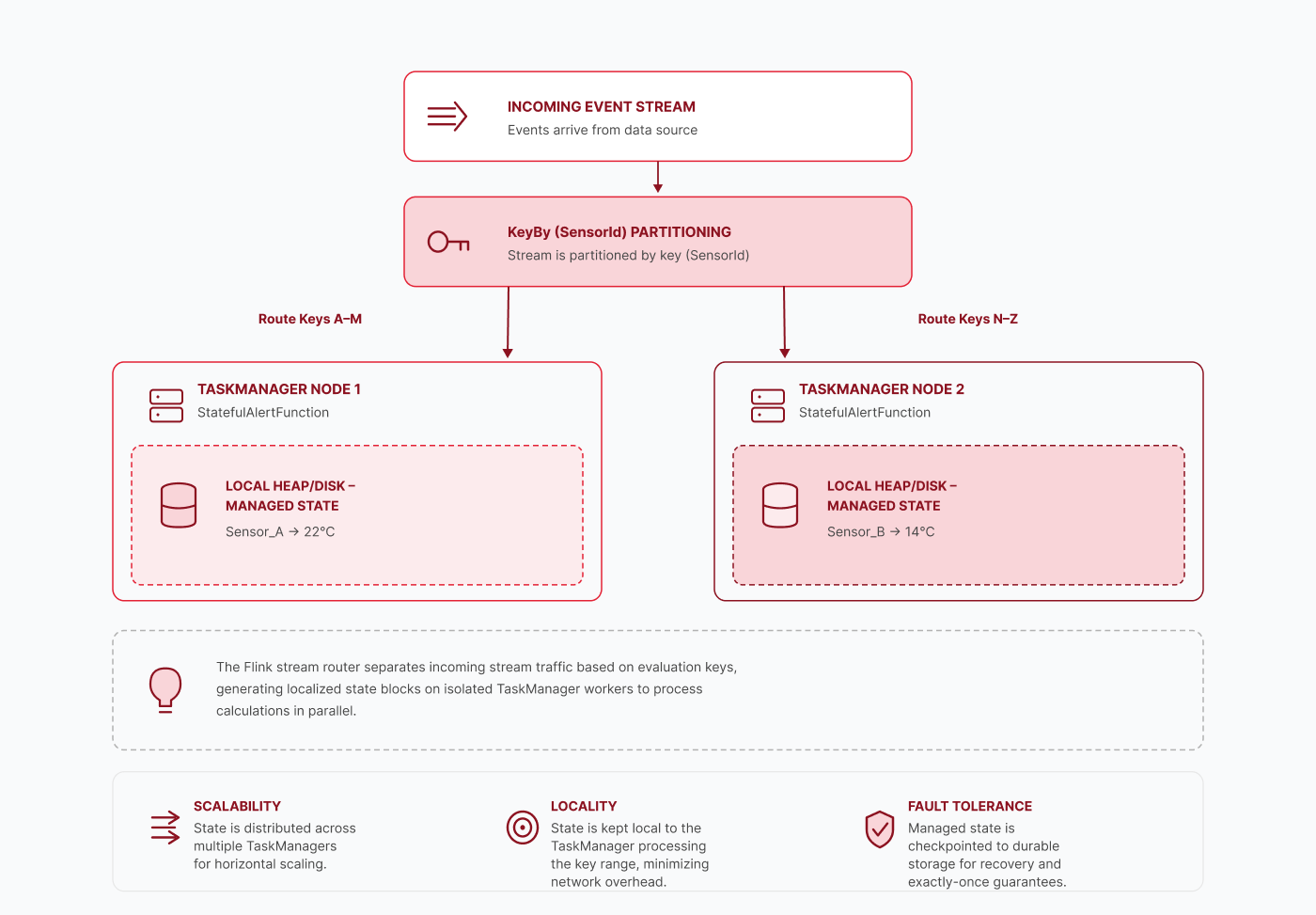
When the stateful job runs in production, Flink distributes state across the cluster using keyBy(), co-locating each key’s state with the task instance responsible for processing it.
Distributed Snapshotting and Fault Tolerance
On every checkpoint barrier, Flink asynchronously snapshots each operator’s local state to durable storage (typically S3, HDFS, or a similar distributed filesystem) without halting the pipeline.
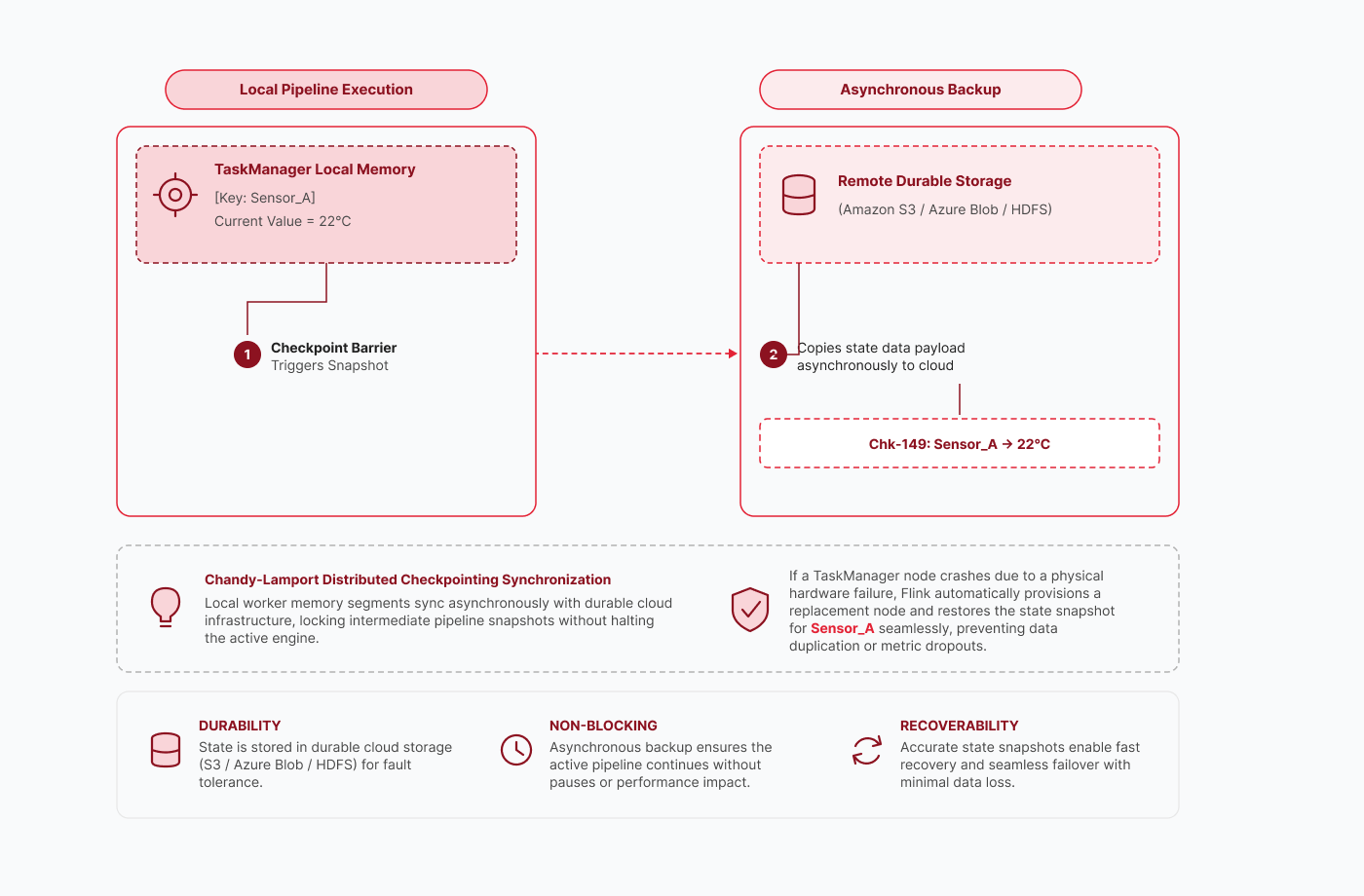
If a TaskManager fails, Flink spins up a replacement and restores the exact state for the affected keys from the last successful checkpoint, with exactly-once semantics, so no duplicate alerts or dropped metrics result from the failure.
State Modeling: Best Practices and Pitfalls
Things to Do
- Always set a State TTL. Streaming keys can arrive indefinitely (new sensor IDs, new user sessions). Without an expiration policy, state grows unbounded until you hit memory or disk exhaustion.
- Choose your partition key carefully. State is scoped per key under keyBy(). A skewed key, say 90% of traffic tied to one customer ID, overloads a single operator instance while others idle. Consider key salting if skew is unavoidable.
- Match the state backend to your workload. Use HashMapStateBackend when state fits comfortably in memory, and you need sub-millisecond access. Switch to EmbeddedRocksDBStateBackend once state size approaches or exceeds available cluster RAM; RocksDB spills to local disk and scales to terabytes of state per task.
- Use incremental checkpointing with RocksDB for large state sizes. Full checkpoints become expensive as state grows; incremental checkpoints only persist the delta since the last snapshot.
Things to Avoid / Trade-Offs
- Don’t use raw Java collections inside ValueState. A plain ArrayList or HashMap stored as a single state value forces full deserialization on every access. Use Flink’s native ListState or MapState instead; they support partial, incremental access.
- Don’t ignore serialization cost. Every read and write to a stateful operator serializes and deserializes data. This is a real, measurable CPU cost compared to stateless execution, so budget for it in capacity planning, especially with RocksDB where (de)serialization happens on every access, not just at checkpoint time.
- Don’t conflate checkpointing with savepoints. Checkpoints are automatic, lightweight, and used for failure recovery. Savepoints are manually triggered, versioned, and used for planned upgrades or job migrations. Treating them interchangeably leads to broken upgrade paths.
Wrapping Up
Stateless and stateful processing aren’t competing choices; most production topologies combine both in a layered design:
- Use stateless processing at the edge. Place filters, format converters, and validators directly behind your message broker (Kafka, Pulsar, Kinesis) to keep ingestion lean and fast.
- Reserve stateful processing for your core analytics layer: aggregations, windowed joins, alerting, and any logic where business context across events is a hard requirement.
Frequently Asked Questions
What is the difference between stateful and stateless stream processing?
Stateless stream processing evaluates each event in complete isolation with no memory of prior events, while stateful stream processing retains information across events tied to the same key. Apache Flink supports both models, but stateful processing is required whenever an output depends on history, such as a running total or a fraud pattern spanning multiple transactions.
What happens if I don’t set a State TTL in Apache Flink?
Without a State TTL, Flink keeps state for every key indefinitely, even for sensors, sessions, or users that have gone inactive. Over time this causes unbounded state growth that eventually exhausts memory or disk on the state backend. Configuring a TTL policy is considered a non-negotiable step for any production Flink job with growing key cardinality.
How do I choose between RocksDB and heap-based state backends in Flink?
Use the HashMapStateBackend (heap-based) when your state fits comfortably in memory and you need sub-millisecond access. Switch to EmbeddedRocksDBStateBackend once state size approaches or exceeds available cluster RAM, since RocksDB spills to local disk and can scale to terabytes of state per task. Ksolves typically benchmarks both against expected state growth before recommending a backend for a client’s workload.
Is Kafka Streams a good alternative to Apache Flink for stateful processing?
Kafka Streams works well for lightweight, self-contained transformations tied closely to a Kafka cluster, but Flink is the stronger choice once a pipeline needs large managed state, complex event processing, or joins across multiple independent streams. The right pick depends on the scale and complexity of the state your application needs to hold, not just the size of the data volume.
When should I move from a stateless to a stateful stream processing architecture?
Move to a stateful architecture as soon as an event’s outcome depends on something that happened earlier in the same stream, such as a moving average, a deduplication window, or a multi-event fraud pattern. If every event can be transformed or filtered on its own, stateless processing stays simpler, cheaper, and easier to scale, so the switch should be need-driven rather than default.
Who can help implement production-grade stateful Flink pipelines?
Ksolves provides Apache Flink consulting and 24×7 managed support covering state backend selection, checkpointing configuration, and recovery design for production streaming workloads. Their engineers work directly on state backend tuning, TTL configuration, and key-skew mitigation rather than generic Flink onboarding.
How much engineering effort does adding state to a Flink pipeline actually require?
Adding state means committing to real ongoing engineering work: selecting and tuning a state backend, configuring checkpoint intervals, planning for state schema evolution, and monitoring state size growth over time. Teams that don’t want to own this lifecycle often bring in a partner like Ksolves for the initial architecture and ongoing state backend tuning so the operational load doesn’t fall entirely on an internal team.
Still have questions about your Flink state strategy? Contact our team.


































Author
About the Author Editorial Team The Ksolves Editorial Team includes certified Salesforce experts, Big Data engineers, AI/ML specialists, Zoho consultants, and experienced technology writers focused on delivering clear, actionable insights for modern businesses. With hands-on experience across Salesforce, Big Data platforms, AI/ML solutions, application development, software testing, and Zoho ERP/CRM, the team publishes practical guides, real-world use cases, and industry updates that support smarter decisions and faster growth. Every article is created to solve business challenges, guide technology adoption, and keep organizations aligned with evolving digital ecosystems.
Share with