


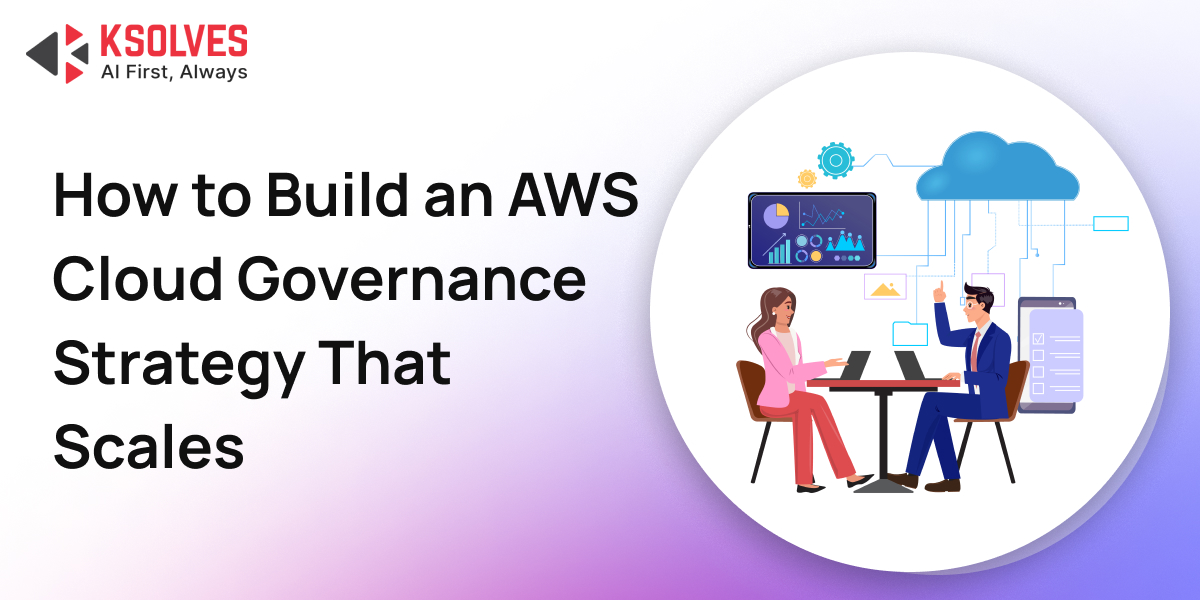
How to Build an AWS Cloud Governance Strategy That Scales With Your Business
AWS
5 MIN READ
September 14, 2026

When most engineering teams hear “AWS cloud governance,” they think of enterprises in regulated industries managing compliance frameworks. The reality is that any organisation running more than a handful of AWS accounts is already dealing with governance problems, whether they have named them that way or not. Unattributed costs, inconsistent tagging, permissions that have drifted from their original intent, and resources that outlive the projects that created them are governance failures, even when nobody calls them that.
According to IBM’s Cost of a Data Breach Report 2024, the global average cost of a data breach has reached $4.88 million, while Tenable’s 2025 Cloud Security Risk Report found that 9% of publicly accessible cloud storage contains sensitive data that organisations did not know was exposed. Both findings trace back to the same root cause: cloud environments that grew faster than the governance structures designed to control them.
Building an AWS cloud governance framework that scales means designing the enforcement layer first, not assembling it incident by incident.
What AWS Cloud Governance Covers and Why It Cannot Be Treated as a Checklist
Cloud governance spans a set of interlocking pillars: security, compliance, operations, identity, cost, and resilience. In practice, these are tightly coupled rather than separate workstreams. Untagged resources break cost attribution, obscure operational ownership, and create compliance exposure simultaneously. Over-permissioned IAM roles create security risk and make cost attribution harder. Unsecured public S3 buckets typically originate in a missing governance policy around storage defaults.
This coupling is why a cloud governance framework treats governance as a system rather than a checklist. Fixing individual gaps in isolation produces incomplete results because the failure modes feed into each other.
AWS Multi-Account Structure: The Foundation Every Governance Layer Depends On
Every other governance layer depends on getting the account structure right first. Separate accounts for production, development, and business units provide natural security boundaries, limit blast radius, simplify cost attribution, and make it possible to apply different AWS guardrails to different environments without complex permission structures within a single account.
Service Control Policies operate above the account level. A developer with full administrator access inside an account cannot take an action that an SCP prohibits, regardless of their IAM permissions. This makes SCPs the most reliable mechanism for enforcing baseline AWS account governance because they cannot be overridden from within.
AWS Control Tower automates new account provisioning within this structure, applying guardrails and baseline configurations before any workloads are deployed. For organisations adding accounts regularly, it removes the risk that new accounts are created outside the governance framework entirely.
As the environment grows beyond two or three accounts, governance gaps compound independently across every account simultaneously.
Suggested Read: How to Reduce AWS Waste Across Multiple Accounts Without a Dedicated FinOps Team
AWS IAM Governance: Why Having the Tooling Is Not the Same as Governing It
While 83% of AWS organisations use Identity Providers to manage cloud identities, overly permissive defaults, excessive entitlements, and standing permissions still expose them to identity-based threats. (Source: Tenable 2025 Cloud Security Risk Report)
AWS security governance for identity requires three things operating together:
- Periodic access reviews using IAM Access Analyzer to surface policies granting more access than required
- Credential hygiene checks identifying stale access keys, unused roles, and accounts without MFA, remediated on a defined cadence
- SCPs enforcing baseline identity standards at the organisational level, preventing long-lived credentials or overly permissive policies regardless of what account administrators decide
The gap between having IAM and governing it is where most identity-related incidents originate.
AWS Cost and Tagging Governance: Two Sides of the Same Problem
AWS cost governance and AWS tagging governance are the same problem from two directions. Tagging provides the ownership metadata that makes cost data meaningful. Cost governance provides the accountability that gives tagging its operational purpose. Neither works without the other.
What untagged and idle resources cost in dollar terms is covered in the first blog in this series
How to build a tagging strategy that prevents unattributed resources from accumulating is covered in the second.
At the governance framework level, three things need to be in place:
- A mandatory tag policy enforced through AWS Organizations Tag Policies applying consistent keys and allowed values across every account
- AWS Budgets managed centrally through the management account, with thresholds that reflect current spend and route alerts to the account owner
- Regular Cost Explorer reviews to identify spend that cannot be attributed to any team or project, the signal that tagging enforcement has gaps
Automated agents that check every EC2, RDS, S3, and EBS resource across all accounts against your tag policy and deliver a per-owner violation report to each owner’s inbox are the most reliable way to maintain tagging governance without depending on anyone to remember to run the audit.
AWS Security and Compliance Monitoring: Why Partial Coverage Is Worse Than None
A governance framework without continuous monitoring is a policy document, not an operational control. Tenable’s 2025 Cloud Security Risk Report found that 97% of exposed cloud storage contains data classified as restricted or confidential. In most cases, the exposure originated in a misconfiguration, a default setting never reviewed, or a permission applied without considering its downstream effects.
The monitoring stack that supports AWS security governance needs four components operating together across every account and every region:
- AWS CloudTrail: Complete audit log of every API call, the foundation of security investigation and compliance reporting
- AWS Config: Continuous evaluation of resource configurations against defined rules, surfacing non-compliant resources for remediation
- Amazon GuardDuty: Threat detection across CloudTrail logs, VPC flow logs, and DNS logs
- AWS Security Hub: Aggregates findings from all services into a single prioritised cross-account view
Each needs to be enabled in every account and every region. Partial coverage produces a false sense of security that is more dangerous than acknowledged gaps.
AWS Governance Automation: Why Manual Processes Stop Working Earlier Than Expected
The point where manual governance stops working is lower than most organisations expect. It is not at twenty accounts. For most organisations running five or more active accounts with regular deployment activity, manual review of daily configuration changes across all accounts is already not happening consistently.
- Enterprise Cloud Governance at scale requires two layers of automation working together.
- Preventive Controls stop non-compliant resources from being created through SCPs, AWS Config Rules with auto-remediation, and infrastructure-as-code validation in CI/CD pipelines that reject deployments failing governance checks before they reach the account.
- Detective Controls continuously scan for drift from the governance baseline, surface findings to the responsible owner, and track remediation over time.
The detective layer is where most cloud governance strategy implementations have the largest gap. Preventive controls are relatively straightforward once account structure and SCPs are in place. Continuous detection across all accounts and resource types, grouped by owner, delivered on a consistent schedule, requires either a dedicated operational function or tooling that does the same job without the headcount.
Automated governance agents that run daily across all accounts, surface policy violations, flag cost anomalies, and report to each account owner are how teams operationalise AWS governance best practices without building a dedicated monitoring function from scratch. See how automated governance works across AWS accounts.
How Ksolves Cloud Agent Operationalises Your AWS Governance Framework
A governance framework defines the rules. The harder operational problem is detecting when those rules are being violated across every account and every region, every day, and getting that information to the right person before it compounds.
Ksolves Cloud Agent is built by Ksolves, a DevOps consulting services partner with 14 years of experience building and operating AWS environments. It runs every weekday morning, scans every account and region you configure, and delivers a consolidated governance and cost report to each account owner before the workday starts.
What it surfaces across your accounts:
- Tag violations across EC2, RDS, S3, and EBS against your required tag policy
- Stopped EC2 instances with storage still billing, unattached EBS volumes, unused Elastic IPs, and idle load balancers
- GP2 storage volumes eligible for GP3 migration at 20% lower cost
- Daily spend anomalies, budget threshold breaches at 80% and 100%, and forecast overruns
- Security Group inbound rules open to the internet on sensitive ports
- IAM over-permission analysis and credential hygiene checks
- WAF coverage mapping across internet-facing resources
- Encryption-at-rest status across S3, EBS, RDS, and DynamoDB
- Public exposure checks across S3 buckets, RDS instances, and snapshots
Each finding goes directly to the account owner responsible for it. Ksolves configures and deploys the system inside your AWS environment and hands it over. You own it after the engagement closes with no recurring platform fees.
To learn more, visit the Ksolves Cloud Agent.
Conclusion
AWS cloud governance built reactively produces a framework with the shape of governance but not the structure. The gaps between reactive fixes are where costs accumulate, permissions drift, and configurations diverge from the baseline. The organisations that avoid this pattern design the enforcement layer first: account structure that provides natural boundaries, SCPs that enforce baseline policy above the account level, identity controls that are reviewed rather than trusted, monitoring that runs continuously, and automated detection that surfaces drift before it compounds.
The AWS cloud management work that most organisations distribute informally- checking cost reports, running tag compliance audits, reviewing IAM policies, scanning for idle resources- is not strategically complex. It is operationally consistent. Consistency is what automation delivers reliably and what manual processes do not sustain at scale.




























AUTHOR
AWS
Vivek Singh is a DevOps and Cloud Engineer at Ksolves India Limited with over 8 years of experience in DevOps, cloud computing, and IT infrastructure. He specializes in designing, implementing, and managing scalable, secure, and highly available cloud environments while streamlining software delivery through DevOps best practices. With expertise in cloud platforms, CI/CD pipelines, infrastructure automation, containerization, Kubernetes, Docker, and Infrastructure as Code (IaC), Vivek has successfully delivered resilient infrastructure solutions that improve operational efficiency and application performance.
Share with