



Polyglot Architecture in Practice: When to Mix Java, Python, and Node.js
Java
5 MIN READ
August 5, 2026

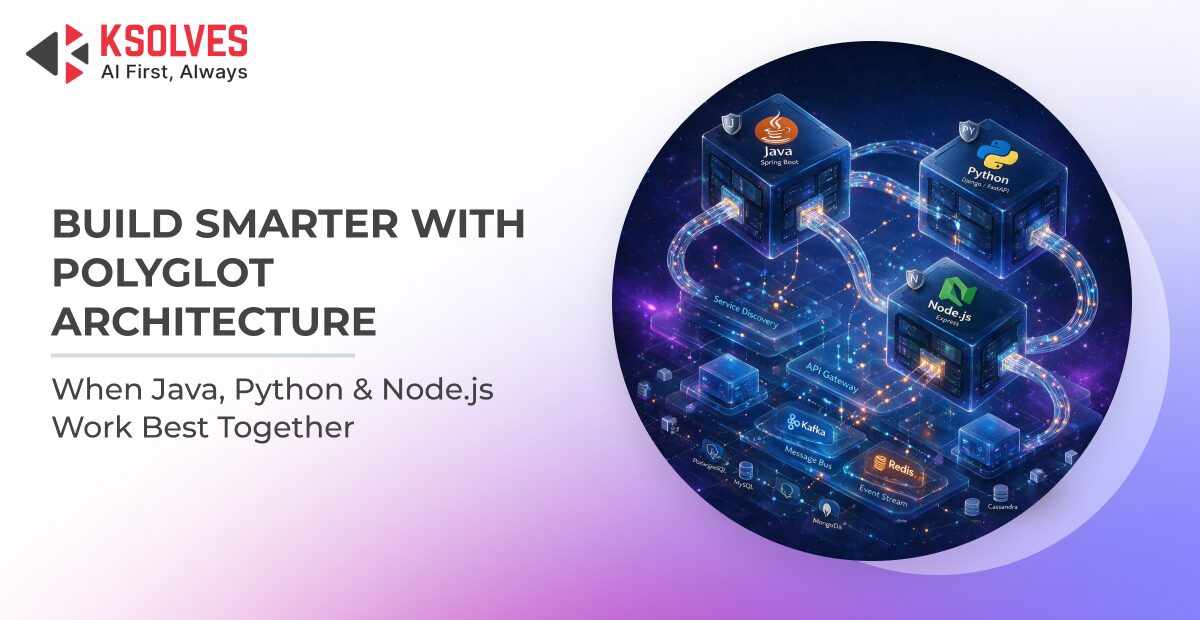
Modern enterprise applications rarely rely on a single technology stack. A payment service may demand Java’s performance and reliability, an AI engine may depend on Python’s rich machine learning ecosystem, while customer-facing APIs and backend-for-frontend (BFF) services often benefit from Node.js’s ability to handle thousands of concurrent requests. As organizations modernize their applications, choosing one language for every workload becomes increasingly impractical.
This shift has led many enterprises toward polyglot architecture, an approach where each microservice is built using the language best suited to its responsibility. But adopting multiple languages isn’t automatically a sign of good architecture. Every additional runtime introduces operational complexity, integration challenges, security considerations, and governance overhead.
The organizations that succeed with polyglot architectures aren’t the ones using the most programming languages. They’re the ones that standardize everything around them, from service contracts and observability to deployment pipelines and platform engineering.
In this blog, we’ll explore when it makes sense to combine Java, Python, and Node.js, where each language delivers the most value, the hidden tradeoffs enterprises often overlook, and the engineering practices.
What is Polyglot Architecture?
Polyglot architecture is a software design approach where different services within the same application are built using different programming languages based on the needs of each workload.
Instead of forcing every component into a single technology stack, organizations choose the language that best aligns with a service’s performance requirements, ecosystem, and business function.
For example, an enterprise application might use:
- Java for high-throughput transactional services.
- Python for AI, machine learning, and data processing.
- Node.js for customer-facing APIs and real-time applications.
Although these services use different technologies, they operate as a unified system through standardized APIs, shared contracts, and common operational practices.
The objective is to build each service with the technology that delivers the best business outcome.
Why Enterprises Are Adopting Polyglot Architectures
Several factors are driving this shift:
- Microservices encourage specialization, allowing each service to evolve independently.
- AI and data engineering workloads naturally rely on Python’s extensive ecosystem.
- Specialized engineering teams often work most effectively with technologies suited to their domain.
- Cloud-native platforms like Kubernetes simplify deploying and managing services regardless of the underlying language.
As applications become more distributed, technology decisions increasingly follow workload requirements rather than organization-wide standards.
Polyglot Isn’t a Goal, But It’s a Consequence
One of the biggest misconceptions about polyglot architecture is that using multiple programming languages is an achievement in itself. In reality, most successful polyglot systems evolve naturally as organizations grow and different workloads demand specialized technologies.
Consider a growing e-commerce platform. Its core order processing continues to run on Java for stability and performance. As the business adopts AI-driven recommendations, data scientists introduce Python to leverage existing machine learning libraries. Meanwhile, customer-facing APIs and BFF services are developed in Node.js to support rapid frontend development and handle high volumes of concurrent requests.
The result is a polyglot architecture, not because the organization planned to use three languages, but because each technology solved a specific business problem more effectively.
This pattern is common across industries. Financial institutions may combine Java for payment processing with Node.js for digital banking experiences. Logistics companies often use Python for route optimization while retaining Java for mission-critical operational systems. In every case, the workload drives the language choice, not developer preference.
However, every additional language also brings operational overhead, from runtime upgrades and dependency management to security patching, CI/CD maintenance, and on-call expertise. That’s why introducing a new language should always be backed by a clear technical or business advantage, not simply team preference.
Successful polyglot architectures prioritize standardization around APIs, observability, deployment, and governance, ensuring that technology diversity accelerates innovation instead of increasing complexity.
Also Read: Here’s Why You Must Deploy Java Microservices on the Cloud
Why One Language Can’t Solve Every Enterprise Problem
Every programming language has its own strengths, tradeoffs, and ecosystem. While it’s possible to build an entire application using a single language, doing so often means compromising on performance, developer productivity, or access to specialized tools.
Modern enterprise applications rarely perform just one function. A single platform may process transactions, power AI models, serve thousands of API requests, analyze data, and integrate with multiple systems. Since these workloads have different technical requirements, expecting one language to handle them all equally well is rarely the most efficient approach.
For example, Python has become the preferred choice for AI and machine learning because of its rich ecosystem of libraries. Java continues to power many high-throughput enterprise systems with its mature tooling and scalability, while Node.js excels at handling I/O-intensive workloads such as APIs and backend-for-frontend (BFF) services.
The goal isn’t to find the “best” language but to choose the one that best fits the workload.
Read More: 10 Best Java Frameworks for Modern Web Application Development
Matching the Language to the Workload
| Workload | Primary Requirement | Best-Fit Language |
| Payment & Transaction Processing | High performance, concurrency | Java |
| AI & Machine Learning | Rich ML ecosystem | Python |
| Customer APIs & BFF Services | High concurrency, low-latency I/O | Node.js |
| Real-Time Notifications | Event-driven processing | Node.js |
| Data Analytics & ETL | Data processing and analytics | Python |
| Core Business Logic | Scalability and maintainability | Java |
As applications become more distributed, it’s common for all these workloads to coexist. Choosing the right language for each service enables better performance, faster development, and greater flexibility.
Where Each Language Earns Its Place
A successful polyglot architecture is about using each one where it delivers the most value.
Java: Built for Enterprise Scale
Java remains the backbone of many enterprise systems thanks to its stability, scalability, and mature ecosystem. It is best suited for services that require high concurrency, predictable performance, and long-term maintainability.
Ideal for:
- Payment and financial systems
- Order and inventory management
- High-throughput APIs
- Enterprise business applications
- Long-running backend services
Python: Powering AI and Data
Python dominates AI, machine learning, and data engineering because of its extensive ecosystem and ease of development. For data-driven workloads, it allows teams to leverage proven libraries instead of building capabilities from scratch.
Ideal for:
- Machine learning
- Predictive analytics
- Recommendation engines
- Data pipelines
- Scientific computing
Node.js: Optimized for High-Concurrency Services
Node.js is designed for lightweight, I/O-bound workloads where handling many simultaneous requests efficiently is critical. Its event-driven architecture makes it a popular choice for modern web applications and microservices.
Ideal for:
- REST and GraphQL APIs
- Backend-for-Frontend (BFF) services
- Real-time applications
- Notification services
- API gateways
Language Comparison at a Glance
| Criteria | Java | Python | Node.js |
| Enterprise Applications | ✅ Excellent | Good | Good |
| AI & Machine Learning | ❌ Limited | ✅ Excellent | ❌ Limited |
| Data Engineering | Good | ✅ Excellent | Moderate |
| Real-Time APIs | Good | Moderate | ✅ Excellent |
| CPU-Intensive Workloads | ✅ Excellent | Moderate | Limited |
| I/O-Bound Services | Good | Moderate | ✅ Excellent |
A Real Enterprise Example: Polyglot Architecture in Action
To understand how polyglot architecture works in practice, consider a large e-commerce platform serving millions of customers across web and mobile channels. The platform manages transactions, inventory, customer experiences, and AI-driven recommendations, all with very different technical requirements.
Rather than building every service in a single language, each workload is developed using the technology best suited to its purpose.
| Service | Language | Why It’s the Right Fit |
| Order & Payment Processing | Java | High performance, reliability, and concurrency for mission-critical transactions |
| Product Recommendation Engine | Python | Access to mature AI and machine learning libraries |
| Customer APIs & BFF | Node.js | Handles high volumes of concurrent API requests with low latency |
| Inventory Management | Java | Supports complex business logic and scalable backend operations |
| Real-Time Notifications | Node.js | Event-driven architecture for fast, asynchronous communication |
| Sales Analytics | Python | Efficient data processing and predictive insights |
While these services use different languages, they operate as a single application through standardized communication protocols such as gRPC and Protocol Buffers, shared observability, and a common deployment platform.
This approach allows each team to innovate independently without sacrificing interoperability or operational consistency.
Interoperability: The Foundation of Successful Polyglot Architectures
The biggest challenge in a polyglot architecture is ensuring those services communicate reliably as the system evolves.
Many organizations start with REST APIs and JSON because they’re simple and familiar. However, as services grow and teams release updates independently, a renamed field, changed data type, or incompatible API version can easily break downstream services.
That’s why successful polyglot architectures prioritize strong interface contracts over language consistency.
Technologies like gRPC and Protocol Buffers (Protobuf) use a schema-first approach, enabling services to communicate through well-defined contracts that catch compatibility issues early in the development cycle. Likewise, contract testing with tools like Pact ensures service providers and consumers remain aligned, allowing teams to deploy independently with confidence.
Ultimately, the success of a polyglot architecture depends less on the languages you choose and more on how reliably those services work together.
Standardize Observability Across Every Language
As the number of services grows, troubleshooting becomes more challenging, especially when those services are built using different languages. Without consistent observability, identifying the root cause of an issue can mean searching through multiple logs, tools, and dashboards.
To avoid this, enterprises should standardize observability across the entire architecture rather than implementing it separately for each technology stack.
A common observability strategy typically includes:
- Centralized logging with a consistent log format.
- Distributed tracing to track requests across services.
- Metrics and dashboards for real-time performance monitoring.
- Correlation IDs to trace transactions end to end.
Tools such as OpenTelemetry, Prometheus, Grafana, and Jaeger help provide unified visibility, regardless of whether a service is built in Java, Python, or Node.js.
When every service follows the same observability standards, teams can resolve issues faster and maintain a reliable user experience.
Why Kubernetes Makes Polyglot Architecture Practical
Containerization has made language choice far less restrictive than it once was. Platforms like Kubernetes allow services built in different languages to be deployed, scaled, and managed using the same operational model.
Whether a service runs on Java, Python, or Node.js, Kubernetes provides:
- Automated scaling based on demand.
- Service discovery and load balancing.
- Rolling updates with minimal downtime.
- Self-healing through automatic restarts.
- Consistent deployment across environments.
This enables engineering teams to focus on building the right service for the workload, while Kubernetes handles the operational complexity of running a distributed application.
Security Considerations in Polyglot Systems
Every new language and runtime introduced into production also expands the security landscape. Different ecosystems have their own dependencies, vulnerabilities, and update cycles, making consistent security practices essential.
To reduce risk, organizations should standardize security across all services by implementing:
- Secure API authentication and authorization
- Encrypted service-to-service communication (mTLS)
- Centralized secrets management
- Regular dependency and vulnerability scanning
- Consistent access control and security policies
Security should be embedded into the platform, not implemented differently by each development team. A unified approach helps protect the entire application while simplifying compliance and governance.
Common Mistakes Enterprises Make
Polyglot architecture delivers significant benefits when implemented thoughtfully, but a few common mistakes can quickly increase complexity.
Some of the most frequent pitfalls include:
- Choosing languages based on preference rather than workload.
- Relying on inconsistent API contracts across services.
- Using different deployment and monitoring practices for each language.
- Ignoring long-term maintenance and operational overhead.
- Introducing new languages without the necessary in-house expertise.
Avoiding these mistakes starts with treating polyglot architecture as a strategic engineering decision, not simply a technology choice.
When Should You Avoid a Polyglot Architecture?
While polyglot architecture offers flexibility, it isn’t the right choice for every organization. Introducing multiple languages without a clear business or technical need can increase operational complexity, slow development, and make long-term maintenance more challenging.
A single-language architecture is often the better option when:
- Your application is relatively small or straightforward.
- The engineering team has limited experience managing multiple technology stacks.
- Operational simplicity is a higher priority than workload specialization.
- The application doesn’t include AI, data-intensive, or highly specialized services.
Polyglot architecture should solve a real problem, not create one. If a single language can effectively meet your application’s current and future needs, keeping the technology stack simple is often the smarter decision.
A Practical Framework for Choosing the Right Language
Rather than asking “Which language is best?”, enterprise architects should ask “Which language is best for this workload?”
Consider the following decision framework:
| Workload | Recommended Language | Why |
| Transaction Processing | Java | High performance and scalability |
| AI & Machine Learning | Python | Extensive AI and data science ecosystem |
| Data Processing & Analytics | Python | Mature data engineering libraries |
| Customer APIs & BFF | Node.js | Efficient handling of concurrent requests |
| Real-Time Notifications | Node.js | Event-driven, non-blocking architecture |
| Core Enterprise Services | Java | Reliability and long-term maintainability |
Beyond technical capabilities, evaluate:
- Does the workload require a specialized ecosystem?
- Does the team have expertise in the language?
- Can your platform support another runtime efficiently?
- Will the long-term benefits outweigh the operational overhead?
The right language should always be driven by business requirements, workload characteristics, and maintainability, not developer preference.
Conclusion
Polyglot architecture isn’t about using multiple programming languages, but it’s about using the right language for the right workload. When combined with standardized APIs, strong service contracts, and a unified engineering platform, it enables organizations to build scalable, resilient, and future-ready applications without adding unnecessary complexity.
At Ksolves, we help enterprises design and modernize cloud-native applications with the right mix of technologies, robust microservices architectures, and industry best practices. Whether you’re adopting Java, Python, Node.js, or a combination of all three, our experts ensure your applications remain interoperable, scalable, and built for long-term success.
Ready to Build a Future-Ready Polyglot Architecture? Partner with Ksolves!
































AUTHOR
Java
Share with