

 Java
 5 MIN READ


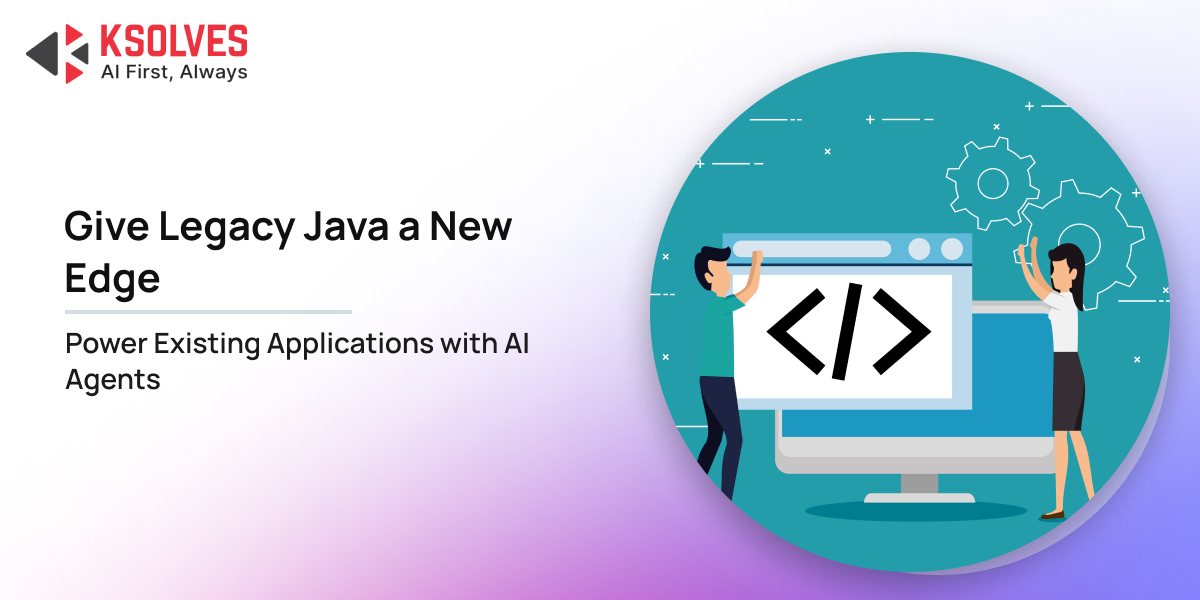
Java has powered enterprise applications for decades, handling everything from financial transactions and customer management to supply chain operations. However, as businesses move toward AI-driven operations, traditional Java applications face a new challenge: integrating modern AI capabilities without disrupting existing systems.
AI agents are changing how enterprises interact with applications. They can retrieve information, execute tasks, coordinate workflows, and support business decisions with minimal manual intervention. Integrating these capabilities into existing Java applications can help organizations modernize their operations without rebuilding their entire technology stack.
Java’s mature ecosystem, enterprise-grade frameworks, and integration capabilities make it a strong foundation for this transition. Developers can connect AI agents to existing business logic, databases, and services while retaining the reliability of established applications.
Why Java Remains Relevant in the AI Era
The rise of AI does not make established enterprise technologies obsolete. Instead, businesses need ways to extend their existing applications with intelligent capabilities. Java provides several advantages that support this transition.
- Established enterprise ecosystem: Many organizations already rely on Java for business-critical applications. Extending these systems with AI can protect existing technology investments.
- Mature frameworks and libraries: Java frameworks such as Spring Boot simplify application development, while newer AI integration frameworks help developers connect Java applications with language models and AI services.
- Scalability and reliability: Java supports large-scale enterprise workloads, making it suitable for applications that need to handle AI-powered operations alongside existing business processes.
- Integration capabilities: Java applications can connect with databases, REST APIs, messaging platforms, and cloud services, providing multiple ways to exchange information with AI agents.
- Security and enterprise support: Java’s established security ecosystem helps developers implement authentication, authorization, and access controls around AI-enabled workflows.
Rather than replacing Java, AI creates opportunities to make existing Java applications more intelligent and adaptable.
Also Read: Java in Cloud-Native Applications: Benefits and Challenges
How AI Agents Can Transform Legacy Java Applications
AI agents go beyond generating text or answering questions. They can interpret requests, access approved tools, perform multi-step tasks, and interact with enterprise systems to achieve specific objectives.
When integrated with legacy Java applications, they can improve several business processes.
- Automate Repetitive Business Workflows
AI agents can handle routine tasks such as processing requests, updating records, validating information, and generating reports. They can interact with existing Java services to execute approved operations, reducing manual intervention. - Retrieve and Process Enterprise Data
Legacy Java applications often contain valuable business information distributed across databases and internal systems. AI agents can retrieve relevant information through authorized APIs and tools, helping users access enterprise data without navigating multiple applications. - Support Intelligent Decision-Making
AI agents can analyze available business information, identify relevant patterns, and summarize findings. For example, an agent connected to a Java-based inventory application can retrieve stock information and highlight products that require replenishment. - Enable Natural-Language Interactions
Employees can interact with enterprise applications using conversational instructions instead of navigating multiple screens or executing complex queries.For example, a user could ask an AI agent to retrieve pending orders for a particular customer. The agent can access the relevant Java application functionality and return the requested information. - Coordinate Tasks Across Multiple Systems
Enterprise workflows often involve multiple applications. AI agents can coordinate operations across connected Java services, CRM platforms, ERP systems, and other enterprise tools, provided the required integrations and permissions are available.
Approaches to Integrating AI Agents with Legacy Java Systems
Integrating AI agents into an existing Java application does not require a complete architectural overhaul. Developers can choose different integration approaches depending on the application’s architecture, data requirements, and business objectives.
1. API-Based Integration
REST APIs provide a straightforward way to connect AI agents with existing Java applications. Developers can expose specific application functionalities through APIs, allowing agents to retrieve information or execute approved operations.
For example, a Java-based order management system can expose APIs for retrieving order details, checking payment status, and updating order records. An AI agent can use these endpoints to respond to user requests and perform authorized actions.
2. Model Context Protocol (MCP)
The Model Context Protocol (MCP) provides a standardized way for AI applications to interact with external tools, resources, and data sources.
Developers can build MCP servers that expose selected Java application capabilities to AI agents. Instead of creating separate integrations for every AI client, MCP provides a consistent interface for accessing supported application functionality.
For example, an MCP server connected to a Java-based CRM can expose customer lookup, lead retrieval, and account information tools to an AI agent.
3. Framework-Based Integration
Java developers can use dedicated frameworks to connect applications with large language models (LLMs), manage prompts, and build AI-powered workflows.
Two relevant options include:
- Spring AI: Provides abstractions for integrating AI models, vector databases, tool calling, and other AI capabilities into Spring-based applications.
- LangChain4j: Simplifies the integration of LLMs, embedding models, retrieval-augmented generation (RAG), and AI services into Java applications.
These frameworks reduce the need to build model integrations and supporting components from scratch.
4. Event-Driven Integration
Event-driven architecture allows Java applications to trigger AI-powered workflows in response to specific business events.
For example, when a new customer order is created, a Java application can publish an event through a messaging platform such as Apache Kafka or RabbitMQ. An AI-powered service can consume that event, analyze the order, and initiate an appropriate workflow.
This approach is useful when AI operations need to run asynchronously without slowing down the primary application.
Step-by-Step: Integrating AI Agents into a Legacy Java Application
A structured integration process helps developers introduce AI capabilities while maintaining existing application functionality.
Step 1: Assess the Existing Java Application
Start by reviewing the application’s architecture, business logic, APIs, databases, and dependencies. Identify workflows that could benefit from AI agent capabilities.
Prioritize use cases based on business value, implementation complexity, and data availability.
Step 2: Identify Enterprise Data Sources and Integration Points
Determine which databases, internal services, and external applications the AI agent needs to access.
Identify the existing APIs and services that can provide this information. If suitable interfaces are unavailable, develop integration layers to expose the required functionality without directly exposing internal application components.
Step 3: Select an AI Model and Integration Framework
Choose an LLM based on the application’s requirements, including response quality, latency, deployment options, data privacy, and cost.
Select an appropriate Java framework, such as Spring AI or LangChain4j, to simplify model connectivity and agent development.
Step 4: Expose Application Functionality Through APIs or MCP Tools
Make selected Java application capabilities accessible through controlled interfaces.
Define the operations an AI agent can perform, the parameters each operation requires, and the responses it should receive. Apply appropriate validation and access restrictions to prevent unauthorized operations.
Step 5: Develop and Integrate AI Agents
Configure the agent with its instructions, available tools, and business context.
Connect it to the required Java services and test its ability to interpret user requests, select appropriate tools, and execute multi-step workflows.
Step 6: Implement Security and Access Controls
Protect enterprise data and application functionality throughout the integration.
Implement authentication, role-based authorization, input validation, and secure API communication. Ensure that agents can access only the information and operations permitted for their users.
Step 7: Test, Deploy, and Monitor
Test the integrated application for functional accuracy, response quality, security, and performance.
Deploy the solution gradually, monitor agent behavior, track API usage, and review execution logs. Continuously evaluate the results to identify issues and improve reliability.
Also Read: How To Develop Cloud Applications Using Java?
Key Challenges in Java and AI Agent Integration
Although Java provides a strong foundation for enterprise AI integration, developers must address several technical challenges.
- Legacy architecture and technical debt:
Older Java applications may rely on tightly coupled components, outdated dependencies, or limited API support. Introducing AI capabilities requires careful integration to avoid disrupting existing workflows. - Data access and interoperability:
Enterprise data is often distributed across different databases and applications. Establishing consistent, secure access to these sources is essential for reliable AI operations. - Security and access control:
AI agents may interact with sensitive enterprise information and business operations. Without proper permissions and safeguards, they can expose data or execute unauthorized actions. - AI response accuracy and reliability:
LLMs can generate incorrect or incomplete responses. Developers need validation mechanisms, controlled tool access, and human oversight for critical operations. - Performance and scalability:
AI model calls can introduce additional latency and resource consumption. Applications must manage concurrent requests, API limits, timeouts, and workload scaling effectively.
Addressing these challenges during the design phase helps ensure that AI integration strengthens rather than complicates existing enterprise systems.
Need an enterprise-ready approach to AI agent integration?
How Ksolves Helps Modernize Legacy Java Applications with AI Agent Integration
Modernizing legacy Java applications requires a combination of Java expertise, enterprise integration capabilities, and practical AI implementation. Ksolves helps businesses extend their existing Java ecosystems with modern AI capabilities while maintaining application stability and business continuity.
Our expertise spans Java application development, enterprise modernization, and AI integration, enabling businesses to move toward AI-powered operations without rebuilding their entire technology stack.
How Ksolves supports your modernization journey:
- Legacy Java Application Modernization:
Upgrade existing Java applications, improve architecture, and address technical debt to make systems more adaptable to modern technologies. - AI Agent Development and Integration:
Build AI agents that connect with enterprise applications, access authorized data, and execute business workflows. - Enterprise API Integration:
Develop and integrate REST APIs and microservices to connect legacy Java systems with AI models, external platforms, and enterprise applications. - AI Framework Integration:
Leverage suitable Java AI frameworks, including Spring AI and LangChain4j, to integrate LLMs and develop AI-powered application capabilities. - Secure and Scalable Architecture:
Implement appropriate authentication, access controls, monitoring, and deployment practices to support reliable enterprise AI solutions.
With Ksolves, businesses can take a structured approach to Java modernization and AI adoption, transforming established applications into intelligent, connected enterprise systems.
Ready to bring AI agents into your Java applications?
Final Words
Modernizing legacy Java applications does not mean abandoning established systems. By integrating AI agents through APIs, MCP, Java frameworks, and event-driven architectures, enterprises can extend existing application capabilities and introduce intelligent automation into business workflows.
However, successful integration depends on choosing the right architecture, securing enterprise data, and maintaining control over AI-driven operations. An incremental modernization strategy allows businesses to adopt AI while preserving their existing technology investments.



 Ksolvesdev