



How Finance Teams Ditch Manual Reporting with Live P&L, Cash Flow & Budget Dashboards in Odoo
Odoo
5 MIN READ
July 16, 2026

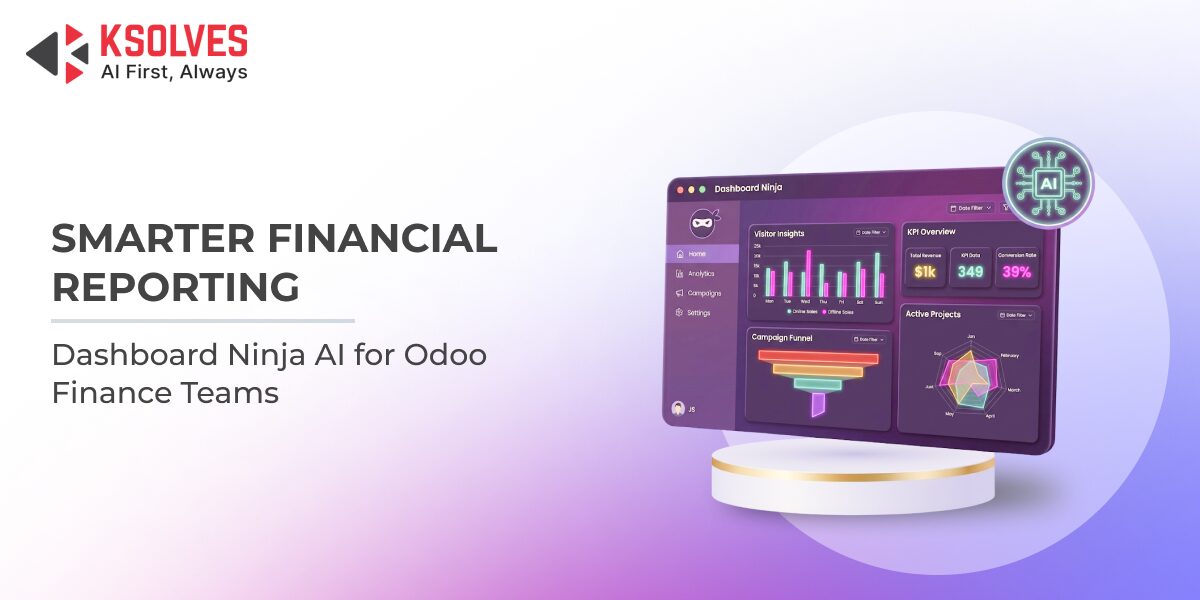
Financial reporting is one of the most critical functions inside any business. Yet many finance teams still spend countless hours exporting spreadsheets, reconciling data manually, consolidating reports from multiple departments, and preparing management summaries at the end of every week or month.
Modern organizations require faster financial insights, live operational visibility, and accurate forecasting. This is where Odoo ERP transforms finance operations.
With centralized accounting, automated data synchronization, and real-time dashboards, Odoo enables finance teams to move beyond static spreadsheets and adopt live Profit & Loss, cash flow, and budget dashboards. When combined with advanced visualization tools like Dashboard Ninja with AI, finance teams gain even deeper analytical capabilities and executive-level reporting visibility.
In this blog, we’ll explore how finance teams are replacing manual reporting with live financial dashboards in Odoo and why real-time financial intelligence has become essential for modern businesses.
The Problem with Manual Financial Reporting
1. Spreadsheet-Driven Reporting Creates Operational Bottlenecks
In many organizations, financial reporting still depends heavily on Excel sheets and manually exported ERP data. Finance teams often pull information separately from:
- Accounting systems.
- Sales reports.
- Procurement data.
- Inventory records.
- Payroll systems.
- Bank statements.
This fragmented workflow creates multiple problems:
- Duplicate data handling.
- Inconsistent numbers across departments.
- Version control confusion.
- Delayed reporting cycles.
- High dependency on manual reconciliation.
As businesses scale, these inefficiencies grow exponentially.
2. Delayed Reporting Leads to Delayed Decisions
Traditional reporting processes are usually periodic:
- Weekly reports.
- Monthly financial closures.
- Quarterly performance reviews.
By the time reports are finalized, the underlying business situation may already have changed.
For example:
- Cash flow shortages may already be impacting operations.
- Overspending may continue unnoticed.
- Profit margins may decline before leadership identifies the issue.
- Budget overruns may escalate without timely intervention.
3. Manual Processes Increase Human Errors
Spreadsheet-based financial reporting introduces unavoidable risks:
- Incorrect formulas.
- Missing journal entries.
- Duplicate data imports.
- Broken spreadsheet references.
- Manual calculation mistakes.
Even small reporting inaccuracies can impact:
- Financial forecasting.
- Budget planning.
- Tax reporting.
- Audit preparation.
- Executive decision-making.
Still Spending Hours Preparing Financial Reports? Simplify it with Dashboard Ninja with AI!
Why Real-Time Financial Dashboards Matter
Modern finance teams need immediate access to accurate business data. Real-time dashboards provide continuous visibility into organizational financial performance without waiting for manual reporting cycles.
1. Faster Financial Decision-Making
Live dashboards allow finance leaders to:
- Monitor profitability instantly.
- Identify unusual spending patterns.
- Track overdue receivables.
- Evaluate operational costs in real time.
- Respond quickly to financial risks.
2. Better Cash Flow Visibility
Cash flow management is one of the most important responsibilities of finance teams.
A company may appear profitable on paper while still facing operational cash shortages due to:
- Delayed customer payments.
- Vendor liabilities.
- Inventory holding costs.
- Payroll obligations.
Live cash flow dashboards help finance teams:
- Track incoming and outgoing cash continuously.
- Monitor unpaid invoices.
- Forecast liquidity requirements.
- Improve working capital management.
3. Improved Budget Monitoring
Traditional budget tracking often happens after expenses are already incurred.
Real-time dashboards allow businesses to:
- Compare budget vs actual expenses continuously.
- Detect overspending early.
- Monitor department-level financial performance.
- Improve cost control.
This creates a more disciplined and data-driven budgeting process.
How Dashboard Ninja with AI Enhances Financial Reporting in Odoo
While Odoo provides strong core accounting and financial reporting capabilities, modern finance teams often require more dynamic, visual, and decision-focused analytics. This is where Dashboard Ninja with AI helps organizations transform traditional ERP reporting into an intelligent, real-time financial monitoring system.
By combining live KPI tracking, advanced visualization, AI-powered insights, and customizable dashboards, Dashboard Ninja with AI enables finance teams to move beyond static reports and gain deeper operational and financial visibility directly inside Odoo.
1. Build Real-Time Financial Dashboards Without Complex Development
Finance teams can create highly interactive dashboards using drag-and-drop dashboard builders and configurable KPI widgets without extensive technical effort.
Organizations can build dashboards for:
- Profit & Loss monitoring.
- Cash flow tracking.
- Budget vs actual analysis.
- Accounts receivable and payable monitoring.
- Expense analysis.
- Revenue trend tracking.
- Multi-company financial reporting.
Since dashboards are connected directly to live Odoo data, financial metrics update automatically as transactions occur across accounting, sales, inventory, purchasing, and invoicing modules.
This eliminates the need for repeated spreadsheet exports and manual report consolidation.
2. Advanced Financial Visualization for Faster Decision-Making
Dashboard Ninja with AI helps finance teams visualize financial performance through:
- Interactive charts and graphs.
- KPI cards and scoreboards.
- Pivot-style analytical views.
- Comparative financial trend analysis.
- Forecast-oriented visual reports.
- Department-wise financial summaries.
- Multi-dashboard layouts for different teams.
Instead of reviewing static spreadsheets, CFOs and finance managers can instantly identify financial trends, operational gaps, and performance deviations through live visual analytics.
3. AI-Powered Financial Insights and Smart Analytics
One of the most valuable capabilities of Dashboard Ninja with AI is its ability to assist finance teams with faster analytical interpretation of financial data.
AI-powered insights can help identify:
- Revenue fluctuations.
- Unusual spending patterns.
- Delayed customer payments.
- Budget deviations.
- KPI anomalies.
- Cash flow irregularities.
- Financial performance trends over time.
This enables finance leaders to detect issues earlier and make more proactive decisions instead of relying solely on retrospective reporting.
AI-assisted analytics improve visibility and efficiency, while financial governance, audits, and accounting validation remain under organizational control.
4. Role-Based Dashboards for Different Finance Stakeholders
Different teams require different financial perspectives. Dashboard Ninja with AI allows organizations to create personalized dashboards for:
- CFOs.
- Finance managers.
- Accountants.
- Department heads.
- Business executives.
For example:
- CFO dashboards can focus on profitability, liquidity, and forecasts.
- Accounts teams can monitor receivables, payables, and reconciliations.
- Department managers can track budget utilization and operational expenses.
This role-based visibility improves accountability and simplifies financial monitoring across the organization.
5. Drill-Down Reporting for Better Financial Analysis
Instead of viewing only summary-level KPIs, finance teams can drill down directly into underlying transactions and records.
Users can analyze:
- Invoice-level details.
- Vendor payment histories.
- Expense breakdowns.
- Department-specific costs.
- Product or project profitability.
- Ledger-level financial entries.
This reduces the time spent switching between multiple reports and improves root-cause analysis during financial reviews.
6. Real-Time Monitoring Across Multiple Business Functions
Because Dashboard Ninja with AI integrates directly with Odoo modules, finance teams can combine operational and financial insights within a single dashboard.
Organizations can monitor:
- Sales revenue alongside receivables.
- Procurement costs alongside vendor liabilities.
- Inventory valuation alongside profitability.
- Operational expenses alongside budget utilization.
This unified visibility helps leadership teams understand how operational activities directly impact financial performance.
7. Mobile-Responsive Executive Reporting
Finance leaders often need access to business-critical KPIs outside the office. Dashboard Ninja with AI supports responsive dashboard access across devices, enabling executives to monitor financial performance anytime and anywhere.
This improves:
- Executive visibility.
- Faster approvals.
- Remote decision-making.
- Real-time financial monitoring.
8. Automated and Scalable Financial Reporting
As businesses grow, financial reporting complexity increases significantly. Dashboard Ninja with AI helps organizations scale reporting operations through:
- Automated KPI updates.
- Dynamic dashboard refresh.
- Centralized financial visibility.
- Reusable dashboard templates.
- Cross-department analytics.
This allows finance teams to focus more on strategic planning and financial analysis rather than manual report preparation.
Upgrade Odoo Reporting with AI-Powered Dashboards using Dashboard Ninja with AI!
Benefits of Using Dashboard Ninja with AI for Financial Reporting
Implementing Dashboard Ninja with AI helps finance teams move beyond static spreadsheets and traditional reporting limitations by enabling real-time, intelligent, and highly visual financial analytics inside Odoo.
- Faster Financial Reporting
Automates live KPI tracking and dashboard updates, reducing the time spent on manual report preparation, spreadsheet consolidation, and repetitive data exports. - Real-Time Financial Visibility
Provides instant access to live Profit & Loss, cash flow, receivables, payables, and budget performance data directly from Odoo. - Improved Decision-Making
Interactive dashboards and AI-powered insights help finance leaders identify trends, anomalies, and financial risks faster for more proactive decision-making. - Better Budget Control
Track budget vs actual spending continuously, monitor department-wise expenses, and detect overspending before it impacts profitability. - Reduced Reporting Errors
Minimizes manual intervention and spreadsheet dependency by synchronizing financial data automatically across Odoo modules. - Interactive and Visual Analytics
Transforms complex financial data into easy-to-understand charts, KPI cards, graphs, and drill-down reports for faster analysis. - Role-Based Financial Dashboards
Create personalized dashboards for CFOs, accountants, finance managers, and department heads based on their reporting needs. - Drill-Down Financial Analysis
Analyze underlying transactions directly from dashboards, including invoices, expenses, vendor bills, and ledger entries. - Multi-Company Financial Monitoring
Monitor financial performance across multiple entities or subsidiaries from a centralized reporting environment. - Mobile-Friendly Executive Reporting
Access live financial dashboards anytime and anywhere through responsive dashboard interfaces. - Scalable Reporting Infrastructure
Supports growing businesses with centralized, automated, and reusable dashboard frameworks for enterprise-scale financial reporting. - Enhanced Operational and Financial Alignment
Combine operational data such as sales, procurement, inventory, and expenses with financial KPIs to gain a complete business performance view.
Final Words
Manual financial reporting slows down decision-making, increases the risk of errors, and limits real-time business visibility. As organizations grow, relying on spreadsheets and disconnected reports becomes increasingly difficult to manage efficiently.
By replacing manual processes with intelligent financial dashboards, businesses can improve reporting accuracy, accelerate financial analysis, and make faster, data-driven decisions with confidence.































AUTHOR
Odoo
Neha Negi, Presales and Business Associate Head at Ksolves is a results-driven ERP consultant with over 8 years of expertise in designing and implementing tailored ERP solutions. She has a proven track record of leading successful projects from concept to completion, driving organizational efficiency and success.
Share with