



Migrate from Older Odoo Versions to the Latest Version with an AI-Driven Approach
Odoo
5 MIN READ
May 13, 2026

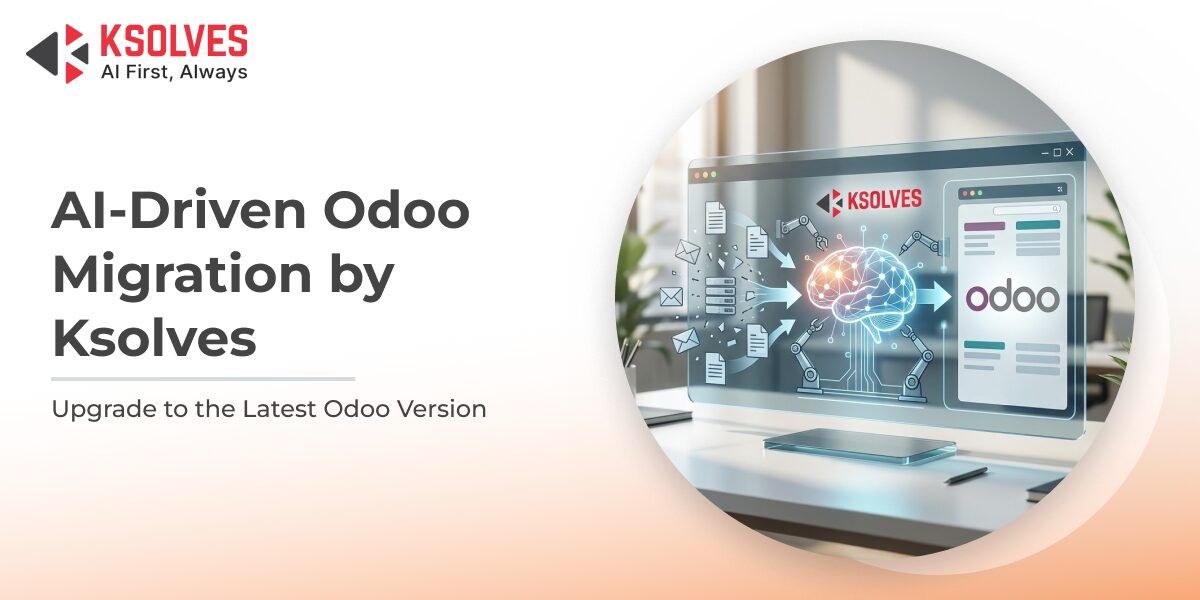
Adopting Odoo ERP is a strong foundation, but staying competitive requires keeping that foundation continuously optimized. As businesses scale, older Odoo versions often struggle to keep up with evolving operational complexity, performance expectations, and integration demands.
Modern enterprises are no longer treating Odoo migration as a routine upgrade. Instead, it has become a strategic initiative to enhance efficiency, reduce technical debt, and unlock advanced capabilities across CRM, accounting, inventory, and eCommerce. With every new release, Odoo introduces smarter workflows, improved user experience, and stronger system performance, making upgrades critical for long-term scalability.
What’s changing now is how businesses approach migration. The shift toward AI-driven Odoo migration is helping organizations minimize risks, accelerate timelines, and ensure data accuracy. It is turning a traditionally complex process into a streamlined transformation.
This blog explores the key reasons why migrate from older Odoo versions to a newer version. We will also explore how Ksolves’ AI-driven Odoo migration ensures a seamless and future-ready upgrade.
What is Odoo Migration?
Odoo migration is the process of upgrading your existing Odoo ERP system to a newer version while ensuring that your business data, workflows, integrations, and custom modules remain intact and fully functional.
A well-planned Odoo ERP migration goes beyond technical upgrades, but it ensures your system continues to support evolving business processes, scalability needs, and performance expectations.
Types of Odoo Migration
- Version Upgrade
Upgrading from older versions (such as Odoo 14/15) to newer releases (like Odoo 18/19).
- Unlocks new features and improved performance.
- Ensures access to the latest security updates and support.
- Reduces dependency on outdated customizations.
- Module Migration
Updating existing modules or replacing them with newer, more efficient ones.
- Aligns functionality with the latest Odoo capabilities.
- Improves system efficiency and usability.
- Ensures compatibility of custom and third-party apps.
- Database Migration
Transferring and restructuring business data from the old system to the new version.
- Includes master data (products, customers) and transactional data (orders, invoices).
- Ensures data integrity, accuracy, and consistency.
- Optimizes database structure for better performance.
More Than Just an Upgrade
Modern Odoo version upgrade is not just about moving to the latest release, but it’s about future-proofing your ERP ecosystem.
A strategic migration helps you:
- Eliminate outdated workflows and technical debt.
- Leverage built-in features instead of heavy customizations.
- Improve operational efficiency and decision-making.
- Integrate seamlessly with modern tools and platforms.
In essence, a well-executed Odoo migration strategy transforms your ERP from a system you use into a system that actively drives business growth.
Why You Should Upgrade to the Latest Odoo Version
Upgrading to the latest version of Odoo ERP is not just a technical decision, but it’s a strategic move to improve efficiency, scalability, and competitiveness. A timely Odoo version upgrade ensures your ERP evolves alongside your business.
1. Access to Advanced Features & Built-In Capabilities
Each new Odoo release introduces enhanced functionalities across core business areas:
- CRM & Sales Automation: Smarter lead tracking, pipeline visibility, and forecasting.
- Accounting & Financial Reporting: Real-time insights, automation, and compliance-ready reports.
- Inventory & Supply Chain: Improved demand forecasting and stock optimization.
- eCommerce & Website: Better user experience, faster storefronts, and integrated operations/
Business Value: Reduces reliance on heavy customizations by leveraging native Odoo features, lowering maintenance costs and complexity.
2. Better Performance and Speed Optimization
A modern Odoo ERP upgrade significantly improves system performance:
- Faster transaction processing.
- Reduced system latency.
- Efficient handling of large datasets and multi-user environments.
Business Value: Enhances productivity by minimizing delays and enabling teams to operate in real time.
3. Enhanced Security and Compliance
Older versions are more vulnerable to risks. Upgrading ensures:
- Regular security patches and vulnerability fixes.
- Stronger data protection mechanisms.
- Alignment with evolving regulatory and compliance standards.
Business Value: Protects critical business data and reduces the risk of security breaches.
4. Improved User Experience (UI/UX)
New Odoo versions focus heavily on usability:
- Cleaner, more intuitive interface.
- Simplified navigation across modules.
- Fully responsive, mobile-friendly design.
Business Value: Improves user adoption, reduces training time, and enhances overall operational efficiency.
5. Continued Support and Long-Term Stability
Odoo provides official support only for recent versions. Staying updated ensures:
- Access to official updates and documentation.
- Faster bug resolution and system improvements.
- Long-term reliability and scalability.
Business Value: Avoids system breakdowns and ensures your ERP remains future-ready and maintainable.
What’s New in the Latest Odoo Versions (18/19 Highlights)
The latest releases of Odoo ERP mark a clear shift toward intelligent automation, improved usability, and deeper business visibility. With each upgrade, Odoo continues to simplify complex operations while empowering businesses to scale with confidence.
Here’s a closer look at what’s new and why it matters:
1. Smarter CRM and Sales Workflows
Odoo 18/19 brings noticeable improvements in how sales teams manage pipelines and customer interactions. With enhanced lead tracking, better activity management, and more accurate forecasting, teams can now focus less on manual updates and more on closing deals.
The result is a more proactive sales process, driven by real-time insights rather than guesswork.
Also Read: Redefine Your Sales Operations with the Odoo Sales
2. More Intelligent Accounting and Financial Control
Financial operations are becoming more automated and precise. From smoother bank reconciliation to improved reporting capabilities, the latest versions make it easier to maintain accuracy and compliance.
Businesses benefit from real-time financial visibility, helping leadership make faster, data-backed decisions.
Also Read: Odoo ERP for Fintech Companies: Automate Accounting, Compliance, and Reporting
3. AI-Driven Automation Across Workflows
One of the most notable advancements is the growing role of automation. Routine tasks such as data entry, validations, and workflow triggers are increasingly streamlined, reducing manual intervention.
This shift allows teams to focus on strategic work, while the system handles repetitive processes in the background.
4. Optimized Inventory and Supply Chain Management
Inventory and logistics capabilities have also evolved. With better demand forecasting, smarter replenishment, and enhanced warehouse visibility, businesses can manage stock more efficiently.
This leads to fewer stockouts, reduced overstocking, and improved operational balance.
Also Read: Top 5 Odoo Inventory Apps for 2025
5. Enhanced Website and eCommerce Capabilities
Odoo’s website and eCommerce modules continue to improve with more flexible design options, faster performance, and better SEO support. Managing online stores is now more intuitive, with smoother product and checkout experiences.
For businesses, this translates into a stronger digital presence and higher conversion potential.
6. Refined User Experience Across the Platform
The interface in Odoo 18/19 feels cleaner, faster, and more intuitive. Navigation has been simplified, and the experience is consistent across devices, whether desktop or mobile.
This ensures faster adoption by teams and reduced training efforts, especially during upgrades.
7. Stronger Collaboration and Project Management
Collaboration tools have become more integrated, enabling teams to manage tasks, share updates, and communicate within a unified system.
This creates a more connected work environment, improving productivity across departments.
8. Improved Integration and Scalability
Modern businesses rely on multiple tools, and Odoo continues to strengthen its integration capabilities. With improved APIs and better compatibility with external platforms, data flows more seamlessly across systems.
At the same time, performance enhancements ensure the platform can scale effortlessly as your business grows.
Unlock the Full Potential of Odoo 19 with Our Guide – Read the Full Guide
Ksolves’ AI-Driven Phased Odoo Migration
Migrating Odoo ERP shouldn’t feel like a risky overhaul; it should feel like a controlled, intelligent evolution. That’s exactly where Ksolves, an AI-first Odoo development company, differentiates itself.
Instead of a one-size-fits-all upgrade, Ksolves follows an AI-driven, phase-wise Odoo migration framework designed to reduce risk, accelerate timelines, and maximize business value at every step.
Phase 1: Intelligent System Discovery
Ksolves begins with a deep, AI-assisted audit of your current Odoo environment.
- Automated analysis of existing modules and customizations.
- Identification of redundant or outdated features.
- Risk mapping for potential migration challenges.
You don’t just assess your system; you gain data-backed clarity on what should evolve, what should stay, and what should go.
Phase 2: Strategic Migration Blueprint
Before any code is touched, a clear roadmap is built.
- Mapping current workflows to new Odoo capabilities.
- Identifying opportunities to replace custom code with native features.
- Defining a future-ready ERP architecture.
This phase ensures migration is not just technical, but it’s aligned with your business growth strategy.
Phase 3: AI-Assisted Code & Module Migration
This is where precision matters most.
- Intelligent refactoring of custom modules.
- Compatibility validation with the latest Odoo version.
- Optimization of code for performance and scalability.
AI accelerates code analysis and reduces manual errors, ensuring a cleaner, more efficient system post-migration.
Phase 4: Smart Data Migration & Validation
Your data is your business backbone. Ksolves treattreats it that way.
- Structured migration of master and transactional data.
- AI-driven validation to ensure accuracy and consistency.
- Elimination of duplicate or corrupted records.
You don’t just move data; you improve its quality and usability.
Phase 5: Automated Testing & Quality Assurance
Testing is no longer reactive; it’s predictive.
- End-to-end workflow simulation.
- Automated test case execution.
- Early detection and resolution of potential issues.
AI helps identify problems before they impact operations, ensuring a smooth and disruption-free transition.
Phase 6: Seamless Deployment & Continuous Optimization
The final step is not the end; it’s the beginning of optimization.
- Controlled go-live with minimal downtime.
- Performance monitoring and fine-tuning.
- Ongoing support and system enhancements.
Migration doesn’t stop at deployment. Ksolves ensures your ERP continues to adapt, improve, and scale.
Why Choose Ksolves for Odoo Migration
When it comes to upgrading Odoo ERP, the difference lies not just in what you migrate, but how you migrate. Ksolves India Limited brings a modern, AI-led approach that transforms migration into a strategic, low-risk, and high-impact initiative.
What Sets Ksolves Apart
- AI-First Migration Strategy: Leveraging intelligent automation to accelerate migration, reduce errors, and ensure data accuracy at every stage.
- Deep Odoo Expertise: Extensive experience across multiple Odoo versions, modules, and complex business environments.
- Proven Cross-Industry Experience: Successfully delivering Odoo migration and implementation projects across diverse industries and business models.
Comprehensive Migration Capabilities
Ksolves ensures every aspect of your migration is handled with precision:
- Custom Module Migration: Upgrading and optimizing existing customizations for compatibility with the latest Odoo versions.
- Data & Attachment MigrationL Secure transfer of master data, transactional records, documents, and attachments without data loss.
- Integration Handling: Ensuring seamless connectivity with third-party systems such as eCommerce platforms, payment gateways, and logistics tools.
The Outcome You Can Expect
- Faster Migration Timelines with minimal disruption.
- Higher Accuracy and Data Integrity.
- Scalable ERP System ready for future growth.
- Reduced Technical Debt and maintenance overhead.
Final Words
Upgrading Odoo ERP is no longer just about staying current, but it’s about building a system that can adapt, scale, and drive smarter decisions as your business evolves. A well-executed Odoo migration eliminates inefficiencies, unlocks modern capabilities, and positions your organization for long-term growth.
With an AI-driven, structured approach from Ksolves, an AI-first Odoo development company, migration becomes less about risk and more about opportunity, ensuring your ERP is not just upgraded, but truly future-ready.
Ready to turn your Odoo upgrade into a competitive advantage? Partner with Ksolves!






























AUTHOR
Odoo
Muntashah Nazir is a technical writer at Ksolves. She is an avid writer with a stronghold on detailed writing. Her expertise lies in providing a complete picture of the technology and its rewards using simple words.
Share with