



Odoo CRM Key Features: A Complete Guide with AI-Driven Implementation for Modern Businesses
Odoo
5 MIN READ
April 23, 2026

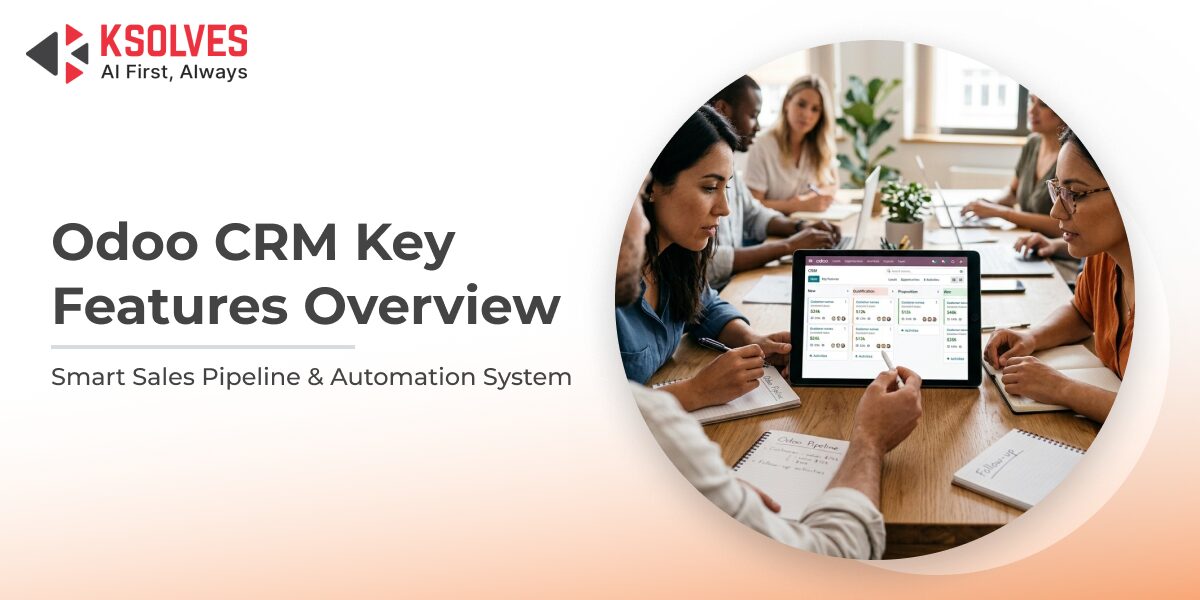
Every business starts with leads, but growth depends on what happens after those leads enter your system. In many organizations, customer data is scattered across emails, spreadsheets, and disconnected tools, making it difficult for sales teams to maintain clarity, speed, and consistency.
This fragmentation often leads to missed follow-ups, unclear priorities, and lost opportunities, not because teams lack effort, but because they lack a unified system.
That’s where Odoo CRM changes the approach.
Instead of treating customer information as isolated entries, it brings everything into a single, connected flow where leads, activities, and opportunities are tracked in context. Every interaction becomes part of a structured pipeline that helps teams act faster and more intelligently.
More importantly, Odoo CRM doesn’t work in isolation, but it integrates naturally with sales, marketing, and operations, creating a continuous business process rather than disconnected workflows.
In this guide, we explore the key features of Odoo CRM and how they help modern businesses improve visibility, efficiency, and sales performance. We’ll walk you through how Ksolves’ AI-driven implementation of Odoo CRM enables faster deployments, improved data accuracy, and a more adaptive CRM system that evolves with business needs.
Overview of Odoo CRM
Odoo CRM is a customer relationship management application that is part of the Odoo ERP suite, designed to help businesses manage leads, opportunities, and sales pipelines in a structured and centralized way.
At its core, Odoo CRM focuses on tracking customer interactions from the first inquiry to the final deal closure, ensuring that every opportunity is managed with complete visibility and control. It is not a standalone tool but a tightly integrated component of the broader Odoo ecosystem.
Integration with Odoo Modules
Odoo CRM connects seamlessly with other key Odoo modules, enabling end-to-end process continuity:
- Sales: Convert opportunities into quotations and sales orders.
- Marketing: Capture and nurture leads through campaigns and automation.
- Inventory: Link sales opportunities with product availability.
- Accounting: Generate invoices and track payments directly from sales flows.
This integration ensures that customer data is shared across departments without duplication, improving accuracy and operational efficiency.
Deployment Options
Odoo CRM offers flexible deployment models to suit different business needs:
- Cloud-based (Odoo Online / Odoo.sh): Quick deployment with managed infrastructure and scalability.
- On-premise (Self-hosted): Full control over customization, hosting, and data security.
Business Suitability
Odoo CRM is designed to scale across organizations of all sizes:
- SMEs benefit from its affordability, modular structure, and ease of use.
- Enterprises leverage its customization capabilities, multi-company support, and deep ERP integration.
This flexibility makes Odoo CRM suitable for businesses at different growth stages, from startups building their first sales pipeline to large enterprises managing complex sales operations.
Key Features of Odoo CRM
Odoo CRM is designed as a tightly connected sales management system that brings structure, visibility, and automation into every stage of the customer journey. Its feature set is built to help businesses manage leads efficiently, improve conversion rates, and maintain a unified view of customer interactions across departments.
1. Lead Management
Odoo CRM provides a flexible system to capture and organize leads from multiple entry points.
- Leads can be generated from website forms, email aliases, manual creation, or data imports.
- Built-in assignment rules automatically route leads to the right salesperson or team.
- Leads can be prioritized using configurable scoring mechanisms or custom business rules.
This ensures faster response times and better focus on high-potential opportunities.
Also Read: Effortless Customer Management with Odoo CRM: The Ultimate Solution
2. Pipeline Management
The CRM uses a visual and interactive Kanban pipeline to manage opportunities.
- Drag-and-drop functionality to move deals across stages.
- Fully customizable sales pipeline aligned with business processes.
- Real-time synchronization across users and teams.
- Probability-based tracking for revenue forecasting.
This provides a clear and actionable view of all ongoing deals.
3. Activity Planning & Follow-ups
Odoo CRM helps sales teams maintain disciplined engagement through structured activity tracking.
- Schedule calls, meetings, and follow-ups directly from opportunity records.
- Define the next activities to ensure continuous customer engagement.
- Automated reminders reduce missed actions and delays.
This improves consistency in sales execution and customer communication.
4. Email Integration
Communication is fully embedded within the CRM workflow.
- Send and receive emails directly from CRM records.
- Predefined email templates improve communication efficiency.
- All conversations are automatically logged in the chatter.
- Email history remains attached to each lead or opportunity.
This eliminates communication gaps and improves traceability.
5. Unified Communication Tracking (Chatter)
Each CRM record includes a centralized communication hub.
- Consolidated view of emails, notes, and activities.
- Internal discussions between sales team members.
- Document attachments linked directly to opportunities.
This ensures complete transparency and collaboration across teams.
6. Reporting & Sales Analytics
Odoo CRM provides real-time insights to support data-driven decisions.
- Sales dashboards with pipeline visualization.
- Revenue forecasting based on opportunity stages.
- Conversion tracking from lead to deal closure.
- Custom reporting with filters and grouping options.
These insights help businesses refine sales strategies and improve performance.
Spotlight Add-On: Dashboard Ninja with AI for Advanced Odoo Reporting
While Odoo CRM offers powerful native reporting, growing businesses often need faster and more advanced insights to manage sales performance and customer operations effectively. This is where Dashboard Ninja with AI enhances decision-making.
Dashboard Ninja with AI combines advanced dashboard visualization with AI-driven intelligence to turn CRM data into real-time, actionable insights.
With Dashboard Ninja with AI, businesses can:
- Create Odoo dynamic dashboards for sales teams, managers, and executives.
- Track key CRM KPIs such as lead conversion, pipeline performance, revenue forecasts, and sales trends.
- Use AI-powered chart explanations to identify opportunities, bottlenecks, and performance gaps.
- Monitor sales activities, customer engagement, and team productivity in real time.
- Analyze business performance with interactive and customizable reports.
Instead of relying on static reports, businesses gain intelligent dashboards that simplify reporting and accelerate data-driven decisions.
7. Marketing Integration
CRM works closely with Odoo marketing tools to improve lead generation and nurturing.
- Website forms and landing pages directly feed leads into CRM.
- Campaign tracking enables source attribution.
- Integration with email marketing for lead nurturing workflows.
This allows businesses to measure marketing effectiveness more accurately.
8. Mobile Accessibility
Odoo CRM supports mobile access for field and remote sales teams.
- Manage leads and opportunities from mobile devices.
- Update pipeline stages in real time.
- Schedule activities and receive instant notifications.
This ensures sales productivity continues beyond office environments.
9. Workflow Automation
Automation features help reduce repetitive manual tasks.
- Rule-based lead assignment and routing.
- Automated activity creation based on triggers.
- Stage progression automation through configured conditions.
This improves efficiency and ensures process consistency.
Advanced Capabilities of Odoo CRM
Odoo CRM goes beyond traditional customer management by offering advanced capabilities that can be configured or extended based on business requirements. These capabilities are especially valuable for organizations that need scalability, deeper insights, and system-level customization across sales operations.
1. AI-Assisted Lead Scoring (Configuration/Integration Based)
Odoo CRM does not enforce a native AI engine by default, but it supports AI-driven enhancements through customization or third-party integrations.
- Enhanced lead prioritization using external AI/ML models.
- Configuring scoring logic using business rules or predictive models.
- Integration with AI tools helps identify high-intent or high-value leads.
This enables sales teams to focus on leads with the highest conversion probability.
2. Predictive Sales Insights
Predictive capabilities in Odoo CRM are typically achieved through reporting modules, BI tools, or custom development.
- Forecasting based on historical sales data and pipeline probabilities.
- Trend analysis of conversion rates and deal velocity.
- Revenue prediction through stage-based weighting models.
- Advanced dashboards via custom or external analytics tools.
These insights help businesses make more data-driven sales decisions.
3. Multi-Company and Multi-Team Management
Odoo CRM is designed to support complex organizational structures.
- Manage multiple companies within a single database.
- Define separate sales teams with independent pipelines.
- Configure access rights and record rules for data isolation.
- Consolidated reporting across business units when required.
This makes it suitable for enterprises operating across regions or brands.
4. API-Based Third-Party Integrations
Odoo provides strong integration capabilities through its external APIs.
- REST and XML-RPC APIs for system communication.
- Integration with external tools such as marketing platforms, ERP systems, and BI tools.
- Sync customer data, leads, and activities across systems.
- Enable real-time or scheduled data exchange.
This ensures Odoo CRM can function as part of a larger enterprise tech ecosystem.
5. Custom Module Development Flexibility
One of the strongest advantages of Odoo is its modular architecture, which allows extensive customization.
- Develop custom CRM workflows using Odoo’s Python-based framework.
- Extend existing models like leads, opportunities, and activities.
- Create custom views, dashboards, and automation logic.
- Build industry-specific features tailored to business needs.
This flexibility allows organizations to adapt the CRM to their exact operational requirements without being limited by out-of-the-box functionality.
Key Business Benefits of Using Odoo CRM
Odoo CRM offers more than just a structured way to manage leads, but it also helps businesses transform how sales teams operate on a daily basis. By centralizing customer data and connecting it with other business functions, it enables organizations to work faster, smarter, and with greater clarity across the entire sales cycle.
1. Improved Sales Pipeline Visibility
One of the biggest advantages of Odoo CRM is the clarity it brings to the sales pipeline. Instead of scattered updates and unclear deal statuses, teams get a real-time visual view of all opportunities through a Kanban-style pipeline.
This makes it easier for managers to identify bottlenecks, track deal progress, and forecast revenue more accurately. As a result, decision-making becomes faster and more data-driven.
2. Faster Lead Conversion Cycles
Speed plays a crucial role in sales success, and Odoo CRM helps reduce delays at every stage of the process. Leads can be assigned automatically, follow-ups can be scheduled instantly, and all customer information is available in one place.
This structured flow ensures that sales teams respond quickly and consistently, ultimately shortening the time it takes to convert leads into customers.
3. Better Team Collaboration
Sales is rarely a solo effort, and Odoo CRM supports teamwork by keeping everyone aligned. All communication, notes, and updates are stored directly within the system, making it easy for team members to stay informed.
Whether a deal is handled by one salesperson or multiple team members, everyone has access to the same updated information, reducing confusion and improving coordination.
4. Reduced Operational Silos
In many organizations, sales, marketing, and operations work in separate systems, which often leads to miscommunication and duplicated effort. Odoo CRM solves this by integrating all these functions within a single platform.
Customer data flows seamlessly between departments, ensuring that everyone works with the same information and reducing operational gaps across the business.
5. Scalable for Growing Businesses
As businesses grow, their CRM needs become more complex. Odoo CRM is designed to scale effortlessly, whether you’re managing a small sales team or a large, multi-company structure.
Its modular design allows businesses to add new applications and features as needed, ensuring the system grows alongside the organization without requiring a complete overhaul.
6. High Customization Without Heavy Licensing Costs
Another key advantage of Odoo CRM is its flexibility. Businesses can tailor workflows, fields, and processes to match their exact requirements without being locked into rigid structures.
Because of its open architecture, customization can be achieved without the heavy licensing costs often associated with traditional CRM platforms. This makes it a practical and cost-efficient solution for long-term use.
Why Ksolves is the Right Odoo Implementation Partner
Implementing an Odoo CRM system is not just about deploying software, but it’s about aligning technology with real business processes. It involves ensuring a clean configuration and building a system that can scale as the organization grows. This is where the role of an experienced implementation partner becomes critical.
As a trusted Odoo implementation partner with 300+ Odoo implementations, Ksolves focuses on delivering CRM solutions that are not only functionally complete but also optimized for performance, usability, and long-term scalability.
What sets Ksolves apart is its AI-led delivery approach, which enhances every stage of the Odoo CRM implementation lifecycle.
AI-Driven Approach Across the Implementation Lifecycle
Instead of relying only on traditional manual methods, Ksolves integrates AI-assisted practices across planning, development, and delivery phases:
- Requirement Analysis & Planning: AI-supported analysis helps interpret business requirements faster and map them more accurately to Odoo CRM workflows.
- Configuration & Customization: Intelligent recommendations assist in designing optimized data models, pipeline structures, and automation rules.
- Development Efficiency: AI-assisted coding support helps accelerate module development and reduce iteration cycles.
- Testing & Quality Assurance: Automated test generation and AI-based validation help identify issues early and improve system stability.
- Deployment & Optimization: AI-driven insights support performance tuning and post-go-live improvements.
This approach helps reduce implementation time, improve accuracy, and ensure more reliable CRM deployments.
Besides this, Ksolves emphasizes building CRM systems that reflect real sales operations. This includes designing logical pipeline structures, configuring meaningful automation flows, and ensuring that the CRM aligns with how sales teams actually work, not just how the system is configured by default.
Final Words
Odoo CRM brings structure and clarity to the way modern businesses manage their sales journey. By unifying lead management, pipeline tracking, communication, and automation within a single system, it helps organizations replace fragmented processes with a more connected and predictable sales flow. This ultimately leads to better visibility, faster decision-making, and more consistent customer engagement.
However, the true impact of Odoo CRM is realized only when it is implemented with a clear understanding of business processes and long-term goals. With an AI-led delivery approach and deep technical expertise, Ksolves ensures that Odoo CRM is not just deployed but thoughtfully aligned with how teams work, making it more effective, scalable, and capable of driving sustained business growth.
Unlock the full potential of Odoo CRM with expert implementation. Partner with Ksolves!






























Author
About the Author Editorial Team The Ksolves Editorial Team includes certified Salesforce experts, Big Data engineers, AI/ML specialists, Zoho consultants, and experienced technology writers focused on delivering clear, actionable insights for modern businesses. With hands-on experience across Salesforce, Big Data platforms, AI/ML solutions, application development, software testing, and Zoho ERP/CRM, the team publishes practical guides, real-world use cases, and industry updates that support smarter decisions and faster growth. Every article is created to solve business challenges, guide technology adoption, and keep organizations aligned with evolving digital ecosystems.
Share with