



How AI is Changing the Future of Software Testing
Salesforce
5 MIN READ
June 17, 2026

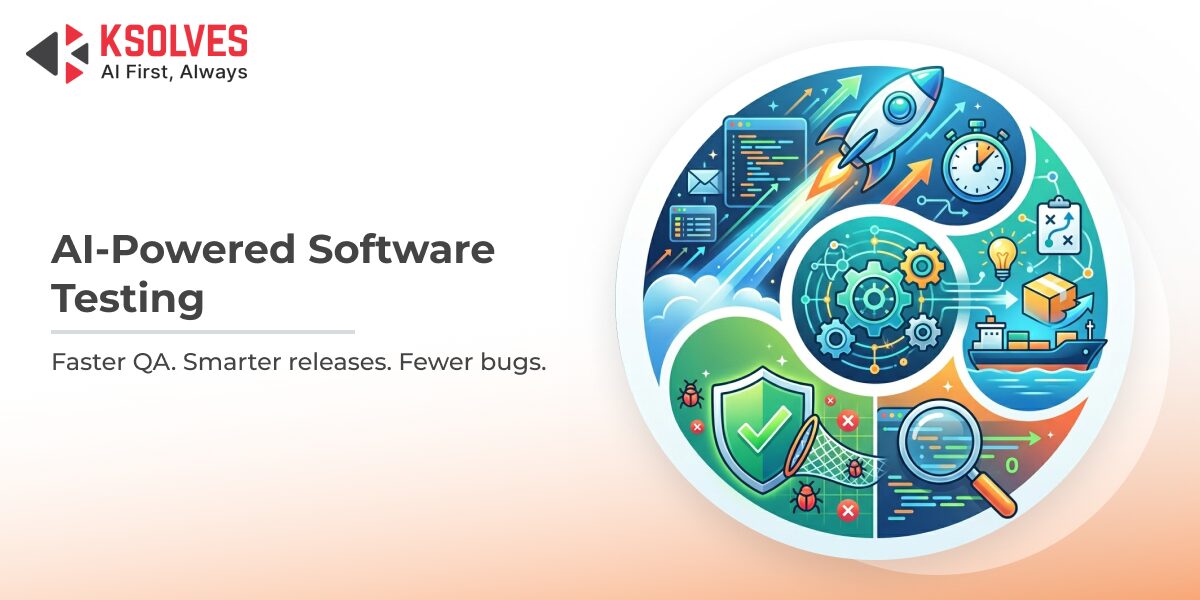
Every minute a critical defect survives in production, businesses lose money, reputation, and user trust. Traditional software testing approaches, built for a slower era of quarterly releases, are breaking under the pressure of CI/CD pipelines, microservices, and feature-rich applications expected to ship daily. Something had to give.
Artificial Intelligence is rewriting the rules. From generating test cases in minutes to predicting which code paths are most likely to fail, AI-powered testing tools are turning quality assurance from a bottleneck into a competitive advantage. Teams that once spent most of their sprint on manual regression testing are now reclaiming that time for innovation.
This blog unpacks how AI in software testing works, which capabilities matter most, where enterprises are seeing real results, and what the road ahead looks like for QA teams embracing intelligent automation.
| Market Insight: | The global AI in Software Testing Market was valued at USD 1.9 billion in 2023 and is projected to reach USD 10.6 billion by 2033 at a CAGR of 18.7%. Separately, the broader automation testing market is on track to exceed USD 169 billion by 2034, confirming AI-driven QA as one of the fastest-growing segments in enterprise technology. |
Why Traditional Testing Can No Longer Keep Up
Modern software ecosystems are fundamentally different from what testing practices were designed to handle. Applications now span mobile, web, APIs, microservices, and IoT endpoints simultaneously. A single user journey can touch dozens of integrated services, any one of which can silently fail.
The Core Challenges Driving the Shift
- Release velocity: Agile teams push code daily or weekly. Manual regression suites take days.
- Test maintenance debt: UI changes break hundreds of scripted tests overnight, costing engineers hours to fix.
- Coverage gaps: Human testers cannot realistically cover every edge case, browser, device, and data permutation.
- Talent scarcity: Enterprises reported a critical skills gap in test automation frameworks.
- Cost of late defects: A bug found in production costs 30x more to fix than one caught during development.
| Market Insight: | As of 2024, more than 70% of global enterprises have fully or partially integrated automated testing into their DevOps workflows, reducing testing time by 35–50% |
Core Ways AI Is Transforming Software Testing
1. AI-Powered Test Case Generation
Writing test cases manually is slow and inherently incomplete. AI models trained on codebases and requirement documents can now auto-generate comprehensive test suites from natural language specs or by analyzing code diffs. NLP-based tools convert user stories directly into executable test cases, cutting authoring time by up to 60%.
2. Self-Healing Test Scripts
One of the biggest pain points in automated testing is maintenance. When a developer renames a button or restructures the DOM, traditional Selenium scripts break immediately. AI-powered self-healing mechanisms detect UI changes at runtime and automatically update locators to keep tests green.
- Reduces test maintenance effort by approximately 40% (Market Growth Reports).
- Eliminates the “flaky test” problem that erodes team confidence in automation suites.
- Tools like Testim, Mabl, and Functionize use ML to continuously learn UI patterns and adapt.
3. Intelligent Test Prioritization and Risk Prediction
Not all tests need to run on every commit. AI models analyze change history, code complexity, and historical failure data to predict which test cases are most likely to catch regressions in a given release. This enables teams to run a focused, high-confidence subset of their suite in short feedback loops.
4. Visual AI Testing
Pixel-level regression testing used to require exhausting screenshot comparisons. AI-powered visual testing tools like Applitools use computer vision to understand the visual intent of a UI component, distinguishing between meaningful regressions and harmless rendering differences across browsers and screen sizes.
- Detects layout shifts, color inconsistencies, and broken elements automatically.
- Works across thousands of browser and device combinations in parallel.
- Reduces false positive rates by up to 80% compared to naive pixel diffing.
5. Predictive Analytics and Defect Forecasting
AI goes beyond running tests. By analyzing historical defect data, code churn metrics, and commit patterns, ML models can predict which modules are high-risk before a single test runs. QA leads can proactively allocate testing resources to the areas most likely to fail.
6. Autonomous Test Execution and Reporting
AI testing platforms can run end-to-end tests, interpret failures, correlate logs, pinpoint root causes, and generate human-readable defect reports without human intervention. This closes the loop between code commit and actionable quality feedback in minutes rather than hours.
Real-World Industry Applications
AI-driven testing is not theoretical. Enterprises across verticals are already capturing measurable gains.
| Industry | Challenge Solved | AI Testing Outcome |
| Banking & Finance | Regulatory compliance testing across multiple product variants | AI helps generate and manage compliance test scenarios, improving audit readiness |
| Healthcare | Validating EHR integrations across different HL7/FHIR endpoints | AI-driven API testing identifies integration issues early in the process |
| E-Commerce | Ensuring consistent UI across browsers and devices during high traffic | Visual AI testing ensures consistent user experience across multiple screens |
| Automotive / IoT | Testing OTA firmware for connected vehicle systems | AI simulation testing helps validate edge-case scenarios efficiently |
| Gaming | Detecting bugs in complex, physics-driven environments | AI-powered QA tools enhance bug detection and improve testing efficiency |
Key AI Testing Technologies You Should Know
Large Language Models (LLMs) for Test Generation
LLMs like GPT-4 and Claude are being fine-tuned to understand codebases and generate unit tests, integration tests, and API contract tests from natural language descriptions. This capability is already shipping in tools like GitHub Copilot and AWS CodeWhisperer.
Also Read: How to Choose the Best LLM for Chatbots
Computer Vision for UI Validation
Convolutional neural networks analyze rendered UIs the same way a human eye does, catching visual regressions that XPath-based tests would miss entirely. Applitools Eyes and Percy are the leading commercial implementations.
Reinforcement Learning for Exploratory Testing
Experimental agents trained with reinforcement learning can autonomously navigate an application, discover edge cases, and surface unexpected behaviors. This approach mirrors how a skilled exploratory tester thinks but operates at machine speed.
Graph Neural Networks for Dependency Analysis
These models map the dependency graph of a codebase and predict blast radius when a component changes, informing which integration tests must run to validate a given PR.
Challenges to Consider Before Adopting AI Testing
AI testing is powerful, but enterprises should approach adoption with clear expectations.
- Initial training investment: AI models need historical test data and defect records to deliver accurate predictions. Organizations with immature data practices will face a ramp-up period.
- Tool integration complexity: Connecting AI testing platforms with existing CI/CD pipelines, issue trackers, and monitoring stacks requires careful architecture planning.
- Over-automation risk: Autonomous testing should complement, not eliminate, human judgment. Exploratory testing and UX validation still benefit significantly from human creativity.
- Security and IP concerns: When AI tools send code or test data to external APIs for analysis, organizations must evaluate data residency and confidentiality implications.
How Ksolves Helps Enterprises Build AI-Ready QA Practices
Adopting AI in software testing is not a plug-and-play decision. It requires an experienced partner who understands both the technology and the operational realities of large-scale software delivery.
Ksolves offers end-to-end AI-powered QA automation services tailored to enterprise software ecosystems. Whether you are modernizing a legacy regression suite, integrating intelligent testing into a DevOps pipeline, or building a quality engineering practice from scratch, our team delivers:
- AI-driven test automation framework design and implementation
- Self-healing test script development for web, mobile, and API layers
- Intelligent test case generation using NLP and code analysis
- CI/CD integration with GitHub Actions, Jenkins, GitLab CI, and Azure DevOps
- Predictive defect analytics dashboards and quality reporting
- QA maturity assessments and roadmap consulting
Ready to transform your quality engineering practice? Connect with Ksolves at www.ksolves.com or write to us at [email protected].
Conclusion
AI is not replacing software testers; instead, it is giving them superpowers. From self-healing scripts that survive UI changes to LLMs that generate comprehensive test suites in minutes, today’s tools make it possible to ship software faster without sacrificing quality. The enterprises leading this shift are not the biggest; they are the most intentional about integrating AI into their quality engineering workflows.
The future of software testing is autonomous, predictive, and intelligent. The question is not whether to adopt AI-driven QA, but how quickly your organization can do so effectively.
Ready to lead the shift? Connect with Ksolves and let us help you build a testing practice built for the AI era.































Author
About the Author Editorial Team The Ksolves Editorial Team includes certified Salesforce experts, Big Data engineers, AI/ML specialists, Zoho consultants, and experienced technology writers focused on delivering clear, actionable insights for modern businesses. With hands-on experience across Salesforce, Big Data platforms, AI/ML solutions, application development, software testing, and Zoho ERP/CRM, the team publishes practical guides, real-world use cases, and industry updates that support smarter decisions and faster growth. Every article is created to solve business challenges, guide technology adoption, and keep organizations aligned with evolving digital ecosystems.
Share with