Project Name
Cut Container Licensing Costs by Migrating Non-Prod to OKD


Our client is an enterprise technology organisation operating a cloud-native application landscape with workloads distributed across multiple environments. Their platform teams relied on Red Hat OpenShift as the standard container orchestration platform for all environments, including development, QA, staging, and production, with no differentiation by workload criticality or commercial support requirement.
As the organisation scaled, the number of non-production clusters grew, driving licensing costs upward without proportional production value. The client needed a way to maintain developer familiarity and operational consistency across environments while significantly reducing recurring platform spend, without introducing a learning curve that would slow engineering velocity.
The same enterprise licence covering a revenue-critical production cluster and a developer sandbox is not a platform strategy, but it is an unexamined default that compounds with every new environment added.
- High Licensing Costs Across Environments: Fully licensed OpenShift clusters were used across dev, QA, staging, and production, driving unnecessary subscription expenses.
- No Production vs. Non-Production Segmentation: Enterprise-grade licensing and support were applied uniformly, regardless of workload criticality.
- Dependency on OpenShift Tooling: Teams relied heavily on OpenShift-specific tools, workflows, and interfaces, increasing migration complexity.
- CI/CD Tight Coupling: Existing pipelines were built around OpenShift-native features, requiring redesign during migration.
- Loss of Commercial Support: Migrating to OKD introduced concerns around the absence of vendor-backed support and SLAs.
- Lack of Workload Classification: No structured framework existed to determine which workloads were suitable for OKD versus OpenShift.
Ksolves, an AI-first OKD consulting services company, implemented a strategic OpenShift–OKD platform bifurcation, retaining Red Hat OpenShift for production workloads while migrating non-production environments to OKD. This approach significantly reduced licensing costs while preserving existing developer workflows, tooling, and CI/CD processes. To ensure operational continuity, Ksolves also provided ongoing managed support for all OKD clusters, replacing the need for Red Hat commercial support.
- Strategic OpenShift–OKD Platform Bifurcation: Retained OpenShift for production workloads while migrating non-production environments to OKD, reducing licensing costs without disrupting developer workflows.
- OKD Cluster Provisioning and Hardening: Built and secured OKD clusters for dev, QA, and staging, mirroring existing OpenShift configurations to ensure a seamless transition.
- Workload Assessment and Migration Sequencing: Applied a structured migration framework to identify suitable workloads and execute a phased, low-risk migration strategy.
- Tekton-Based CI/CD Modernization: Migrated CI/CD pipelines to Tekton, creating a consistent deployment framework across OpenShift and OKD while removing platform lock-in.
- Ksolves Managed Support for OKD: Delivered ongoing support, upgrades, patching, and incident management for OKD clusters, replacing the need for Red Hat support.
- Developer Experience Preservation: Maintained identical tooling, console access, and namespace structures, making the migration virtually invisible to developers.
Technology Stack
| Category | Technology |
|---|---|
| Platform | OKD |
| Platform | Red Hat OpenShift |
| DevSecOps | Tekton |
| Infrastructure | Kubernetes |
| Methodology | Ksolves Managed Support |
Production keeps its enterprise licence. Non-production keeps its developer experience. The licensing bill does not.
- Non-Production Licensing Costs Eliminated Entirely: All dev, QA, and staging workloads now run on OKD at zero licence cost, removing the substantial recurring OpenShift subscription fees that had been applied to every non-production cluster regardless of its commercial support requirement.
- Developer Workflow Disruption Reduced to Zero: One-to-one CLI, console, and namespace mapping from OpenShift to OKD meant zero learning curve and zero developer retraining hours required: the platform change was operationally invisible to every engineer who uses it daily.
- CI/CD Pipeline Portability Achieved Across Both Platforms: Tekton-based pipelines now deploy consistently across OpenShift in production and OKD in non-production from a single pipeline definition, eliminating the OpenShift-native coupling that had previously created platform lock-in across the development and QA environments.
- Vendor Support Dependency Replaced With Managed Support: Ksolves managed support now covers 100% of OKD clusters, delivering patching, upgrades, and incident response without Red Hat commercial dependency, and providing the operational assurance the client needed to migrate with confidence.
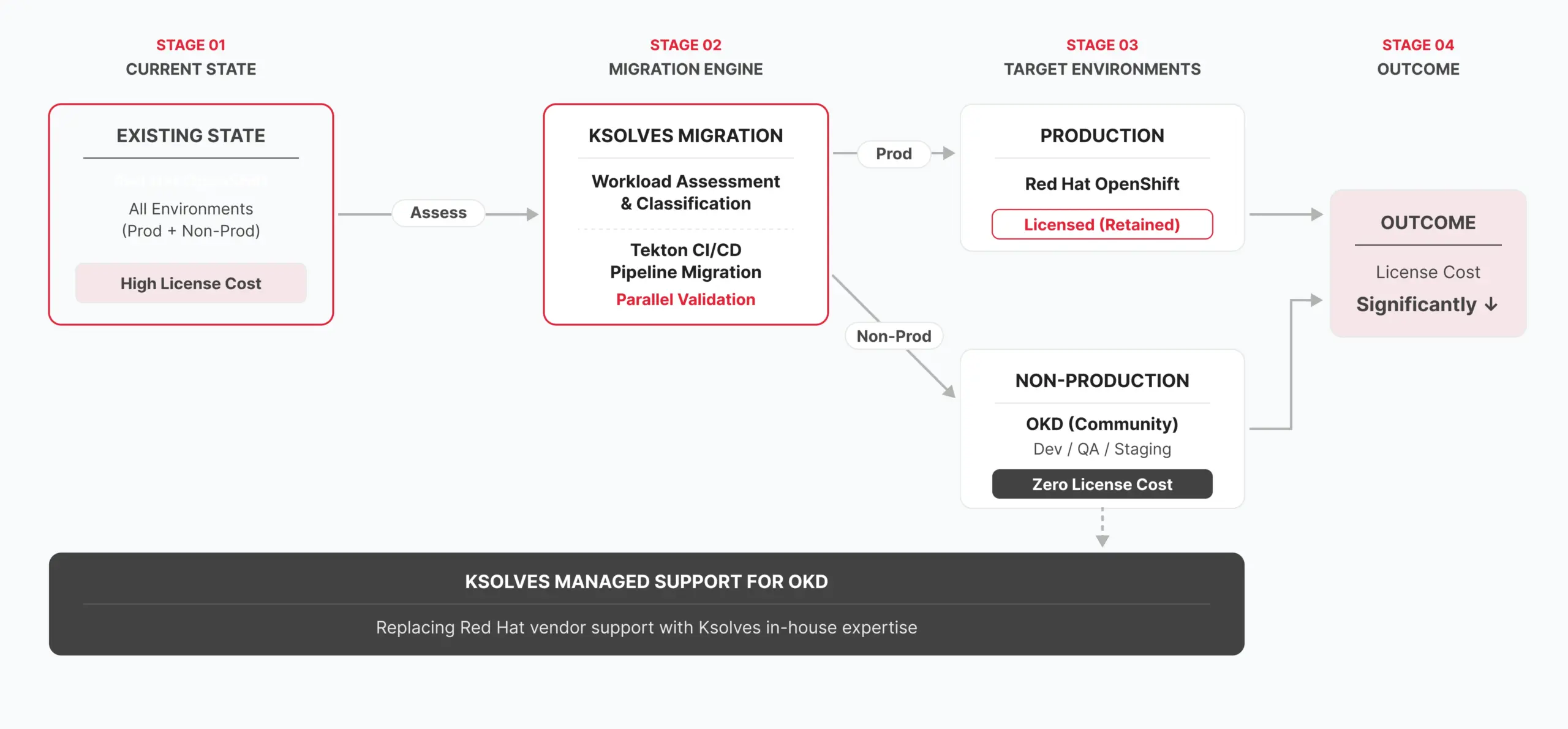
By adopting a strategic OpenShift–OKD bifurcation model, Ksolves helped the client eliminate unnecessary non-production licensing costs while maintaining the same developer experience. Production workloads remained on supported OpenShift clusters, while dev, QA, and staging environments moved to OKD with Ksolves-managed support. The result was a scalable, cost-efficient platform strategy that delivers ongoing savings without adding operational complexity.
Are Rising Container Licensing Costs Limiting Your Platform Strategy?