



Odoo vs SAP: A Complete ERP Comparison for Growing Businesses (2026)
Odoo
5 MIN READ
April 30, 2026

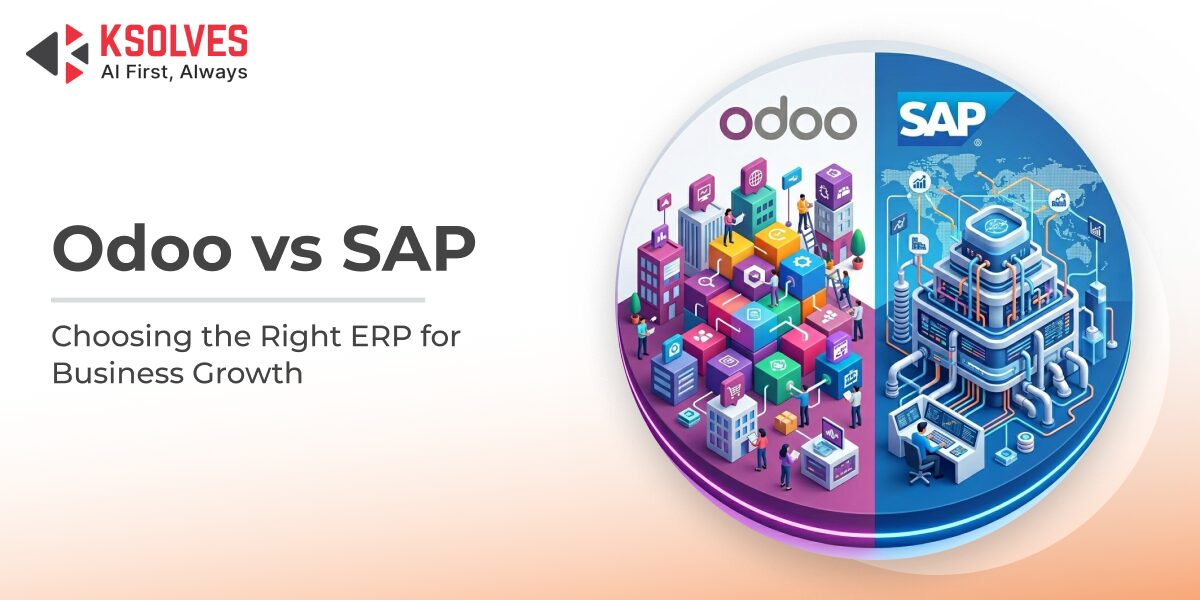
Your SAP contract renewal is coming up. The licensing cost just went up again. Your team needs three months and a specialist consultant to make a simple workflow change. Sound familiar? You’re not alone. Thousands of businesses are asking the same question in 2026: Is SAP still worth it, or is Odoo the smarter move?
On one side, SAP represents enterprise-grade power, built for complex, global operations. On the other hand, Odoo offers a flexible, modular, and cost-effective approach that aligns with modern, fast-growing businesses.
So, how do you decide between Odoo vs SAP ERP, especially when factors like cost, scalability, and implementation speed can directly impact ROI?
This blog covers the SAP vs Odoo comparison that breaks down everything, from features and pricing to real-world fit, so you can confidently choose the ERP that supports your next phase of growth.
Understanding the ERP Landscape in 2026
ERP systems in 2026 are no longer just back-office tools; they are strategic enablers of growth, agility, and competitive advantage. Businesses today expect their ERP to act as a central intelligence layer, connecting data, processes, and decision-making in real time.
Modern ERP solutions must go beyond basic functionality to deliver:
- Real-time data visibility for faster, insight-driven decisions.
- AI-powered automation that reduces manual effort and improves accuracy.
- Scalable architecture that grows seamlessly with the business.
- Seamless integrations across ecosystems, from CRM to supply chain platforms.
This shift toward cloud-first, agile ERP systems has redefined how organizations evaluate technology. As a result, comparisons like Odoo vs SAP ERP, SAP vs Odoo comparison, and open source ERP vs SAP are becoming central to ERP selection strategies, especially for businesses aiming to balance flexibility, cost, and scalability.
Overview of Odoo
Odoo is a modern, all-in-one ERP designed for businesses that need speed, flexibility, and control without the heavy complexity of traditional systems. What sets Odoo apart in the Odoo vs SAP ERP conversation is its ability to unify business functions through a modular, scalable framework.
What Makes Odoo Different?
Unlike conventional ERP systems, Odoo is built as a suite of interconnected apps that work seamlessly together. Businesses can start small, say with CRM or Accounting, and expand into a fully integrated ERP as they grow.
Core Strengths
- Modular Architecture: Choose only the apps you need and scale on demand.
- Open-Source Flexibility: Full control over customization, making it a strong contender in open source ERP vs SAP comparisons.
- Unified Platform: Eliminates data silos by connecting sales, finance, inventory, HR, and more.
- User-Centric Design: Intuitive interface that reduces training time and boosts adoption.
Built for Modern Growth
Odoo aligns well with organizations looking for:
- Faster implementation cycles.
- Lower total cost of ownership.
- Agile workflows that evolve with business needs.
Why it’s Gaining Momentum
As companies rethink legacy systems, Odoo is emerging as a powerful SAP ERP alternative, especially for SMEs and mid-sized enterprises seeking a balance between capability and cost. Its ability to deliver enterprise-grade functionality without enterprise-level complexity makes it a key player in the SAP vs Odoo 2026 landscape.
Overview of SAP
SAP represents the benchmark for enterprise-grade ERP, built to manage complex, high-volume, and globally distributed operations with precision. In the SAP vs Odoo comparison, SAP stands out for its depth, standardization, and ability to support mission-critical processes at scale.
What Defines SAP’s Approach?
SAP is engineered around structured, end-to-end process control. Rather than modular flexibility first, it emphasizes consistency, compliance, and data integrity across every business function, making it ideal for organizations where accuracy and governance are non-negotiable.
Core Product Ecosystem
- SAP S/4HANA: Next-generation intelligent ERP powered by in-memory computing for real-time analytics.
- SAP Business One: Streamlined ERP tailored for small and mid-sized businesses.
Core Strengths
- Deep Industry Functionality: Pre-built solutions for sectors like manufacturing, BFSI, retail, and utilities.
- Enterprise-Grade Scalability: Designed to handle multi-country, multi-entity operations seamlessly.
- Advanced Analytics & AI: Embedded intelligence for forecasting, risk management, and decision support.
- Strong Compliance & Governance: Ideal for highly regulated environments with strict reporting requirements.
Built for Complexity at Scale
SAP is best suited for organizations that:
- Operate across multiple geographies and regulatory frameworks.
- Manage large-scale supply chains and financial structures.
- Require standardized processes across departments and subsidiaries.
Why Enterprises Rely on SAP
For decades, SAP has been the backbone of global enterprises because it delivers stability, control, and depth. While it demands higher investment and longer implementation cycles, it provides the level of operational rigor and scalability that large organizations depend on.
In the evolving SAP vs Odoo 2026 landscape, SAP continues to lead where complexity, compliance, and global scale are the top priorities.
Also Read – Why Odoo ERP is the Ideal Choice for SMEs? How Ksolves’ AI-Driven Approach Maximizes ROI
Odoo vs SAP: Key Differences at a Glance
Choosing between Odoo and SAP isn’t just a feature comparison, but it’s a decision between agility and structure, speed and depth, cost-efficiency and enterprise rigor.
Here’s a sharper look at how these two ERP systems differ across the dimensions that matter most in a real-world SAP vs Odoo comparison:
| Feature | Odoo | SAP |
| Positioning | Agile, modular ERP | Enterprise-grade, process-driven ERP |
| Deployment Approach | Flexible (Cloud & On-premise) | Structured (Cloud & On-premise) |
| Implementation Speed | Fast, iterative rollout | Long, phased implementation |
| Customization | Highly flexible (open-source advantage) | Controlled, complex, consultant-driven |
| User Experience | Modern, intuitive UI | Functional but complex interface |
| Cost Structure | Low upfront, scalable pricing | High upfront + ongoing costs |
| Scalability Style | Scale-as-you-grow | Built for large-scale from day one |
Odoo vs SAP: Feature-by-Feature Comparison
A true SAP vs Odoo comparison goes beyond surface-level features. It’s about how each system performs in real business scenarios, where usability, cost, flexibility, and scalability directly impact growth and ROI.
1. Ease of Use
Odoo
Odoo is designed with a user-first approach, offering a clean, modern interface that feels intuitive even for non-technical users. Its app-based navigation, Kanban views, and simplified dashboards reduce dependency on extensive training, enabling faster adoption across teams.
SAP
SAP delivers powerful capabilities, but its interface can feel complex and layered. Users often require formal training and onboarding, especially in systems like SAP S/4HANA, making the learning curve steeper.
Insight: For organizations prioritizing quick adoption and minimal disruption, Odoo offers a clear usability advantage.
| Aspect | Odoo | SAP |
| User Experience | Clean, modern, intuitive UI | Complex, layered interface |
| Learning Curve | Minimal training required | Steep learning curve |
| Adoption Speed | Fast across teams | Slower, requires onboarding |
| Overall | User-friendly | Powerful but complex |
2. Customization & Flexibility
Odoo
Built on an open-source framework, Odoo allows deep customization at every level, from workflows and modules to UI and reports. Businesses can tailor the system precisely to their processes, making it a strong contender in open source ERP vs SAP discussions.
SAP
SAP supports customization, but within a controlled and structured environment. Changes often require specialized consultants, increasing both time and cost. Customizations must also align with SAP’s architecture, limiting flexibility.
Insight: Odoo empowers businesses to adapt the ERP to their needs, while SAP expects businesses to align with its predefined structures.
| Aspect | Odoo | SAP |
| Architecture | Open-source, highly flexible | Structured, controlled |
| Customization Level | Deep and adaptable | Limited, consultant-driven |
| Cost of Customization | Lower | Higher |
| Overall | Highly flexible | Rigid but stable |
3. Implementation Time
Odoo
Known for its rapid deployment model, Odoo implementations can go live in weeks or a few months, depending on the scope. Its modular design allows phased rollouts, reducing risk and accelerating time-to-value.
SAP
SAP implementations are typically large-scale transformation projects, often taking 6 to 18 months or more. They involve extensive planning, configuration, testing, and change management.
Insight: If speed and agility are critical, Odoo significantly shortens the path to ROI.
| Aspect | Odoo | SAP |
| Deployment Time | Weeks to months | 6–18 months+ |
| Approach | Modular, phased rollout | Large-scale transformation |
| Time-to-Value | Fast ROI | Delayed ROI |
| Overall | Quick implementation | Time-intensive |
4. Cost Comparison (SAP vs Odoo Cost)
Odoo Pricing
- Subscription-based model (per user/app)
- Minimal upfront investment
- Lower implementation and customization costs
- Flexible scaling without heavy financial commitment
SAP Pricing
- High licensing fees (especially for enterprise solutions)
- Expensive implementation and consulting services
- Ongoing maintenance, upgrades, and support costs
Insight: In most Odoo ERP vs SAP pricing scenarios, Odoo is far more accessible, making it a preferred choice for growing businesses and SMEs.
| Aspect | Odoo | SAP |
| Pricing Model | Subscription-based | License-heavy |
| Upfront Cost | Low | High |
| Implementation Cost | Affordable | Expensive |
| Maintenance | Lower | High ongoing costs |
| Overall | Cost-effective | High investment |
5. Scalability
Odoo
Odoo offers progressive scalability; businesses can start with a few modules and expand as operations grow. It supports multi-company and multi-location setups, making it ideal for scaling organizations.
SAP
SAP is built for large-scale, complex enterprises from day one. It handles high transaction volumes, global operations, and multi-layered organizational structures with ease.
Insight: Odoo scales with your growth journey, while SAP is designed for organizations already operating at scale.
| Aspect | Odoo | SAP |
| Growth Approach | Scale-as-you-grow | Built for large scale |
| Business Fit | SMEs to mid-sized | Large enterprises |
| Complexity Handling | Moderate to high (with customization) | Very high |
| Overall | Flexible scalability | Enterprise-grade scalability |
6. Integration Capabilities
Odoo
Odoo can easily integrate with other systems or platforms, enabling seamless connectivity with third-party tools like eCommerce platforms, payment gateways, and logistics systems.
SAP
SAP also offers strong integration capabilities, but they often require specialized expertise and middleware tools, making integrations more resource-intensive.
Insight: Odoo simplifies integrations, while SAP delivers robustness at the cost of complexity.
| Aspect | Odoo | SAP |
| API Flexibility | High | Moderate to high |
| Integration Ease | Simple, developer-friendly | Complex, requires expertise |
| Ecosystem | Wide and accessible | Strong but specialized |
| Overall | Easy integrations | Robust but complex |
7. AI & Automation
Odoo
Odoo is steadily evolving with AI-driven features, including automation in workflows, smart recommendations, and improved reporting. It focuses on practical automation that enhances day-to-day operations.
SAP
SAP leads in advanced enterprise AI and analytics, offering capabilities like predictive analytics, intelligent automation, and real-time insights powered by platforms like SAP S/4HANA.
Insight: SAP offers deeper AI capabilities for large enterprises, while Odoo provides accessible, business-friendly automation.
| Aspect | Odoo | SAP |
| AI Capabilities | Emerging, practical automation | Advanced enterprise AI |
| Use Cases | Workflow automation, recommendations | Predictive analytics, intelligent automation |
| Accessibility | Easy to use | Requires expertise |
| Overall | Business-friendly AI | Deep, enterprise-level AI |
Also Read – How to Choose the Right Odoo App for Your Business
Pros and Cons: Odoo vs SAP
A balanced view of Odoo and SAP highlights not just what each system does well, but where each may fall short depending on your business needs.
Odoo: Pros & Cons
Benefits of Odoo
- Affordable and Scalable: Odoo’s flexible pricing model makes it highly accessible, especially for businesses evaluating SAP vs Odoo cost. You can start small and scale without significant financial strain.
- Flexible and Customizable: Its open-source architecture allows businesses to tailor workflows, modules, and integrations, making it a strong option in open source ERP vs SAP comparisons.
- User-Friendly Experience: A modern, intuitive interface ensures faster adoption with minimal training, reducing operational friction.
- Faster Time-to-Value: Quick implementation cycles mean businesses can start realizing ROI much earlier compared to traditional ERP systems.
Drawbacks of Odoo
- Customization Required for Complex Needs: For highly complex, enterprise-level operations, Odoo may require additional customization and development effort.
- Less Native Depth for Niche Industries: While flexible, it may not offer the same out-of-the-box depth as SAP for highly specialized industries.
SAP: Pros & Cons
Benefits of SAP
- Enterprise-Grade Capabilities: SAP is built to handle large-scale, complex operations, making it ideal for global enterprises and high-volume environments.
- Strong Compliance and Governance: It excels in regulatory compliance, financial reporting, and audit readiness, critical for regulated industries.
- Deep Industry Functionality: SAP provides pre-configured solutions tailored to specific sectors, reducing the need for heavy customization in some cases.
Drawbacks of SAP
- High Cost Structure: From licensing to implementation and maintenance, SAP represents a significant investment, often a key concern in Odoo ERP vs SAP pricing discussions.
- Complex Implementation: Deployment can be time-consuming and resource-intensive, often requiring specialized consultants and long project timelines.
- Steep Learning Curve: The system’s complexity can impact user adoption and require extensive training.
When Should You Choose Odoo?
Choose Odoo if your priority is agility, speed, and cost-efficiency, especially in a fast-changing business environment.
Odoo is the Right Fit If You:
- Are a growing business that needs flexibility: Odoo adapts quickly as your processes evolve, making it ideal for scaling organizations.
- Are budget-conscious: With lower upfront investment and flexible pricing, it stands out in SAP vs Odoo cost comparisons.
- Need faster deployment and quicker ROI: Its modular approach allows rapid implementation, helping you realize value in weeks, not months.
- Prefer a user-friendly system: Minimal training requirements ensure faster adoption across teams.
- Want a future-ready, modular ERP: You can start small and expand as needed without overcommitting resources.
Also Read – Managing Multi-Client Projects with Odoo’s Project Forecasting
When Should You Choose SAP?
Choose SAP if your business demands scale, control, and deep operational standardization.
SAP is the Right Fit If You:
- Operate across multiple countries or entities: SAP is built to handle global operations with complex organizational structures.
- Require strong compliance and governance: It excels in regulated industries where auditability and reporting are critical.
- Manage highly complex workflows: Ideal for businesses with intricate supply chains, financial structures, and large transaction volumes.
- Need industry-specific depth out of the box: SAP offers pre-built solutions tailored to sectors like manufacturing, BFSI, and utilities.
- Can invest in long-term ERP transformation: While implementation is time-intensive, it delivers robust, enterprise-grade capabilities.
Odoo vs SAP for Manufacturing Companies
Manufacturing businesses require ERP systems that can handle production planning, inventory control, supply chain coordination, and cost tracking at scale.
Odoo for Manufacturing
- Ideal for small to mid-sized manufacturers seeking agility.
- Strong capabilities in:
- Bill of Materials (BoM).
- Work orders and shop floor management.
- Inventory and procurement integration.
- Faster implementation and lower cost make it a practical choice in SAP vs Odoo cost evaluations.
- Flexible customization supports evolving production workflows.
SAP for Manufacturing
- Best suited for large-scale, complex manufacturing operations.
- Advanced features in:
- Production planning (MRP).
- Quality management.
- Global supply chain optimization.
- Strong fit for companies requiring standardization across plants and geographies.
Verdict: In Odoo vs SAP ERP for manufacturing, Odoo excels in flexibility and cost-efficiency, while SAP dominates in high-volume, multi-plant operations.
Also Read – How Odoo ERP Streamlines Manufacturing
Odoo vs SAP for Healthcare
Healthcare organizations demand ERP systems that ensure compliance, patient data management, and operational efficiency.
Odoo for Healthcare
- Suitable for clinics, diagnostic centers, and mid-sized healthcare providers.
- Features include:
- Patient management integration.
- Billing and accounting.
- Inventory for medical supplies.
- Offers a cost-effective solution in SAP ERP alternative discussions.
- Can be customized for healthcare-specific workflows.
SAP for Healthcare
- Designed for large hospitals and healthcare networks.
- Strengths include:
- Regulatory compliance and audit trails.
- Integrated financial and operational systems.
- Advanced analytics for patient and operational data.
Verdict: In SAP vs Odoo comparison for healthcare, SAP leads in compliance-heavy, large-scale environments, while Odoo is ideal for agile and cost-conscious healthcare providers.
Also Read – Odoo for Healthcare: Managing Appointments, Billing & Compliance with Ease
Odoo vs SAP for Hospitality Businesses
Hospitality businesses require ERP systems that unify reservations, customer experience, billing, and operations.
Odoo for Hospitality
- Best for hotels, restaurants, and hospitality chains looking for flexibility.
- Key strengths:
- Integrated POS and booking systems
- CRM for guest management
- Inventory and staff management
- Easy to deploy and scale, making it suitable for best ERP for SMEs 2026.
SAP for Hospitality
- Suitable for large hotel chains and global hospitality brands.
- Offers:
- Enterprise-level financial control.
- Advanced reporting and analytics.
- Standardized operations across multiple locations.
Verdict: In Odoo vs SAP ERP for hospitality, Odoo delivers agility and better user experience, while SAP provides enterprise-level consistency and control.
Also Read – How Odoo ERP Enhances Guest Services in the Hospitality Industry
Odoo vs SAP for Retail
Retail businesses need ERP systems that can manage inventory, sales, customer experience, and omnichannel operations seamlessly.
Odoo for Retail
- Ideal for retailers, eCommerce businesses, and growing brands.
- Key capabilities:
- Unified POS and eCommerce integration.
- Real-time inventory tracking.
- CRM and marketing automation.
- Cost-effective and quick to implement, making it strong in Odoo ERP vs SAP pricing comparisons.
SAP for Retail
- Built for large retail chains and global brands.
- Offers:
- Advanced demand forecasting.
- Supply chain optimization.
- Multi-store and multi-country operations.
Verdict: In SAP vs Odoo ERP systems for retail, Odoo is best for fast-growing and mid-sized retailers, while SAP is suited for large-scale, complex retail ecosystems.
Also Read – Top 10 Benefits of Odoo Customization for Retail Businesses
SAP vs Odoo for Logistics & Supply Chain
Logistics and supply chain operations demand real-time visibility, inventory accuracy, route optimization, and seamless coordination across warehouses, vendors, and customers. The choice between SAP vs Odoo for logistics & supply chain depends on the scale, complexity, and level of control your operations require.
Odoo for Logistics & Supply Chain
- Best suited for small to mid-sized logistics companies and growing distribution networks.
- Strong capabilities in:
- Inventory and warehouse management (multi-warehouse support).
- Order processing and procurement automation.
- Integration with eCommerce and third-party logistics (3PL) systems.
- Provides real-time tracking and visibility across operations.
- Flexible workflows make it ideal for evolving supply chain models.
- Cost-effective and faster to deploy, making it a strong option in SAP vs Odoo cost comparisons.
SAP for Logistics & Supply Chain
- Designed for large-scale, global supply chain operations.
- Advanced capabilities include:
- End-to-end supply chain planning and execution.
- Demand forecasting and inventory optimization.
- Transportation and route management.
- Enables high-level coordination across global suppliers, warehouses, and distribution centers.
- Strong analytics and reporting for performance optimization.
- Ideal for organizations requiring standardized, high-volume logistics operations.
Also Read – Boosting Efficiency in Logistics and Supply Chain with List View Manager in Odoo
SAP vs Odoo for Construction
Construction businesses operate in a highly dynamic environment where project timelines, cost control, resource allocation, and on-site coordination must stay tightly aligned. Choosing between SAP vs Odoo for construction depends on whether your priority is agility and cost-efficiency or complex project governance and scale.
Odoo for Construction
- Best suited for small to mid-sized construction firms and contractors.
- Key capabilities:
- Project management with task tracking and milestones.
- Budgeting, cost estimation, and expense control.
- Procurement and inventory for materials.
- Timesheets and workforce management.
- Offers real-time visibility into project progress and costs.
- Flexible customization to adapt to different project types.
- Faster deployment and lower cost make it attractive in SAP vs Odoo cost considerations.
SAP for Construction
- Ideal for large construction companies managing complex, multi-site projects.
- Advanced capabilities include:
- Enterprise-level project planning and execution.
- Contract management and financial control.
- Resource planning across multiple projects and locations.
- Compliance, risk management, and reporting.
- Supports large-scale infrastructure projects with strict governance requirements.
- Enables standardized processes across divisions and geographies.
Also Read – Transforming Construction Workflows with Odoo
Why Businesses Are Migrating from SAP to Odoo?
ERP decisions are rarely about software alone. They reflect how a business operates today, and how it needs to operate tomorrow. While SAP has long been associated with large-scale enterprise operations, many organizations eventually reach a point where its structure starts to feel heavier than helpful.
At that stage, businesses don’t necessarily “replace SAP.” They realign their ERP strategy with current realities: cost, agility, usability, and control. This is where Odoo often becomes a more practical alternative.
1. Rising licensing costs that don’t scale with value
As organizations expand within SAP, costs tend to grow faster than the actual business value extracted from the system. Additional modules, users, and infrastructure requirements can significantly increase the total cost of ownership.
Over time, leadership teams begin questioning whether the continued investment is proportional to the outcomes being achieved.
2. Increasing dependency on external consultants
SAP ecosystems often rely heavily on certified partners for even minor changes or enhancements. While this ensures structure, it also introduces bottlenecks.
- Longer turnaround times for updates
- Higher dependency on external resources
- Reduced internal flexibility in decision-making
This slows down business responsiveness in fast-moving markets.
3. Low user adoption across teams
A recurring challenge with complex ERP systems is user resistance. In many organizations, SAP becomes a system that exists in the background rather than actively driving daily operations.
Common patterns include:
- Teams continuing to rely on Excel for reporting and tracking
- Workarounds outside the system becoming the norm
- Limited engagement from non-technical users
When adoption drops, ERP value naturally declines.
4. Slow and expensive customization cycles
Business requirements evolve continuously, but SAP customization often follows a slower and cost-intensive path.
- Changes require structured approval cycles
- Development and testing timelines are longer
- Costs increase with every customization layer
This creates friction between business needs and system capability.
5. Complexity outweighing operational efficiency
SAP is powerful, but that power comes with complexity. For many organizations, especially those scaling rapidly or operating in dynamic environments, this complexity becomes a constraint rather than an advantage.
Businesses often start looking for:
- Faster configuration cycles
- Simpler workflows
- Easier onboarding for teams
- More flexibility in adapting processes
See How a Manufacturer Migrated from SAP to Odoo in Just 7 Days with Ksolves’ AI-Driven Approach – Read the Full Case Study
Real Cost Benchmarks: SAP vs Odoo (Indicative Market Ranges)
To help decision-makers evaluate ERP investment more transparently, here’s a practical cost comparison based on typical enterprise implementations across mid-to-large organizations.
SAP Implementation Costs (First-Year Estimates)
- SAP S/4HANA (Enterprise-grade ERP)
- License + implementation: $150,000 – $300,000+.
- Higher-end deployments (multi-country, complex integrations) can exceed this range significantly.
- SAP Business One (SME-focused ERP)
- License + implementation: $50,000 – $120,000.
- Costs vary based on customization, modules, and partner involvement.
Odoo Implementation Costs (First-Year Estimates)
- Odoo Enterprise
- Subscription + implementation: $20,000 – $60,000.
- Flexible pricing based on users, modules, and customization depth.
- Lower total cost due to modular architecture and faster deployment cycles.
Migration Costs (SAP → Odoo via Ksolves)
Migration cost depends on system complexity, data volume, and integration landscape:
- Standard Migration (SMEs / limited modules): $15,000 – $40,000.
- Mid-level Enterprise Migration: $40,000 – $100,000.
- Complex Multi-system Migration: $100,000 – $200,000+.
These estimates typically include:
- Data migration and cleansing
- Process re-mapping
- Custom module development
- Integration with existing tools
- Testing, training, and go-live support
While SAP often requires a significantly higher upfront and ongoing investment, Odoo, especially when implemented by an AI-first Odoo partner like Ksolves, reduces total cost of ownership through faster deployment, modular scalability, and reduced dependency on heavy infrastructure.
This makes Odoo a strategically viable alternative for businesses seeking enterprise-grade capability without an enterprise-level cost burden.
Final Words
The SAP vs Odoo decision isn’t about choosing the “better” ERP, but it’s about choosing the one that fits your current reality and future ambition.
Odoo stands out as a modern, flexible, and cost-effective solution, ideal for businesses that value speed, adaptability, and faster ROI. It’s why many organizations see it as the best ERP for SMEs 2026 and a practical SAP ERP alternative.
On the other hand, SAP continues to lead where scale, complexity, and compliance are critical. For enterprises operating across geographies with intricate processes, SAP delivers the structure and depth required to maintain control.
Frequently Asked Questions
Is Odoo better than SAP?
The answer depends on your business priorities. Odoo is often the better choice for organizations seeking flexibility, affordability, and faster implementation. In contrast, SAP is better suited for large enterprises that require deep functionality and structured processes.
Can Odoo replace SAP?
For many small and mid-sized businesses, Odoo can successfully replace SAP while reducing complexity and cost. However, enterprises with highly complex, global operations may still rely on SAP for its advanced capabilities.
What is the difference between SAP and Odoo?
At a high level, the difference lies in approach:
- Odoo offers a modular, user-friendly, and cost-effective ERP
- SAP provides a comprehensive, enterprise-grade system built for scale and complexity
How much does it cost to migrate from SAP to Odoo?
Migration costs vary based on data volume, customization, and business processes. However, in most cases, moving to Odoo results in significantly lower total cost of ownership, including reduced licensing, implementation, and maintenance expenses.
Is Odoo good for large enterprises?
Yes. Odoo can support large enterprises, especially those prioritizing agility and cost-efficiency. That said, organizations with extremely complex or regulated environments may require additional customization compared to SAP.
Is SAP S/4HANA worth the cost vs Odoo?
SAP S/4HANA is worth the investment for companies that need advanced analytics, global scalability, and strict compliance frameworks. For growing businesses, however, Odoo often delivers faster ROI and greater flexibility at a lower cost.






























AUTHOR
Odoo
Neha Negi, Presales and Business Associate Head at Ksolves is a results-driven ERP consultant with over 8 years of expertise in designing and implementing tailored ERP solutions. She has a proven track record of leading successful projects from concept to completion, driving organizational efficiency and success.
Share with