



Lawmatics vs Salesforce: Best CRM for Law Firms 2026
Salesforce
5 MIN READ
May 8, 2026

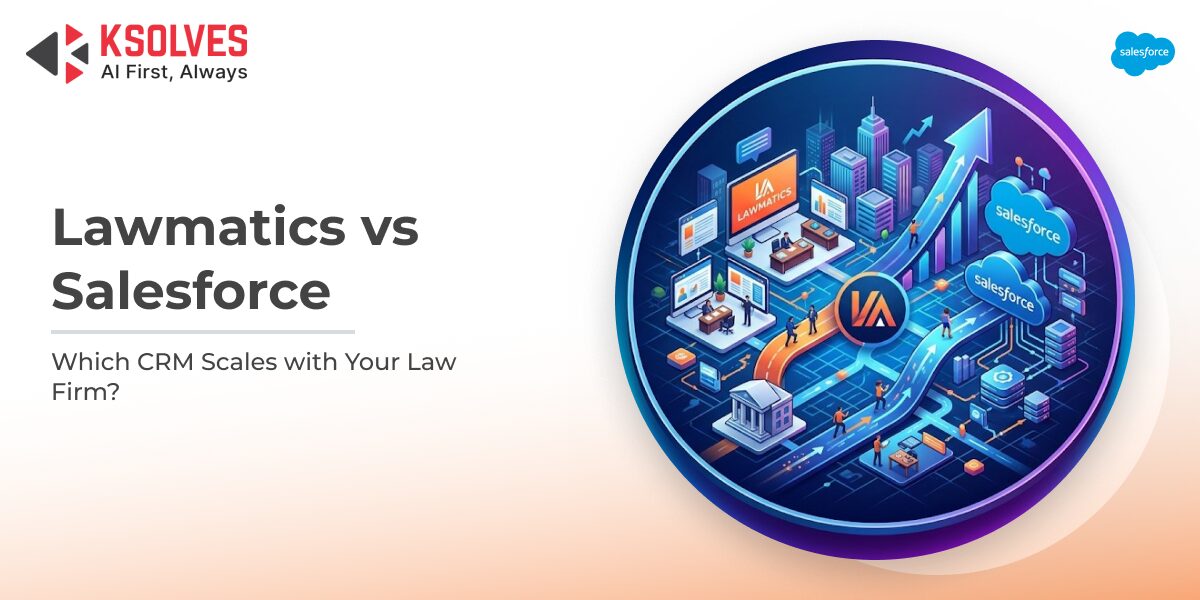
Your law firm’s CRM is not just a contact database. It is the engine behind your client intake, follow-up cadence, pipeline visibility, and eventually, your revenue growth. And when you are weighing Lawmatics against Salesforce, you are really asking a more fundamental question: how big do you plan to get, and how fast?
Both platforms have real strengths. But they are built for very different firms, at very different stages. Getting this choice wrong costs time, money, and client opportunities. This blog breaks down what each platform does well, where it falls short, and which one actually scales with a growing practice in 2026.
According to a buyer’s survey, over 78% of law firms now have some form of CRM software, yet only 7% use it effectively to manage leads and client engagement. The gap is rarely about features. It is about fit.
What is Lawmatics?
Lawmatics is a legal-specific CRM built around client intake and marketing automation. It was designed from the ground up for law firms, and that focus shows. The platform excels at converting website visitors into consultations through automated intake forms, lead nurturing sequences, email and SMS campaigns, and conditional workflow logic.
For growth-focused firms running paid advertising or referral programs, Lawmatics provides a structured, funnel-based approach to client acquisition that most general CRMs cannot match out of the box. Its conditional intake workflows are a standout feature: a personal injury lead mentioning surgery can be automatically routed into a different follow-up track than one reporting minor injuries, without any manual intervention.
Lawmatics starts at $149 per user per month with a three-user minimum, positioning it firmly in the mid-market for legal software.
Where it works best: Small to mid-sized firms (2 to 30 attorneys) with dedicated intake or marketing staff and a high volume of inbound leads who need structured, automated nurturing from first contact through signed retainer.
Where it struggles: Lawmatics is not built for enterprise-scale complexity. Reporting depth, ERP-style integration, multi-office workflows, and cross-practice data management are areas where its legal-specific focus becomes a limitation rather than an advantage.
What is Salesforce?
Salesforce is the world’s leading CRM platform, used by more than 150,000 companies globally across every major industry. For law firms, it is the platform of choice when flexibility, scalability, and AI capability matter more than out-of-the-box legal templates.
What makes Salesforce different from any legal-specific CRM is its architecture. It is not a product — it is a platform. Sales Cloud handles pipeline management and client relationships. Service Cloud manages matters, cases, and support workflows. Einstein AI delivers predictive lead scoring, automated insights, and intelligent recommendations across every part of the CRM. Agentforce enables firms to deploy AI agents that handle intake triage, client communication, and case routing autonomously, around the clock.
Salesforce does not arrive pre-configured for legal. It requires expert implementation to map its capabilities to law firm workflows. But once configured properly, it handles the complexity that legal-specific tools simply were not designed for: multi-practice data structures, firm-wide reporting, deep ERP integration, custom compliance workflows, and AI-powered operations at scale.
Where it works best: Mid-to-large firms (30+ attorneys), multi-office practices, corporate legal departments, and any firm planning significant growth that will outpace what a purpose-built legal CRM can support.
Where it struggles: Salesforce is not the right choice for a small firm that needs to be live in two weeks with minimal IT involvement. Implementation requires time, expertise, and budget — and cutting corners on any of these produces a CRM that underperforms.
Head-to-Head Comparison – Lawmatics vs Salesforce
| Factor | Lawmatics | Salesforce |
| Legal-specific features | Built-in (intake, matter, billing) | Requires configuration or AppExchange apps |
| Client intake automation | Excellent, conditional logic included | Configurable with Flow Builder and Einstein |
| AI capabilities | Basic AI for email drafting | Einstein AI: lead scoring, predictions, Agentforce agents |
| Scalability | Mid-market, plateaus at ~30-50 attorneys | Enterprise-grade, no ceiling |
| Reporting and analytics | Good for intake metrics | Deep, cross-object reporting with Tableau |
| Integration ecosystem | Legal tools, some marketing tools | Thousands of integrations across every category |
| Implementation timeline | 2 to 6 weeks | 8 to 16+ weeks depending on scope |
| Starting cost | $149/user/month (3-user minimum) | Varies; enterprise deployments require implementation budget |
| Best for | Growth-focused small to mid firms | Mid-to-large or rapidly scaling firms |
The AI Factor: Where Salesforce Pulls Ahead
In 2026, AI capability is no longer a nice-to-have in legal CRM. Clients expect faster responses, more personalized communication, and quicker intake — and the firms delivering that are using AI to make it happen.
Lawmatics has introduced AI-assisted email drafting that generates follow-up messages based on a lead’s behavior. It is a useful feature and a meaningful step forward for a legal-specific tool.
Salesforce’s Einstein AI operates at a different scale entirely. It performs predictive lead scoring, ranking every incoming prospect by their likelihood of converting based on historical patterns across hundreds of data points. Agentforce, Salesforce’s autonomous AI agent platform, can handle intake triage, respond to after-hours inquiries, route cases to the right attorney, and draft client communications, all without human intervention. Almost 85% of enterprises are now adopting AI to enhance efficiency, and for law firms processing significant lead volumes, this level of AI integration creates a compounding operational advantage that purpose-built tools cannot easily replicate. (Source: cloudconsultings.com)
For firms where speed-to-lead and conversion optimization are already priorities, the gap between Lawmatics’s AI features and Salesforce’s Einstein and Agentforce stack is significant and widening.
When to Choose Lawmatics
Lawmatics is the right choice when your firm is in active client acquisition mode and needs marketing and intake automation up and running quickly, without a large IT investment.
It fits well for consumer-facing practices such as personal injury, family law, immigration, and criminal defense, where high lead volume and structured follow-up sequences drive conversion. If your firm treats client acquisition like a sales funnel and has dedicated intake staff to manage and optimize automation logic, Lawmatics delivers genuine value.
Choose Lawmatics if your firm has fewer than 30 attorneys, your primary challenge is converting more inbound leads, and you do not need deep cross-system integrations or enterprise reporting.
When to Choose Salesforce
Salesforce becomes the better choice when your firm’s complexity outgrows what a legal-specific CRM can handle.
Signs you are ready for Salesforce include: managing leads, matters, and client relationships in separate disconnected systems; needing cross-practice or multi-office reporting; wanting to deploy AI agents for client intake and triage; or planning growth that will require a CRM architecture that scales without re-platforming in two years.
Corporate, business law, and large litigation practices particularly benefit from Salesforce’s ability to manage complex multi-entity relationships, partner and referral networks, and compliance-heavy workflows. For any firm with 30 or more attorneys, or a smaller firm with aggressive growth plans and sufficient budget, Salesforce is the more future-proof investment.
How Ksolves Delivers Value in This Area
Ksolves is an AI-first Salesforce consulting partner, with deep expertise in implementing Salesforce for complex, compliance-driven environments. For law firms evaluating Salesforce, the question is never just whether the platform can do the job. It almost always can. The question is whether it will be configured correctly to deliver results in a legal context.
Ksolves’s AI-enabled Salesforce developers bring an implementation approach that compresses timelines by up to 50% compared to traditional methods, using AI-assisted workflows, pre-built legal configuration templates, and iterative delivery to get firms live faster and at lower cost.
From configuring Salesforce Sales Cloud and Service Cloud for legal intake and matter management, to deploying Agentforce agents that handle after-hours client inquiries autonomously, Ksolves ensures that Salesforce is built to fit how your firm actually works rather than how a generic template assumes it does. Our team also brings AI and ML capabilities that extend Salesforce’s intelligence layer beyond standard Einstein features, enabling custom models and automation tailored to legal workflows.
Law firms that have implemented Salesforce with Ksolves report 20 to 30% cost reductions in operational overhead and significantly faster time to value than self-managed or under-resourced implementations.
Conclusion
Lawmatics and Salesforce are not competing for the same type of firm. Lawmatics is a focused, well-designed tool for legal intake and client acquisition, and it does that job well for smaller practices. Salesforce is an enterprise-grade platform that handles the full complexity of running and growing a law firm, particularly when AI capabilities are part of the equation.
For firms planning to grow, the question is not just which CRM is better today. It is which CRM will still be the right answer in three years. Salesforce, implemented by an experienced AI-first partner like Ksolves, delivers the scalability, intelligence, and integration depth that ambitious firms need. With up to 50% faster software delivery and 20 to 30% lower operational costs compared to traditional implementations, Ksolves ensures your Salesforce investment delivers from day one.
Ready to explore whether Salesforce is the right platform for your firm’s next stage of growth? Connect with the Ksolves team today.
Frequently Asked Questions
What is the main difference between Lawmatics and Salesforce for law firms?
When should a law firm choose Salesforce over Lawmatics?
How does Salesforce’s Agentforce benefit law firms specifically?
How long does Salesforce implementation take for a law firm?
Is Salesforce too complex for small law firms?
What cost savings can law firms expect from a Salesforce implementation with Ksolves?
Have questions about the right CRM for your firm? Contact our team for a free 30-minute consultation.


































Author
About the Author Editorial Team The Ksolves Editorial Team includes certified Salesforce experts, Big Data engineers, AI/ML specialists, Zoho consultants, and experienced technology writers focused on delivering clear, actionable insights for modern businesses. With hands-on experience across Salesforce, Big Data platforms, AI/ML solutions, application development, software testing, and Zoho ERP/CRM, the team publishes practical guides, real-world use cases, and industry updates that support smarter decisions and faster growth. Every article is created to solve business challenges, guide technology adoption, and keep organizations aligned with evolving digital ecosystems.
Share with