



How Salesforce Improves Compliance and Batch Tracking in Pharma Manufacturing
Salesforce
5 MIN READ
June 16, 2026

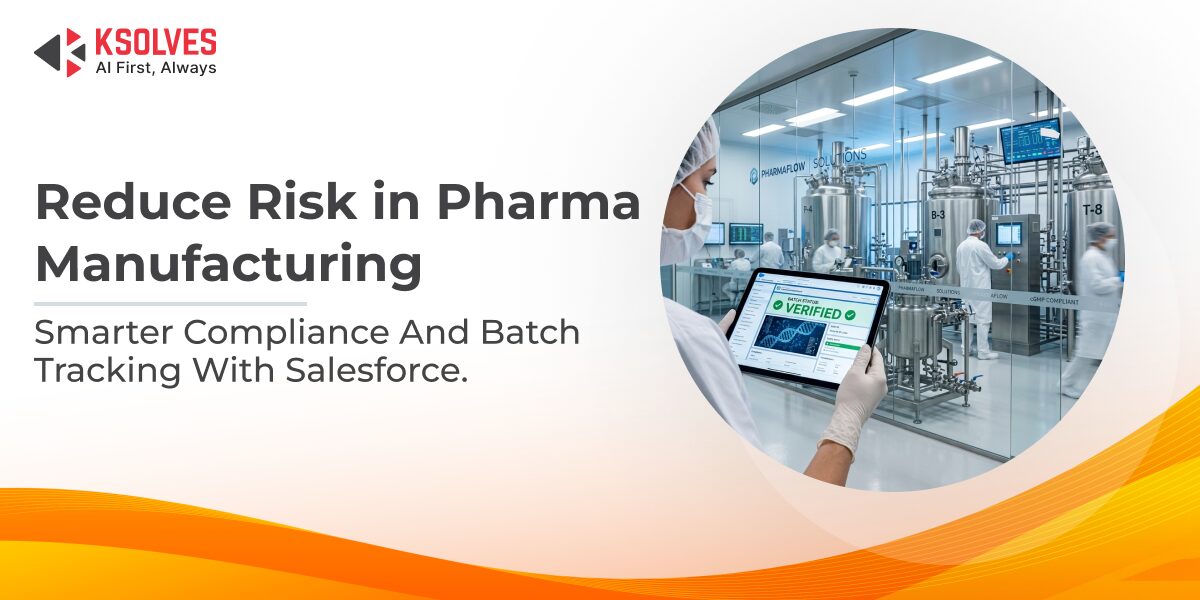
Pharmaceutical manufacturing is more complex than ever. Expanding drug portfolios, global supply chains, and tightening regulations are putting immense pressure on manufacturers to maintain strict compliance while scaling production efficiently.
Regulatory requirements such as FDA inspections, GMP standards, DSCSA traceability mandates, and 21 CFR Part 11 electronic record rules demand accurate documentation, real-time visibility, and audit-ready systems. Even a minor compliance gap can result in recalls, penalties, and long-term reputational damage.
However, many pharma companies still rely on spreadsheets, paper-based batch records, and disconnected legacy systems that lack real-time tracking and reporting capabilities. These outdated tools make compliance management slow, reactive, and risk-prone.
This is where Salesforce for the manufacturing industry plays a defining role — enabling centralized compliance management, digital batch tracking, and end-to-end traceability for modern manufacturers. Through Manufacturing Cloud, Health Cloud, and robust integration capabilities, it enables centralized compliance management, digital batch tracking, and end-to-end traceability.
In this article, we explore how Salesforce helps modern pharma companies strengthen compliance, improve batch visibility, and build a future-ready regulatory framework.
The Compliance Landscape in Pharmaceutical Manufacturing
Pharmaceutical manufacturing operates under strict global regulations designed to protect patient safety and ensure product quality. Compliance requires validated processes, accurate documentation, and full traceability across production and distribution.
Key Regulatory Frameworks
Manufacturers must comply with major regulatory bodies, each governing a different aspect of production and market access:
| Regulatory Body | Scope |
|---|---|
| FDA (U.S.) | Governs drug approval, manufacturing, and safety standards |
| EMA (EU) | Ensures quality and efficacy across European markets |
| WHO GMP | Sets global best practices for production and quality control |
21 CFR Part 11
This FDA regulation defines how electronic records and electronic signatures must be managed. Systems must provide secure data storage, audit trails, and tamper-proof documentation. It is essential for companies using digital batch records and quality systems.
DSCSA and Drug Traceability
The Drug Supply Chain Security Act (DSCSA) requires end-to-end traceability of prescription drugs. Manufacturers must enable serialization, product verification, and secure electronic data exchange to prevent counterfeit or unsafe products from entering the supply chain.
Risks of Non-Compliance
Failure to comply can lead to recalls, regulatory penalties, production shutdowns, and reputational damage. Most critically, it can compromise patient safety — an outcome no manufacturer can afford.
Why a Unified Compliance Platform Is Essential
With growing regulatory complexity, fragmented systems increase compliance risk. A unified, real-time platform centralizes documentation, ensures traceability, automates reporting, and keeps manufacturers audit-ready at all times.
What Is Batch Tracking in Pharma Manufacturing?
Batch tracking in pharmaceutical manufacturing refers to the process of recording and monitoring every step involved in producing a specific batch of a drug product. From raw material sourcing to final packaging, each activity is documented to ensure product quality, safety, and regulatory compliance. It enables manufacturers to quickly identify, isolate, and investigate issues if defects or deviations occur.
Batch Tracking vs. Serialization
Batch tracking focuses on monitoring a group of products manufactured together under the same conditions, ensuring consistency at the batch level. Serialization, on the other hand, assigns a unique identifier to each individual saleable unit to support item-level traceability — especially for supply chain compliance requirements such as DSCSA. While batch tracking ensures production integrity, serialization strengthens distribution-level transparency.
Key Data Captured in Batch Records
A complete batch record typically includes the following data points, creating a full audit trail that regulators can review at any time:
- Raw material details and supplier information
- Equipment used and production parameters
- Step-by-step process documentation
- In-process quality checks
- Final quality control (QC) test results
- Deviations, corrective actions, and approvals
Electronic Batch Records (EBR) vs. Paper-Based Systems
Electronic Batch Records (EBR) digitize the entire documentation process, enabling real-time data capture, automated validations, and built-in compliance checks. In contrast, paper-based systems are manual, error-prone, and time-consuming to review. EBR systems reduce documentation errors, improve data integrity, and support regulatory requirements such as 21 CFR Part 11 compliance.
Challenges with Legacy Batch Tracking Systems
Many pharma companies still rely on disconnected or outdated systems. Common challenges include:
- Manual data entry errors
- Delayed deviation detection
- Limited real-time visibility
- Difficult audit preparation
- Poor integration with quality and supply chain systems
Modern, integrated platforms help overcome these challenges by centralizing batch data, automating workflows, and ensuring audit readiness at every stage of production.
How Salesforce Addresses Pharma Compliance Needs
Salesforce has evolved well beyond its origins as a sales CRM. Today, it offers a suite of industry-specific tools that pharma manufacturers can configure to meet their most demanding compliance requirements.
Salesforce Manufacturing Cloud and Health Cloud
Salesforce Manufacturing Cloud gives pharma operations teams a centralized view of production agreements, account-based forecasting, and real-time operational data. Health Cloud extends this capability into patient-facing and clinical workflows, supporting regulated processes like adverse event tracking, medical affairs management, and patient support programs. Together, these two clouds give pharma organizations a connected platform that spans manufacturing, quality, and commercial operations.
Audit Trails and Electronic Signatures
Salesforce maintains a comprehensive, time-stamped audit trail of every action taken within the platform — capturing who made a change, what was changed, and when. Its electronic signature capabilities can be configured to meet 21 CFR Part 11 requirements, making it a viable foundation for replacing paper-based approval processes with fully traceable digital workflows.
Automated Compliance Workflows and Alerts
Salesforce Flow and Process Builder allow compliance teams to automate repetitive regulatory tasks such as deviation notifications, approval routing, CAPA assignments, and regulatory submission reminders. Automated alerts ensure that nothing falls through the cracks, reducing human error and keeping teams consistently on schedule.
Role-Based Access Controls and Data Security
Salesforce provides granular, role-based access controls that restrict data visibility and editing rights based on a user’s function and clearance level. This is critical in regulated environments where data integrity must be protected and every access event must be logged and traceable.
Document Management and Version Control
Through Salesforce Content and its integration with document management tools, pharma teams can manage SOPs, batch records, and regulatory submissions with full version control. Every document revision is tracked, previous versions are preserved, and approvals are captured digitally — keeping organizations audit-ready at all times.
Salesforce for End-to-End Batch Tracking
End-to-end batch tracking requires complete visibility from raw material intake to finished product distribution. Salesforce enables pharma manufacturers to centralize, monitor, and control batch data in real time.
Real-Time Batch Monitoring
With configurable dashboards in Salesforce Manufacturing Cloud, teams can track batch status, production milestones, quality checks, and approval stages instantly. This reduces delays and improves decision-making across the production floor.
ERP, MES, and LIMS Integration
Salesforce integrates seamlessly with ERP, MES, and LIMS platforms, consolidating production, laboratory, and supply chain data into a single, unified view for better traceability and faster response to quality events.
Raw Material to Finished Goods Traceability
Every ingredient, supplier lot, production step, and QC result can be linked to a specific batch, creating a complete digital chain of custody from raw material intake to final product release.
Deviation and CAPA Management
Automated workflows help log deviations, trigger investigations, assign corrective actions, and maintain audit-ready documentation within the same platform — eliminating the need for disconnected spreadsheets or manual handoffs.
Recall Readiness and Reporting
In the event of a recall, manufacturers can instantly generate traceability reports identifying affected batches, distribution channels, and impacted customers — significantly reducing response time and regulatory exposure.
Barcode, QR, and RFID Integration
Salesforce supports integration with barcode scanners, QR codes, and RFID systems, enabling accurate, automated data capture at every stage of production and distribution without manual intervention.
Salesforce Integration Capabilities in Pharma Manufacturing
Modern pharma operations depend on connected systems. Salesforce acts as a central integration layer, bringing production, quality, and supply chain data together in real time.
ERP Connectivity (SAP, Oracle, and Others)
Salesforce integrates with ERP platforms like SAP and Oracle to sync production orders, inventory levels, and procurement workflows. This ensures operational and commercial teams work from a single source of truth.
Seamless Data Flow with MuleSoft
By integrating MuleSoft with Salesforce, manufacturers can connect ERP, MES, LIMS, and third-party systems through secure APIs. This removes data silos and enables automated, bidirectional data exchange across manufacturing systems.
IoT Integration for Real-Time Monitoring
Salesforce can connect with IoT-enabled production equipment to capture temperature, pressure, and machine performance data in real time. This supports proactive maintenance and faster quality intervention before issues escalate.
API-Driven Supply Chain Visibility
With API-based integrations, companies can securely share serialization, shipment, and batch data across distributors and partners — strengthening traceability and meeting DSCSA and other regulatory compliance requirements.
Challenges and Considerations When Implementing Salesforce in Pharma
Implementing Salesforce in pharmaceutical manufacturing requires careful planning to ensure regulatory alignment, operational continuity, and user adoption.
Computerized System Validation (CSV)
Pharma companies must validate Salesforce as a regulated system to meet compliance standards. This includes documented testing, audit trail verification, access controls, and proof that the system performs consistently under defined conditions.
Change Management and Training
Shifting from paper-based or legacy systems to Salesforce demands structured change management. Teams need role-based training, clear SOP updates, and leadership alignment to ensure smooth adoption across quality, production, and compliance functions.
Data Migration from Legacy Systems
Migrating batch records, quality data, and historical compliance documentation can be complex. Data must be cleansed, mapped accurately, and validated to maintain integrity and traceability throughout the transition.
Cost and Implementation Timeline
Costs vary depending on customization, integrations, validation scope, and scale of deployment. A phased rollout often reduces risk and ensures better control over timelines and budgets.
Why Choose Ksolves for Salesforce Implementation in Pharma
Salesforce implementation in a regulated pharmaceutical environment requires more than technical configuration. It demands deep regulatory awareness, structured validation practices, and a clear understanding of GMP, 21 CFR Part 11, and end-to-end traceability requirements.
Ksolves combines strong Salesforce expertise with pharma domain knowledge to design compliant, secure, and audit-ready solutions – and as a trusted provider of Salesforce implementation services, delivers end-to-end Salesforce support — including audit trails, role-based access controls, automated workflows, and electronic signature capabilities — ensuring scalable, future-ready platforms that support multi-site operations and evolving regulatory demands.
Conclusion
Pharmaceutical manufacturers operate in a highly regulated environment where compliance, traceability, and accuracy are non-negotiable. Salesforce helps centralize compliance workflows, digitize batch tracking, enable real-time visibility, and strengthen audit readiness across manufacturing and supply chain operations.
By connecting systems, automating documentation, and ensuring secure data management, Salesforce provides a scalable foundation for regulatory confidence and operational efficiency. If you are looking to modernize compliance and batch tracking in your pharma operations, partnering with the best Salesforce Summit Partner can make all the difference. Connect with Ksolves to explore how Salesforce can support your regulatory goals and long-term growth.
Frequently Asked Questions
What is batch tracking in pharmaceutical manufacturing and why does it matter?
How does Salesforce help pharma companies meet 21 CFR Part 11 compliance requirements?
What is the difference between batch tracking and serialization in pharma supply chains?
Can Salesforce integrate with ERP, MES, and LIMS systems used in pharma manufacturing?
What are the main challenges pharma companies face when implementing Salesforce in regulated environments?
How does Salesforce support recall readiness in pharmaceutical manufacturing?
Why should pharma manufacturers choose Ksolves for Salesforce implementation?
Have questions about Salesforce compliance for your pharma operations? Contact our team to discuss your requirements.
































Author
About the Author Editorial Team The Ksolves Editorial Team includes certified Salesforce experts, Big Data engineers, AI/ML specialists, Zoho consultants, and experienced technology writers focused on delivering clear, actionable insights for modern businesses. With hands-on experience across Salesforce, Big Data platforms, AI/ML solutions, application development, software testing, and Zoho ERP/CRM, the team publishes practical guides, real-world use cases, and industry updates that support smarter decisions and faster growth. Every article is created to solve business challenges, guide technology adoption, and keep organizations aligned with evolving digital ecosystems.
Share with