



AI-Driven Demand Forecasting in Odoo for Grocery Retailers
Odoo
5 MIN READ
August 27, 2026

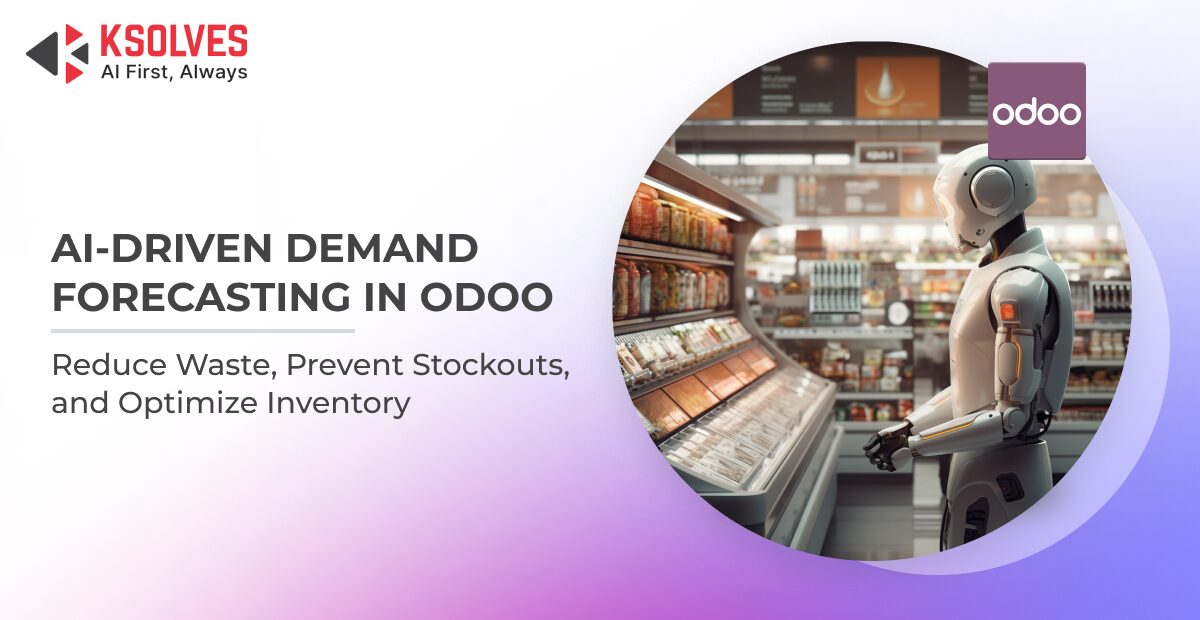
Grocery retailers operate in one of the most dynamic retail environments. Customer demand changes daily, many products have limited shelf lives, and external factors like weather, holidays, promotions, and local events can significantly influence purchasing behavior. As a result, maintaining the right inventory levels is a constant challenge.
Traditional demand forecasting methods, often based on spreadsheets or historical averages, struggle to keep pace with these changing conditions. They frequently result in excess inventory, product spoilage, stockouts, and higher operational costs.
AI-driven demand forecasting addresses these challenges by analyzing historical sales, inventory movements, seasonal patterns, supplier lead times, and other business data to generate accurate demand predictions. When combined with Odoo’s integrated ERP platform, businesses gain real-time insights that help optimize purchasing, inventory replenishment, and stock allocation.
In this blog, we’ll explore how AI-powered demand forecasting in Odoo helps grocery retailers improve inventory planning, reduce waste, and make faster, data-driven decisions.
Why Demand Forecasting Is Critical for Grocery Retailers
Inventory is one of the largest investments for any grocery retailer. Ordering too much increases storage costs and product wastage, while ordering too little leads to stockouts and lost sales. Accurate demand forecasting helps retailers predict how much stock they will need, reduce expiry-related wastage, and maintain the right inventory levels while keeping products fresh for customers.
Common Inventory Challenges
Grocery retailers face several operational challenges that make inventory planning difficult:
- Perishable inventory: Fresh produce, dairy, bakery items, and frozen goods have limited shelf lives, making overstocking costly.
- Demand fluctuations: Customer buying patterns change based on weekends, holidays, weather, and local events.
- Large product catalogs: Managing demand across thousands of SKUs manually is time-consuming and error-prone.
- Supplier variability: Delayed deliveries or inconsistent lead times can disrupt replenishment planning.
- Promotional campaigns: Discounts and special offers often create temporary demand spikes that are difficult to predict manually.
The Cost of Poor Demand Forecasting
Inaccurate forecasting affects both revenue and operational efficiency. Common consequences include:
- Higher food waste due to expired inventory.
- Lost sales from unavailable products.
- Increased inventory carrying costs.
- Emergency procurement at higher prices.
- Reduced customer satisfaction and loyalty.
Also Read: Optimizing E-commerce Sales and Operational Efficiency with Odoo
What is AI-Driven Demand Forecasting?
AI-driven demand forecasting uses machine learning and predictive analytics to estimate future product demand based on historical and real-time business data. Unlike traditional forecasting methods that rely on fixed rules or manual calculations, AI continuously learns from changing market conditions and customer behavior.
Instead of looking only at past sales, AI evaluates multiple variables simultaneously, including:
- Historical sales trends.
- Seasonal demand patterns.
- Promotional activities.
- Product life cycles.
- Inventory movement.
- Supplier lead times.
- Store-specific purchasing behavior.
- External factors such as holidays and weather.
As more data becomes available, AI refines its predictions, helping businesses make better purchasing and inventory decisions over time.
Turn Odoo into an Intelligent Forecasting Platform with Ksolves!
Key AI Demand Forecasting Use Cases in Grocery Retail
Every grocery retailer faces the same challenge: keeping shelves stocked without tying up capital in excess inventory. AI-powered demand forecasting in Odoo addresses this challenge by helping businesses anticipate demand and make smarter inventory decisions.
1. Predict Daily and Weekly Product Demand
Customer demand is rarely consistent. Products that sell quickly on weekends may see lower demand during weekdays, while weather, holidays, and local events can significantly influence buying patterns.
AI analyzes historical sales data alongside recent purchasing trends to predict demand at the SKU level. This enables retailers to maintain optimal inventory levels for both fast-moving and slow-moving products.
Business impact:
- Better inventory availability.
- Reduced stock imbalances.
- More accurate purchasing decisions.
2. Optimize Replenishment Planning
Manual replenishment often relies on fixed reorder points that fail to reflect changing demand. As a result, businesses either replenish too early or too late.
AI continuously evaluates sales velocity, current inventory, supplier lead times, and forecasted demand to recommend when and how much inventory should be replenished.
Business impact:
- Fewer emergency purchases.
- Improved procurement planning.
- Lower inventory carrying costs.
3. Reduce Food Waste for Perishable Products
Managing perishables is one of the biggest challenges in grocery retail. Overstocking fresh produce, dairy, bakery items, or frozen foods often leads to product expiration and financial losses.
AI helps retailers align inventory levels with expected demand, ensuring perishable products are replenished more accurately while minimizing excess stock.
Business impact:
- Reduced product spoilage.
- Lower inventory waste.
- Improved inventory turnover.
4. Prepare for Seasonal and Promotional Demand
Festivals, holiday seasons, promotional campaigns, and local events often create sudden changes in customer demand. Traditional forecasting methods struggle to account for these fluctuations.
AI identifies recurring seasonal patterns and evaluates the impact of previous promotions to generate more reliable forecasts before demand peaks occur.
Business impact:
- Better promotional planning.
- Improved product availability during peak periods.
- Reduced lost sales.
5. Improve Multi-Store Inventory Planning
Retail chains often experience different purchasing patterns across locations. A product that sells quickly in one store may move much more slowly in another.
AI generates store-level demand forecasts, allowing businesses to replenish inventory based on local demand instead of applying a single strategy across all locations.
Business impact:
- Balanced inventory across stores.
- Reduced inter-store stock transfers.
- Improved customer satisfaction.
6. Strengthen Procurement Planning
Demand forecasting is about purchasing at the right time.
By combining forecasted demand with supplier lead times and purchase history, AI helps procurement teams schedule purchases more effectively and avoid last-minute ordering.
Business impact:
- Better supplier coordination.
- Improved purchasing efficiency.
- Reduced supply chain disruptions.
AI Features That Improve Forecast Accuracy
The effectiveness of demand forecasting depends on how quickly the system adapts to changing business conditions. AI enhances forecasting by continuously learning from new data instead of relying on static rules.
- Intelligent Pattern Recognition
AI identifies demand patterns that are difficult to detect manually, including changing customer preferences, seasonal buying habits, and emerging product trends. This allows forecasts to evolve as purchasing behavior changes. - Demand Anomaly Detection
Unexpected demand spikes or sudden sales drops can disrupt inventory planning. AI detects unusual demand patterns early, enabling businesses to investigate the cause and respond before inventory problems arise. - Automated Reorder Recommendations
Instead of relying on predefined reorder quantities, AI recommends purchase quantities based on current inventory, expected demand, supplier lead times, and safety stock requirements. This helps businesses maintain optimal inventory without excessive manual planning. - Continuous Forecast Updates
Demand forecasting is not a one-time activity. AI continuously incorporates new sales, inventory, and procurement data to refine future predictions. This ensures businesses are working with the latest insights rather than outdated forecasts.
Business Benefits of AI-Driven Demand Forecasting in Odoo
Implementing AI-powered demand forecasting enables grocery retailers to improve both operational efficiency and profitability.
- Optimize Inventory Levels
Maintain the right balance between inventory availability and carrying costs by purchasing according to expected demand. - Minimize Food Waste
Reduce spoilage by aligning inventory replenishment with actual consumption patterns, especially for perishable goods. - Increase Product Availability
Ensure popular products remain in stock, improving customer satisfaction and reducing lost sales. - Lower Inventory Holding Costs
Avoid unnecessary overstocking while maintaining sufficient safety stock for high-demand products. - Improve Supplier Planning
Plan procurement more effectively by considering forecasted demand alongside supplier lead times and purchasing schedules. - Strengthen Cash Flow
Reduce capital tied up in excess inventory and invest more efficiently in products with higher demand potential. - Make Faster, Data-Driven Decisions
Access real-time forecasting insights through Odoo dashboards, enabling inventory, procurement, and operations teams to respond proactively instead of reacting to stock issues after they occur.
Why Choose Odoo for AI-Driven Demand Forecasting in Grocery Retail?
Demand forecasting is only as effective as the quality of data behind it. Many grocery retailers struggle because their sales, inventory, procurement, and POS systems operate independently, making it difficult to generate accurate forecasts or respond quickly to changing demand.
Odoo solves this challenge by connecting every core business function within a single ERP platform. Instead of relying on fragmented data and manual reconciliation, retailers gain a unified view of their operations, enabling AI to generate more accurate demand forecasts and actionable inventory recommendations.
1. Build Forecasts on Real-Time Business Data
AI forecasting requires access to current and reliable information. Odoo continuously captures data from sales, inventory, procurement, POS, manufacturing, and accounting, ensuring forecasts reflect what’s happening across the business, not just historical sales.
This enables retailers to respond quickly to changing customer demand and make inventory decisions with greater confidence.
2. Turn Forecasts into Automated Actions
Forecasts create value only when they drive execution. Odoo transforms demand predictions into operational workflows by automating inventory replenishment and procurement processes.
Retailers can:
- Generate purchase orders based on forecasted demand.
- Maintain optimal safety stock levels.
- Schedule replenishment before shortages occur.
- Reduce manual planning and purchasing errors.
This shortens procurement cycles and helps ensure products are available when customers need them.
3. Gain End-to-End Inventory Visibility
Demand forecasting doesn’t stop at predicting sales, but it requires complete visibility into inventory performance.
Odoo provides real-time insights into:
- Stock availability across warehouses and stores.
- Inventory movement and turnover.
- Slow-moving and fast-moving products.
- Products approaching expiry.
- Incoming purchase orders and expected deliveries.
With this visibility, businesses can make informed decisions before inventory issues affect operations.
4. Make Smarter Decisions Across Every Store
Customer demand varies by location, product category, and buying behavior. Odoo allows businesses to analyze inventory and sales performance at both the company and store level, helping managers make location-specific replenishment decisions instead of applying a one-size-fits-all approach.
This is especially valuable for grocery chains operating multiple stores or distribution centers.
5. Scale as Your Business Grows
As product catalogs expand and transaction volumes increase, inventory planning becomes more complex. Odoo’s modular architecture allows businesses to scale their operations without replacing their ERP system.
Whether managing a neighborhood grocery store, a supermarket chain, or a multi-warehouse distribution network, Odoo provides the flexibility to support growing operational demands while maintaining accurate forecasting and inventory control.
Why Partner with Ksolves for AI-Powered Odoo Demand Forecasting?
Implementing AI-driven demand forecasting isn’t just about integrating an AI model into your ERP. It requires a deep understanding of grocery retail operations, inventory dynamics, procurement workflows, and Odoo’s capabilities to deliver forecasts that translate into measurable business outcomes.
As an AI-first Odoo development company, Ksolves helps grocery retailers build intelligent ERP solutions that not only predict demand but also automate the actions needed to maintain optimal inventory levels, reduce waste, and improve operational efficiency.
1. Industry-Focused Odoo Implementations
Every grocery business has unique challenges, from managing perishable inventory and high-volume SKUs to coordinating multiple suppliers and store locations. We configure Odoo around your operational workflows, ensuring your ERP supports the way your business actually operates.
2. AI-Driven Demand Forecasting That Delivers Results
We leverage AI and predictive analytics to help you move beyond historical reporting. Our solutions analyze sales trends, inventory movement, seasonal demand, supplier lead times, and purchasing patterns to generate accurate demand forecasts that support better inventory planning.
3. Intelligent Inventory & Procurement Automation
Forecasting creates value only when it drives action. We automate replenishment workflows, reorder planning, and procurement processes so your teams can respond proactively to changing demand while minimizing manual effort and reducing stock-related risks.
4. A Connected ERP Ecosystem
Our team integrates every critical business function, including Sales, Inventory, Purchase, POS, Accounting, Manufacturing, and Reporting, into a unified Odoo environment. This ensures AI models work with complete, real-time business data, improving forecast accuracy and operational visibility.
5. Real-Time Insights for Faster Decisions
We build intuitive dashboards that provide instant visibility into inventory performance, product demand, replenishment requirements, forecast accuracy, and key operational KPIs. This empowers decision-makers to identify risks early and take corrective action before they impact the business.
6. Continuous Optimization Beyond Go-Live
Demand patterns evolve, and so should your ERP. Beyond implementation, we continuously optimize your Odoo environment by refining forecasting models, enhancing workflows, and introducing AI-driven improvements that help your business adapt to changing customer demand and market conditions.
7. Transform Inventory Planning into a Competitive Advantage
With Ksolves, you gain more than an Odoo implementation partner – you gain a team that combines AI expertise, retail domain knowledge, and proven Odoo capabilities to help you reduce food waste, prevent stockouts, optimize working capital, and build a more agile, data-driven grocery retail business.
Conclusion
AI-driven demand forecasting is helping grocery retailers shift from reactive inventory management to proactive decision-making. By combining predictive insights with real-time operational data, businesses can reduce food waste, prevent stockouts, optimize procurement, and consistently meet customer demand while improving profitability.
At Ksolves, we combine AI expertise with deep Odoo implementation experience to build demand forecasting solutions tailored to grocery retail operations. From intelligent inventory planning to automated replenishment and real-time analytics, we help businesses unlock the full potential of Odoo and build smarter, more resilient supply chains.
Partner with Ksolves to build an intelligent Odoo solution tailored to your grocery retail business.



































AUTHOR
Odoo
Neha Negi, Presales and Business Associate Head at Ksolves is a results-driven ERP consultant with over 8 years of expertise in designing and implementing tailored ERP solutions. She has a proven track record of leading successful projects from concept to completion, driving organizational efficiency and success.
Share with