



Reducing Administrative Burden in Healthcare with Salesforce Automation
Salesforce
5 MIN READ
September 4, 2026

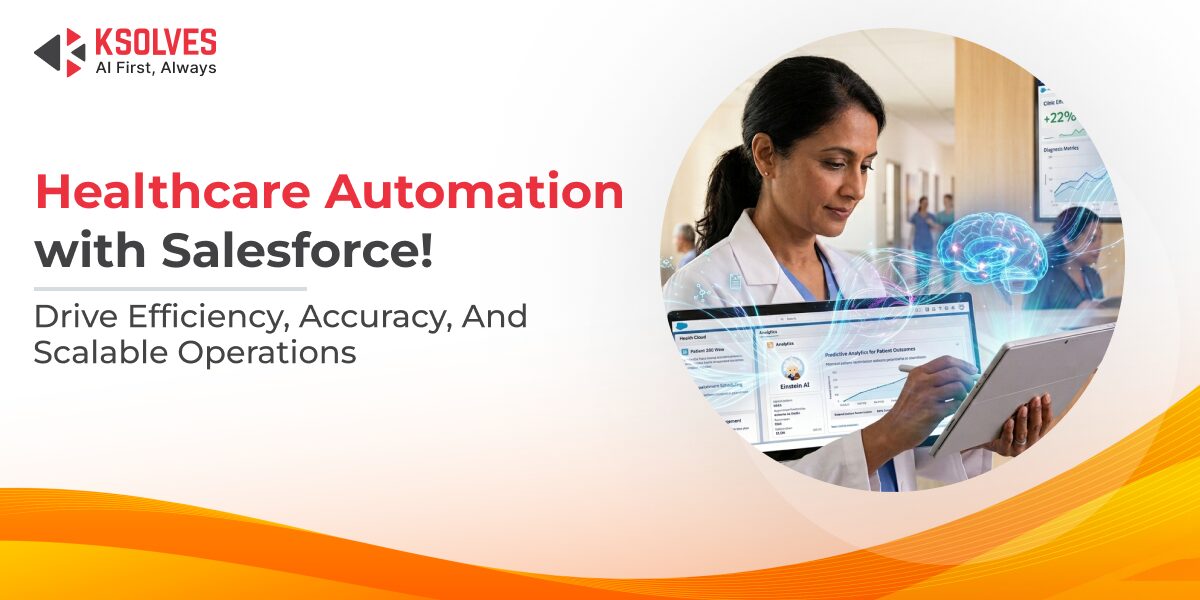
Healthcare systems today manage far more than clinical care. From patient onboarding and insurance verification to compliance reporting and care coordination, administrative workloads have expanded significantly over the past decade.
Studies show that physicians spend around 16.6% of their working time on administrative tasks, highlighting how much effort is diverted away from direct patient care. Despite this growing burden, many organizations still rely on manual workflows and disconnected digital tools, leading to delays, data silos, and limited operational visibility.
As regulations become stricter and patient volumes continue to rise, these inefficiencies directly affect how quickly and accurately care can be delivered. To sustain quality outcomes and control costs, healthcare providers must move beyond fragmented processes and adopt streamlined, integrated systems that support both administrative teams and frontline staff.
What Administrative Burden Looks Like in Healthcare
Administrative work in healthcare extends far beyond basic paperwork. It involves multiple time-sensitive processes that must be handled accurately while complying with strict regulatory and payer requirements. When these tasks rely on manual effort or disconnected systems, they create inefficiencies across the care continuum.
- Appointment scheduling and rescheduling often require staff to manage high call volumes, coordinate provider availability, and update multiple systems. Missed appointments, double bookings, and last-minute cancellations increase administrative workload and reduce clinic utilization.
- Patient intake and data entry remain heavily manual in many organizations. Staff must collect demographic, medical, and consent information across different forms and systems. This increases the risk of errors, duplicate records, and incomplete patient profiles that impact downstream care.
- Insurance verification and prior authorizations are among the most resource-intensive administrative tasks. Teams must confirm coverage details, eligibility, and payer rules, often through multiple portals or phone calls. Delays or inaccuracies in this process can result in denied claims, treatment delays, and revenue leakage.
- Care coordination and follow-ups require consistent communication between providers, patients, and care teams. Without centralized systems, tracking referrals, test results, discharge instructions, and follow-up appointments becomes fragmented, leading to gaps in care and poor patient experiences.
- Reporting, compliance, and documentation overload add another layer of complexity. Healthcare organizations must meet regulatory, clinical, and operational reporting requirements while maintaining detailed audit trails. Manual documentation not only consumes staff time but also increases the risk of non-compliance and reporting errors.
Why Traditional Systems Fall Short
Traditional healthcare systems struggle to support modern administrative needs because data is spread across multiple platforms such as EHRs, billing systems, and CRMs, making it difficult to maintain a unified patient view. Many teams still rely heavily on emails, spreadsheets, and phone calls to coordinate tasks, which leads to delays, errors, and poor accountability.
Limited automation and lack of real-time workflow visibility prevent administrators from identifying bottlenecks or optimizing processes. As patient volumes increase, these fragmented and manual systems fail to scale, resulting in higher costs, staff burnout, and reduced operational efficiency.
How Salesforce Automation Addresses Healthcare Admin Challenges
Salesforce automation addresses key healthcare admin challenges by replacing manual processes with integrated, intelligent workflows.
Centralized Patient and Provider Data
Salesforce brings data from EHRs, billing systems, and administrative workflows into a single, unified view, enabling teams to access accurate information without switching between systems.
Workflow Automation to Eliminate Repetitive Tasks
Automation streamlines appointment reminders, intake processes, insurance verification, approvals, and follow-ups, reducing manual effort and administrative workload.
Real-time Visibility into Operational Processes
Dashboards and reports provide instant insights into task status, bottlenecks, and performance metrics, helping administrators make faster, data-driven decisions.
Secure, Compliant, and Scalable Cloud Platform
Salesforce offers enterprise-grade security, compliance support, and cloud scalability, allowing healthcare organizations to handle growing patient volumes without compromising data protection or system performance.
Ready to Automate Your Healthcare Operations?
Salesforce Clouds and Capabilities for Healthcare Automation
Salesforce offers a comprehensive ecosystem of clouds and technologies that help healthcare organizations automate administrative processes, improve care coordination, and gain better visibility across operations. Each cloud plays a specific role in reducing manual effort and enabling more connected healthcare experiences.
1. Health Cloud
Health Cloud implementation enables healthcare organizations to create unified patient profiles by consolidating data from clinical and non-clinical systems into a single view. It supports care timelines that provide visibility into patient interactions, treatments, and administrative touchpoints. Health Cloud also streamlines care coordination and case management by allowing teams to track care plans, manage referrals, and collaborate efficiently across departments.
2. Service Cloud
Service Cloud implementation helps automate patient inquiries and support cases by routing requests to the right teams based on priority and context. With omni-channel capabilities, healthcare organizations can engage patients through phone, email, chat, and self-service portals, ensuring consistent and timely communication while reducing administrative workload on support staff.
3. Sales Cloud (for Healthcare Networks)
Sales Cloud supports referral management and provider onboarding by centralizing relationship data and automating workflows. Healthcare networks can manage relationships with partners, payers, and provider groups more effectively, improving collaboration, tracking referral pipelines, and ensuring smoother onboarding processes.
4. MuleSoft
MuleSoft connects Salesforce with EHRs, billing platforms, and insurance systems using pre-built connectors from the MuleSoft Accelerator for Healthcare. It supports HL7 FHIR R4, HL7 v2, and X12 EDI standards covering insurance eligibility (270/271) and claims transactions (837/835), enabling real-time, standards-compliant data exchange without custom point-to-point integrations.
5. Einstein AI & Automation
Einstein AI enhances healthcare administration with intelligent automation and insights. It enables intelligent case routing and prioritization based on urgency and context, while predictive insights help teams anticipate patient needs, improve engagement, and automate follow-ups. This reduces manual decision-making and supports more proactive healthcare operations.
Key Automation Use Cases That Reduce Admin Workload
Appointment Scheduling & Reminders
Automation allows patients to book, reschedule, or cancel appointments through digital channels without staff involvement. Automated reminders via SMS or email reduce no-shows and last-minute cancellations, helping healthcare organizations improve schedule utilization while lowering call center volume.
Digital Patient Intake
Digital intake forms replace paper-based registration and manual data entry. Built on Salesforce Experience Cloud or OmniStudio portals, intake forms capture patient demographics, consent, and insurance details before visits. Data is automatically mapped to Health Cloud records via OmniStudio DataRaptors, eliminating manual re-entry. DocuSign’s native Salesforce connector handles e-signatures, keeping consent documentation secure and audit-ready.
Case Routing
Automation categorizes and routes administrative cases such as insurance queries, billing issues, and referral requests to the right teams based on predefined rules. This reduces response times, prevents misrouted requests, and improves first-contact resolution for patients and internal teams.
Automated Follow-Ups
Automated follow-ups ensure consistent communication across the patient journey. Systems can trigger reminders for upcoming appointments, test results, prescription refills, or post-visit instructions, reducing missed actions while maintaining patient engagement without manual outreach.
Real-Time Dashboards
Real-time dashboards give administrators visibility into appointment volumes, case backlogs, response times, and workflow performance. These insights help teams identify bottlenecks early, allocate resources more effectively, and continuously optimize administrative operations.
Role of a Salesforce Implementation Partner: How Ksolves Helps
A Salesforce implementation partner helps healthcare organizations simplify and automate complex administrative operations. Ksolves delivers healthcare-focused Salesforce implementations designed to address real operational challenges such as fragmented patient data, manual workflows, and system integration gaps.
In a recent patient data management project, Ksolves helped a multi-specialty hospital centralize patient records, automate intake and scheduling, and integrate Salesforce with its EHR system. The solution improved day-to-day efficiency while ensuring secure data access and regulatory compliance. Beyond implementation, Ksolves continues to support healthcare teams with scalable automation, real-time reporting, and ongoing optimization as operational and regulatory demands grow.
- 30% improvement in patient data accuracy by eliminating duplicate and inconsistent records
- 25% reduction in patient wait times through faster intake and data access
- 40% faster care coordination with unified patient information
- 20% increase in staff productivity by reducing manual administrative work
- Stronger compliance readiness with secure, audit-ready patient data
Final Thoughts
Administrative burden is no longer just an operational challenge in healthcare; it directly impacts care quality, staff efficiency, and patient experience. Manual processes, disconnected systems, and limited visibility continue to slow down critical workflows, diverting time and resources away from patient care.
With the right Salesforce clouds, AI-driven automation, and system integrations, healthcare providers can significantly reduce administrative workload while improving accuracy and responsiveness.
Partnering with an experienced Salesforce implementation provider like Ksolves ensures these capabilities are aligned with real healthcare workflows. For more information, you can contact our team at [email protected].































AUTHOR
Salesforce
Shivam Yadav, a Senior Software Engineer at Ksolves, with 4+ years of experience, specializing in Health Cloud and Salesforce development. A 4× Salesforce Certified expert (PD1, PD2, SFCC B2C DEV, Associate), he excels in React Native, Java, Python, and C++.
Share with