



6 Machine Learning Metrics That Truly Impact Your Business Bottom Line
Machine Learning
5 MIN READ
September 7, 2026

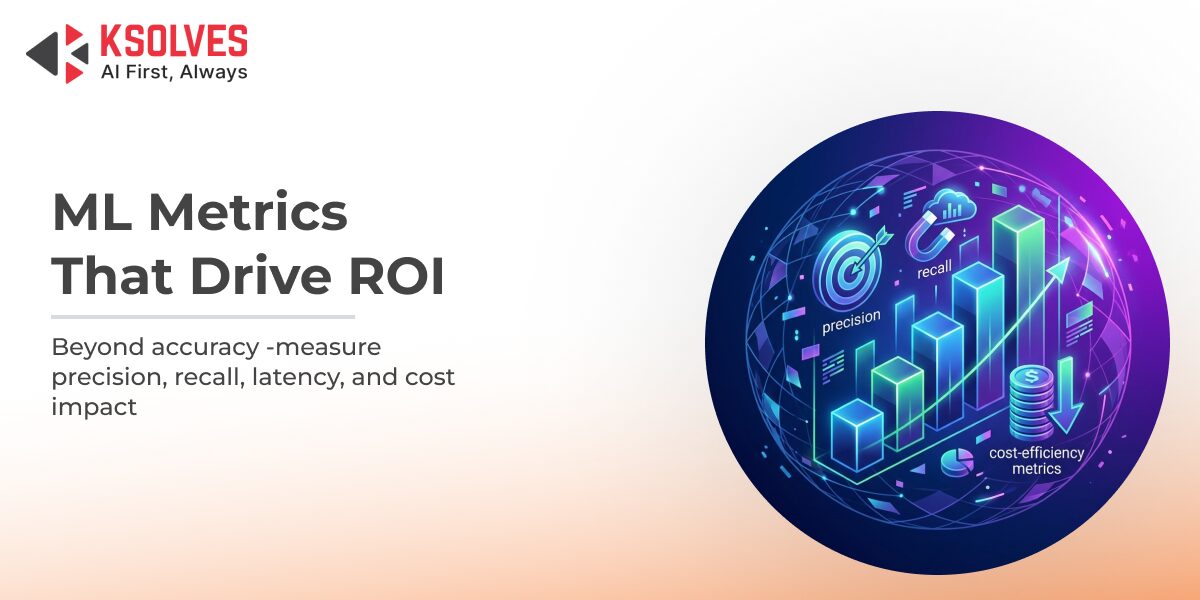
Machine learning is now a core driver of digital transformation across industries, from finance and retail to healthcare and manufacturing. Organizations invest heavily in ML models to automate decisions, predict outcomes, and optimize operations. However, many initiatives fail to deliver measurable returns because success is evaluated using purely technical metrics that do not reflect real business impact.
This blog will explain the machine learning metrics that directly influence your bottom line by linking model performance to revenue growth, cost optimization, and operational efficiency. Instead of focusing solely on accuracy, businesses must measure what truly matters in production environments where decisions have financial consequences.
Why Accuracy Alone Is Not Enough in Machine Learning
Accuracy is often the first metric teams look at when evaluating machine learning model performance. While it is useful, it can be highly misleading in real-world business scenarios. In imbalanced datasets, a model can achieve high accuracy while failing to detect critical events such as fraud, churn, or defects.
ML Metrics That Directly Influence Business Performance
The following machine learning metrics help organizations evaluate models not just as technical assets, but as business tools. These metrics provide insights into cost efficiency, revenue protection, user experience, and overall return on investment. When tracked correctly, they allow leaders to make informed decisions about model deployment, optimization, and scaling.
Metric 1: Precision – Reducing Costly False Positives
Precision measures how many of the model’s positive predictions are actually correct. In business use cases such as fraud detection, spam filtering, or targeted marketing, false positives can be expensive. They lead to unnecessary investigations, customer friction, and wasted marketing spend.
High precision ensures that actions triggered by the model are meaningful and cost-effective. For example, in a retail promotion engine, better precision means offers are sent to users who are more likely to convert, directly improving marketing ROI.
Metric 2: Recall – Capturing Missed Revenue Opportunities
Recall measures how many actual positive cases the model successfully identifies. In scenarios like churn prediction, defect detection, or lead qualification, low recall means missed opportunities that can negatively impact revenue.
A model with poor recall may look acceptable on paper but fail to detect customers at risk of leaving or products likely to fail. Improving recall helps businesses act proactively, retain customers, and prevent losses, making it a critical metric for revenue optimization.
Metric 3: F1 Score – Balancing Precision and Recall
The F1 score combines precision and recall into a single metric, providing a balanced view of model effectiveness. This metric is especially important in business-critical systems where both false positives and false negatives carry costs.
For example, in credit risk assessment or automated approvals, an imbalance can either increase risk exposure or reduce potential revenue. The F1 score helps teams strike the right balance and build more reliable decision-making systems.
Metric 4: ROC-AUC – Measuring Decision-Making Power
ROC-AUC (Receiver Operating Characteristic Area Under the Curve) evaluates a model’s ability to distinguish between classes by measuring the True Positive Rate against the False Positive Rate across classification thresholds. Unlike accuracy, it provides insight into how well a model ranks outcomes and handles class imbalance.
This makes ROC-AUC particularly valuable in use cases such as credit scoring, customer prioritization, and risk modeling. A higher ROC-AUC indicates stronger decision-making capability, enabling businesses to allocate resources more effectively and reduce operational risk.
Metric 5: Model Latency – When Speed Impacts Revenue
Model latency refers to the end-to-end time to generate predictions, including data preprocessing, feature engineering, model inference, and infrastructure components like network and database queries. In real-time applications such as recommendation engines, dynamic pricing, or fraud prevention, latency directly affects user experience and conversion rates.
Slow predictions can lead to abandoned transactions or delayed actions. Optimizing ML model latency ensures smoother user interactions, higher engagement, and better system scalability, all of which contribute to improved business outcomes.
Metric 6: Cost per Prediction – Connecting ML to ROI
Cost per prediction measures how much it costs to generate each inference, including infrastructure, compute, and maintenance expenses. As ML systems scale, this metric becomes critical for long-term sustainability.
Turn These Metrics Into Measurable ML ROI
Turning ML Metrics into Business Impact with ML Consulting Services
While these metrics are powerful, many organizations struggle to select, track, and interpret them correctly. This is where expert guidance becomes essential. Partnering with experienced ML Consulting Services providers helps businesses align machine learning initiatives with strategic objectives.
Ksolves offers end-to-end ML Consulting Services that focus on business-driven metrics, model optimization, and production readiness. By combining technical expertise with domain understanding, Ksolves helps organizations translate ML performance into measurable business value.
Conclusion
Machine learning success is not defined by technical excellence alone. It is defined by measurable impact on revenue, cost efficiency, and customer experience. By focusing on the right ML metrics, businesses can move beyond experimentation and build scalable, value-driven ML systems. Measuring what truly matters ensures that machine learning becomes a strategic asset rather than just a technical investment.
FAQs
What is the difference between accuracy and business-impact machine learning metrics?
Machine learning accuracy metrics measure how often a model’s predictions are technically correct, while business-impact metrics like precision, recall, and cost per prediction connect those predictions to revenue, cost, and customer outcomes. Accuracy can look strong even when a model is failing on the rare, high-value cases — such as fraud or churn — that matter most to the business. Business-impact metrics fill this gap by tying model performance directly to financial results.
What happens if a company only tracks model accuracy?
Relying only on accuracy can hide poor performance on imbalanced problems like fraud detection or churn prediction, where the events that matter most are rare. A model can post a high accuracy score while still missing most fraudulent transactions or at-risk customers, leading to wasted marketing spend and slow-to-surface losses. This is why teams need metrics such as precision, recall, and ROC-AUC alongside accuracy.
How do businesses choose the right machine learning metric for their use case?
The right metric depends on which type of error costs the business more — false positives or false negatives — and on how the model’s output will be used. Fraud detection often prioritizes precision to avoid costly false alarms, while churn prediction leans on recall to catch as many at-risk customers as possible. Ksolves’ ML Consulting Services help organizations map their specific use case to the metrics, thresholds, and monitoring setup that best reflect real business risk.
How does precision differ from recall in a business context?
Precision measures how many of a model’s positive predictions are actually correct, which matters most when false positives are expensive, such as unnecessary fraud investigations. Recall measures how many actual positive cases the model successfully catches, which matters most when missed cases are costly, such as an undetected churn risk or product defect. Most business-critical systems balance both using the F1 score rather than optimizing for one alone.
When should a company start measuring cost per prediction?
Cost per prediction becomes important as soon as a machine learning model moves from a pilot into production and starts running at meaningful volume, since infrastructure and compute costs scale with every inference. Waiting until the model is already deployed at scale often means discovering that a highly accurate model is financially unsustainable to run. Tracking it from the early production stage helps teams balance performance with long-term operational efficiency.
Who can help a business select and implement the right ML metrics?
Data science teams, ML engineers, and specialized consulting partners typically lead the work of selecting, tracking, and interpreting business-aligned ML metrics. Ksolves offers end-to-end ML Consulting Services that combine technical model evaluation with domain understanding, helping organizations translate metrics like precision, recall, and cost per prediction into measurable business value. Contact our team to discuss which metrics matter most for your ML systems.
Have more questions about turning ML metrics into business results? Contact our team.

 Mayank Shukla
Machine Learning is no longer a technology of the future. It is a core production capability powering fraud detection, demand […]
 Mayank Shukla
In recent years, machine learning (ML) has evolved from a niche technology into a vital tool across various industries. From […]






























Author
About the Author Editorial Team The Ksolves Editorial Team includes certified Salesforce experts, Big Data engineers, AI/ML specialists, Zoho consultants, and experienced technology writers focused on delivering clear, actionable insights for modern businesses. With hands-on experience across Salesforce, Big Data platforms, AI/ML solutions, application development, software testing, and Zoho ERP/CRM, the team publishes practical guides, real-world use cases, and industry updates that support smarter decisions and faster growth. Every article is created to solve business challenges, guide technology adoption, and keep organizations aligned with evolving digital ecosystems.
Share with