



Apache Cassandra vs DataStax Cassandra: The Complete 2026 Comparison
Apache Cassandra
5 MIN READ
September 17, 2026

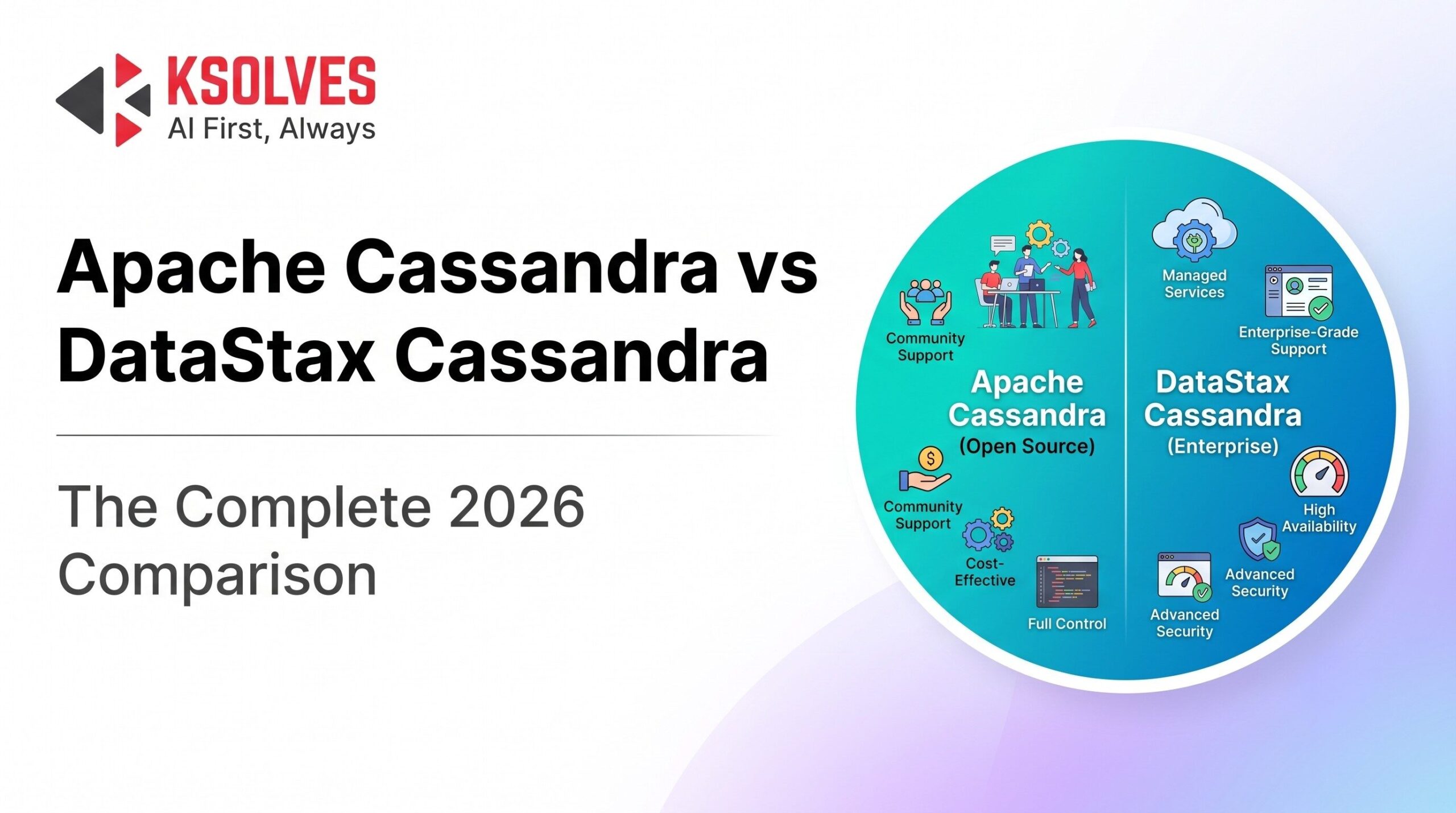
Organizations evaluating distributed NoSQL databases for high-volume, mission-critical applications frequently encounter two closely related names: Apache Cassandra and DataStax. Although connected, the two are not interchangeable, and the distinction has become more significant since IBM completed its acquisition of DataStax in May 2025. This guide examines DataStax Enterprise vs Apache Cassandra, clarifies whether DataStax is the same as Cassandra, and reviews licensing, pricing, security, and performance considerations to help decision-makers select the right path for their data architecture.
What Is Apache Cassandra?
Apache Cassandra is an open-source, distributed database management system designed to handle massive volumes of data across multiple nodes, data centers, and cloud regions with no single point of failure. Governed by the Apache Software Foundation and licensed under Apache License 2.0, it employs a masterless, peer-to-peer architecture in which every node can accept reads and writes. Cassandra’s column-family data model, combined with tunable consistency (ranging from ONE to ALL), allows engineering teams to calibrate the precise trade-off between consistency, availability, and latency that a given workload requires. With Cassandra 5.0, the project introduced Storage-Attached Indexes (SAI), vector search for AI and machine learning workloads, and an improved unified compaction strategy, demonstrating that the open-source core continues to evolve independently.
Is DataStax the Same as Cassandra?
DataStax is a commercial company, now part of IBM, built entirely on top of Apache Cassandra. It does not replace Cassandra; rather, it packages Cassandra with additional enterprise tooling, professional support, and, in its cloud form (Astra DB), a fully managed database-as-a-service layer. Every DataStax product continues to run Cassandra’s core storage engine and query language (CQL) underneath. In short, DataStax Cassandra represents Apache Cassandra plus a commercial layer, not a separate database.
DataStax Enterprise vs Apache Cassandra: Core Differences
DataStax Enterprise (DSE) historically bundled Cassandra with built-in Apache Spark for analytics, integrated search, graph capabilities, in-memory processing options, and a management console called OpsCenter. Apache Cassandra, by contrast, ships as a lean, single-purpose distributed database: any capability beyond core storage and querying must be integrated separately, such as Spark, Elasticsearch or OpenSearch, and monitoring stacks.
Following the IBM acquisition, DataStax’s commercial focus has shifted noticeably toward Astra DB (its cloud-native, serverless Cassandra offering) and Luna (a paid support subscription for organizations self-hosting open-source Cassandra), while DSE continues to be maintained for existing enterprise customers operating on-premises. In practice, the “DSE vs Cassandra” decision in 2026 is less about selecting a packaged enterprise product and more about choosing between self-managed open source, a paid support subscription, or a fully managed cloud database, ideally with guidance from experienced Apache Cassandra consulting services to align the choice with long-term operational goals.
DSE vs Cassandra Open Source: Licensing
DataStax Enterprise vs Cassandra open source, and DataStax vs Cassandra licensing more broadly, is where the two paths diverge most clearly:
Apache Cassandra is entirely open source under Apache License 2.0. There is no license fee, no vendor lock-in, and organizations may inspect, modify, and redistribute the code freely. Governance rests with the Apache Software Foundation rather than any single vendor.
DataStax Enterprise and Astra DB require a commercial agreement. DSE layers proprietary components, including search, graph, and advanced security modules, on top of the open-source base, and these additions are not released under Apache License 2.0. Astra DB, meanwhile, operates on consumption-based, cloud-only pricing, so organizations are licensing access to a managed service rather than installable software.
For organizations with strict open-source procurement policies, or teams that require full control over deployment topology, Apache Cassandra’s licensing model remains the simpler and more transparent choice.
DataStax vs Cassandra Pricing
Pricing is typically the deciding factor once licensing is understood:
Apache Cassandra costs nothing to download or operate. Real expenditure goes into infrastructure (compute, storage, network) and, critically, into the operational expertise required to configure replication, compaction, repairs, and upgrades correctly. This is where many organizations underestimate total cost of ownership.
IBM Elite Support for Apache Cassandra (formerly DataStax Luna, rebranded November 1, 2025) is a subscription tied to cluster size: Standard covers roughly 20–150 nodes with unlimited tickets and hour-level SLAs, while Plus targets larger deployments with extended version support. Premium add-ons provide fifteen-minute response times and named support engineers.
Astra DB uses pay-as-you-go, consumption-based pricing across reads, writes, and storage, which can suit variable workloads but requires careful capacity forecasting to avoid unpredictable costs at scale.
Partnering with a dependable Apache Cassandra support services provider can often make open-source Cassandra both more economical and more reliable than either an unsupported DIY deployment or a full commercial subscription.
DataStax vs Apache Cassandra Security Features
Out of the box, Apache Cassandra provides solid fundamentals: internal authentication, role-based access control (RBAC), client-to-node and node-to-node SSL/TLS encryption, and audit logging, available from Cassandra 4.0 onward. These capabilities are sufficient for most production deployments when configured correctly.
DataStax Enterprise historically extended this with more granular security controls, including LDAP and Kerberos integration, transparent data encryption at rest, and unified auditing tools bundled into OpsCenter, aimed at regulated industries such as finance and healthcare that require these controls available out-of-the-box rather than assembled from separate open-source tools. Astra DB adds cloud-native security layers, including VPC peering, private endpoints, and standard compliance certifications, since it operates as a managed service. This gap has narrowed as the open-source project has matured, although regulated enterprises frequently continue to prefer DataStax’s pre-integrated security tooling to reduce their own configuration burden.
DataStax vs Cassandra Performance
Because DataStax’s commercial products run the same core Cassandra engine, raw single-node performance is not fundamentally different; the distinctions emerge in operational performance at scale. DSE has historically included performance-tuning defaults and workload isolation between transactional, analytical, and search traffic, reducing the tuning effort required from teams without deep Cassandra expertise. The deciding factor is almost always data modeling, compaction strategy, and cluster sizing, not the distribution itself. In practice, performance is won or lost through sound architecture and disciplined operations, not through the vendor label on the deployment.
Apache Cassandra: Pros and Cons
Pros
- A large, active community
- Integration with Apache Spark, Solr, and the broader big-data ecosystem
- Tunable consistency
- Masterless architecture with no single point of failure
- Linear scalability for read- and write-heavy workloads
- Continuous innovation, including vector search and SAI, at no licensing cost
Cons
- The operational burden, including repairs, compaction tuning, upgrades, and capacity planning, falls entirely on the internal team
- JVM-based garbage collection tuning requires specialized expertise
- Advanced enterprise tooling, such as unified security consoles and built-in analytics, is not included out of the box
DataStax Cassandra: Pros and Cons
Pros
- Enterprise-grade support with defined SLAs
- Pre-integrated security and analytics tooling
- Faster time-to-production for teams without in-house Cassandra specialists
- Via Astra DB, a fully managed option that removes infrastructure management entirely
Cons
- Commercial licensing costs
- A learning curve associated with DataStax-specific tooling and APIs
- Potential vendor dependency
- Following the acquisition, some uncertainty among long-time users regarding product roadmap and pricing direction as DataStax integrates into IBM’s broader watsonx and AI data strategy
DataStax Enterprise vs Apache Cassandra 2026: What Has Changed
The IBM acquisition, which closed on May 28, 2025, represents the most significant shift in this comparison in recent years. IBM has indicated its intention to incorporate DataStax’s Astra DB and Cassandra expertise into its watsonx.data and broader AI platform strategy, positioning Cassandra as core infrastructure for enterprise AI applications, including retrieval-augmented generation workloads supported by Astra DB’s vector search capability. For buyers, this means DataStax’s roadmap in 2026 is increasingly oriented toward AI and cloud delivery, while the open-source Apache Cassandra project continues to evolve independently under the Apache Software Foundation, with its own release cadence and community priorities. Organizations seeking a vendor-neutral, self-directed roadmap will find open-source Cassandra fully independent of this shift. Organizations seeking IBM’s backing, AI tooling integration, and a managed cloud path will find DataStax and Astra DB explicitly positioned for that purpose.
Which One Should You Choose?
Teams with in-house Cassandra expertise who want full control at zero licensing cost tend to remain with open-source Apache Cassandra. Teams that require enterprise support SLAs, pre-built security and analytics tooling, or a fully managed cloud database often find DataStax’s commercial offerings a worthwhile investment.
Many enterprises settle on a hybrid approach: running open-source Cassandra while engaging an experienced Apache Cassandra development company for architecture design, performance tuning, and round-the-clock operational support, gaining enterprise-grade reliability without the full commercial licensing overhead. For organizations already running production clusters, dedicated Apache Cassandra upgrade services can also ease the transition to newer major versions without disrupting live workloads.
Closing Thoughts
Apache Cassandra remains one of the most powerful and thoroughly proven databases in the NoSQL category, valued for high availability and its resilience against any single point of failure, qualities that matter most to organizations that cannot tolerate downtime or data loss. DataStax builds valuable enterprise tooling on top of that same foundation, and under IBM it is now oriented squarely toward AI-driven data workloads. Understanding where each option genuinely adds value, rather than assuming they are the same product, is the essential first step toward choosing the right path for an organization’s data infrastructure.
FAQs
Is DataStax the same thing as Apache Cassandra?
No – Apache Cassandra is the open-source database itself, while DataStax is a commercial company (now part of IBM) that packages Cassandra with added enterprise tooling and support. Every DataStax product still runs Cassandra’s core storage engine and CQL query language underneath. Choosing DataStax doesn’t mean leaving Cassandra behind; it means adding a commercial layer on top of it.
What happens if I don’t have in-house Cassandra expertise?
Running Cassandra without solid operational expertise often leads to poorly tuned repairs, compaction issues, and JVM garbage collection problems that show up as latency spikes or downtime. These operational gaps are one of the most common reasons Cassandra projects run into trouble. Partnering with an experienced Apache Cassandra support services provider like Ksolves can close that gap without requiring a full commercial licensing commitment.
How do I migrate from DataStax Enterprise back to open-source Cassandra?
Migrating off DSE typically means auditing which proprietary DSE features (search, graph, security modules) your applications actually depend on, then replacing them with open-source equivalents. Data itself transfers cleanly since DSE runs the same core Cassandra engine and CQL. Ksolves’ Apache Cassandra consulting services can help plan and execute this kind of transition without disrupting live workloads.
Is Astra DB a good alternative to running my own Cassandra cluster?
Astra DB, DataStax’s managed cloud service, removes infrastructure management entirely and uses consumption-based pricing, which suits teams that want to avoid operational overhead. Self-managed Apache Cassandra costs nothing to license but requires infrastructure and skilled staff to run well. The right choice depends on whether your team prefers paying for convenience or investing in operational expertise.
When did DataStax become part of IBM?
IBM completed its acquisition of DataStax on May 28, 2025. Since then, DataStax’s commercial roadmap — especially Astra DB and Luna support — has shifted toward IBM’s watsonx and broader AI data strategy. The open-source Apache Cassandra project, however, continues to evolve independently under the Apache Software Foundation.
Who provides Apache Cassandra support if I don’t want a DataStax subscription?
Several third-party providers offer Apache Cassandra support outside of DataStax’s Luna or IBM Elite Support subscriptions. Ksolves is one such Apache Cassandra development company, offering architecture design, performance tuning, and round-the-clock operational support for self-managed clusters, giving teams enterprise-grade reliability without a DataStax commercial agreement.
How much does it cost to run Apache Cassandra versus DataStax?
Apache Cassandra itself is free, but real costs come from infrastructure and the operational expertise needed to run it well. IBM Elite Support for Apache Cassandra (formerly DataStax Luna) is priced by cluster size, while Astra DB uses pay-as-you-go pricing across reads, writes, and storage. The better cost comparison is total cost of ownership — infrastructure, staffing, and support combined — rather than license price alone.
Have more questions? Contact our team.

 Anil Kushwaha
Apache Hudi has emerged as one of the most effective data lake tools for enterprises that need to move beyond […]
 Anil Kushwaha
In real-time analytics, the gap between the millisecond an event is generated and the moment an end user interacts with […]






























AUTHOR
Apache Cassandra
Anil Kushwaha, Technology Head at Ksolves, is an expert in Big Data. With over 11 years at Ksolves, he has been pivotal in driving innovative, high-volume data solutions with technologies like Nifi, Cassandra, Spark, Hadoop, etc. Passionate about advancing tech, he ensures smooth data warehousing for client success through tailored, cutting-edge strategies.
Share with