 Salesforce
 5 MIN READ


Salesforce licensing costs are becoming an increasingly important consideration for businesses investing in CRM, automation, and AI-powered customer experiences.
With new capabilities entering the Salesforce ecosystem, choosing the right licensing route is no longer just a procurement decision. It is a financial decision that can influence long-term business growth.For decision-makers, this creates a practical challenge: how can businesses get the Salesforce licenses they need without spending more than necessary?
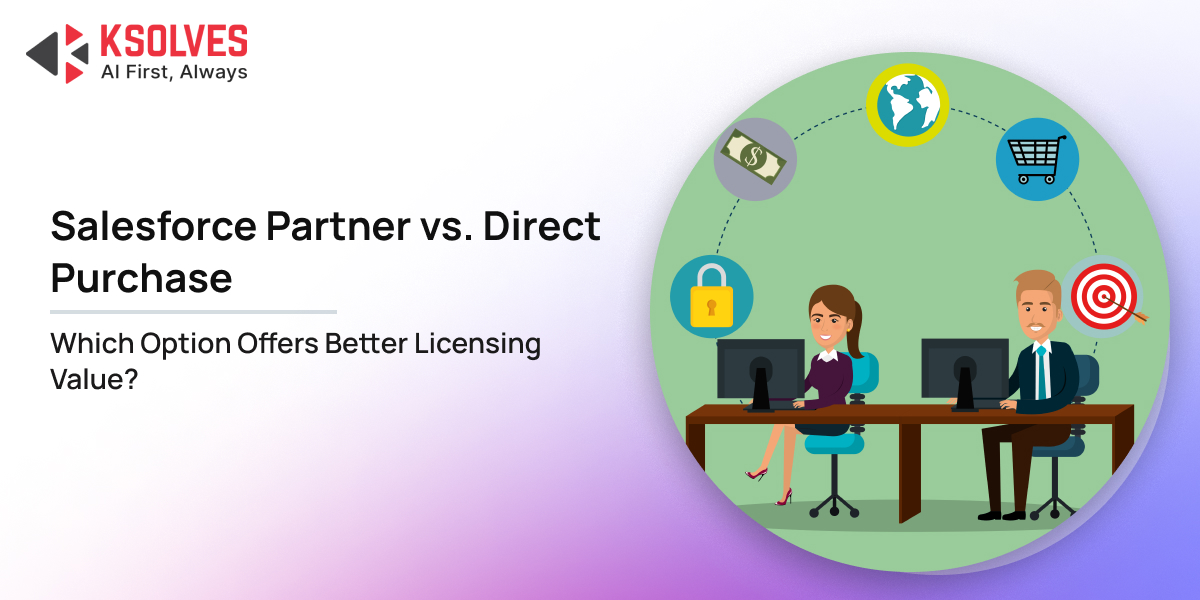
Two common options are purchasing licenses directly from Salesforce or working with a Salesforce consulting partner and license reseller. Both approaches provide access to Salesforce products, but the commercial support, negotiation opportunities, implementation guidance, and overall value can differ.
Understanding the difference between a Salesforce partner vs. a direct purchase helps businesses choose a licensing strategy that fits their budget, operational needs, and future plans.
Why Salesforce License Procurement Needs a Smarter Approach
The financial impact of Salesforce licensing goes beyond the monthly or annual subscription fee. Businesses must also consider the number of users, access requirements, additional features, renewals, implementation costs, and future expansion.
Salesforce’s FY2026 results, announced in February 2026, reported $41.5 billion in annual revenue, while Agentforce ARR reached $800 million, representing 169% year-over-year growth. This highlights the growing investment in Salesforce’s CRM and AI ecosystem.
For business leaders, the takeaway is clear: buying Salesforce is not simply about getting access to software. It is about selecting the right products, controlling recurring expenses, and making sure the investment supports measurable business outcomes.
A licensing decision that looks affordable initially can become expensive when unused seats, unnecessary add-ons, and poorly negotiated renewal terms enter the picture.
What Is Salesforce Direct Purchase?
Salesforce direct purchase means buying subscriptions directly from Salesforce through its sales team or official sales channels. Your organization discusses its requirements, receives a quotation, negotiates commercial terms, and signs an agreement directly with Salesforce.
This approach is particularly useful for businesses that already understand their CRM requirements and have an internal team capable of managing licensing decisions.
How Salesforce direct purchase works
- The business contacts Salesforce’s sales team.
- The sales representative discusses business requirements and product options.
- Salesforce shares pricing based on the selected edition, number of users, and additional features.
- The procurement team negotiates pricing and contract terms.
- The business signs the agreement and receives its licenses.
What Is Salesforce Partner Purchase?
Salesforce partner purchase means acquiring Salesforce licenses through an authorized Salesforce reseller or licensing partner rather than managing the entire purchasing process directly.
A Salesforce consulting partner license reseller can help businesses understand their requirements, identify suitable editions, arrange license procurement, and support license management.
Unlike a basic software purchasing arrangement, a partner-led approach can connect licensing decisions with Salesforce implementation, customization, integration, and ongoing support.
How partner-based Salesforce licensing works
- The business shares its requirements with an authorized reseller.
- The partner evaluates team size, business processes, and existing technology.
- The partner recommends appropriate licenses and editions.
- Pricing and available commercial options are discussed.
- The partner coordinates license procurement and onboarding.
- Ongoing assistance can include license reviews, renewals, and utilization management.
For organizations looking for both licensing and implementation assistance, working with an experienced partner can offer additional operational value.
Salesforce Partner vs Direct Purchase: Key Differences
Both purchasing methods provide access to Salesforce products, but they differ in how businesses approach procurement, negotiations, support, and long-term license management.
| Comparison factor | Direct purchase | Partner purchase |
| Purchasing channel | Salesforce directly | Authorized Salesforce reseller |
| Pricing discussion | Direct negotiation | Partner-assisted commercial discussion |
| License selection | Internal team evaluates needs | Partner provides recommendations |
| Procurement | Managed internally | Partner can coordinate procurement |
| Implementation | Separate internal or external team | Can be connected with partner services |
| Renewals | Managed internally | Partner-assisted renewal management |
| License optimization | Internal responsibility | Partner can review utilization |
| Ongoing assistance | Salesforce support and internal teams | Additional partner-led consulting and support |
The important distinction is that direct purchasing gives businesses a direct commercial relationship with Salesforce, while partner purchasing can provide a broader combination of licensing guidance and professional services. The right choice depends on the organization’s purchasing capabilities and the total value received.
Salesforce Licensing Discounts: Which Option Offers Better Savings?
Cost savings are often the biggest reason businesses compare Salesforce partners vs. direct purchases. However, Salesforce licensing discounts are not guaranteed simply because a company chooses a particular purchasing channel.
Discounts and commercial terms can depend on several factors, including:
- Number of licenses purchased.
- Selected Salesforce editions.
- Contract duration.
- Overall purchasing commitment.
- Additional products and services.
- Renewal history and negotiation timing.
- Eligibility for specific programs or offers.
How direct purchasing can reduce licensing costs
When negotiating directly with Salesforce, businesses can discuss volume-based commercial terms, contract commitments, and product bundles.
For example, an enterprise purchasing 300 licenses may have different negotiation opportunities from a startup purchasing 15 licenses. A well-prepared procurement team can also negotiate renewal conditions and request a clear breakdown of subscription charges.
The key takeaway: The best licensing discount is not always the largest percentage reduction. It is the commercial arrangement that minimizes unnecessary spending while providing the right functionality.
Salesforce Direct Contract Negotiation vs Partner-Led Negotiation
Negotiation is another important factor when deciding how to purchase Salesforce licenses.
In direct purchasing, the organization communicates with Salesforce’s sales representatives and negotiates the agreement itself.
In partner-led purchasing, an authorized reseller helps assess requirements, prepare licensing recommendations, and coordinate the procurement process.
Both approaches can support better commercial decisions, but the preparation behind the negotiation makes the biggest difference.
What businesses should negotiate directly with Salesforce
If you choose direct purchasing, focus on:
- License pricing: Request a detailed quotation for every selected edition.
- Contract duration: Compare annual and multi-year commitments.
- Renewal conditions: Understand future price changes and renewal deadlines.
- License flexibility: Discuss how additional or reduced user requirements will be handled.
- Product bundles: Check whether bundled products provide genuine value.
- Additional costs: Clarify add-ons, storage, usage-based charges, and other expenses.
What a Salesforce consulting partner brings to negotiations
An experienced partner can help businesses understand which licenses are actually required before procurement begins.
A partner can also coordinate license renewals, assess changing requirements, and help businesses avoid paying for features that their teams rarely use. Businesses should request comparable quotations and evaluate the complete commercial arrangement.
Real-World Business Use Cases: Which Purchasing Model Works Better?
Different industries have different licensing requirements. A purchasing model that works for a startup may not be suitable for a large enterprise. Here are some practical business scenarios.
Startups: Direct Purchase Can Be a Practical Choice
A startup with 10–15 employees may need Salesforce for basic sales tracking, lead management, and customer communication.
If the founders understand their requirements and have someone who can manage the CRM internally, direct purchasing may be sufficient. However, startups planning rapid expansion should also consider future license requirements.
Buying an advanced edition before the business needs its features can create unnecessary recurring costs.
- Recommended approach: Direct purchasing for straightforward requirements, with partner consultation when the business needs help selecting editions or planning implementation.
Manufacturing: Partner Purchase Can Deliver Better Licensing Value
Manufacturing businesses often have different user groups, including sales teams, distributors, field service employees, and back-office staff.
A company with 200 employees might need different Salesforce access levels across its departments.
For example:
- 40 sales representatives need sales functionality.
- 35 service employees need customer service functionality.
- 25 managers need reporting and management access.
- Other employees may need limited access or no individual CRM subscription.
Purchasing identical licenses for everyone may increase expenses without improving productivity.
An authorized reseller can assess these requirements and help create a more suitable licensing structure.
- Recommended approach: Partner-led procurement for businesses with multiple departments and different user requirements.
Retail and E-Commerce: Partner Purchase for Seasonal Growth
Retail businesses often experience changing staffing requirements during festive seasons, sales campaigns, and promotional periods.
For example, an e-commerce company may need additional customer service capacity during a major shopping event. If its licensing agreement does not account for changing requirements, it may end up purchasing more licenses than it needs throughout the year.
A licensing partner can help the business assess its existing agreement, review usage, and plan future requirements.
- Recommended approach: Partner-led licensing for organizations with seasonal staffing and multi-channel customer operations.
Large Enterprises: Compare Both Before Making a Decision
An enterprise with 500 or more Salesforce users may already have an experienced procurement department.
Direct negotiation can be valuable because the company may have established vendor relationships and significant purchasing commitments.
However, large organizations also face challenges involving license duplication, multiple Salesforce clouds, departmental budgets, and complex renewals. A partner can provide additional expertise in reviewing these requirements.
- Recommended approach: Compare direct and partner quotations, then evaluate pricing, implementation support, and long-term license management together.
How to Calculate the True Cost of Salesforce License Procurement
One of the biggest mistakes businesses make is comparing only the price per user.
The actual cost of Salesforce ownership includes more than subscription charges.
A proper licensing budget should consider:
| Cost component | What to evaluate |
|---|---|
| Subscription fees | Annual or monthly license costs |
| Additional features | Paid add-ons and premium functionality |
| Implementation | Configuration, customization, and deployment |
| Integration | Connecting Salesforce with existing business systems |
| Training | Preparing employees to use the platform |
| Administration | Internal resources for ongoing management |
| Renewal | Future subscription and contractual changes |
| Usage charges | Applicable consumption-based costs |
Why Choose Ksolves for Salesforce License Procurement?
Selecting the right licensing partner is just as important as selecting the right Salesforce edition. Businesses need a partner that understands Salesforce products, licensing requirements, implementation challenges, and long-term business objectives.
This is where Salesforce Reseller Solutions can support organizations looking for a more structured approach to Salesforce license procurement.
As an authorized Salesforce Cloud Reseller Partner, Ksolves helps businesses with license consulting, purchasing, renewals, and ongoing licensing support. Its approach focuses on understanding business requirements before recommending a licensing arrangement.
Access to Salesforce Consulting Expertise
Licensing decisions are more effective when they are connected to the actual Salesforce implementation. We also provide Salesforce consulting, customization, integration, and ongoing support, helping businesses connect their licensing investment with operational outcomes.
The Advantage of Working With a Salesforce Summit Partner
At Ksolves, we are also a Salesforce Summit Partner , a distinction that reflects its standing in Salesforce’s partner ecosystem.
Our team brings Salesforce consulting capabilities across different business functions and industries. For decision-makers, this matters because licensing is not an isolated activity. The right license selection should support implementation plans, future automation, data requirements, and business growth.
By combining reseller capabilities with Salesforce consulting expertise, Ksolves helps organizations approach licensing as a long-term business investment.
Final Thoughts
Salesforce licensing is a long-term business investment, and the purchasing decision should go beyond finding the lowest subscription price. Partner purchasing can provide additional value through licensing recommendations, procurement assistance, implementation expertise, and ongoing optimization.
For organizations looking to balance licensing costs with business growth, working with an experienced authorized reseller can be a practical approach.
With our Salesforce reseller capabilities and Summit Partner expertise, Ksolves helps businesses make informed licensing decisions and get more value from their Salesforce investment.
Ready to make your Salesforce licensing decision? Connect with us to evaluate your licensing requirements, explore suitable options, and build a procurement strategy that supports your business goals.
Frequently Asked Questions
Is buying Salesforce through a partner cheaper than buying directly?
Not necessarily. Salesforce partner pricing discounts depend on commercial eligibility, licensing requirements, and negotiated terms. However, partners can help businesses reduce unnecessary expenses through better license selection and utilization management.
Can businesses negotiate Salesforce pricing directly?
Yes. Businesses can discuss subscription pricing, contract duration, product bundles, and renewal conditions through Salesforce direct contract negotiation. The final terms depend on the agreement and applicable commercial policies.
What is a Salesforce consulting partner license reseller?
A Salesforce consulting partner license reseller is an authorized partner that helps businesses purchase Salesforce licenses while potentially providing consulting, implementation, renewal, and optimization services.
Does purchasing through a Salesforce reseller affect license ownership?
The contractual and provisioning arrangements depend on the specific reseller agreement. Businesses should confirm the contracting entity, account administration, renewal responsibilities, and access arrangements before signing.
How can businesses get better Salesforce licensing discounts?
Businesses should assess actual user requirements, compare editions, evaluate contract terms, review available commercial offers, and negotiate based on their purchasing commitments. Comparing authorized reseller and direct quotations can also help identify better value.
Can an existing Salesforce customer switch to a reseller?
Existing customers can explore reseller arrangements, subject to Salesforce policies and their current contractual terms. Renewal dates, contract obligations, and account transfer requirements should be reviewed before making the change.