



Why Angular Continues to Dominate Enterprise Front-End Development in 2026
Angular
5 MIN READ
November 2, 2026

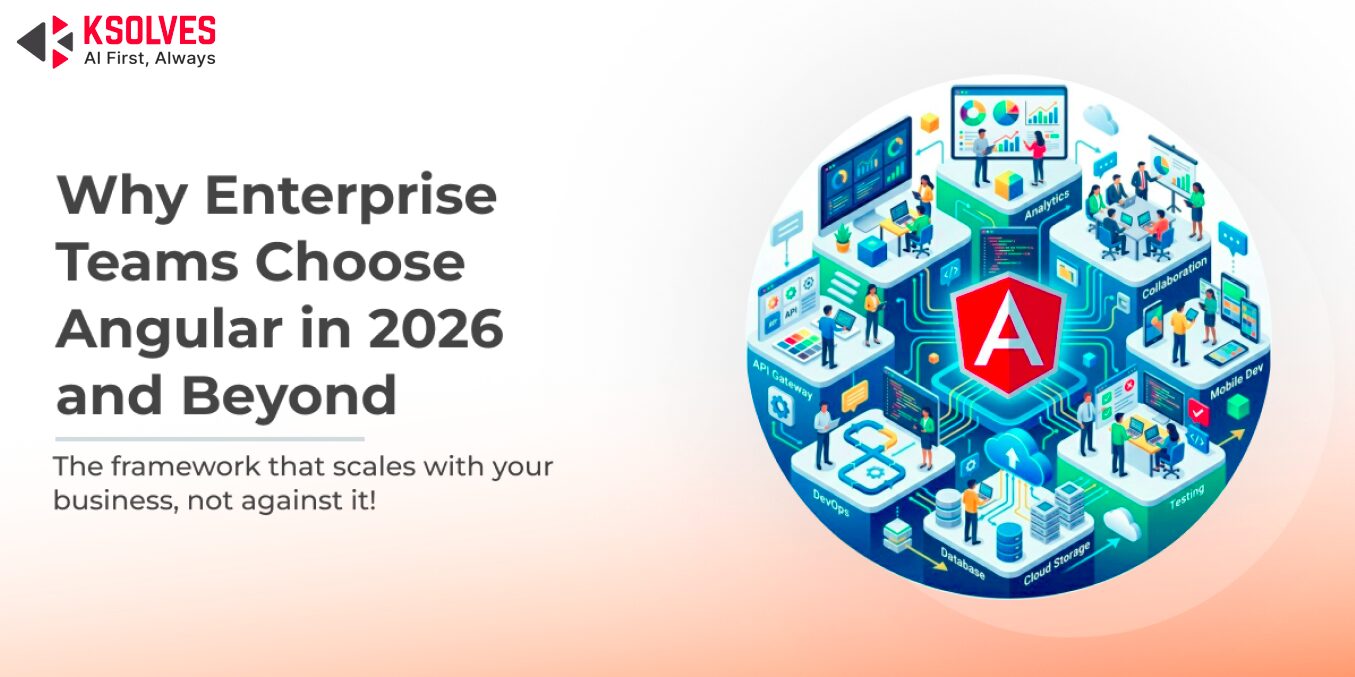
The front-end development landscape has never been more crowded. React boasts the largest developer community, Vue touts its gentle learning curve, and newer frameworks like Svelte promise revolutionary performance. Yet when you walk into the development offices of major banks, healthcare systems, insurance companies, and government agencies, you’ll find something surprising: Angular is everywhere.
The Enterprise Reality: Different Requirements, Different Priorities
Enterprise applications are very different from small websites or short-term projects. These systems often include millions of lines of code, are maintained by large teams spread across regions, and are expected to run reliably for many years.
For enterprises, the key question is not which framework is trending today. The real concern is which framework will remain stable, secure, and maintainable five or ten years down the line.
Choosing the wrong framework can result in growing technical debt, security risks, slower development, and expensive rewrites. Angular helps enterprises avoid these issues through its structured and predictable approach.
Why Angular Works So Well for Enterprises
1. Opinionated Architecture Brings Consistency
Angular enforces a clear structure for applications. While this may feel restrictive for small projects, it is extremely valuable in large teams.
With Angular, developers follow standard patterns for components, services, and modules. This makes it easier for new developers to understand the codebase, reduces confusion, and speeds up code reviews. Teams spend less time debating structure and more time delivering features.
2. TypeScript From the Start
Angular is built on TypeScript, not added to it later. For enterprise applications that handle sensitive data such as financial records or healthcare information, type safety plays a critical role.
TypeScript helps catch errors early, makes refactoring safer, and improves collaboration across teams. Strong typing also improves IDE support, which boosts developer productivity and reduces long-term maintenance effort.
3. Built-In Tooling for Enterprise Needs
Angular provides most of the tools enterprises need out of the box:
- Angular CLI ensures consistent project setup and builds.
- Dependency injection improves testability.
- Integrated testing support encourages better code quality.
- RxJS helps manage complex asynchronous workflows.
This reduces reliance on multiple third-party libraries and lowers the risk of abandoned or poorly maintained dependencies. Enterprises benefit from a unified platform backed by Google with long-term support. Many enterprises also pair an Angular front end with a microservices architecture on the back end, so each layer can be scaled and released independently.
4. Predictable Releases and Safe Upgrades
Angular follows a predictable release schedule with clear documentation and migration guidance. Enterprises can plan upgrades with confidence, knowing that breaking changes are managed carefully.
Angular also provides automated migration tools and detailed upgrade guides. This stability is critical for organizations planning long-term investments in their applications.
Building an Enterprise Application That Needs to Scale?
Real-World Example: Healthcare Application Modernization
The theoretical advantages of Angular become concrete when you examine real implementations. Ksolves recently completed a legacy healthcare application migration that demonstrates Angular’s enterprise value proposition in action.
The project involved modernizing a critical healthcare platform handling sensitive patient data and complex regulatory requirements. The legacy system suffered from inconsistent code quality, poor performance, security vulnerabilities, and mounting maintenance costs.
By migrating to Angular, the healthcare organization achieved dramatic improvements:
- Application performance increased by 40%.
- Development efficiency improved by 35%.
- The modernized architecture provided a scalable foundation for future growth.
- The migration maintained strict HIPAA compliance and enhanced security through Angular’s built-in protections.
This case study exemplifies why healthcare, finance, and government sectors consistently choose Angular. When regulatory compliance, security, and long-term maintainability are non-negotiable requirements, Angular’s structured approach delivers results that flexible frameworks struggle to match.
You can read the complete case study here: Legacy Healthcare Application Migration
Addressing Common Concerns About Angular
Angular is sometimes criticized, but many of these concerns are less relevant in enterprise environments.
1. The Steep Learning Curve
Some say Angular has a steep learning curve. Enterprises often invest in training because they need developers who understand architecture and long-term design, not just quick setup.
2. Bundle Size
Others mention bundle size. Modern Angular applications use lazy loading, tree shaking, and code splitting to deliver strong performance. Enterprises usually prioritize stability and maintainability over minor size differences.
3. A Smaller Talent Pool
Another common argument is that React has a larger talent pool. In practice, Angular’s clear structure often makes onboarding easier because developers follow consistent patterns instead of team-specific conventions.
Angular Compared to Other Frameworks in 2026
Each front-end framework serves a different purpose. While React, Vue, and newer frameworks work well for many use cases, enterprise applications have stricter requirements around structure, scalability, and long-term support.
Angular is designed specifically with these enterprise needs in mind.
| Criteria | Angular | React | Vue | Newer Frameworks (Svelte, Solid) |
|---|---|---|---|---|
| Architecture | Opinionated and standardized | Flexible and developer-defined | Semi-structured | Minimal and flexible |
| Suitability for Large Teams | Very strong | Depends on team discipline | Moderate | Limited |
| Built-in Tooling | Extensive and built-in | Relies on third-party libraries | Moderate | Limited |
| Type Safety | Built-in with TypeScript | Optional | Optional | Limited |
| Long-Term Stability | High with predictable releases | Depends on ecosystem choices | Growing | Unproven |
| Enterprise Adoption | Very high | High but inconsistent | Moderate | Low |
| Learning Curve | Higher but structured | Lower at start | Lower | Low |
| Best Fit Use Case | Large, long-term enterprise apps | Flexible or fast-moving products | Medium-sized apps | Experimental or small projects |
The Future of Angular in Enterprise Development
Angular continues to evolve in ways that matter to enterprise teams, while maintaining strong backward compatibility. New capabilities such as standalone components, signal-based reactivity, and improved hydration help improve performance, simplify application structure, and enhance the overall developer experience.
By combining modern front-end capabilities with predictable updates and stability, Angular provides exactly what enterprises need from a long-term technology platform. It enables organizations to innovate confidently while ensuring their applications remain reliable, secure, and maintainable for years to come.
Final Thoughts
Angular may not always dominate popularity charts, but it continues to lead in enterprise front-end development. Its structured architecture, strong tooling, predictable updates, and focus on maintainability make it ideal for large, long-running applications.
For organizations building systems that manage sensitive data, support large teams, and require long-term reliability, Angular remains a practical and proven choice in 2026.
At Ksolves, we have helped enterprises modernize legacy systems and build scalable Angular applications across industries. Our Angular development services focus on performance, security, and long-term value.





























AUTHOR
Angular
Gaurav Patil is an Odoo Developer with 4.6 years of experience engineering custom applications and streamlining business workflows. Specializing in cloud platform constraints, he focuses on mastering Odoo Online development, blending creative technical execution with deep platform knowledge to deliver robust enterprise solutions entirely independent of server-side access.
Share with