 Big Data
 5 MIN READ


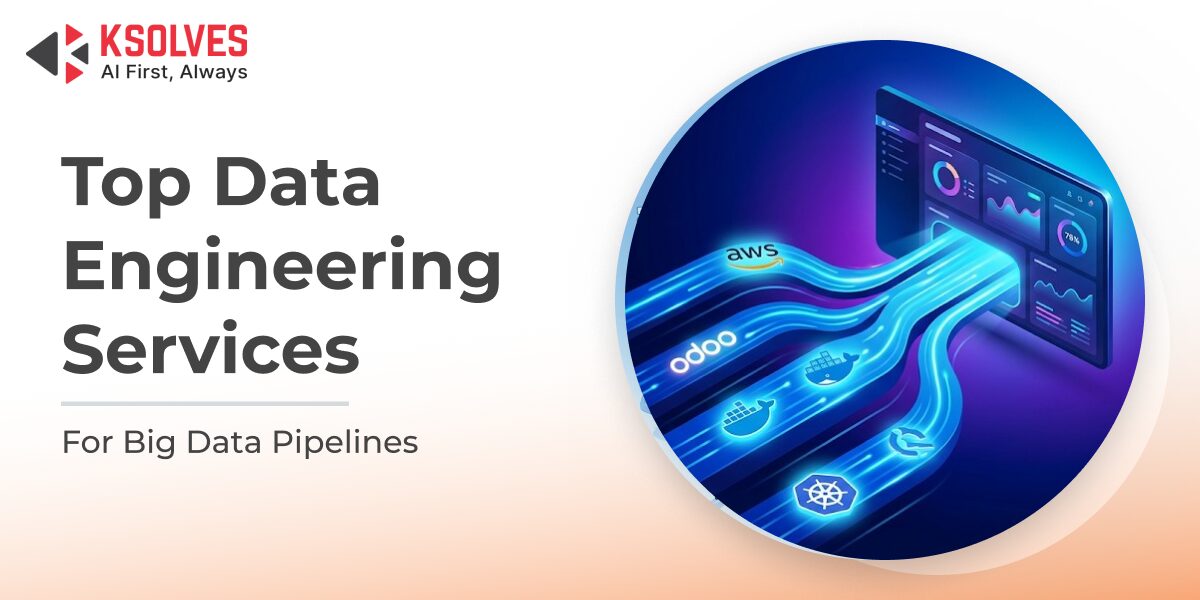
Most data pipeline failures are not caused by bad tools. They are caused by the wrong architecture choice made too early, without enough engineering discipline behind it. When your data volumes start hitting the terabyte range and pipelines need to stay current, not just accurate, the service layer underneath matters more than the platform you chose.
Data engineering services for big data pipelines cover a specific set of disciplines: ingestion, transformation, orchestration, storage, and real-time processing. Each one is a decision point. Get it wrong at ingestion and every downstream process inherits the error. Get orchestration wrong and your pipeline runs on faith.
This post covers what those services actually involve, which tools show up most often in serious production environments, and what separates a provider worth working with from one who will hand you a working demo and disappear.
What Are Data Engineering Services for Big Data Pipelines?
Data engineering services are the technical work required to build, run, and maintain the infrastructure that moves data from source to destination at scale. For big data pipelines specifically, that means handling data volumes, velocities, and formats that rule out manual or lightweight approaches.
The scope includes pipeline design and architecture, data ingestion from structured and unstructured sources, transformation and validation logic, workflow orchestration, cloud storage and warehouse integration, and ongoing monitoring. A good data engineering engagement covers all of these, not just the build phase. Organizations evaluating partners for this work should start by understanding what a mature big data consulting engagement looks like before scoping any tooling decisions.
Why Big Data Pipelines Need Specialized Engineering
A pipeline that processes a few million rows per day is a different engineering problem than one processing billions. The differences are not just about speed. They involve fault tolerance, schema evolution, late-arriving data, exactly-once delivery guarantees, and cost management at scale.
Standard ETL tools built for smaller workloads often fail silently, struggle with backpressure, or produce inconsistent results when partition counts grow. Big data pipeline engineering requires frameworks and architectural patterns that handle these failure modes explicitly.
Core Data Engineering Services for Big Data Pipelines
Data Ingestion Engineering
Ingestion is where data enters your pipeline. For big data, this means handling high-throughput batch loads, continuous event streams, and change data capture (CDC) from operational databases simultaneously.
Services in this area cover connector development for source systems (databases, APIs, SaaS platforms, IoT devices), ingestion framework configuration (Apache Kafka, AWS Kinesis, Apache NiFi, Google Pub/Sub), and schema registry setup to handle format changes without breaking downstream consumers.
Apache NiFi support services are particularly relevant for organizations needing flow-based data routing with built-in provenance tracking. Kafka dominates real-time event streaming environments where throughput and durability matter most.
ETL and ELT Pipeline Development
Extract, Transform, Load (ETL) and its modern variant, ELT, are the backbone of most big data workflows. The choice between them depends on your storage layer: if you have a cloud data warehouse with strong compute (Snowflake, BigQuery, Redshift), ELT often makes more sense because transformation happens after raw data lands.
Engineering services here include writing transformation logic in DBT, Spark, or SQL-based frameworks, building data validation and quality checks into the pipeline, and designing idempotent jobs that can safely re-run without duplicating records.
Real-Time Data Streaming Services
Batch pipelines refresh data on a schedule. Streaming pipelines keep data current within seconds or minutes. Use cases that need streaming include fraud detection, operational dashboards, logistics tracking, and customer-facing personalization.
Apache Kafka, Apache Flink, and Spark Streaming are the frameworks most commonly deployed here. Engineering work covers stream topology design, stateful processing logic, watermarking for late-arriving events, and integration with downstream sinks like data lakes or operational databases.
For a deeper look at architecture and configuration, Ksolves’ guide on building a big data pipeline with Apache Spark and Kafka covers topology design and stateful processing in production environments.
Data Pipeline Orchestration
Orchestration determines when jobs run, in what order, and what happens when something fails. Without proper orchestration, pipelines become brittle manual processes dependent on cron jobs and institutional knowledge.
Apache Airflow is the most widely adopted orchestration layer for big data environments. Apache Prefect and Dagster are growing alternatives with better observability and dynamic DAG support. Services in this area include DAG design, dependency mapping, retry and alerting logic, and SLA monitoring.
Cloud Data Warehouse and Data Lake Integration
Most modern big data pipelines land data in a cloud storage layer before it reaches end consumers. Common targets include AWS S3 with Athena or Redshift, Google Cloud Storage with BigQuery, Azure Data Lake Storage with Synapse, and Snowflake consulting services across any major cloud.
Engineering services cover storage tier design (hot, warm, cold), partition strategy for query performance, table format selection (Delta Lake, Apache Iceberg, Apache Hudi), and access control configuration. Getting partitioning wrong at this stage creates performance problems that are expensive to fix later.
Data Quality and Validation Engineering
At big data scale, bad data is expensive. A single upstream schema change or null value in the wrong field can invalidate days of processing. Data quality engineering adds automated validation gates at ingestion, transformation, and output stages.
This includes writing expectation suites with tools like Great Expectations or dbt tests, building anomaly detection into pipeline monitoring, and setting up alerting so failures surface before they hit downstream consumers.
Data Governance and Lineage Services
Regulatory environments and internal audit requirements increasingly demand that organizations know exactly where their data came from, how it was transformed, and who has access to it. Data lineage tracking answers those questions automatically.
Engineering services here cover metadata management with tools like Apache Atlas or DataHub, column-level lineage tracking, data catalog setup, and access governance policies. These are not optional for healthcare, financial services, or any organization subject to GDPR or similar frameworks.
What to Look for in a Data Engineering Services Provider
Production Experience, Not Just Tool Familiarity
A provider who has configured Airflow in a sandbox and one who has maintained it across a dozen production pipelines are not equivalent. Ask for examples of pipelines they have built at your data volume range and what failure modes they encountered.
Architecture-First Approach
The first deliverable from a serious data engineering engagement should be an architecture document, not a working pipeline. Providers who want to start building before the architecture is agreed on are optimizing for their delivery speed, not your long-term outcome.
Monitoring and Observability as a Default
Pipelines that ship without monitoring are unfinished. Any engagement should include dashboards for pipeline health, job duration trends, data freshness, and error rates. If observability is presented as a separate workstream or optional add-on, that is a warning sign.
Knowledge Transfer
Pipelines you cannot maintain without the team that built them are a liability. A provider worth working with documents their work, trains your team, and builds pipelines with operational simplicity as a design criterion.
Common Tools Used in Big Data Engineering Services
| Category | Common Tools |
|---|---|
| Streaming / Messaging | Apache Kafka, AWS Kinesis, Google Pub/Sub |
| Batch Processing | Apache Spark, AWS Glue, Dataflow |
| Orchestration | Apache Airflow, Prefect, Dagster |
| Data Flow / Routing | Apache NiFi |
| Transformation | dbt, Apache Spark SQL, Trino |
| Storage / Table Format | Apache Iceberg, Delta Lake, Apache Hudi |
| Data Warehousing | Snowflake, BigQuery, Redshift, Synapse |
| Data Quality | Great Expectations, DBT Tests, Monte Carlo |
| Lineage and Governance | Apache Atlas, DataHub, OpenMetadata |
For a broader breakdown of the top big data tools used in production environments in 2026, including newer entrants alongside these staples, Ksolves’ annual tool guide covers each category in detail.
How Ksolves Delivers Data Engineering Services for Big Data Pipelines
Most data pipeline projects slow down at the same place: the gap between what was built and what operations teams can actually maintain. Ksolves closes that gap by treating documentation, monitoring, and knowledge transfer as engineering requirements, not post-project afterthoughts.
Every Ksolves data engineer uses AI tools daily, across architecture review, pipeline code generation, test coverage, and documentation. That reduces the time between design sign-off and production deployment by roughly half compared to standard project timelines. For clients, that means less time waiting and a lower total project cost.
Ksolves’ big data engineering practice covers the full pipeline lifecycle: ingestion design, transformation and ELT development, orchestration with Airflow, cloud data warehouse integration (Snowflake, BigQuery, Redshift), real-time streaming with Kafka and Flink, data quality frameworks, and governance tooling. Apache NiFi engagements are also part of the practice, supported by the team behind Data Flow Manager (dfmanager.com), a NiFi-specific management and monitoring product.
If your pipeline is unreliable, growing faster than your team can manage, or needs a rebuild at scale, the right starting point is a scoped architecture review, not a vendor demo. One recent example is our work on Informatica integration patterns that fail safely, where we found and fixed seven platform traps before they could cause silent data loss.