



Monolith to Microservices Migration: Complete Strategy, Challenges & Best Practices
Microservices
5 MIN READ
August 10, 2026

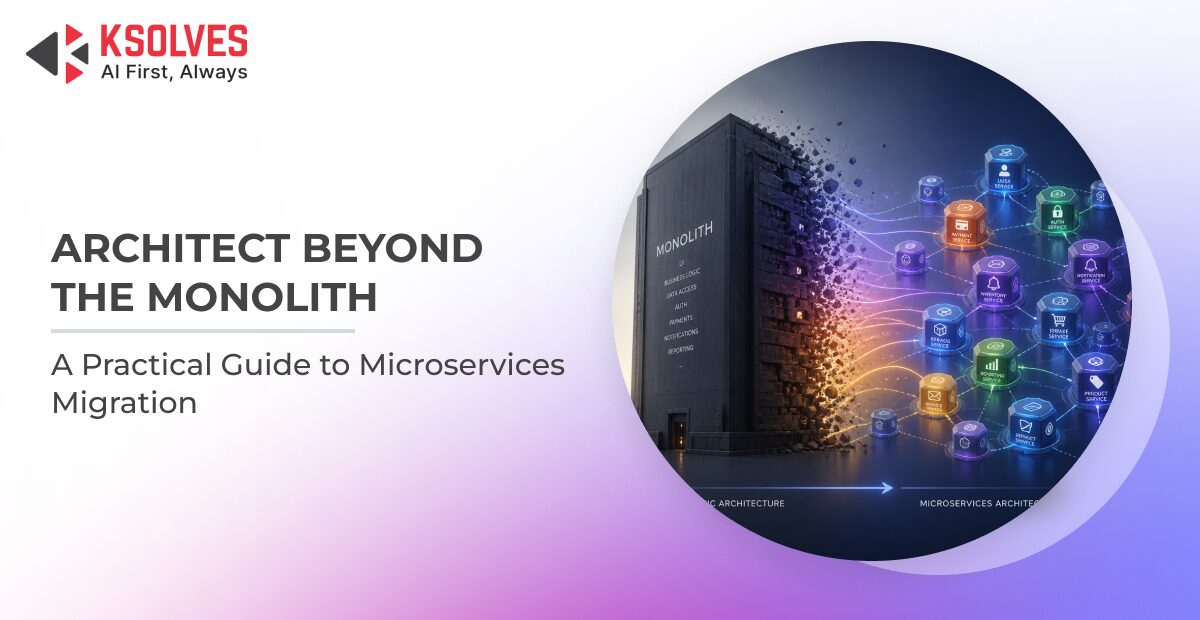
Most successful software products begin as monoliths. A single codebase is easier to develop, test, and deploy, allowing teams to deliver features quickly without the complexity of distributed systems. Many of today’s largest technology companies, including Amazon, Netflix, and Uber, started with monolithic architectures before evolving as their applications and engineering organisations grew.
The challenge begins when the architecture can no longer keep pace with the business. As the codebase expands, deployments become slower, releases require greater coordination, and changes in one module start affecting others. Teams spend more time managing dependencies than delivering new functionality, while scaling individual components becomes increasingly difficult because the entire application must scale as one unit.
This is where organisations begin considering microservices. However, migrating from a monolith is an architectural and operational transformation. Success depends on identifying the right service boundaries, adopting new deployment and monitoring practices, and modernising incrementally without disrupting business operations.
This guide explores the practical lessons learned from real-world monolith-to-microservices migrations, including when migration makes sense, how to approach it strategically, and the common pitfalls to avoid.
What is a Monolithic Architecture?
A monolithic architecture is an application where the user interface, business logic, APIs, and data access layer are developed and deployed as a single unit. Although the application may contain multiple functional modules, such as user management, inventory, payments, and reporting, they typically share the same codebase, deployment pipeline, and database.
For many organisations, this architecture offers significant advantages:
- Simple development and deployment.
- Easier testing and debugging.
- Lower operational overhead.
- Centralised transaction management.
- Faster feature delivery for smaller teams.
These benefits make monoliths an excellent choice for startups and products in their early growth stages.
However, as applications and engineering teams grow, the architecture often becomes increasingly difficult to maintain. Deployments take longer, modules become tightly coupled, regression risks increase, and scaling specific parts of the application independently becomes impossible. What once accelerated development gradually begins slowing it down.
Why Organisations Move to Microservices
Most organisations adopt microservices because their business and engineering teams have outgrown the limitations of a monolithic architecture, not because monoliths are inherently flawed.
1. Growing Teams, Shared Bottlenecks
As development teams expand, multiple teams begin working on different business capabilities simultaneously. In a monolith, they still share the same codebase and release process, meaning one delayed feature or failed test can postpone the entire release.
Over time, deployments become larger, slower, and increasingly difficult to coordinate.
2. Tight Coupling Increases Risk
In mature monoliths, modules often share business logic and database schemas. A seemingly minor change in one area can introduce unexpected issues elsewhere, increasing regression testing efforts and reducing release confidence. Teams naturally become more cautious, slowing the pace of innovation.
3. Scaling Becomes Inefficient
A monolithic application scales as a single unit. If only the search functionality experiences a spike in traffic, the entire application must often be replicated to handle the additional load.
Microservices allow individual services to scale independently, improving resource utilisation and operational efficiency.
4. Technology Evolution Becomes Difficult
As business requirements evolve, organisations may want to introduce specialised technologies. For example, Python for AI workloads or Go for high-performance services.
Within a monolith, adopting multiple technology stacks is challenging because every module shares the same runtime environment. Microservices provide the flexibility for individual services to evolve independently when appropriate.
5. Independent Deployments Enable Faster Delivery
Modern businesses release software continuously. In a monolith, even a small enhancement to one module typically requires redeploying the entire application.
Microservices reduce this dependency by allowing individual services to be built, tested, and deployed independently, enabling faster releases with lower operational risk.
Also Read: Top 10 Benefits of Microservices: How Modern Architecture Boosts Business Agility
Signs Your Monolith Has Reached Its Limits
Not every application needs microservices. However, if the following challenges have become recurring rather than occasional, it may be time to evaluate a migration strategy:
- Releases require coordination across multiple teams.
- Deployment windows continue to grow.
- Changes in one module frequently affect others.
- Different parts of the application have vastly different scaling requirements.
- Engineering teams spend more time resolving dependencies than building features.
- Business growth is being constrained by slow software delivery.
These are often signs that the organisation has outgrown its existing architecture.
That said, microservices are not a universal solution. In many cases, a well-structured modular monolith remains the better choice.
When You Should Not Migrate to Microservices
Microservices have become the default architecture for many modern applications, but that doesn’t mean they are the right choice for every organisation. In fact, some of the most successful software systems continue to run as well-designed monoliths because their business requirements don’t justify the added complexity of a distributed architecture.
Before committing to a migration, ask a simple question:
Is the architecture limiting the business, or are we solving a problem that doesn’t exist?
If your application is stable, your deployment process is efficient, and your engineering teams aren’t experiencing significant coordination challenges, migrating to microservices may introduce more problems than it solves.
A migration may not be the right choice if:
- Your engineering team is relatively small and can collaborate effectively within a single codebase.
- Releases are infrequent and rarely cause deployment issues.
- The application has predictable workloads with no need to scale individual components independently.
- Operational maturity around CI/CD, monitoring, and DevOps is still developing.
- Business priorities favour rapid feature delivery over architectural modernisation.
For many organisations, improving modularity within the existing monolith delivers greater value than introducing dozens of independently deployed services.
The goal should always be to solve business problems, not to adopt microservices because they have become an industry trend.
Also Read: When to Use Microservices Architecture for Your Application
Monolith vs Microservices: Understanding the Trade-offs
Neither architecture is universally better. Each excels under different conditions, and choosing the right one depends on your product, team structure, and operational maturity.
| Aspect | Monolithic Architecture | Microservices Architecture |
| Deployment | Single application deployment | Independent deployment for each service |
| Scalability | Entire application scales together | Individual services scale independently |
| Team Ownership | Shared ownership across teams | Clear ownership of business capabilities |
| Technology Stack | Typically one technology stack | Different services can use different technologies |
| Fault Isolation | Failures can impact the entire application | Failures are generally isolated to individual services |
| Data Management | Shared database | Database per service (recommended) |
| Operations | Simpler infrastructure | Higher operational complexity |
| Development Speed | Faster for smaller teams | Better suited for large, distributed teams |
Also Read: Monolithic vs Microservices: What’s the Major Difference?
A common misconception is that microservices automatically improve performance. In reality, they replace in-process communication with network communication, introducing latency, distributed failures, and operational overhead. The primary advantage is independent development, deployment, and scalability, not faster application performance.
Planning the Migration Before Writing Code
Many organisations begin a migration by extracting code. Successful organisations begin by understanding their business domains.
The planning phase often determines whether a migration succeeds or becomes an expensive, long-running rewrite. Before extracting the first service, teams should develop a clear understanding of the existing application, its dependencies, and the business capabilities it supports.
A structured assessment should answer questions such as:
- Which modules change most frequently?
- Which business capabilities experience the highest traffic?
- Where are the biggest deployment bottlenecks?
- Which modules have the fewest dependencies?
- Which services would benefit most from independent scaling?
These answers help identify the best candidates for extraction while reducing migration risk.
Equally important is understanding team structure. Conway’s Law suggests that software architecture naturally reflects organisational communication patterns. If teams cannot own services independently, simply introducing microservices will not eliminate coordination challenges.
Finding the Right Service Boundaries
One of the biggest reasons microservices migrations fail is that organisations split applications based on technical layers rather than business capabilities.
For example, creating services such as:
- User Service
- Database Service
- API Service
may appear logical from a technical perspective, but these services often remain tightly coupled because they represent implementation layers rather than independent business functions.
Instead, services should align with bounded contexts, a core principle of Domain-Driven Design (DDD). Each service should own a distinct business capability, its data, and its lifecycle.
For an eCommerce platform, natural service boundaries might include:
- Order Management
- Inventory
- Payments
- Shipping
- Customer Accounts
- Notifications
Each of these domains can evolve independently while exposing well-defined APIs to the rest of the system.
One of the most effective techniques for identifying these boundaries is Event Storming. By bringing together architects, developers, product owners, and domain experts to map business events and workflows, teams can identify natural boundaries before writing any migration code.
The resulting architecture is typically far more resilient than one derived solely from database schemas or existing code modules.
A Practical Monolith-to-Microservices Migration Roadmap
Successful migrations are evolutionary rather than revolutionary. Instead of replacing the entire application at once, organisations should modernise incrementally while continuing to deliver business value.
A practical migration roadmap looks like this:
Step 1: Assess the Existing Architecture
Identify tightly coupled modules, deployment bottlenecks, technical debt, and business-critical workflows. This establishes the migration priorities.
Step 2: Strengthen Observability
Before introducing distributed systems, implement centralised logging, monitoring, and distributed tracing. If a request cannot be traced through today’s application, diagnosing issues across multiple services will become significantly harder.
Step 3: Identify Service Boundaries
Use Domain-Driven Design, business capability mapping, and Event Storming workshops to define services that can operate independently.
Step 4: Introduce an API Gateway
Place an API Gateway in front of the application to provide a single entry point for routing, authentication, rate limiting, and traffic management. This becomes the foundation for incremental migration.
Step 5: Extract Low-Risk Services First
Begin with loosely coupled capabilities such as notifications, search, or reporting. Early successes help validate the architecture while minimising business risk.
Step 6: Adopt Event-Driven Communication
As services become independent, replace tightly coupled synchronous interactions with asynchronous messaging where appropriate. This improves resilience and reduces inter-service dependencies.
Step 7: Continuously Measure and Optimise
Migration is not complete when the monolith disappears. It is complete when the new architecture delivers measurable improvements in deployment speed, scalability, reliability, and team productivity.
The Strangler Fig Pattern in Practice
One of the biggest mistakes organisations make is attempting a complete rewrite of the monolith before delivering any value. Large-scale rewrites often take years, introduce significant risk, and leave little room for validating architectural decisions along the way.
The Strangler Fig Pattern offers a safer, incremental approach.
Instead of replacing the application all at once, new functionality is built as independent services while the existing monolith continues to handle the remaining workloads. An API Gateway or reverse proxy routes requests to either the monolith or the new services, allowing traffic to shift gradually as each capability is extracted.
For example, an eCommerce platform might follow this sequence:
- Route notification requests to a new Notification Service.
- Extract the Search Service and redirect search traffic.
- Move payment processing to an independent Payment Service.
- Separate inventory management.
- Gradually retire the remaining monolithic components.
Because traffic is redirected through the gateway, rolling back a problematic service is often as simple as changing a routing rule rather than redeploying the entire application.
This incremental strategy allows organisations to validate each service under real production workloads, reduce migration risk, and continue delivering new features throughout the transformation instead of waiting for a “big bang” release.
The Data Consistency Problem Nobody Warns You About
One of the biggest architectural changes during a microservices migration is how data is managed.
In a monolith, modules typically share a single database, allowing multiple operations to complete within a single ACID transaction. If any step fails, the entire transaction is rolled back automatically, keeping the application consistent.
Once those modules become independent services with their own databases, that guarantee disappears. A business process such as placing an order now spans multiple services, each responsible for its own data and transactions.
Consider a simple order workflow:
- Order Service creates an order.
- Inventory Service reserves stock.
- Payment Service processes payment.
- Shipping Service schedules delivery.
If payment fails after inventory has already been reserved, the system must determine how to recover. Unlike a monolith, there is no single transaction that can roll everything back.
This is why distributed data consistency becomes one of the most challenging aspects of a microservices architecture.
Equally important is recognising that eventual consistency is a business decision, not just a technical one. Whether a customer can briefly see an order in a “Pending” state while payment is confirmed is something product owners, architects, and engineering teams should agree on early in the design process.
Solving Distributed Transactions with the Saga Pattern
Since traditional database transactions don’t work across independent services, microservices rely on the Saga Pattern to coordinate long-running business processes.
Instead of executing one global transaction, each service performs its own local transaction. If a later step fails, previously completed actions are reversed through compensating transactions.
For the same order workflow:
- Order Service creates the order.
- Inventory Service reserves stock.
- Payment Service processes payment.
- Shipping Service creates the shipment.
If payment is declined, the workflow doesn’t roll back automatically. Instead:
- Inventory releases the reserved stock.
- The order is cancelled.
- The customer is notified.
The system reaches a consistent state without requiring a distributed database transaction.
There are two common ways to implement Sagas:
- Choreography
Each service publishes and listens for events independently.
Advantages
- No central coordinator
- Loosely coupled services
- Simple for smaller workflows
Challenges
- Difficult to understand complex business flows
- Event chains become harder to trace as systems grow
b. Orchestration
A central orchestrator manages the sequence of service interactions.
Advantages
- Better visibility into business workflows
- Easier error handling
- Simpler to monitor and modify
Challenges
- Introduces a coordinating component
- Requires careful design to avoid becoming a bottleneck
The choice depends on system complexity, but both approaches are widely adopted in enterprise microservices architectures.
Database Strategy: Shared Database vs Database per Service
Database design is another critical decision during migration.
Many teams initially retain a shared database because it appears to simplify the transition. While this reduces short-term effort, it also preserves one of the biggest problems of a monolith – tight coupling.
a. Shared Database
Benefits
- Easier initial migration
- Simpler reporting
- Familiar data model
Challenges
- Services remain tightly coupled
- Schema changes affect multiple teams
- Independent deployments become difficult
- Data ownership becomes unclear
b. Database per Service
In a mature microservices architecture, each service owns its own database and controls how its data is stored and accessed.
Benefits
- Independent deployments
- Clear ownership
- Better scalability
- Technology flexibility
Challenges
- Data duplication
- Cross-service reporting becomes more complex
- Eventual consistency must be managed
Rather than querying another service’s database directly, services communicate through APIs or events. Although this requires additional design effort, it preserves service autonomy and prevents hidden dependencies from emerging over time.
API Gateways: The Front Door to Your Services
As applications evolve into dozens of independent services, exposing every service directly to clients quickly becomes difficult to manage.
An API Gateway provides a single entry point for all client requests, handling common concerns before traffic reaches backend services.
Typical responsibilities include:
- Request routing
- Authentication and authorisation
- Rate limiting
- SSL termination
- API versioning
- Request aggregation
- Traffic management
During a migration, the gateway plays an even more important role. It enables the Strangler Fig Pattern by routing some requests to the existing monolith while directing others to newly extracted services. As more capabilities are migrated, routing rules can be updated without affecting clients.
This abstraction allows organisations to modernise incrementally while maintaining a consistent external API.
Common Mistakes That Derail Microservices Migration
Many migration challenges are not caused by technology but by poor planning and unrealistic expectations.
Some of the most common mistakes include:
- Splitting services around technical layers instead of business capabilities.
- Attempting a complete “big bang” rewrite instead of migrating incrementally.
- Allowing multiple services to share the same database.
- Overusing synchronous communication, creating tightly coupled services.
- Ignoring observability until production issues appear.
- Underestimating the operational maturity required to manage distributed systems.
- Treating microservices as a solution for every application.
Avoiding these pitfalls can significantly reduce migration risk and improve long-term maintainability.
Is Your Organisation Ready for Microservices?
Before beginning a migration, assess whether your organisation is prepared for the operational and architectural changes that microservices require.
Ask yourself:
- Do multiple teams need to deploy independently?
- Are deployment bottlenecks affecting business agility?
- Do different parts of the application have different scaling requirements?
- Do you have mature CI/CD and monitoring practices?
- Can teams independently own and support individual services?
If the answer to most of these questions is yes, microservices may be the right evolution. If not, investing in a better-structured modular monolith could deliver greater value with far less complexity.
Accelerate Your Monolith to Microservices Migration with Ksolves
A successful microservices migration is measured by how seamlessly your business continues to operate while your architecture evolves. That’s where the right implementation partner makes the difference.
At Ksolves, an AI-driven microservices development company, we help enterprises modernise legacy applications through incremental, low-risk migration strategies that minimise disruption and deliver measurable business outcomes.
From assessing application readiness and defining service boundaries to containerising workloads and implementing cloud-native platforms, we guide organisations through every stage of the transformation journey.
Our expertise spans:
- Legacy application assessment and modernisation.
- Microservices architecture and domain-driven design.
- API-first integration and event-driven architectures.
- Kubernetes and OpenShift consulting.
- CI/CD automation and DevOps enablement.
- Performance optimisation, monitoring, and observability.
Conclusion
Migrating to microservices is not about adopting a new architecture—it’s about enabling faster innovation, independent deployments, and long-term scalability. Success comes from defining the right service boundaries, modernising incrementally, and building a strong operational foundation.
With a well-planned migration strategy, organisations can reduce technical debt, improve agility, and modernise legacy applications without disrupting business operations.
Ready to Modernise Your Applications with Ksolves?

































AUTHOR
Microservices
Share with