



Why Responsive Design Matters in Mobile App Development
Mobile App Development
5 MIN READ
January 16, 2026

In an era where over 60% of global web traffic comes from mobile devices, delivering a flawless experience across smartphones and tablets has become non-negotiable. Whether it’s shopping, learning, consulting, or entertainment, users expect apps to load quickly, look clean, and respond seamlessly across devices. This is where responsive design becomes essential. This blog will explore why responsive design is crucial in mobile app development, the key elements that make it effective, and how it benefits both users and businesses.
Why Responsive Design Matters in Modern Mobile Apps
Responsive design helps apps adapt to various screen sizes, operating systems, and resolutions. From large tablets to compact smartphones, it guarantees that every user sees optimized content without sacrificing visual quality or functionality. Below are the reasons why responsive design matters so much in mobile apps:
1. Enhancing User Experience (UX)
User experience is the backbone of app success. A responsive mobile app ensures effortless navigation, readable text, correctly scaled visuals, and smooth interactions. When apps respond correctly to the device’s orientation and screen size, users enjoy a frictionless browsing experience. Improved UX leads to higher engagement, better retention, and stronger customer loyalty.
2. Supporting Cross-Platform Compatibility
With users switching between Android, iOS, and sometimes Windows devices, responsive design helps maintain consistent usability everywhere. It reduces the need for separate layouts for different screen sizes, enabling a unified, scalable interface. This not only saves development time but also simplifies long-term maintenance, a crucial advantage for product teams.
3. Improving App Performance & Load Speed
Performance is a significant factor that determines whether a user stays or leaves. Responsive mobile design ensures faster loading by using flexible grids, optimized images, and adaptive elements. Lightweight UI components reduce bounce rates and improve app flow. Better performance ultimately results in higher customer satisfaction and stronger app store ratings.
4. Boosting Accessibility for All Users
Accessibility is now a non-negotiable element of design. Responsive mobile apps adapt to user preferences, including text scaling, dark mode, screen zooming, and assistive tools. This inclusiveness helps businesses reach audiences of all age groups and abilities, widening their digital presence and brand trust.
Key Elements of Effective Responsive Mobile Design
Creating a truly responsive mobile app requires more than just resizing screens. It involves strategic UI/UX decisions that ensure smooth, consistent, and intuitive interactions across devices. The following elements form the foundation of effective responsive design:
1. Flexible Layouts & Adaptive Grids
Modern apps rely on adaptive grids that automatically reorganize UI components. This ensures that buttons, menus, and content blocks remain properly aligned across devices. Flexible layouts enhance visual harmony and prevent interface clutter.
2. Scalable Images & Media Queries
Responsive images ensure that graphics remain crisp without slowing down the app. Media queries allow developers to tailor visuals, fonts, and layout structures based on screen size and orientation. This technique is essential for both performance and aesthetics.
3. Touch-Friendly Interactions
Since mobile devices rely on touch gestures, elements like tap targets, buttons, and sliders must be optimized for finger-based navigation. Responsive design ensures that interactive elements aren’t too small or too close together, preventing user frustration.
4. Mobile-First Design Approach
Designing for mobile screens first ensures that essential features are prioritized. The content is structured clearly, navigation is simplified, and the visual hierarchy remains consistent. Once the mobile version is optimized, scaling up for larger screens becomes easier and faster.
Business Benefits of Responsive Design in Mobile App Development
The advantages of responsive design go far beyond aesthetics. It directly impacts user acquisition, operational efficiency, and long-term growth. Here’s how:
1. Wider Audience Reach
When apps display flawlessly on all screen sizes, businesses automatically increase their user base. Responsive design ensures your audience doesn’t encounter usability issues on devices with lower resolutions or unusual aspect ratios.
2. Reduced Development & Maintenance Costs
Instead of building multiple layouts for different devices, responsive design enables reusable components and unified UI frameworks. This reduces development cycles, lowers costs, and keeps updates simple across platforms.
3. Improved SEO & App Store Visibility
Search engines prioritize mobile-friendly applications. Apps with responsive design load faster and perform better, meeting Google’s mobile-first indexing principles. This improves online visibility and increases the chance of being discovered by new users.
4. Higher Conversion Rates & User Retention
A responsive app that performs well builds trust and encourages users to stay longer. When navigation is seamless and purchasing workflows are smooth, conversion rates increase organically.
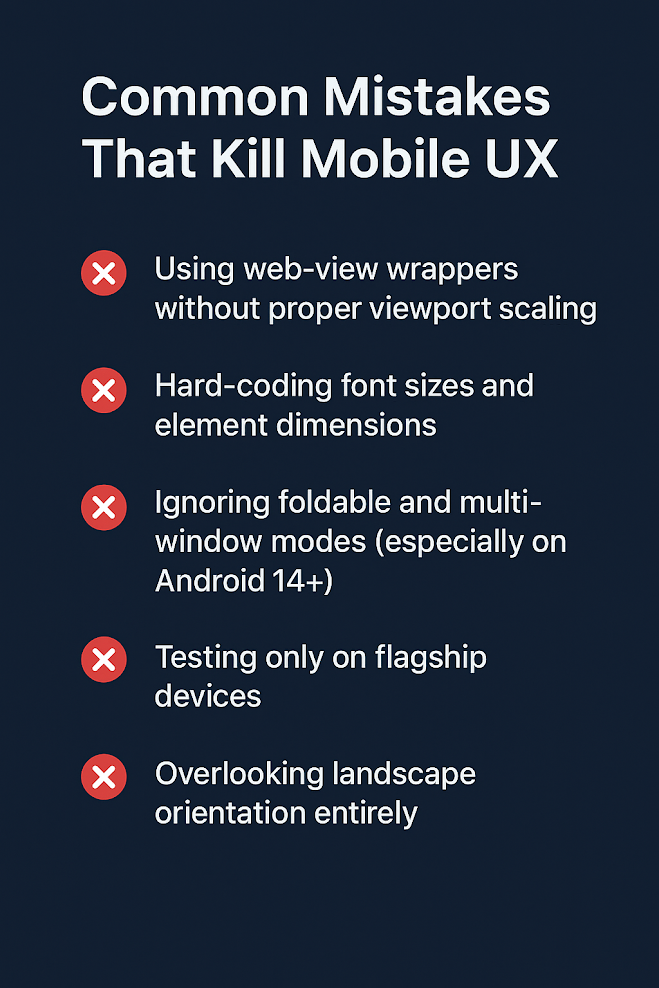
Common Mistakes That Kill Mobile UX
Ready to Build a Truly Responsive Mobile App?
Ksolves specializes in delivering high-performing mobile applications that work flawlessly across all devices. With a strong focus on UI/UX, performance optimization, and scalable architecture, our team ensures that your app not only looks great but also delivers exceptional functionality. We use modern frameworks, adaptive design principles, and deep industry expertise to help businesses build apps that stand out.
If you want to build a responsive, scalable, and feature-rich mobile application, Ksolves can help you achieve it. Our Cross Platform Mobile App Development Services ensure intuitive interfaces, seamless performance, and cross-device compatibility, built exactly to your needs and future growth goals.
Conclusion
Responsive design is essential for every modern mobile app. It improves usability, enhances performance, and ensures consistent experiences across devices. In a world where user expectations are constantly rising, businesses cannot afford to overlook responsive design. With the right development partner like Ksolves, you can create apps that deliver speed, accessibility, and convenience, all while staying future-ready.

 ksolves Team
Mobile applications have transformed the way customers interact with digital products. They function as persistent, high-frequency touchpoints that deliver personalized […]































Author
About the Author Editorial Team The Ksolves Editorial Team includes certified Salesforce experts, Big Data engineers, AI/ML specialists, Zoho consultants, and experienced technology writers focused on delivering clear, actionable insights for modern businesses. With hands-on experience across Salesforce, Big Data platforms, AI/ML solutions, application development, software testing, and Zoho ERP/CRM, the team publishes practical guides, real-world use cases, and industry updates that support smarter decisions and faster growth. Every article is created to solve business challenges, guide technology adoption, and keep organizations aligned with evolving digital ecosystems.
Share with