



Build and Scale a Profitable Multi-Vendor Store with Odoo WooCommerce Connector
Odoo
5 MIN READ
October 5, 2026

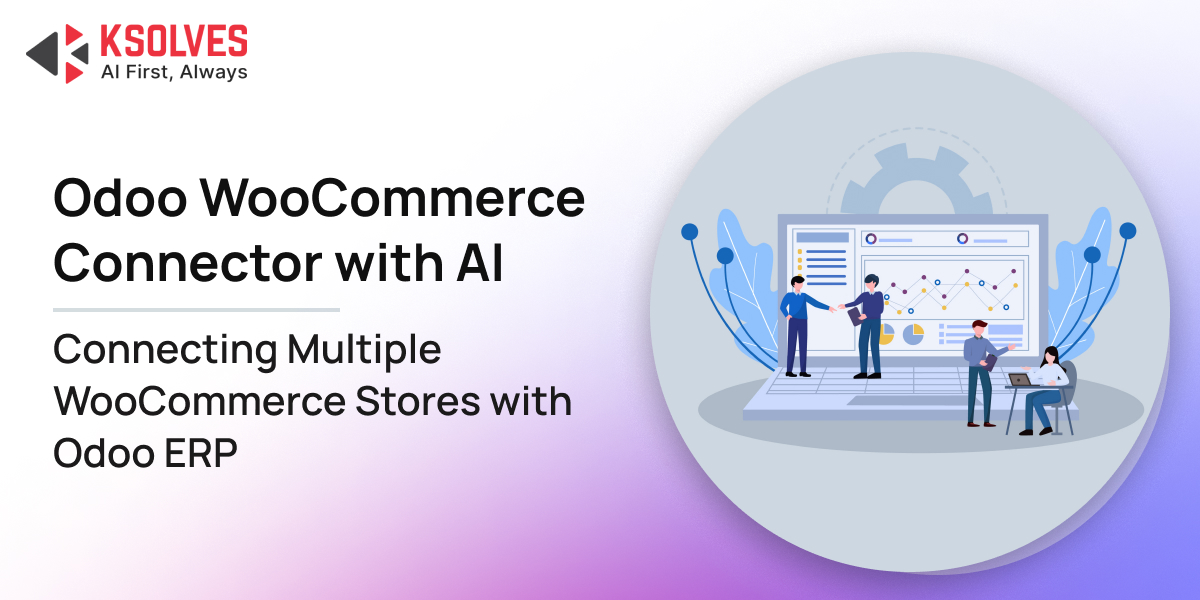
Scaling a multi-vendor WooCommerce marketplace is not just about adding more sellers and products. As orders, inventory, customers, and storefronts multiply, disconnected systems can quickly turn routine operations into a manual, error-prone process.
Odoo WooCommerce Connector with AI brings WooCommerce and Odoo together to create a more connected eCommerce operation. Businesses can synchronize products, inventory, customers, orders, payments, and other data while managing multiple WooCommerce stores from a single Odoo database.
What makes the connector more powerful is its AI-powered error explanation capability. When synchronization fails, Azure OpenAI analyzes the error and translates complex technical messages into clear, actionable guidance, helping teams troubleshoot issues faster and keep operations moving.
Why Multi-Vendor WooCommerce Businesses Need a Connected ERP
A growing marketplace can quickly accumulate large volumes of operational data. Products may be added or updated in WooCommerce, orders may arrive continuously, inventory may change in Odoo, and customers may interact with different storefronts.
When these systems are managed manually, teams often need to:
- Re-enter product and customer information.
- Import orders manually.
- Update inventory across platforms.
- Check whether synchronization operations have completed successfully.
- Investigate failed imports or exports.
- Process invoices and payments separately.
- Monitor multiple WooCommerce stores individually.
Connecting WooCommerce with Odoo creates a centralized operational layer where businesses can synchronize key data, automate routine workflows, monitor integration activity, and manage multiple WooCommerce stores from one Odoo database.
Managing multiple WooCommerce stores? Try Odoo WooCommerce Connector with AI!
Why WooCommerce Works for Multi-Vendor Marketplaces
WooCommerce is a popular eCommerce platform for businesses that need flexibility and control over their online storefronts. Its WordPress foundation and extensive ecosystem allow businesses to customize the shopping experience and extend functionality through plugins and integrations.
- Flexible Storefront and Customization
WooCommerce allows businesses to customize their storefront using themes, plugins, custom fields, and development. This flexibility is useful for marketplace businesses with specific product, customer, checkout, or operational requirements. - Scalable eCommerce Foundation
As businesses expand their product catalogues and transaction volumes, WooCommerce can be extended with additional functionality to support evolving eCommerce requirements. - Extensive Plugin Ecosystem
WooCommerce supports a broad ecosystem of plugins and integrations covering payments, shipping, marketing, analytics, marketplace functionality, and other eCommerce requirements. - Cost-Effective eCommerce Platform
WooCommerce is built on an open-source foundation, allowing businesses to select the functionality and extensions they need rather than relying on a single fixed platform configuration.
However, a flexible storefront still needs a reliable backend to manage the growing volume of business data. This is where connecting WooCommerce with Odoo becomes valuable.
How Odoo WooCommerce Connector with AI Simplifies Multi-Vendor Operations
The Odoo WooCommerce Connector with AI connects WooCommerce stores with Odoo and enables businesses to synchronize important eCommerce data between both platforms.
Rather than treating WooCommerce and Odoo as isolated systems, businesses can use Odoo as a centralized operational environment while continuing to use WooCommerce for their online storefronts.
1. Connect Multiple WooCommerce Stores to One Odoo Database
Businesses operating multiple WooCommerce storefronts can connect them to a single Odoo database.
This provides a centralized environment for managing synchronized data across different WooCommerce instances instead of maintaining separate backend processes for every store.
For businesses operating multiple brands, regions, product categories, or storefronts, this can simplify administration and provide greater operational consistency.
2. Enable Bidirectional Product Synchronization
Product information can move between WooCommerce and Odoo in both directions.
The connector supports synchronization of:
- Products and product variants.
- Product attributes and attribute values.
- Product categories.
- Product tags.
- Product display images.
- Product gallery images.
Businesses can import products from WooCommerce into Odoo or export products from Odoo to WooCommerce based on their operational requirements.
The connector also allows users to publish or unpublish products in WooCommerce directly from Odoo, reducing the need to perform the same activity separately in the storefront.
3. Keep Stock Levels Synchronized
Inventory accuracy is critical for eCommerce businesses. Selling products based on outdated stock information can result in overselling, order delays, and customer dissatisfaction.
The connector supports bidirectional stock-level synchronization between WooCommerce and Odoo.
This allows businesses to keep product stock information aligned across both systems and reduce the need for repetitive manual inventory updates.
4. Automate the WooCommerce Order Lifecycle
Orders are one of the most important data flows between an eCommerce storefront and an ERP.
The connector can import WooCommerce orders, including shipped and unshipped orders, into Odoo. Businesses can also update WooCommerce order statuses from Odoo.
The connector supports automated order workflows for activities such as:
- Validating orders.
- Creating invoices.
- Registering payments.
- Forcing invoice dates where required.
- Confirming shipments.
This allows businesses to reduce repetitive order-processing activities and create a more structured flow from online purchase to fulfillment.
5. Automate Data Synchronization with Webhooks
Manual synchronization is useful when businesses need controlled imports or exports. However, many operational events need to be reflected in Odoo automatically.
The connector supports webhook-based synchronization for WooCommerce events involving:
- Orders
- Products
- Customers
- Coupons
When supported records are created or updated in WooCommerce, webhook actions can automatically initiate synchronization with Odoo.
This reduces dependence on users repeatedly checking for changes and manually initiating imports.
6. Use Flexible Import and Export Controls
Businesses can also control synchronization manually when required.
The connector provides multiple options for importing and exporting data:
- Import/Export All
- Specific ID Filter
- Date Filter
This provides flexibility for different operational scenarios. For example, a business can synchronize an entire dataset, process selected records, or limit synchronization to a particular date range.
The direction of synchronization can also be configured according to the business workflow, whether it is WooCommerce to Odoo, Odoo to WooCommerce, or bidirectional.
7. Manage Payments and Refunds from Odoo
Order processing often involves more than simply importing order information.
The connector supports the import of payment gateway information associated with WooCommerce orders into Odoo.
Businesses can also initiate refunds from Odoo when an order requires a refund, helping keep post-sale activities within the ERP environment.
8. Map WooCommerce Custom Fields to Odoo
Different businesses may capture information in WooCommerce that does not directly correspond to standard Odoo fields.
The connector’s Meta Mapping functionality allows users to map WooCommerce custom fields to Odoo fields while importing or exporting data.
This provides greater flexibility when the standard data structure does not fully match a business’s operational requirements.
Also Read: Syncing Odoo with WooCommerce for Seamless Wholesale Operations
AI-Powered Error Explanation: Smarter WooCommerce-Odoo Troubleshooting
Integration failures can be difficult to troubleshoot, especially when technical error messages require developer expertise to interpret. The Odoo WooCommerce Connector’s AI-powered error explanation uses Azure OpenAI to turn complex synchronization errors into clear, actionable insights.
What is AI-Powered Error Explanation?
The connector analyzes Python errors from failed WooCommerce-Odoo synchronization operations and generates easy-to-understand explanations. Users can get:
- Plain-language error explanations.
- Possible causes and relevant context.
- Actionable troubleshooting guidance.
- Resolution steps for common issues.
This helps both technical and non-technical teams understand failures and respond faster.
How AI-Powered Debugging Works
Synchronization Failure → Failed Log → Error Analysis → AI Explanation → Troubleshooting Guidance
When a synchronization fails, the connector captures the error in its logs. The AI then analyzes the error and available business context to generate a relevant explanation. Users can also request explanations for historical failed logs without reproducing the original issue.
Key AI Capabilities
-
Real-Time & Historical Error Explanations: Get AI-generated explanations for newly failed operations or previously recorded logs.
-
Context-Aware Troubleshooting: The system considers available business context to provide more relevant guidance.
-
Error Detection and Categorization: Errors are identified and categorized before generating an explanation, helping streamline troubleshooting.
-
Customizable AI Prompts: Businesses can customize prompts to generate guidance suited to their specific domain and requirements.
-
Secure Configuration: Azure OpenAI credentials can be managed through Odoo’s system parameters.
-
Focused AI Usage: AI explanations are generated for failed logs, keeping AI usage focused on troubleshooting rather than routine successful operations.
Ready to Scale Your WooCommerce Operations with Less Manual Work?
Visibility and Monitoring for WooCommerce-Odoo Synchronization
Automation is most effective when businesses can also see what is happening within the integration.
The connector provides several tools for monitoring synchronization activity.
1. Failed Job Logs
Failed logs allow users to track import and export operations that did not complete successfully.
These logs provide a starting point for investigating synchronization failures, while the AI-powered error explanation capability can help users understand the technical issue.
2. Webhook Logs
Webhook logs provide visibility into webhook activities performed at the WooCommerce end.
This can be useful when investigating whether a WooCommerce event triggered the expected synchronization activity in Odoo.
3. Informative Dashboard
The connector dashboard provides a visual overview of synchronization activity.
Users can monitor:
- New states
- Failed states
- Progress states
- Completed states
- Successfully synchronized domain counts
The information can be represented using bar charts or line charts, giving users a quick view of synchronization activity across supported domains.
4. Sales Reporting
Businesses can generate sales reports for a particular WooCommerce instance.
For organizations managing multiple stores, store-level reporting can provide additional visibility into sales activity without requiring users to work exclusively from individual WooCommerce dashboards.
Also Read: How Odoo WooCommerce Connector with AI Helps You Increase Sales
Odoo WooCommerce Connector with AI vs. Manual Multi-Store Management
| Operational Area | Manual Management | Odoo WooCommerce Connector |
|---|---|---|
| Product Updates | Repetitive manual updates | Bidirectional synchronization |
| Inventory | Manual stock updates | Bidirectional stock synchronization |
| Orders | Manual imports and processing | Automated and webhook-based synchronization |
| Multiple Stores | Separate store management | Multiple WooCommerce stores in one Odoo database |
| Failed Operations | Manual investigation | Failed logs with AI-powered explanations |
| Order Processing | Repetitive activities | Configurable automated workflows |
| Custom Fields | Manual handling | Meta Mapping |
| Payments | Separate platform management | Payment information imported into Odoo |
| Refunds | Separate processing | Refund initiation from Odoo |
| Reporting | Store-by-store visibility | Odoo-based sales reporting |
| Webhook Activity | Limited visibility | Dedicated webhook logs |
Conclusion
Scaling a multi-vendor WooCommerce business requires more than managing a growing product catalogue. Businesses need connected systems that can synchronize data, automate repetitive workflows, and provide visibility across stores.
The Odoo WooCommerce Connector with AI brings these capabilities together through bidirectional synchronization, webhook automation, centralized store management, and integrated monitoring. With AI-powered error explanations, businesses can also understand and troubleshoot failed synchronization operations faster.




























AUTHOR
Odoo
Neha Negi, Presales and Business Associate Head at Ksolves is a results-driven ERP consultant with over 8 years of expertise in designing and implementing tailored ERP solutions. She has a proven track record of leading successful projects from concept to completion, driving organizational efficiency and success.
Share with