



Odoo API Integration: How to Connect Odoo With Other Systems
Odoo
5 MIN READ
September 14, 2026

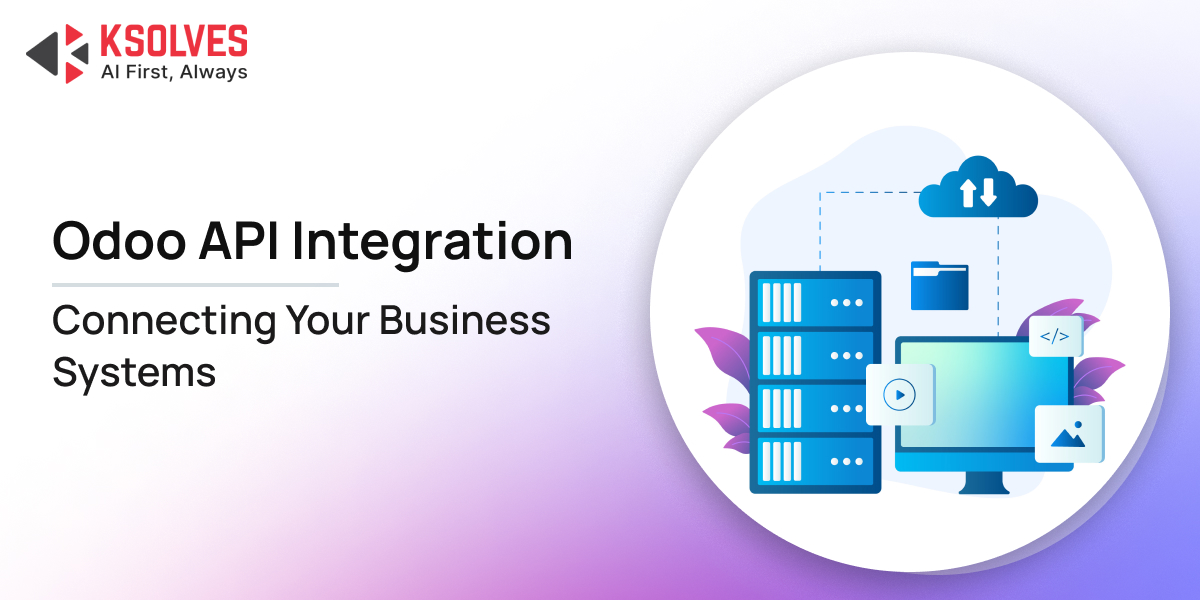
Odoo is often at the center of business operations, but it rarely works alone. Orders may come from an e-commerce platform, payments from a separate gateway, shipments from a logistics system, and customer data from another application.
Without integration, teams end up moving data manually between these systems, creating duplicate work, delays, and inconsistent records.
Odoo API integration connects these systems so data can move between them automatically. An online order, for example, can flow into Odoo, trigger sales and inventory processes, and send relevant updates back to the connected platform.
However, effective integration is not just about connecting two APIs. It requires the right data mapping, authentication, error handling, synchronization logic, and integration architecture.
What is Odoo API Integration?
Odoo API integration connects Odoo with external applications, platforms, databases, or services, allowing them to exchange data and automate business workflows. Instead of moving information manually between systems, APIs enable data to flow between them based on defined rules and processes.
For example, when a customer places an order on an e-commerce platform, the integration can send the order details to Odoo, where the corresponding sales order can be created, and inventory processes can be triggered. Relevant updates can then be shared back with the connected system.
Depending on the business requirements, an Odoo integration can synchronize:
- Customer and contact information.
- Products and pricing.
- Sales and purchase orders.
- Invoices and payments.
- Inventory and stock levels.
- Shipping and delivery updates.
The scope of the integration depends on which systems are connected, what data needs to be exchanged, how frequently it should sync, and which system should act as the source of truth.
Which APIs Does Odoo Support?
Odoo provides external API capabilities that allow external applications to interact with Odoo data and business models. The available API mechanisms and recommendations can vary by Odoo version and deployment, so the implementation should always be based on the specific Odoo version being used.
1. External API Options
Odoo has traditionally supported RPC-based external API approaches, allowing external applications to authenticate with Odoo and interact with its models and methods.
For businesses requiring a REST-style interface, REST APIs can also be implemented through custom Odoo development or appropriate integration extensions, depending on the project requirements.
The choice depends on factors such as:
- Odoo version.
- Integration architecture.
- External system requirements.
- Security requirements.
- Data volume.
- Real-time requirements.
- Existing connectors or middleware.
2. Odoo Models and Fields
A key concept in Odoo integration is the model.
Odoo stores different types of business records through models. For example:
- res.partner: contacts and customers
- sale.order: sales orders
- product.product: product variants
- account.move: invoices and other accounting documents
An integration needs to understand which models and fields should be read, created, or updated.
For example, an external order may need to be mapped to an Odoo sale.order, while customer information may need to be mapped to res.partner.
Which Systems Can You Integrate With Odoo?
Odoo can be connected with a wide range of external systems, including:
- E-commerce Platforms
Synchronize products, customers, orders, inventory, and fulfillment information between Odoo and online stores. - Payment Gateways
Connect payment systems to support transaction updates, payment reconciliation workflows, and order processing. - CRM and Sales Platforms
Exchange customer, lead, opportunity, and sales information between Odoo and external CRM systems. - Accounting and Financial Systems
Synchronize relevant financial records where Odoo needs to exchange information with another accounting or financial platform. - Inventory and Warehouse Systems
Connect warehouse management systems, scanners, logistics applications, and other inventory-related platforms. - Shipping and Logistics Platforms
Send shipment information to logistics providers and receive tracking or delivery updates. - Marketplaces
Synchronize marketplace orders, product information, inventory, and customer data with Odoo. - Custom Applications and Databases
Businesses can also connect proprietary applications, databases, portals, and internal systems with Odoo through suitable integration methods.
Also Read: Integrating Shopify with Odoo: A Step-by-Step Guide for eCommerce Success
How Odoo API Integration Works
Odoo API integration acts as a communication layer between Odoo and external systems, allowing them to exchange information and trigger actions without constant manual intervention.
A simplified integration flow looks like this:
External System → API Request → Authentication → Odoo Model/Method → RBAC Validation ->Data Processing → Response → External System
While the basic flow is straightforward, the underlying architecture can become more sophisticated when multiple systems, middleware, webhooks, queues, or high-volume data are involved.
1. Authentication
Before exchanging data, the external system must authenticate with Odoo using the authentication method supported by the chosen API and Odoo version.
Access permissions should follow the principle of least privilege, ensuring the integration can access only the data and operations it actually needs.
2. Sending an API Request
Once authenticated, the external system sends a request to Odoo. The request may ask Odoo to retrieve existing information or provide data needed to create or update a record.
For example, an e-commerce platform may send customer and order details to Odoo after a purchase.
3. Odoo Processes the Request
Odoo identifies the relevant model and method based on the request. It can then search for existing records, create new records, update information, or execute a business operation.
The request is processed according to Odoo’s data structure, access rights, and configured business rules.
4. Odoo Returns a Response
After processing the request, Odoo sends a response to the external system. Depending on the operation, the response may contain the requested data, a newly created record ID, an update confirmation, or an error.
5. Handling Errors
Not every API request will succeed. Missing fields, invalid data, authentication issues, permission problems, network failures, or business-rule violations can interrupt synchronization.
A reliable integration should log these failures, identify the affected transaction, and provide appropriate retry or reconciliation mechanisms rather than allowing data to be silently lost.
Also Read: Integrating Odoo with Legacy Systems: Challenges and Solutions
How to Integrate Odoo With Another System
A reliable integration should be planned before development begins. The following process provides a practical starting point.
Step 1: Define the Integration Requirements
First, determine what the integration needs to accomplish. Define:
- Systems being connected.
- Data that needs to be exchanged.
- Direction of data flow.
- Synchronization frequency.
- Business rules.
- Expected transaction volume.
- Error-handling requirements.
For example, an e-commerce integration might require orders to move into Odoo while inventory availability and shipment information move back to the store.
Step 2: Identify Odoo Models and Fields
Identify the Odoo models involved in each workflow. For every data element, determine:
- Source field.
- Destination field.
- Data type.
- Whether the field is required.
- Whether transformation is required.
- Whether the record already exists in Odoo.
This data mapping is one of the most important parts of integration development.
Step 3: Choose the Integration Approach
There is no single integration architecture that works for every Odoo project. Depending on the requirements, you may use:
- An existing connector.
- Odoo’s external API.
- A custom Odoo module.
- Middleware or an integration platform.
- Webhooks.
- Scheduled synchronization.
For a straightforward integration, an existing connector may be sufficient. Complex workflows involving multiple applications may require custom development or middleware.
Step 4: Configure Authentication and Access
Set up the appropriate Odoo user and access permissions for the integration.
Follow the principle of least privilege: the integration should receive only the access necessary to perform its intended operations.
Authentication credentials should also be stored securely and should not be hard-coded into applications or publicly exposed configuration files.
Step 5: Build the API Connection
The development team can then establish the connection and implement the required operations. Depending on the workflow, this may include:
- Authenticating with Odoo.
- Reading records.
- Creating records.
- Updating records.
- Searching for existing records.
- Calling relevant business methods.
- Processing API responses.
Step 6: Map and Transform Data
Data structures between systems rarely match perfectly.
For example, an external platform may use one field for a customer’s full name while Odoo stores separate first and last names. Product identifiers, tax information, currencies, units of measure, and addresses can also require transformation.
The integration should define these mappings explicitly rather than assuming that equivalent-looking fields always have the same meaning.
Step 7: Handle Errors and Failed Synchronizations
Integrations need to account for failures.
Common problems include:
- Invalid authentication.
- Missing required fields.
- Invalid record values.
- Duplicate records.
- Network failures.
- Timeouts.
- Permission errors.
- Third-party API failures.
A good integration should log meaningful errors, avoid silently losing transactions, and provide a mechanism for retrying or reviewing failed operations.
Step 8: Test the Integration
Testing should cover both successful and unsuccessful scenarios.
Test:
- Data creation.
- Data updates.
- Duplicate handling.
- Invalid data.
- Authentication failures.
- API failures.
- Partial failures.
- Large data volumes.
- Concurrent transactions.
- Recovery after failures.
The objective is not simply to confirm that data moves between systems, but to verify that it remains accurate throughout the workflow.
Step 9: Deploy and Monitor
After testing, the integration can be deployed to production.
Monitoring should cover:
- API requests.
- Failed transactions.
- Synchronization status.
- Processing times.
- Authentication problems.
- System availability.
Logs and alerts can help teams identify integration failures before they affect customers or internal operations.
Also Read: Top Challenges in WooCommerce-Odoo Integration and How to Solve Them
Common Odoo API Integration Challenges
- Data Model Differences
Two systems may represent the same business concept differently. Careful mapping and transformation are therefore essential. - Duplicate Records
If the integration cannot reliably identify existing customers, products, or orders, it may create duplicate records. Using stable external identifiers and well-defined matching rules can reduce this risk. - Authentication and Permissions
Incorrect credentials or insufficient Odoo permissions can cause API operations to fail. - Synchronization Conflicts
When the same record can be changed in multiple systems, conflicts can occur. The integration should define which system is authoritative for each data type and how conflicts are resolved. - Large Data Volumes
Moving large numbers of records through individual API requests can affect performance. Depending on the architecture, batching, queues, scheduled processing, or other optimization techniques may be appropriate. - Failed Transactions
A multi-step workflow can partially succeed. For example, a customer record may be created successfully while the corresponding order fails. The integration should account for these scenarios and provide a way to retry or reconcile failed transactions. - Odoo and Third-Party Updates
Changes to Odoo, external APIs, authentication mechanisms, or data structures can affect an existing integration. Integrations therefore require ongoing maintenance rather than being treated as one-time development projects.
Odoo API Integration vs. Odoo Connector
The terms API integration and connector are sometimes used interchangeably, but they are not necessarily the same.
An API is a mechanism through which systems communicate. A connector is typically a more complete integration solution designed for a particular platform or workflow.
For example:
| Approach | Best suited for |
|---|---|
| Existing connector | Standard integration requirements |
| Direct API integration | Controlled, relatively specific data exchange |
| Custom Odoo module | Complex Odoo-side business logic |
| Middleware | Multiple systems and more complex workflows |
| Webhooks | Event-driven synchronization where supported |
| Scheduled synchronization | Periodic data exchange |
The right choice depends on the systems involved, the complexity of the workflows, data volume, and maintenance requirements.
When Should You Consider Custom Odoo API Integration?
A custom integration may make sense when:
- No suitable connector exists.
- Existing connectors do not support required workflows.
- Complex business rules are involved.
- Multiple systems need to exchange information.
- Custom data transformations are required.
- Real-time or near-real-time synchronization is necessary.
- The business has proprietary applications or processes.
How Much Does Odoo API Integration Cost?
There is no fixed cost for Odoo API integration because the scope can vary significantly between projects.
Key cost factors include:
- Number of systems being connected.
- Number of integration workflows.
- API complexity.
- Data volume.
- Real-time versus scheduled synchronization.
- Custom business logic.
- Data transformation requirements.
- Existing connectors.
- Testing requirements.
- Monitoring and ongoing maintenance.
A simple one-way synchronization can be considerably less complex than a multi-system integration involving real-time updates, complex business rules, and reconciliation.
Also Read: The Hidden Cost of Manual Reporting in Odoo and How Dashboard Ninja with AI Solves It
How Ksolves Helps With Odoo API Integration
Connecting Odoo with another system is not simply about making two applications communicate. The integration needs to fit your business workflows, data structure, security requirements, and future growth.
Ksolves, an AI-first Odoo development company, helps businesses design, develop, and maintain Odoo integrations that connect ERP data with the systems they already use.
Our Odoo API integration services can cover:
- Third-Party System Integration:
Connect Odoo with e-commerce platforms, marketplaces, payment gateways, logistics systems, CRM platforms, and custom applications. - Custom API Development:
Build integration solutions when an existing connector does not meet your business requirements. - Data Synchronization:
Automate the exchange of customers, products, orders, inventory, invoices, payments, and other relevant data. - Custom Connectors:
Develop connectors tailored to specific platforms, workflows, and business rules. - Data Mapping & Transformation:
Ensure information is correctly mapped between Odoo and external systems, even when their data structures differ. - Error Handling & Monitoring:
Implement validation, logging, retry mechanisms, and monitoring to make integrations easier to manage. - Integration Upgrades & Support:
Maintain and adapt integrations as Odoo, third-party platforms, and business requirements evolve.
Whether you need a straightforward two-system integration or a more complex setup involving multiple applications, Ksolves can help build an Odoo integration around your actual business processes, not just the available APIs.
Have a Complex Odoo Integration Requirement? Let’s Build the Right Solution!
Final Words
Odoo API integration can turn a collection of disconnected business systems into a connected operational ecosystem. By automating data exchange, businesses can reduce manual work, improve data consistency, and create smoother workflows across sales, inventory, finance, e-commerce, and other functions.
However, a successful integration requires more than connecting APIs. The right architecture, accurate data mapping, secure access, reliable error handling, and ongoing maintenance are what make an integration dependable as the business grows.






























AUTHOR
Odoo
Share with