



Odoo Migration Cost: 8 Key Factors That Affect the Budget
Odoo
5 MIN READ
August 27, 2026

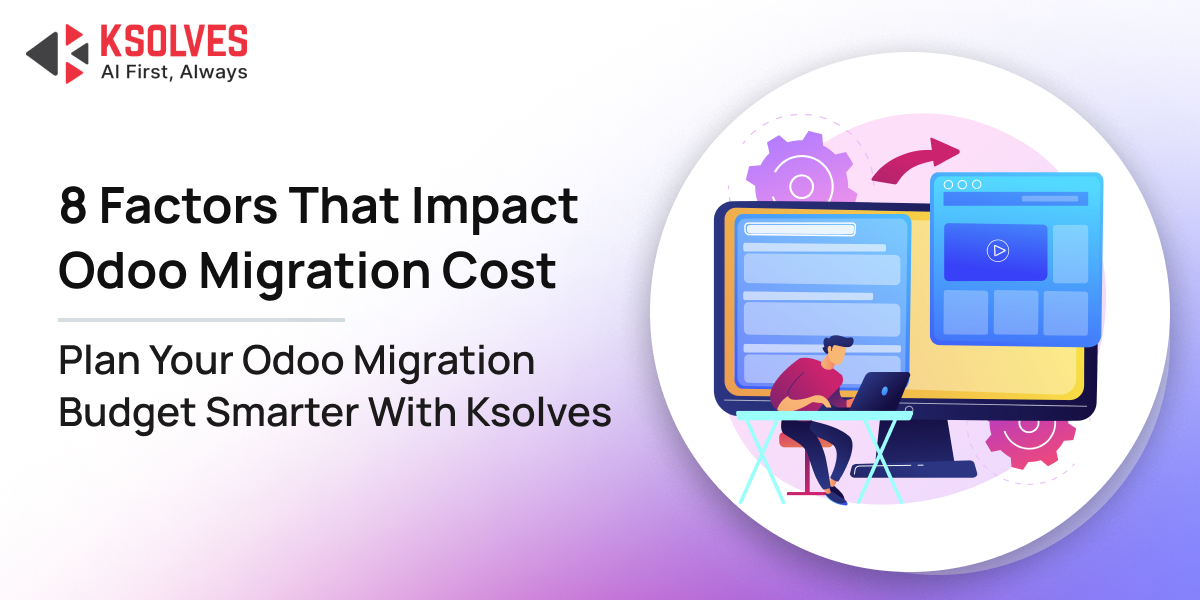
An Odoo migration can look deceptively simple on paper: move the data, update the system, test it, and go live. In reality, the database is only one piece of the puzzle. Behind it may be years of custom development, modified workflows, third-party apps, integrations, accounting configurations, and business rules that have become deeply embedded in daily operations.
That is why there is no universal Odoo migration cost. Two businesses migrating to the same Odoo version can have completely different budgets, even if they have a similar number of users. A lightly customized Odoo environment may require relatively limited migration work, while a heavily customized system with multiple integrations can turn the migration into a substantial redevelopment and testing exercise.
The real cost question, therefore, is not “How much does Odoo migration cost?” but “What will it take to move our specific Odoo environment safely to its next stage?” Understanding that difference before the project begins can help you avoid hidden costs, unnecessary redevelopment, and expensive surprises during go-live.
In this blog, we explore the key factors that affect Odoo migration cost, what should be included in the migration budget, and how businesses can control costs without compromising migration quality or operational continuity.
What Does an Odoo Migration Involve?
An Odoo migration is more than moving existing records into a newer database. It involves evaluating the entire Odoo environment to ensure that data, customizations, modules, integrations, and business workflows continue to work correctly after the migration.
Depending on the system, the process may include:
- Database and data migration: Moving, transforming, and validating business data.
- Custom module migration: Adapting or redeveloping custom modules for the target Odoo version.
- Website migration: for ecom or website users
- Third-party app assessment: Checking whether installed Odoo apps are compatible or need replacement.
- Customization review: Identifying outdated or incompatible customizations and deciding whether to retain, redesign, or remove them.
- Integration updates: Adapting APIs and connections with external systems such as payment gateways, eCommerce platforms, or logistics solutions.
- Business workflow validation: Verifying critical processes across sales, inventory, accounting, manufacturing, and other relevant functions.
- Testing and reconciliation: Checking data integrity, workflows, reports, and integrations before going live.
- Production migration and go-live: Executing the final migration with appropriate downtime and rollback planning.
- Post-migration support: Resolving issues and stabilizing the environment after deployment.
- Training : with updated processes
The scope can vary significantly from one business to another. A thorough technical assessment is therefore essential for estimating Odoo migration cost accurately and identifying potential risks before the migration begins.
8 Factors That Affect Odoo Migration Cost
1. The Current and Target Odoo Versions
The version gap is one of the first things a migration team evaluates.
A migration between closely related versions may involve fewer changes than moving from a significantly older Odoo release to a much newer one. Across major versions, changes to the framework, APIs, views, workflows, security mechanisms, reporting, and standard modules can affect existing custom functionality.
For example, a customization developed for an older Odoo framework may not be directly compatible with the target version. It may need code changes or complete redevelopment rather than a simple database upgrade.
Therefore, Odoo upgrade cost is influenced not only by the target version but also by the technical distance between the existing and target environments.
2. Custom Modules and Customizations
Custom development is often one of the largest variables in an Odoo migration services cost estimate.
Businesses frequently modify Odoo to support processes that are not available out of the box. These modifications can include:
- Custom modules.
- Custom fields.
- Automated actions.
- Custom reports.
- Modified views.
- Custom workflows.
- Business-specific pricing or approval logic.
- Portal functionality.
- Custom integrations.
- Website / ecom modification
The migration team needs to determine whether each customization can be adapted, replaced with standard Odoo functionality, redesigned, or removed.
This creates an important migration decision:
Should you migrate the customization, or migrate the business requirement?
A legacy customization that solved a problem several years ago may no longer be necessary. Rebuilding everything exactly as it exists can increase both migration effort and future maintenance costs.
3. Number and Complexity of Odoo Modules
The number of installed modules also affects migration effort.
A database using standard CRM, Sales, and Inventory functionality is generally easier to assess than an environment spanning:
- Accounting
- Manufacturing
- Purchase
- Inventory
- Sales
- CRM
- eCommerce
- HR
- Helpdesk
- Project
- Field Service
- Custom applications
However, module count alone does not determine the budget. Dependencies and customization depth matter more than the raw number of modules.
A highly customized Inventory workflow, for example, can require more migration work than several lightly configured standard modules.
4. Database Size and Data Complexity
Data migration is another major component of the overall Odoo migration cost. A database can contain years of:
- Customer and vendor records.
- Products and product variants.
- Sales orders.
- Purchase orders.
- Invoices and accounting entries.
- Inventory transactions.
- Manufacturing records.
- Attachments.
- Website and eCommerce data.
- User activity and operational history.
Larger databases generally require more processing and validation. More importantly, historical data may contain inconsistencies that need to be addressed before migration.
The key question is not simply:
“How many records do we have?”
It is:
“Which records need to move, in what form, and with what level of historical integrity?”
Some businesses need complete historical continuity. Others may only need selected historical records in the live system while retaining older data separately for reference or compliance. That decision can materially affect migration scope.
5. Data Quality and Data Cleansing
Poor-quality data can turn a technically straightforward migration into a complex project. Common issues include:
- Duplicate customers.
- Duplicate products.
- Incomplete addresses.
- Obsolete products.
- Inconsistent units of measure.
- Incorrect tax configurations.
- Invalid references.
- Unused records.
- Inconsistent master data.
Migrating poor-quality data without addressing these issues simply transfers the problem into the new environment.
Data cleansing therefore needs to be considered when calculating Odoo data migration cost. The more transformation and validation required, the greater the migration effort.
6. Third-Party Odoo Apps
Many Odoo environments depend on third-party applications in addition to custom development. Before migration, each third-party module should be reviewed for target-version compatibility.
There are generally three possibilities:
- A compatible version is available and can be migrated.
- The application needs adaptation or replacement.
- The functionality needs to be redeveloped because the application is no longer supported or suitable.
This is particularly important when a third-party application interacts with core Odoo models or custom modules.
Third-party app licensing or subscription charges should also be distinguished from the technical migration budget.
7. External Integrations
An Odoo database may be connected to systems outside Odoo, such as:
- Payment gateways.
- eCommerce platforms.
- Marketplaces.
- Shipping providers.
- Banking systems.
- CRM platforms.
- Business intelligence tools.
- Customer portals.
- Custom applications.
An Odoo version migration can affect these integrations when APIs, authentication methods, data structures, or custom integration logic change.
For this reason, an Odoo ERP migration should include an integration inventory before development begins.
It is not enough to confirm that data exists in Odoo. The migration team must also verify that data continues to move correctly between Odoo and connected systems after the upgrade.
8. Testing, Reconciliation, and Go-Live Requirements
Testing is sometimes treated as an optional project phase when estimating migration budgets. It should not be.
A successful migration must be validated against actual business operations.
Depending on the environment, testing may include:
- Functional testing.
- Regression testing.
- Integration testing.
- User acceptance testing.
- Accounting validation.
- Inventory reconciliation.
- Workflow validation.
- Report validation.
- Performance checks where relevant.
Finance teams may need to reconcile opening balances and accounting records. Operations teams may need to verify stock quantities and movements. Sales teams may need to validate quotations, orders, invoicing, and customer workflows.
The more business-critical processes involved, the greater the testing effort.
What Makes an Odoo Migration Expensive?
The highest migration costs usually come from complexity, not simply database size.
Consider two businesses:
Business A
- Standard Odoo modules
- Minimal customization
- Few integrations
- Clean master data
- Limited historical requirements
Business B
- Multiple custom modules
- Modified accounting and inventory workflows
- Several third-party apps
- Multiple external integrations
- Large historical database
- Complex reporting requirements
Both may have a similar number of users, and both may migrate to the same Odoo version. Yet Business B can require significantly more migration effort.
This is why a reliable Odoo migration pricing estimate should be based on a technical discovery rather than user count alone.
Odoo Migration Cost: What Should Your Budget Include?
A practical migration budget should account for more than development.
|
Cost Area |
Typical Scope |
|
Migration assessment |
Technical audit, module and customization inventory |
|
Data migration |
Extraction, transformation, mapping, and validation |
|
Custom module migration |
Code adaptation or redevelopment |
|
Third-party apps |
Compatibility assessment and replacement/adaptation |
|
Integration migration |
API and external-system updates |
|
Testing |
Functional, regression, integration, and UAT |
| Production migration |
Final migration, deployment, and go-live |
| Post-go-live support |
Issue resolution and stabilization |
Not every project requires every activity at the same level. The objective is to identify the activities your particular environment actually needs.
How to Get a More Accurate Odoo Migration Cost Estimate
A reliable Odoo migration cost estimate starts with a clear picture of your existing environment. Before requesting a quote, document the technical and operational factors that can influence the migration effort:
- Current and target Odoo versions.
- Installed standard and custom modules.
- Custom workflows, fields, reports, and business logic.
- Database size and historical data requirements.
- Number of companies, warehouses, and users.
- Third-party Odoo applications.
- External integrations and APIs.
- Accounting, localization, and compliance requirements.
- Critical business workflows.
- Reporting and analytics requirements.
A migration partner can use this information to conduct a technical migration assessment and classify the work into areas such as data migration, customization redevelopment, app replacement, data cleanup, integration updates, and testing.
This approach provides a more realistic budget based on the actual complexity of your Odoo environment rather than relying on a generic per-user or per-module migration price.
How Ksolves Helps Reduce Odoo Migration Cost Without Increasing Risk
Ksolves, an AI-first Odoo development company, uses an assessment-led, AI-first approach to identify where migration effort is genuinely required and where complexity can be reduced.
1. Identify What Actually Needs to Be Migrated
Ksolves evaluates existing workflows, customizations, and modules to determine what should be migrated, redeveloped, replaced, or retired. This prevents businesses from spending money rebuilding legacy functionality that no longer adds value.
2. Reduce Manual Migration Effort with AI-Assisted Delivery
Ksolves incorporates AI across its Odoo delivery process to accelerate project planning, development, configuration, and validation. This can help teams identify issues earlier and reduce repetitive manual effort while maintaining the required technical checks.
The objective is not simply to migrate faster but to make the migration process more predictable and efficient.
3. Focus Testing Where Business Risk Is Highest
Testing every part of an Odoo environment with the same intensity is inefficient. Ksolves focuses validation around critical workflows, integrations, data, and business processes to identify issues before production deployment.
This helps reduce the risk of costly post-go-live problems without adding unnecessary testing effort.
4. Preserve What Works and Modernize What Does Not
Ksolves does not treat migration as a simple “copy and upgrade” exercise. Where existing processes remain valuable, they can be preserved. Where outdated customizations create technical debt, they can be redesigned around the capabilities of the target Odoo environment.
This helps organizations avoid paying to carry unnecessary complexity into their new system.
5. Build the Migration Around Your Actual Business Processes
Ksolves Odoo delivery approach is centered on configuring and customizing Odoo around real business requirements rather than forcing operations into a generic template. This is particularly important for businesses with complex workflows spanning finance, inventory, sales, procurement, manufacturing, or distribution.
The result is a migration strategy designed to balance cost, continuity, and long-term maintainability, rather than optimizing for the lowest initial quote alone.
Final Words
Odoo migration cost depends on much more than database size or user count. Customizations, data complexity, third-party apps, integrations, testing, and business requirements can significantly influence the final budget. A detailed assessment helps identify these factors before migration begins.
With Ksolves Odoo Migration Services, businesses can take an assessment-led approach to identify what should be migrated, redeveloped, replaced, or optimized. Our AI-first Odoo delivery approach helps reduce unnecessary migration effort while maintaining data integrity, business continuity, and long-term system reliability.































AUTHOR
Odoo
Neha Negi, Presales and Business Associate Head at Ksolves is a results-driven ERP consultant with over 8 years of expertise in designing and implementing tailored ERP solutions. She has a proven track record of leading successful projects from concept to completion, driving organizational efficiency and success.
Share with