

 QA
 5 MIN READ


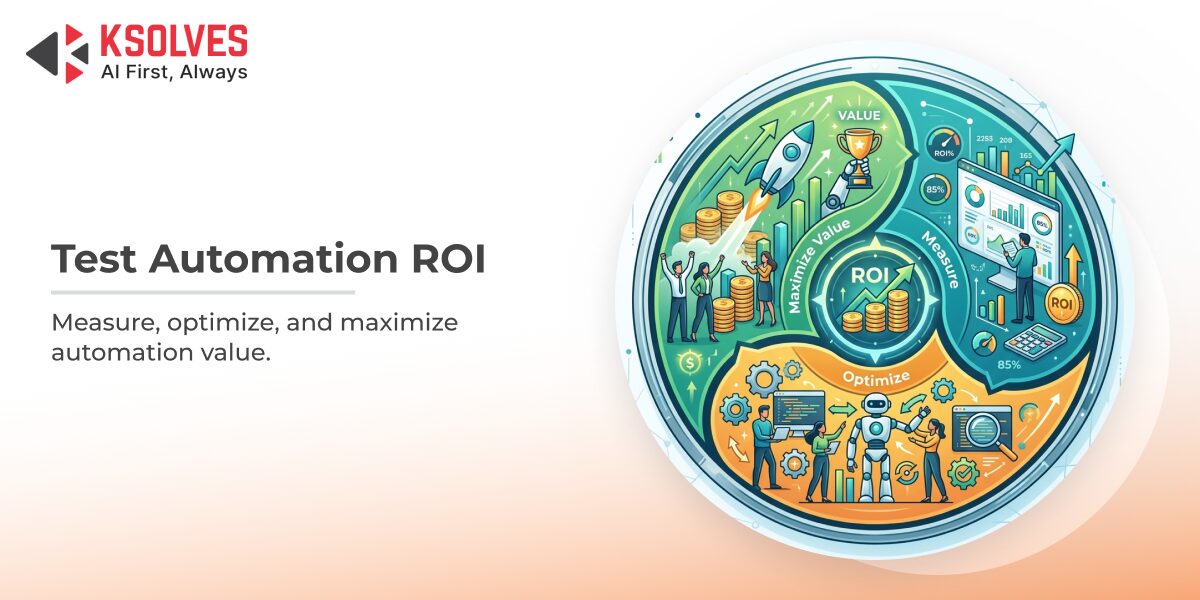
In modern software development, speed and quality are no longer trade-offs. Organizations are expected to deliver faster releases without compromising reliability. This is where test automation becomes a strategic investment rather than just a technical upgrade. However, the real challenge lies in proving its value. Measuring Automation ROI helps businesses justify investments, optimize testing strategies, and align QA efforts with business outcomes.
This blog hence explores how to accurately measure automation ROI, the key metrics and cost factors involved, common pitfalls to avoid, and proven strategies to maximize returns using an AI-first testing approach.
What is Automation ROI in Test Automation?
Automation ROI (Return on Investment) measures the value gained from automated testing relative to the costs of implementing and maintaining it. It is not just about cost savings but also about efficiency, risk reduction, and faster delivery cycles.
The standard formula used is:
ROI = (Benefits – Costs) / Costs × 100%
While this formula looks simple, calculating accurate inputs requires a deeper understanding of both tangible and intangible factors.
Key Components of Automation ROI
Benefits of Test Automation
- Time savings through faster execution of repetitive test cases
- Improved test coverage across platforms, environments, and scenarios
- Reduced manual effort for repetitive validation tasks
- Early bug detection, leading to lower defect-fixing costs
Costs Involved
- Tool licensing and infrastructure setup
- Test script development and ongoing maintenance
- Team training and onboarding
- Environment and test data management
Costs involved in test automation include tool licensing, test script development, ongoing maintenance, and team training — which is why many organizations choose to hire software testers with specialist automation expertise rather than upskilling from scratch.
How to Measure Automation ROI Effectively
-
Time-Based ROI
One of the most straightforward ways to measure ROI is by calculating time saved:
Savings = (Manual test time – Automated test time) × Number of tests × Test runs
If automation consistently saves hours in every sprint, those gains quickly translate into measurable ROI.
-
Efficiency ROI
Efficiency ROI focuses on productivity improvements rather than just cost savings. It includes:
- Faster release cycles
- Reduced regression testing time
- Increased testing frequency
This approach highlights how automation accelerates delivery velocity and enhances team output.
-
Risk-Based ROI
Automation plays a crucial role in reducing production defects, which directly impacts:
- Customer experience
- Brand reputation
- Revenue loss due to failures
Although harder to quantify, the value of preventing critical defects is often one of the most significant contributors to ROI.
-
Business Impact Metrics
To truly measure ROI, organizations should align automation outcomes with business KPIs such as:
- Release frequency
- Customer satisfaction
- Defect escape rate
- Cost per release
Focusing only on time savings can lead to incomplete insights, whereas business-aligned metrics provide a clearer picture of value.
Common Mistakes That Reduce Automation ROI
-
Automating Everything
Not all test cases should be automated. Over-automation increases maintenance effort and reduces overall efficiency.
-
Ignoring Maintenance Costs
Automation is not a one-time activity. As applications evolve, test scripts must be updated regularly, adding to ongoing costs.
-
Poor Test Case Selection
Automating unstable or low-priority scenarios leads to poor ROI. High-frequency and business-critical test cases yield better returns.
-
Measuring the Wrong Metrics
Focusing on surface-level metrics like execution speed without linking them to business outcomes can misrepresent the true value of automation.
How to Maximize Automation ROI
Adopt an AI-First Testing Approach
AI-driven testing enhances traditional automation by:
- Automatically updating test scripts when UI changes occur
- Identifying high-risk areas for targeted testing
- Optimizing test coverage intelligently
Prioritize High-Impact Test Cases
Start with regression, smoke, and business-critical test cases. These areas provide immediate and measurable returns.
Integrate Automation into CI/CD
Continuous testing ensures faster feedback loops, enabling teams to detect issues early and release updates more frequently.
Continuously Monitor and Optimize
Automation ROI should be evaluated regularly. Continuous tracking helps refine testing strategies and improve long-term outcomes.
Maximize ROI with Ksolves AI-First Software Automation Testing Services
At Ksolves, we take a modern, AI-first approach to quality assurance. Our Software Automation Testing Services are designed to deliver measurable ROI by combining intelligent automation with deep domain expertise.
We help organizations:
- Implement scalable and future-ready automation frameworks
- Leverage AI for smart test case generation and optimization
- Enable continuous testing within DevOps pipelines
- Improve defect detection through predictive analytics
With Ksolves, businesses move beyond basic automation to achieve faster releases, reduced costs, and superior software quality.
Conclusion
Automation ROI is not just about reducing testing costs. It is about enabling faster delivery, improving quality, and minimizing risks. By focusing on the right metrics, selecting the right test cases, and adopting an AI-first approach, organizations can unlock the full potential of test automation.
In a competitive digital landscape, success depends on how effectively you measure, optimize, and scale your automation efforts. If your organization also wants the same, then contact our AI-driven software testing team today or send us a query at [email protected].