



Security Test Automation: The QA Shield Every Business Needs
QA
5 MIN READ
August 20, 2026

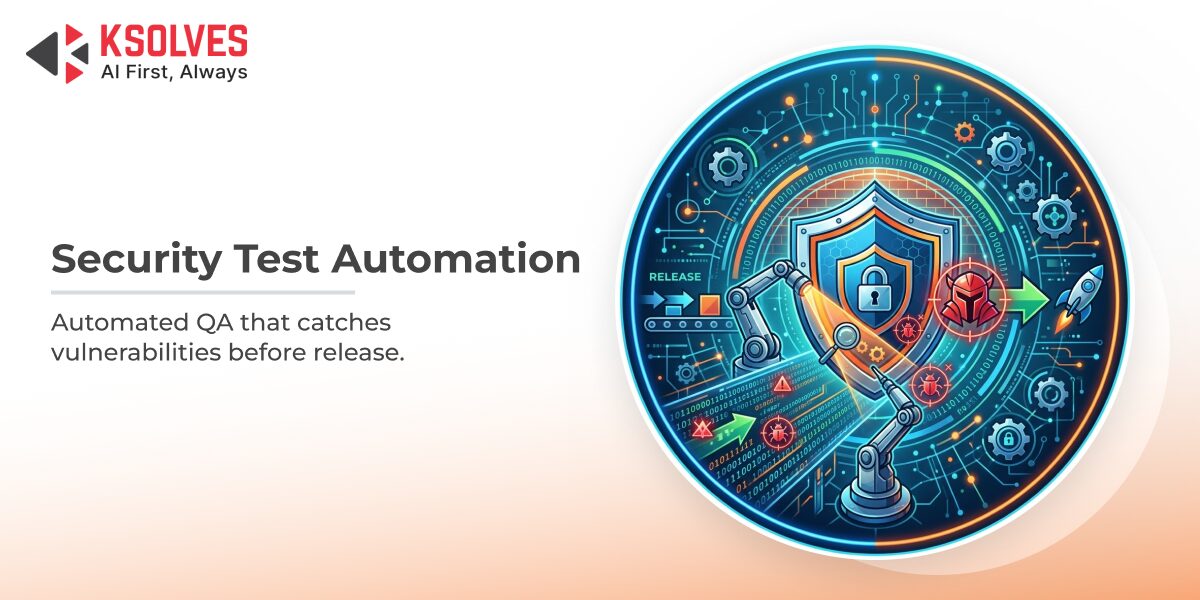
Manual security checks cannot keep pace with modern software delivery. As release cycles accelerate and attack surfaces expand, waiting until the end of a project to validate security is not just risky, it is expensive. Automated security testing, embedded directly inside a QA pipeline, is the only scalable way to catch vulnerabilities before they reach production.
This blog covers what security test automation really means, how it fits inside a QA program, the types that matter most, and why Ksolves builds it directly into your software delivery lifecycle.
The Cost of Getting Security Wrong
The financial consequences of weak security are no longer abstract. According to IBM’s Cost of a Data Breach Report 2024, the global average cost of a data breach climbed 10% year-over-year between 2023 and 2024, reaching $4.88 million per incident. Organizations operating across multi-cloud environments averaged over $5 million in recovery costs alone.
These figures exclude regulatory fines, litigation, and long-term reputational damage. Businesses that embed security testing inside their automated QA pipeline address these risks early, at a fraction of the post-breach cost.
What Is Security Test Automation?
Security test automation is the practice of using scripted tools and testing frameworks within a QA workflow to continuously validate that a software system is protected against unauthorized access, data leaks, injection attacks, and other vulnerabilities, without manual intervention on every release.
When integrated into a CI/CD pipeline, security tests run alongside functional and regression tests. Vulnerabilities are flagged in the same sprint they are introduced, not weeks later during a manual audit cycle. Engineers define the threat scenarios once; automation runs them on every build, every sprint, every deployment.
Manual vs Automated Security Testing
Both approaches have a role in a mature QA program. The key is knowing what to automate and what to leave to skilled testers.
| Aspect | Manual Security Testing | Automated Security Testing |
|---|---|---|
| Execution Frequency | Point-in-time assessment only | Runs on every build and every commit |
| Scalability | Expensive to run at scale | Scales with your delivery cadence |
| Dependency | Dependent on tester availability and expertise | Consistent and repeatable results |
| Strengths | Strong for logic-based and exploratory threats | Ideal for OWASP Top-10 coverage and compliance checks |
| Release Coverage | Cannot realistically run on every release | Catches vulnerabilities in the sprint where they are created |
Types of Security Tests Inside a QA Pipeline
A well-designed software test automation strategy covers multiple security testing types, each targeting a different layer of the application stack.
| Security Test Type | What It Covers | Automation Fit | Priority |
|---|---|---|---|
| Vulnerability Scanning | Scans for known CVEs, misconfigurations, and outdated dependencies | High | Critical |
| SAST (Static Analysis Testing) | Source code analyzed for injection flaws, hardcoded secrets, and insecure coding patterns before the application runs | High | Critical |
| DAST (Dynamic Analysis Testing) | Probes the running application in real time for XSS, SQL injection, authentication bypass, and similar threats | Medium | High |
| API Security Testing | Validates endpoint authentication, rate limiting, data exposure risks, and broken object-level access controls | High | High |
| Penetration Testing | Simulates real-world attacks end-to-end to map exploitable paths across the system | Partial | Critical |
| Compliance Checks | Automated validation against GDPR, HIPAA, PCI DSS, and other regulatory controls on every release | High | Regulatory |
Why Every QA Program Needs Security Automation
Security testing is not a separate phase that follows QA. It is an integral layer of it. Here is what embedding it inside automation delivers for your business.
- Catches vulnerabilities in the sprint: Fixes are cheap in development and catastrophic in production. Automation shifts security left, where it has the greatest impact and the lowest cost.
- Scales with CI/CD pipelines: Every commit triggers a full security sweep with no extra sprint time and no manual bottlenecks slowing down your delivery team.
- Proves regulatory compliance: Automated audit trails provide on-demand evidence for GDPR, HIPAA, PCI DSS, and ISO 27001 reviews without scrambling before an audit.
- Reduces cost significantly: Early detection through automation costs a fraction of what post-breach remediation, legal exposure, and recovery operations demand.
- Builds customer trust: Demonstrable security practices are now a competitive differentiator. Customers and partners increasingly expect proof, not promises.
- Reduces QA cycle time: Automated scripts complete in minutes what manual audits take days to cover, freeing your QA team for higher-value testing work.
- Compliance frameworks supported: GDPR, HIPAA, PCI DSS, ISO 27001, SOC 2, OWASP Top 10, NIST CSF
Automate Security Testing with Ksolves
At Ksolves, security testing is not a bolt-on service. It is a core part of how we build and deliver software test automation programs for our clients.
From static and dynamic analysis to API security testing, vulnerability scanning, and compliance validation, we design testing strategies that are fully aligned with your tech stack, industry regulations, and release cadence. Whether you are shipping a fintech platform, a healthcare application, or an enterprise ERP system, our QA automation experts ensure security is a built-in quality standard across your entire delivery lifecycle.
Conclusion
Security test automation is not a luxury reserved for large enterprises. It is a baseline expectation for any team shipping software at speed. By embedding security checks inside your QA pipeline, vulnerabilities are caught in the sprint they are created, compliance is validated continuously, and your customers receive software they can trust. The shift from reactive security audits to proactive automated testing is one of the highest-value changes a QA program can make.
Bring Security Testing Into Your QA Pipeline
FAQs
What is security test automation?
Security test automation is the practice of using scripted tools within a QA pipeline to continuously check software for vulnerabilities like injection flaws and unauthorized access, without manual intervention on every release. It typically runs alongside functional and regression tests in a CI/CD pipeline. Ksolves builds these checks directly into a client’s software delivery lifecycle rather than treating them as a separate audit.
What happens if a company skips automated security testing?
Without automated security testing, vulnerabilities often surface only after a manual audit or, worse, after a breach, and the average cost of a data breach reached $4.88 million in 2024 according to IBM. Skipping automation also means compliance evidence for standards like GDPR or HIPAA has to be assembled manually before every audit, which slows releases.
How does security testing get added to a CI/CD pipeline?
Security tests are scripted once, using the same frameworks already running functional tests, and triggered automatically on every commit or build. Static analysis (SAST) checks source code before the app runs, while dynamic analysis (DAST) probes the running application for issues like SQL injection or authentication bypass.
What’s the difference between penetration testing and security test automation?
Penetration testing simulates real-world attacks manually or semi-manually to map exploitable paths across a system, while security test automation runs scripted checks continuously on every build. The two are complementary: automation catches known vulnerability patterns on every release, while penetration testing digs into complex, context-specific weaknesses automation can miss.
When should a QA team introduce security automation into its pipeline?
The earlier the better, since security checks are cheapest to fix in development and most expensive after production release, so most teams introduce automated scanning and SAST checks as soon as a CI/CD pipeline exists, then layer in DAST and API security testing as the application matures. Ksolves typically integrates these checks during the same sprint a QA automation framework is set up, rather than as a later add-on.
Who provides security test automation services for enterprise software teams?
Enterprise security test automation is generally handled by QA automation vendors or specialized DevSecOps consultancies that can integrate scanning tools into an existing CI/CD pipeline. Ksolves provides this as part of its software test automation practice, covering SAST, DAST, API security testing, vulnerability scanning, and compliance validation across fintech, healthcare, and ERP environments.
Have a question we didn’t cover? Contact our team.































Author
About the Author Editorial Team The Ksolves Editorial Team includes certified Salesforce experts, Big Data engineers, AI/ML specialists, Zoho consultants, and experienced technology writers focused on delivering clear, actionable insights for modern businesses. With hands-on experience across Salesforce, Big Data platforms, AI/ML solutions, application development, software testing, and Zoho ERP/CRM, the team publishes practical guides, real-world use cases, and industry updates that support smarter decisions and faster growth. Every article is created to solve business challenges, guide technology adoption, and keep organizations aligned with evolving digital ecosystems.
Share with