



How Salesforce Enables End-to-End Supply Chain Visibility for Manufacturers
Manufacturing Cloud
5 MIN READ
May 20, 2026

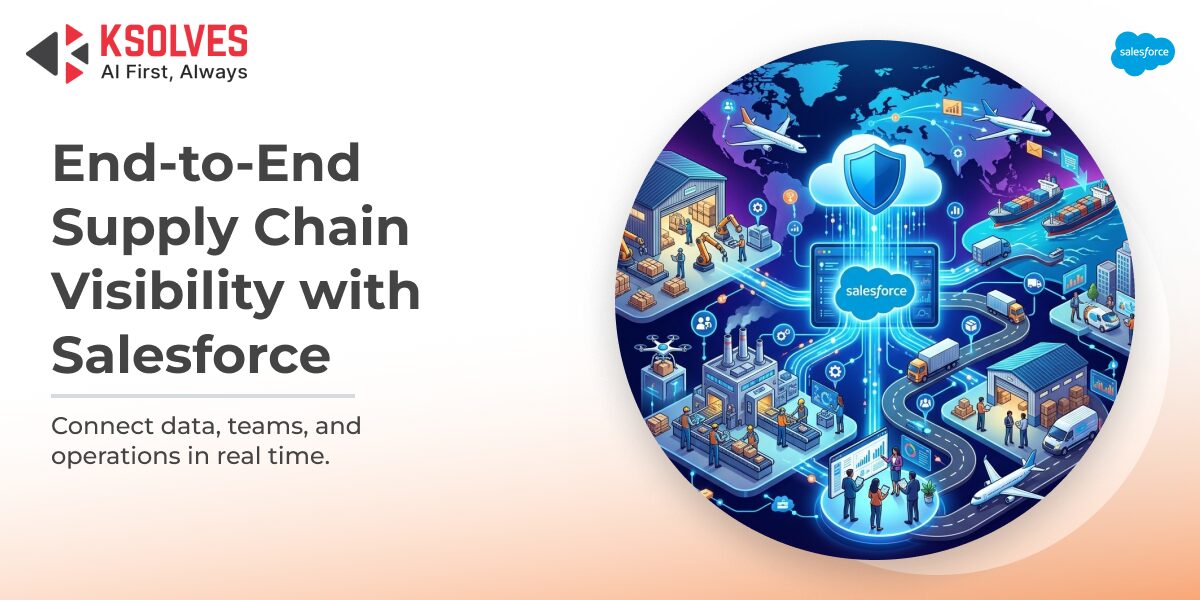
In the manufacturing industry, where even minor disruptions can ripple across production lines and delivery schedules, supply chain visibility has become a critical priority. Studies show that 79% of companies with high-performing supply chains achieve revenue growth greater than the industry average, a clear indicator of the value of transparency and control.
Yet, many manufacturers still struggle with fragmented systems, siloed data, and limited real-time insights. These challenges often lead to delayed decision-making, inventory imbalances, and reduced customer satisfaction.
Salesforce for manufacturing helps bridge these gaps by unifying data, automating workflows, and providing a centralized view of the entire supply chain. From managing supplier relationships to tracking inventory and order status, Salesforce empowers manufacturers to take control of their operations and respond quickly to disruptions.
Why Supply Chain Visibility Matters in Manufacturing
Supply chain visibility directly influences key performance factors in manufacturing, from controlling operational costs to ensuring product quality and meeting delivery timelines. With clear, real-time insights into inventory, shipments, production schedules, and supplier performance, manufacturers can make smarter decisions, reduce waste, and avoid costly disruptions.
As global supply chains become more complex, managing multiple vendors, regulations, and logistics partners across geographies adds layers of risk. Without unified visibility, even a minor delay or miscommunication can ripple through the entire chain, causing missed deadlines or production halts.
Poor visibility often results in overstocking, stockouts, or delayed order fulfillment, all of which affect revenue and customer trust. It also makes it harder to meet service-level agreements (SLAs) or respond quickly to market demands. By contrast, a connected, transparent supply chain allows manufacturers to anticipate issues, collaborate better across teams, and stay agile in a fast-moving environment.
How Salesforce Empowers Supply Chain Visibility
Salesforce for manufacturing industry brings much-needed transparency to supply chains by unifying data across departments like sales, operations, procurement, and inventory management. Instead of working in silos, teams can access a single source of truth, from order statuses to production forecasts, all within the Salesforce ecosystem.
Real-time collaboration is another key advantage. With Salesforce’s cloud-based platform, internal teams and external stakeholders like suppliers, distributors, and logistics partners can stay aligned on delivery schedules, inventory levels, and demand changes. This improves responsiveness and reduces communication gaps that often lead to delays or stock imbalances.
Salesforce also integrates seamlessly with core manufacturing systems like ERP, MES (Manufacturing Execution Systems), and WMS (Warehouse Management Systems) using MuleSoft. These integrations help create a connected ecosystem where data flows freely between systems, enabling end-to-end supply chain visibility and smarter, faster decisions.
Key Salesforce Products & Features for Manufacturers
Salesforce offers a suite of purpose-built tools that help manufacturers gain better control over their supply chains, improve forecasting accuracy, and enhance customer satisfaction. Here’s a deep dive into how each product drives operational efficiency:
1. Agentforce Manufacturing (Formerly – Salesforce Manufacturing Cloud)
Designed for the manufacturing industry, Agentforce Manufacturing bridges the gap between sales, operations, and production. It allows companies to align forecasts with actual demand by combining real-time sales agreements, production volumes, and planned orders into one centralized platform. Manufacturers can anticipate shifts in demand and adjust capacity planning accordingly, which reduces overproduction and ensures timely fulfillment.
Key Benefits:
- Aligns sales and production planning.
- Offers a consolidated view of run-rate business and new opportunities.
- Enhances forecast accuracy using historical and in-progress data.
2. Einstein AI (Artificial Intelligence)
Einstein AI implementation adds predictive intelligence across the entire Salesforce ecosystem. For manufacturers, it can forecast inventory needs, identify at-risk orders, detect anomalies in the supply chain, and optimize demand-supply balance. By uncovering trends early, businesses can proactively manage delays, minimize waste, and improve customer experience.
Key Benefits:
- Predicts demand fluctuations and inventory shortages.
- Recommends optimal order quantities based on past trends.
- Automates alerts for delayed shipments or production bottlenecks.
3. CRM Analytics (formerly Tableau CRM)
CRM Analytics transforms raw operational data into meaningful insights with interactive dashboards and reports. It enables manufacturers to monitor KPIs like order fulfillment rates, supplier performance, transportation efficiency, and inventory turnover. By visualizing data in real time, decision-makers can identify bottlenecks and take corrective actions quickly.
Key Benefits:
- Real-time dashboards for supply chain performance monitoring.
- Drill-down capabilities to trace issues to specific plants, products, or vendors.
- Supports strategic decisions with historical and predictive analysis.
4. MuleSoft (Integration Platform)
MuleSoft enables seamless integration between Salesforce and other enterprise systems, including ERP (SAP, Oracle), MES (Manufacturing Execution Systems), and WMS (Warehouse Management Systems). This allows for real-time data exchange and creates a unified view of orders, inventory levels, production status, and supplier updates.
Key Benefits:
- Accelerates digital transformation by connecting legacy and cloud systems.
- Ensures end-to-end data consistency across the supply chain.
- Reduces manual entry and operational silos.
5. Service Cloud & Field Service
Customer service is a critical part of the manufacturing value chain. Service Cloud helps manage after-sales support with intelligent case routing, SLA tracking, and omnichannel communication. Field Service further enhances the experience by enabling real-time technician dispatching, parts tracking, and on-site service management. It is ideal for maintenance-heavy industries like machinery or electronics.
Key Benefits:
- Improves warranty management and returns processing.
- Increases technician productivity with AI-based scheduling.
- Enhances customer satisfaction with faster issue resolution.
Real-World Manufacturing Use Cases with Salesforce
From predictive inventory planning to smarter field service management, Salesforce helps manufacturers turn complexity into a competitive advantage. These use cases show how technology transforms operations into outcomes.
- Inventory Optimization with Demand Sensing
Agentforce Manufacturing (or Agentforce 360 for Manufacturing), powered by Einstein AI, enables manufacturers to align production and inventory with real-time market demand. By leveraging AI-driven demand sensing, businesses can anticipate fluctuations, avoid stockouts or overstocking, and improve working capital efficiency. For example, a consumer electronics manufacturer can use Salesforce to reduce excess inventory through better forecast accuracy. - Supplier Performance Monitoring and Alerts
With integrated dashboards from Tableau CRM and automated workflows, Salesforce allows businesses to track supplier KPIs such as delivery timeliness, defect rates, and cost variances. Instant alerts help procurement teams act quickly when performance drops, ensuring minimal disruption. A Tier-1 auto parts supplier can use this feature to identify lagging vendors and shorten response time significantly. - Smart Production Planning Based on Live Customer Data
Sales and customer service data can be fed into ERP/MES systems via MuleSoft, enabling agile production scheduling. Manufacturers can adapt shop floor plans based on real-time orders, cancellations, and customer preferences—avoiding bottlenecks. A home appliances company integrated Salesforce and their MES to shift from weekly to daily production cycles, increasing responsiveness. - Field Service Coordination Based on Stock Availability
Service Cloud and Field Service enable intelligent technician dispatching based on location, skill, and available parts. If a part isn’t in stock at a service center, the system can automatically reroute a nearby technician who has it. This reduces first-time fix failures and improves SLA compliance. For instance, a heavy machinery brand achieved a 30% increase in first-time fix rate.
Best Practices for Implementing Salesforce to Boost Supply Chain Visibility
To truly benefit from Salesforce in your supply chain operations, it’s important to take a strategic, phased approach. These best practices help ensure smoother adoption and measurable outcomes.
- Align IT and Supply Chain Stakeholders Early
Collaboration between tech teams and supply chain leaders ensures that both business needs and system capabilities are addressed from the start. It helps avoid silos and misaligned goals during implementation. - Prioritize High-Impact Use Cases First
Focus on areas like inventory visibility, order tracking, or demand forecasting—where improved transparency can bring immediate value. Early wins build momentum and support broader rollouts. - Monitor Adoption and ROI with Dashboards
Use tools like Tableau CRM or native Salesforce dashboards to track user engagement, process efficiency, and KPIs. This visibility keeps teams accountable and highlights what’s working. - Partner with Salesforce Manufacturing Experts
A Salesforce consulting partner with industry experience can tailor the solution to your specific supply chain challenges. They bring best practices, integration expertise, and help reduce time to value.
How Ksolves Transformed Manufacturing Operations with Salesforce
Ksolves helped a global manufacturing client overcome sales and response bottlenecks by implementing a tailored solution powered by Salesforce Einstein and AI-driven automation.
Initially, the manufacturer faced a high volume of email inquiries related to product information and quotes, leading to long response delays and inconsistent workflows. Key data like product specs, pricing, and customer info was spread across separate systems, making it difficult for agents to respond quickly or accurately.
To address these challenges, we implemented:
- AI-powered email handling with Salesforce Einstein
- Dynamic quote generation using custom prompts
- Automated workflows built with Salesforce Flows and Apex
- Real-time data integration
The outcome:
- Significantly faster response times and reduced turnaround on customer quotes.
- Sales agents independently managed inquiries, reducing load on managers.
- Customers received accurate, timely information, improving trust and satisfaction.
- The solution scaled effortlessly with growing demand.
Wrapping Up!
For manufacturers today, supply chain visibility is key to staying competitive. It helps improve agility, cut costs, and deliver better customer experiences. Salesforce in manufacturing brings all the pieces together—from sales and service to production and inventory—on a single, connected platform.
Whether you’re looking to streamline inventory management, improve production planning, or enhance customer service, Salesforce provides the tools to make your supply chain more transparent and intelligent.
At Ksolves, we specialize in Salesforce implementation services tailored to the unique needs of manufacturers. With proven expertise in AI, automation, and system integration, we help clients modernize their operations and drive measurable business outcomes. Get in touch with us at [email protected] to start your digital transformation journey.
Frequently Asked Questions
What is end-to-end supply chain visibility and why does it matter for manufacturers?
End-to-end supply chain visibility means having real-time insight into every stage of your supply chain — from raw material sourcing and production to warehousing, logistics, and customer delivery. For manufacturers, this visibility is critical because even minor disruptions can cascade across production lines and delay order fulfillment. Companies with high-performing, transparent supply chains consistently outperform industry peers in revenue growth and customer satisfaction.
How does Salesforce Manufacturing Cloud improve supply chain visibility?
Salesforce Manufacturing Cloud creates a unified platform that connects sales agreements, production forecasts, and inventory data in real time. By combining demand signals from Sales Cloud with operational data from ERP and MES systems via MuleSoft, manufacturers gain a single source of truth across departments. This eliminates silos, reduces forecast errors, and allows teams to respond quickly to demand shifts or supplier disruptions.
Can Salesforce integrate with existing ERP and warehouse management systems for supply chain management?
Yes. Salesforce integrates with ERP platforms such as SAP and Oracle, as well as MES and WMS systems, through MuleSoft’s Anypoint Platform. These integrations enable real-time data exchange across production, inventory, and logistics layers, creating true end-to-end visibility without replacing legacy systems. Ksolves specialises in designing and implementing these integrations for manufacturing environments.
What role does Einstein AI play in managing supply chain disruptions?
Einstein AI adds predictive intelligence to the Salesforce ecosystem, helping manufacturers detect at-risk orders, forecast demand fluctuations, and identify anomalies before they escalate into disruptions. It can automatically trigger alerts for delayed shipments or production bottlenecks and recommend corrective actions. By surfacing early warning signals, Einstein AI allows supply chain teams to act proactively rather than reactively.
How does Salesforce Field Service support manufacturers with after-sales supply chain workflows?
Salesforce Field Service enables intelligent technician dispatching based on location, skill set, and parts availability, ensuring service teams always have the right inventory on hand. Integration with Service Cloud provides agents with warranty history, SLA tracking, and real-time case routing. For maintenance-heavy manufacturers, this reduces first-time fix failures and ensures compliance with service-level agreements across field operations.
What are the best practices for implementing Salesforce to boost supply chain visibility in manufacturing?
A successful Salesforce rollout for manufacturing supply chains starts with aligning IT and operations stakeholders early, then prioritising high-impact use cases such as inventory visibility and demand forecasting. Integrating Salesforce with ERP systems from day one is essential to avoid data silos. Partnering with an experienced Salesforce consulting firm — like Ksolves, a Salesforce Summit Partner — can significantly reduce implementation risk and accelerate time to value.
How long does it take to implement Salesforce Manufacturing Cloud for supply chain visibility?
Implementation timelines vary based on the complexity of existing systems, the number of integrations required, and the scope of customisation. A focused pilot covering inventory visibility or demand forecasting can typically be completed within a few weeks, while a full-scale rollout including ERP integration and multi-cloud deployment may span several months. Ksolves follows a phased approach to ensure minimal operational disruption and faster delivery of measurable outcomes.
Have questions about implementing Salesforce for your manufacturing supply chain? Contact our team for a tailored consultation.
 ksolves Team
A customer can now use AI to find the right product in seconds. Why should buying it still require a […]































Author
About the Author Editorial Team The Ksolves Editorial Team includes certified Salesforce experts, Big Data engineers, AI/ML specialists, Zoho consultants, and experienced technology writers focused on delivering clear, actionable insights for modern businesses. With hands-on experience across Salesforce, Big Data platforms, AI/ML solutions, application development, software testing, and Zoho ERP/CRM, the team publishes practical guides, real-world use cases, and industry updates that support smarter decisions and faster growth. Every article is created to solve business challenges, guide technology adoption, and keep organizations aligned with evolving digital ecosystems.
Share with