

 Salesforce
 5 MIN READ


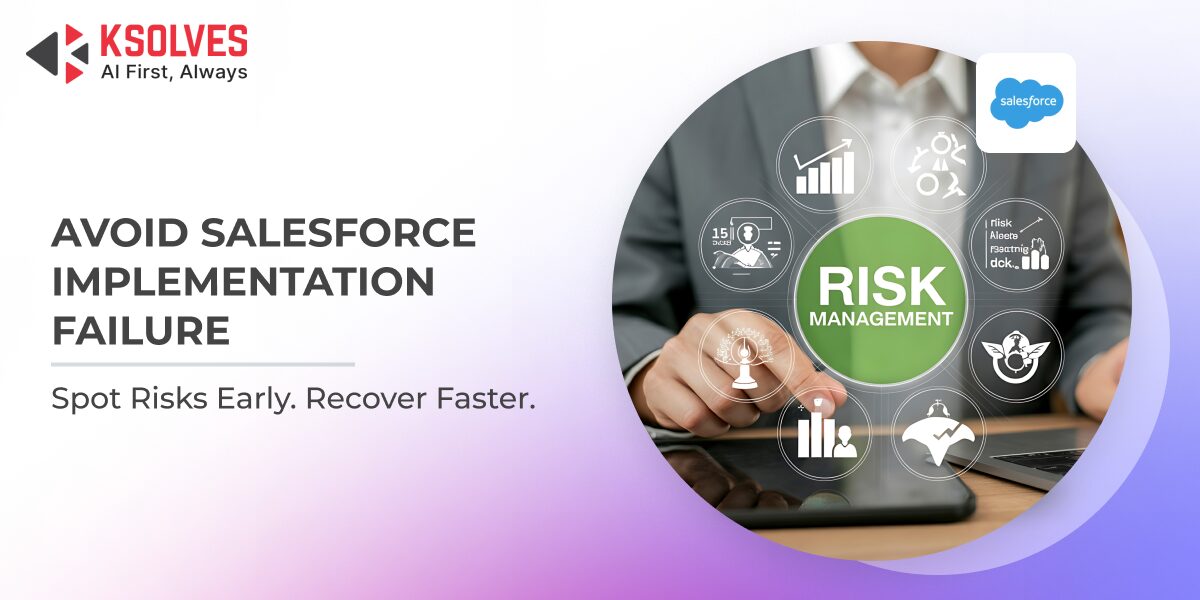
Salesforce is the world’s leading CRM platform, yet a surprising number of organizations never see the returns they were promised. Budgets are spent, timelines stretch, adoption lags, and the system that was supposed to transform operations ends up a costly underachiever. The platform is rarely the problem. More often, failures trace back to process gaps, misaligned expectations, and decisions made before a single workflow was configured.
Understanding what causes these failures and recognizing the early warning signs is the difference between a CRM that drives revenue and one that drains resources. This blog breaks down the root causes of Salesforce implementation failures, the signals that indicate trouble ahead, and the concrete strategies organizations can use to recover and succeed.
The Scale of the Problem
The numbers are harder to ignore than many organizations admit. According to a Harvard Business Review analysis, around one-third of all CRM projects fail, based on an average across a dozen analyst reports, with failure rates ranging from 18% to 69%. When the measure shifts from technical delivery to actual business growth, the failure rate climbs closer to 90%. These are not small, scrappy deployments. Many of the organizations in these statistics invested heavily in licensing, consulting, and training, only to end up with a system that sales and service teams quietly work around.
Root Causes of Salesforce Implementation Failures
1. Undefined Business Objectives
Salesforce is not a plug-and-play solution. Without clearly documented goals tied to measurable outcomes, teams configure features with no unified direction. Sales wants pipeline visibility, marketing wants lead scoring, and leadership wants dashboards. When these priorities are never reconciled, the build becomes fragmented and serves no one well.
2. Weak Executive Sponsorship
Implementations without active, visible leadership support consistently underperform. When executives treat Salesforce as an IT project rather than a business transformation, adoption suffers at every level. Managers do not enforce usage, teams continue relying on spreadsheets, and the system becomes an expensive reporting formality.
3. Poor Data Quality and Migration Planning
Bad data is one of the most common and least acknowledged killers of CRM success. Migrating duplicate contacts, incomplete account records, and inconsistent field values into Salesforce does not clean up old problems. It imports them. Without a defined data governance strategy, the platform becomes a source of confusion rather than clarity.
4. Over-Customization Early in the Process
Organizations frequently customize Salesforce extensively before they understand how their teams actually work within it. Complex custom objects, deeply modified page layouts, and third-party integrations built before processes are stable create technical debt that becomes expensive and difficult to unwind later.
5. Neglecting User Adoption
A Salesforce instance that no one uses is a failed implementation, regardless of how well it was built. Many projects allocate very little time to change management, training, and ongoing user enablement. Reps who do not see immediate value in the tool default to their old habits, and system usage metrics quietly decline.
Key Warning Signs to Watch For
Catching a failing implementation early is far less expensive than recovering from a full breakdown. These are the red flags organizations should monitor:
- Low login rates and activity data: If Salesforce reports show minimal daily activity, adoption has stalled.
- Data being maintained outside the system: Spreadsheets, emails, and notes replacing Salesforce records signal user rejection.
- Reports no one trusts: When leadership questions the accuracy of dashboards, data integrity has broken down.
- Implementation timeline overruns: Repeated sprint delays often signal that requirements are unclear or the scope is growing uncontrolled.
- High consultant turnover: Frequent changes in the implementation team create knowledge gaps and inconsistent configurations.
- Leadership disengagement: When executives stop attending steering committee meetings, the project loses its compass.
Recognizing two or more of these signals simultaneously is a strong indicator that immediate intervention is needed.
Recovery Strategies That Work
Failing Salesforce implementations are recoverable, but recovery requires honesty about what went wrong and a structured approach to fixing it.
-
Conduct a Comprehensive Implementation Audit
Before making any changes, document what was built, what was intended, and where the gap exists. Review custom objects, automation logic, integration points, and data quality. A structured audit creates a clear baseline for recovery planning.
-
Reset Business Requirements
Revisit the original goals of the implementation with current stakeholders. Priorities change. Teams change. The requirements defined 18 months ago may no longer reflect the business. Use this reset to eliminate unnecessary complexity and align the build to current operational needs.
-
Prioritize Data Cleansing
Invest in data quality before expanding functionality. Deduplicate records, standardize field formats, establish data entry standards, and assign ownership for data maintenance. Clean data is the foundation that makes every other Salesforce capability more reliable.
-
Rebuild Adoption Intentionally
Adoption does not happen from a single training session. Build a structured enablement program that includes role-specific training, in-system guidance, champions within each team, and regular reinforcement from managers. Make it easier for reps to log activity in Salesforce than outside of it.
-
Simplify Before You Scale
If over-customization contributed to the failure, simplification must come before new features. Streamline page layouts, reduce redundant fields, and ensure the system reflects how teams actually work today rather than how someone imagined they would work during the scoping phase.
How Ksolves Can Help You Get It Right
Recovery from a failed or underperforming Salesforce deployment is absolutely achievable with the right partner. Ksolves offers end-to-end Salesforce Implementation Services designed to align platform configuration with your actual business processes, not just technical specifications. Whether you are starting fresh, rescuing a stalled project, or optimizing a live instance that is not delivering results, our certified Salesforce team brings both technical depth and change management expertise to every engagement.
From data migration and custom development to adoption programs and ongoing support, Ksolves helps organizations build implementations that teams actually use and that leadership can measure.
From Spreadsheets to Salesforce: A Real Transformation
- The Problem: A large nonprofit ran pickup and sustainability operations entirely on Excel, with no automation, manual compliance tracking, and zero operational visibility.
- The Solution: Ksolves implemented Salesforce Nonprofit Cloud and Agentforce AI, replacing every manual process with automated workflows and real-time data.
- The Results: Manual tracking eliminated, compliance automated, and operations running on a scalable platform built for growth.
Conclusion
Salesforce implementation failures are common, but they are not inevitable. The pattern is consistent: unclear objectives, weak adoption strategies, poor data governance, and insufficient sponsorship produce the same disappointing outcomes regardless of organization size or industry. The good news is that each of these failure points has a clear, actionable fix. The organizations that succeed with Salesforce are not necessarily the ones with the largest budgets. They are the ones who approach implementation as a business change initiative rather than a software project. If your current implementation is showing warning signs, do not wait for the problems to compound.
Connect with Ksolves and turn your Salesforce investment into the competitive advantage it was always meant to be, or send us your query at [email protected].


 Rakesh Kumar