

 Mobile App Development
 5 MIN READ


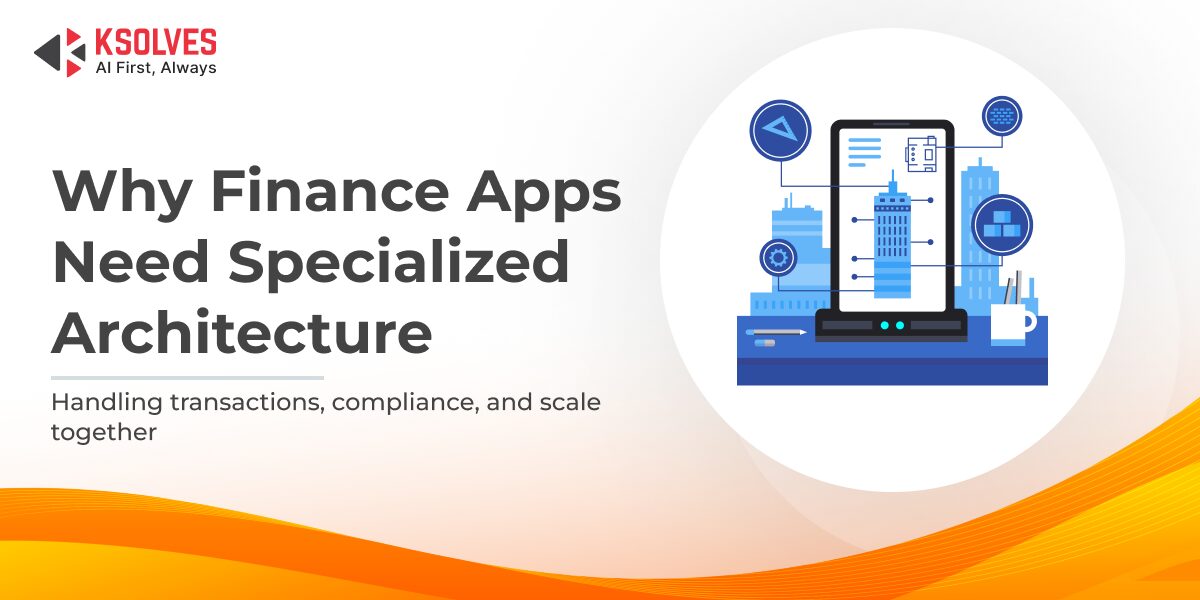
The finance industry has rapidly evolved into a mobile-first ecosystem powered by digital banking, instant payments, online lending, and real-time investment platforms. Today, however, performance and security alone are not enough. The next generation of finance mobile apps is being built on AI-first principles to deliver predictive insights, fraud prevention, and hyper-personalized user experiences.
These applications handle sensitive data, large transaction volumes, and strict compliance requirements while also enabling intelligent decision-making in real time. As a result, financial mobile apps must combine strong security, scalable backend architecture, efficient data pipelines, and embedded AI capabilities.
This blog explores how modern financial institutions engineer AI-first mobile apps that deliver speed, intelligence, safety, and reliability at scale.
Why Finance Mobile Apps Need AI-First Architecture
Financial applications are fundamentally different from typical consumer apps. Beyond traditional requirements, they now demand intelligence at every layer.
Modern finance mobile apps must support:
- Real-time transaction processing and updates
- High concurrent user activity
- AI-driven fraud detection and anomaly identification
- Predictive analytics for financial insights
- Secure identity verification and data protection
- Seamless integration with core banking systems
- Compliance with regulations such as AML, KYC, PCI DSS, and data privacy laws
- High availability and disaster recovery readiness
Even a minor performance or security gap can lead to financial loss or regulatory penalties. By integrating AI capabilities through dedicated model inference services and data pipelines, applications can proactively detect risks, optimize performance, and enhance user engagement.
AI-Driven Microservices and API-First Architecture
A microservices architecture remains the backbone of scalable financial mobile apps, now enhanced with dedicated AI services integrated via APIs and data pipelines.
How AI Enhances Microservices
Each microservice can leverage AI models through inference services to improve decision-making:
- User onboarding with AI-based KYC verification
- Loan eligibility using ML-driven credit scoring
- Fraud detection through real-time anomaly detection models
- Smart notifications powered by behavioral analysis
- Document verification using computer vision
Example
A digital lending platform may include:
- AI-powered onboarding and identity verification
- ML-based loan risk scoring engine
- Intelligent repayment prediction models
- Fraud detection service using anomaly detection
- Conversational AI for customer support
The API-first approach connects these services with mobile apps, payment gateways, credit bureaus, and external data providers. AI models are exposed via APIs, enabling seamless integration of intelligence across the system.
AI Lifecycle Considerations
To ensure reliability and long-term performance, AI systems must be managed beyond just deployment. This includes:
- Model training on relevant and high-quality datasets
- Validation to ensure accuracy, fairness, and compliance
- Deployment through scalable inference services
- Continuous monitoring for performance, latency, and data drift
- Periodic retraining to adapt to changing user behavior and market conditions
Without this lifecycle management, AI-powered microservices risk performance degradation, biased outcomes, and regulatory non-compliance.
Security and Compliance in AI-Powered Finance Apps
Security remains critical, but AI is now a key enabler of proactive threat detection.
Key Security Practices
- End-to-end encryption: Sensitive data is encrypted in transit and at rest using secure key management systems.
- AI-powered fraud detection: Fraud detection systems use streaming data pipelines, real-time feature extraction, and anomaly detection or classification models to identify suspicious activity as transactions occur.
- Multi-factor authentication and biometrics: Includes fingerprint login, facial recognition, OTP verification, and behavioral biometrics.
- Tokenization and secure API gateways: Replace sensitive financial data with tokens and monitor API activity.
- AI-based anomaly detection: Identifies unusual behavior such as location shifts, device mismatches, or abnormal transactions.
- Compliance-aware logging and monitoring: AI helps automate audit trails and detect compliance risks.
Security is no longer reactive. AI enables finance mobile apps to predict and prevent threats before they occur.
AI-Enhanced Hybrid Mobile Architectures
Hybrid mobile development continues to be a preferred approach for finance mobile apps, but it is now being combined with AI-driven capabilities to deliver smarter user experiences.
Benefits of AI-Enhanced Hybrid Architecture
- Unified UI across platforms with personalized experiences
- Faster development cycles with reusable codebases
- AI-driven insights, such as spending analysis and recommendations
- Native modules for secure storage and biometric authentication
- Scalable backend integration with AI services
- Lower maintenance costs with centralized updates
Example
A personal finance app can include:
- Hybrid UI for dashboards, analytics, and budgeting tools
- Native modules for biometric authentication and secure transactions
- AI engine for expense categorization and financial forecasting
- Recommendation system for savings, investments, and alerts
This combination ensures performance, intelligence, and security in one cohesive architecture.
Real-Time Data Pipelines and AI Analytics
Modern financial mobile apps rely heavily on real-time data processing combined with AI analytics, supported by scalable streaming and data infrastructure.
Key Capabilities
- Stream processing for instant transaction updates
- AI models for real-time risk scoring
- Personalized dashboards powered by user behavior analysis
- Predictive insights for investments and spending patterns
- Automated alerts for unusual activity
Behind these capabilities, real-time pipelines are typically built using streaming platforms such as Apache Kafka, along with feature stores and data warehouses that support both low-latency inference and large-scale analytics workloads.
These capabilities enable users to make faster, more informed financial decisions while allowing institutions to optimize operations.
Why Financial Firms Need an AI-First Mobile App Development Company
Financial organizations today require more than just development expertise. They need a partner that understands how to embed AI into every layer of the application.
An AI-first mobile app development company helps deliver:
- Intelligent, data-driven user experiences
- AI-powered fraud detection and risk management
- Scalable microservices with integrated ML models
- Real-time analytics and predictive insights
- Secure and compliant application architecture
- Continuous AI model optimization and monitoring
Ksolves positions itself as an AI-first company, actively integrating AI into both its internal workflows and service delivery. By leveraging AI across development, testing, and deployment, Ksolves ensures faster delivery cycles, improved accuracy, and smarter financial solutions.
With deep expertise in fintech, banking, insurance, and capital markets, Ksolves builds finance mobile apps that are not only high-performing but also intelligent and future-ready.
Conclusion
The future of financial mobile apps lies in AI-first architecture. While performance, scalability, and security remain foundational, intelligence is now the defining factor.
By combining:
- AI-driven microservices
- API-first integration
- Hybrid mobile development
- Real-time data pipelines
- Advanced security frameworks
Financial institutions can deliver applications that are fast, secure, and capable of making intelligent decisions in real time.
Partnering with an AI-first mobile app development company like Ksolves ensures that your finance mobile apps are built not just for today’s demands but for the future of intelligent finance.
Staying ahead of the curve also means tracking what’s next, and our roundup of the top mobile app development trends covers 5G readiness, AI personalization, and wearable integrations reshaping fintech apps.
Got ideas or queries in your mind? Connect with our AI-certified mobile app developers today or send us your query at [email protected].