



Odoo ERP for Discrete Manufacturing: A Complete Guide to Streamlining Production
Odoo
5 MIN READ
July 10, 2026

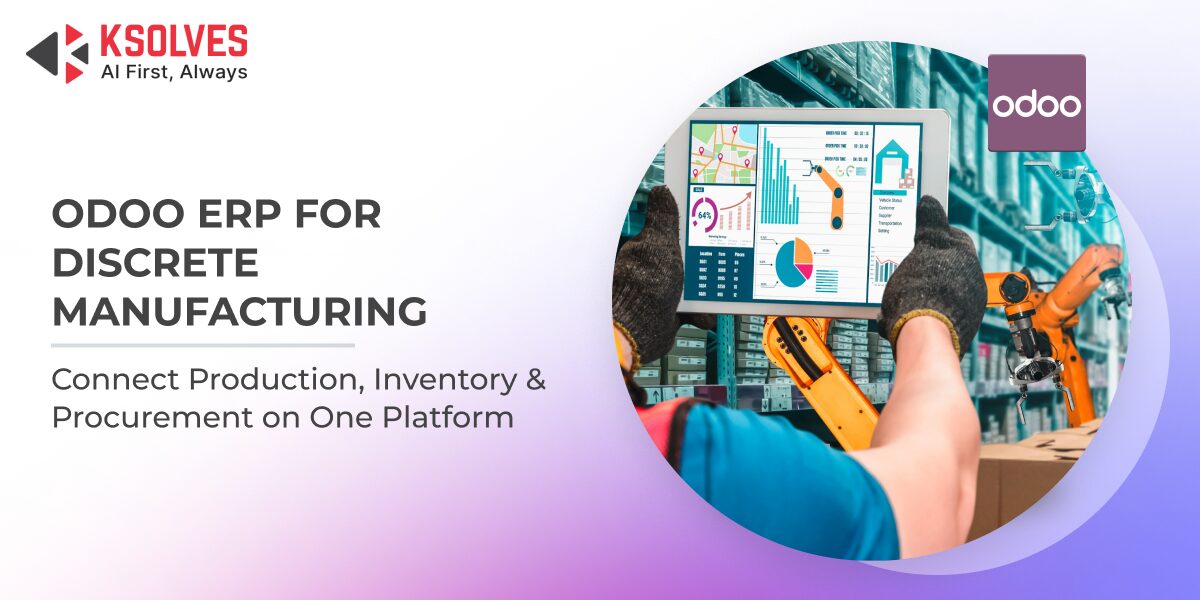
Discrete manufacturing is becoming increasingly complex. Manufacturers must manage intricate Bills of Materials (BOMs), fluctuating demand, inventory availability, production schedules, quality requirements, and supplier networks, all while controlling costs and meeting customer expectations.
Many organizations still rely on disconnected systems and spreadsheets to manage these operations. As production scales, these manual processes often lead to inefficiencies, limited visibility, inventory inaccuracies, and costly delays.
To remain competitive, discrete manufacturers need a centralized platform that connects every aspect of the business. Odoo ERP provides an integrated solution that unifies manufacturing, inventory, procurement, quality, maintenance, sales, and finance within a single system.
In this guide, we’ll explore how Odoo ERP helps discrete manufacturers streamline production processes, improve operational efficiency, enhance traceability, and build scalable, future-ready manufacturing operations.
What is Discrete Manufacturing?
Discrete manufacturing is the process of producing distinct, countable products by assembling individual components, parts, and subassemblies. Each finished product can be identified as a separate unit and, if required, disassembled back into its individual components.
Unlike process manufacturing, which relies on formulas, recipes, and continuous production flows, discrete manufacturing follows a structured assembly process governed by a Bill of Materials (BOM) and defined production operations.
Common examples of discrete manufacturing include:
- Automobiles and automotive components.
- Industrial machinery and equipment.
- Consumer electronics.
- Furniture and home furnishings.
- Medical devices.
- Aerospace and defense products.
Because every product consists of multiple parts that must be sourced, tracked, assembled, and tested, manufacturers need strong control over production planning, inventory management, quality assurance, and traceability throughout the manufacturing lifecycle.
Discrete Manufacturing vs. Process Manufacturing
While both manufacturing models transform raw materials into finished products, they differ significantly in how production is planned and executed.
| Discrete Manufacturing | Process Manufacturing |
| Produces distinct, countable products. | Produces goods through formulas or recipes. |
| Products are assembled from individual components. | Products are created by mixing ingredients or materials. |
| Uses Bills of Materials (BOMs) and routing operations. | Uses recipes, formulas, and batch processes. |
| Finished products can often be disassembled into parts. | Finished products cannot typically be separated into original ingredients. |
| Supports product variants and customization. | Focuses on consistent batch production. |
| Common in automotive, electronics, machinery, and furniture industries. | Common in food & beverage, chemicals, pharmaceuticals, and cosmetics industries. |
For example, a car manufacturer assembles thousands of individual components to create a finished vehicle, making it a discrete manufacturing process. In contrast, a beverage manufacturer combines ingredients according to a formula to produce a drink, which is a process manufacturing operation.
Understanding these distinctions is essential when selecting an ERP system, as discrete manufacturers require specialized capabilities such as BOM management, work orders, engineering change control, serial number tracking, and production scheduling, all areas where Odoo ERP delivers significant value.
Key Operational Challenges in Discrete Manufacturing
Despite technological advancements, many manufacturers continue to struggle with:
- Managing Multi-Level BOMs: Complex product structures often involve hundreds or thousands of components spread across multiple BOM levels.
- Inventory Visibility: A lack of real-time inventory tracking can lead to stockouts, overstocking, and production delays.
- Production Scheduling: Balancing machine capacity, labor availability, and order priorities is often difficult using manual methods.
- Quality Management: Maintaining consistent product quality requires inspections throughout the manufacturing process.
- Demand Forecasting: Unpredictable demand patterns can result in excess inventory or missed customer commitments.
- Engineering Change Management: Frequent design revisions must be controlled to prevent manufacturing disruptions and quality issues.
Why Discrete Manufacturers Need an ERP System
As discrete manufacturing operations grow in complexity, managing production, inventory, procurement, quality, and financial processes through disconnected systems becomes increasingly difficult. Manufacturers need real-time visibility and seamless coordination across departments to remain competitive, reduce costs, and meet customer expectations.
An ERP system provides the foundation for achieving these goals by centralizing data, automating workflows, and connecting every aspect of the manufacturing operation.
The Limitations of Legacy Systems
Many manufacturers continue to rely on a combination of spreadsheets, standalone software applications, and manual processes to manage critical operations. While these systems may support basic requirements, they often create inefficiencies that limit productivity and growth.
Common challenges include:
- Data Silos Across Departments: Production, inventory, procurement, sales, and finance teams often operate in separate systems, making it difficult to access consistent and accurate information.
- Manual Production Tracking: Relying on paper-based processes and spreadsheets increases administrative effort and creates opportunities for human error.
- Delayed Reporting and Insights: Without real-time data, management teams struggle to identify issues quickly and make informed decisions.
- Limited Operational Visibility: Manufacturers lack a complete view of production performance, inventory levels, resource utilization, and order status.
- Higher Operational Costs: Inefficient workflows, duplicated efforts, and poor coordination often result in increased labor and operational expenses.
- Increased Risk of Errors: Manual data entry and disconnected systems can lead to inventory discrepancies, production delays, and quality issues.
Without a unified platform, decision-makers are often forced to react to problems after they occur rather than proactively managing operations.
Benefits of ERP for Discrete Manufacturing
An ERP system integrates business processes, departments, and data into a single platform, enabling manufacturers to operate with greater efficiency, accuracy, and control.
- Unified Business Operations
ERP creates a single source of truth across manufacturing, inventory, procurement, sales, quality, and finance, ensuring every department works with the same real-time information.
- Improved Production Efficiency
Automated workflows, production scheduling, and work order management help eliminate bottlenecks, reduce manual tasks, and improve overall throughput.
- Better Inventory Control
Real-time inventory visibility enables accurate stock management, optimized replenishment planning, and reduced carrying costs.
- Enhanced Traceability
Manufacturers can track materials, components, work orders, lot numbers, serial numbers, and finished products throughout the entire production lifecycle.
- Faster, Data-Driven Decision-Making
Access to live dashboards and operational reports empowers managers and executives to make informed decisions based on accurate business data.
- Scalability for Growth
As business requirements evolve, an ERP system can support additional products, facilities, users, and processes without the limitations of disconnected applications.
By implementing a modern ERP solution such as Odoo, discrete manufacturers can transform fragmented operations into a connected, data-driven manufacturing environment that supports efficiency, profitability, and long-term growth.
Also Read: How Odoo is beneficial in Manufacturing Industries
What Makes Odoo ERP Ideal for Discrete Manufacturing?
Discrete manufacturers need more than just production software; they need a connected system that brings together planning, inventory, procurement, quality, and finance. Odoo ERP delivers exactly that through an integrated, scalable, and data-driven platform.
1. Unified Platform for End-to-End Manufacturing Management
Manufacturing operations involve multiple departments that must work in sync. Odoo connects key business functions, including:
- Manufacturing
- Inventory
- Procurement
- Sales & CRM
- Accounting
- Maintenance
- Quality Management
By eliminating data silos, Odoo enables seamless workflows and ensures every team works from the same real-time information.
2. Modular and Scalable Architecture
Every manufacturer has unique requirements and growth plans. Odoo’s modular structure allows businesses to implement only the applications they need and add more functionality over time.
Manufacturers can start with core modules such as:
- Manufacturing
- Inventory
- Purchase
- Accounting
and expand with:
- Quality Management
- Maintenance
- PLM
- Advanced Reporting
This flexibility keeps implementation simple while supporting long-term growth.
3. Real-Time Operational Visibility
Effective manufacturing decisions depend on accurate, real-time data. Odoo provides live dashboards and reports that offer visibility into:
- Production performance
- Inventory levels
- Work center utilization
- Procurement activities
- Manufacturing costs and profitability
With instant access to operational insights, managers can identify bottlenecks, improve efficiency, and make faster, data-driven decisions.
Key Odoo ERP Features for Discrete Manufacturing
Discrete manufacturing requires precise coordination between engineering, production, inventory, procurement, quality, and maintenance teams. Odoo ERP provides an integrated set of tools that help manufacturers manage these processes from a single platform, ensuring greater efficiency, visibility, and operational control.
1. Bill of Materials (BOM) Management
The Bill of Materials is the foundation of every discrete manufacturing process. Whether you’re producing a simple assembly or a highly engineered product with multiple subassemblies, Odoo helps maintain complete control over product structures.
Key capabilities include:
- Multi-level Bills of Materials.
- Product variants and configurable products.
- By-products and alternative BOMs.
- Component consumption tracking.
- Integration with engineering changes through Odoo PLM.
With accurate BOM management, manufacturers can reduce planning errors and ensure consistent production outcomes.
Benefits
- Improved production accuracy.
- Better material planning.
- Faster introduction of product changes.
- Greater product consistency.
2. Production Planning and Manufacturing Orders
Odoo enables manufacturers to convert sales forecasts and customer demand into structured manufacturing plans. Manufacturing Orders (MOs) can be generated automatically based on inventory rules, sales orders, or replenishment requirements.
Key capabilities include:
- Manufacturing order management.
- Production scheduling.
- Work center planning.
- Component availability checks.
- Capacity visibility across operations.
This helps production teams maintain smooth workflows while minimizing delays and resource conflicts.
Benefits
- Improved production scheduling.
- Reduced bottlenecks.
- Better resource utilization.
- Higher on-time delivery performance.
3. Work Order and Shop Floor Management
For manufacturers operating multiple production stages, Odoo Work Orders provide real-time visibility into shop floor activities.
Operators can access work instructions, record progress, track production times, and update job status directly within the system.
Key capabilities include:
- Automated work order generation.
- Digital work instructions.
- Production progress tracking.
- Time tracking by operation.
- Work center monitoring.
This creates greater transparency across manufacturing operations and improves execution consistency.
Benefits
- Enhanced shop floor visibility.
- Increased workforce productivity.
- Improved process control.
- Reduced manual reporting.
4. Inventory and Warehouse Management
Inventory management plays a critical role in discrete manufacturing. Odoo provides real-time stock visibility to help ensure materials are available when production requires them.
Key capabilities include:
- Real-time inventory tracking.
- Multi-warehouse management.
- Inventory replenishment rules.
- Barcode-enabled warehouse operations.
- Lot and serial number traceability.
- Inventory forecasting.
By synchronizing inventory with production requirements, manufacturers can avoid costly disruptions and excess stock.
Benefits
- Reduced stockouts.
- Lower inventory carrying costs.
- Improved stock accuracy.
- Better production continuity.
Also Read: Top 5 Odoo Inventory Apps for 2025
5. Procurement and Supplier Management
Material shortages can quickly impact production schedules. Odoo connects procurement processes directly with manufacturing and inventory requirements to help ensure the right materials arrive at the right time.
Key capabilities include:
- Automated RFQs and purchase orders.
- Vendor management.
- Purchase agreements.
- Supplier performance monitoring.
- Demand-based procurement planning.
This integration enables more efficient purchasing decisions and stronger supplier coordination.
Benefits
- Faster procurement cycles.
- Improved supplier relationships.
- Reduced material shortages.
- Better purchasing control.
6. Quality Management
Maintaining consistent quality is essential in discrete manufacturing. Odoo Quality enables organizations to perform inspections at predefined stages of production and inventory operations.
Key capabilities include:
- Quality control points.
- Inspection checks.
- Quality alerts.
- Non-conformance tracking.
- Corrective action management.
Instead of identifying issues after production is complete, manufacturers can detect and resolve problems earlier in the process.
Benefits
- Reduced defects and rework.
- Improved product consistency.
- Better compliance management.
- Enhanced customer satisfaction.
7. Product Lifecycle Management (PLM)
Design changes are inevitable in discrete manufacturing. Odoo PLM helps engineering and production teams collaborate on product updates while maintaining control over revisions and approvals.
Key capabilities include:
- Engineering Change Orders (ECOs).
- Revision management.
- Version-controlled BOMs.
- Approval workflows.
- Change tracking and documentation.
This ensures production teams always work with the latest approved product specifications.
Benefits
- Faster implementation of design changes.
- Improved collaboration between engineering and manufacturing.
- Reduced production errors.
- Stronger product governance.
Also Read: How Odoo PLM Simplifies Engineering Change Order (ECO) Management
8. Maintenance Management
Equipment failures can significantly impact production performance. Odoo Maintenance helps manufacturers implement preventive maintenance strategies to maximize asset availability.
Key capabilities include:
- Preventive maintenance scheduling.
- Maintenance requests.
- Equipment tracking.
- Downtime monitoring.
- Maintenance history management.
By proactively maintaining equipment, manufacturers can reduce unexpected disruptions and extend asset life.
Benefits
- Increased equipment uptime.
- Reduced maintenance costs.
- Improved operational reliability.
- Better production continuity.
How Odoo Streamlines the Entire Manufacturing Lifecycle
One of Odoo ERP’s biggest advantages is its ability to connect every stage of the manufacturing process on a single platform. From demand planning and procurement to production, quality control, inventory management, and financial reporting, information flows seamlessly across departments, enabling greater efficiency and visibility throughout the product lifecycle.
Stage 1: Demand and Sales Planning
Manufacturing begins with demand. Odoo connects sales, inventory, and production planning to ensure manufacturing activities are aligned with actual customer requirements and market demand.
Sales orders, forecasts, and inventory levels provide the foundation for production planning, helping manufacturers make informed decisions about capacity and resource allocation.
Stage 2: Material Procurement
Once production requirements are established, Odoo helps ensure the necessary materials are available at the right time.
By linking procurement with inventory and manufacturing operations, the system can automatically generate purchase requisitions or RFQs when stock levels fall below defined thresholds or production demand increases.
Stage 3: Production Execution
Odoo transforms production plans into actionable Manufacturing Orders and Work Orders, guiding operators through every stage of the manufacturing process.
Production teams can track work progress in real time, while managers gain complete visibility into shop floor activities, resource utilization, and production performance.
Stage 4: Quality Assurance
Quality control is integrated directly into manufacturing workflows rather than treated as a separate process.
Inspection checkpoints can be configured at critical stages of production and inventory operations, helping teams identify and resolve issues before they impact finished products.
Stage 5: Inventory Management and Order Fulfillment
As products move through production, inventory records are automatically updated in real time. Finished goods become immediately available for storage, allocation, or shipment.
Integrated warehouse and logistics workflows help ensure accurate inventory control and timely customer deliveries.
Stage 6: Cost Control and Financial Visibility
Every manufacturing activity, from material consumption and labor utilization to procurement and inventory movements, flows directly into Odoo’s accounting and financial modules.
This gives manufacturers a clear understanding of production costs, margins, and overall business performance without relying on manual reconciliation.
Real-World Use Cases of Odoo ERP in Discrete Manufacturing
The true value of Odoo ERP becomes evident when applied to real-world manufacturing environments. Whether producing automotive components, electronic devices, industrial equipment, or customized furniture, manufacturers face unique operational challenges that require a connected and scalable ERP solution. Odoo helps address these challenges by streamlining processes, improving visibility, and enabling better decision-making across the production lifecycle.
1. Automotive Components Manufacturing
Automotive component manufacturers operate in highly demanding environments where precision, traceability, and production efficiency are critical. Managing complex Bills of Materials (BOMs), coordinating with multiple suppliers, and maintaining strict quality standards can quickly become challenging when relying on disconnected systems.
Odoo helps manufacturers gain greater control over production planning, inventory management, and quality processes. With automated manufacturing workflows, real-time inventory visibility, and end-to-end traceability, businesses can improve operational efficiency while meeting stringent industry requirements.
Key Benefits:
- Better production planning and scheduling.
- Improved inventory accuracy.
- Enhanced quality control and traceability.
- Reduced production delays.
2. Electronics Manufacturing
The electronics industry is characterized by rapid innovation, frequent product updates, and complex component sourcing. Manufacturers must constantly adapt to engineering changes while maintaining complete visibility into components and finished products.
Odoo supports electronics manufacturers through serial number tracking, engineering change management, and automated procurement planning. This ensures better control over product revisions, inventory levels, and supply chain activities.
Key Benefits:
- Improved component traceability.
- Faster implementation of product changes.
- Better inventory and procurement management.
- Greater responsiveness to market demand.
3. Industrial Equipment Manufacturing
Industrial equipment manufacturers often deal with highly customized products, long production cycles, and extensive resource planning requirements. Coordinating engineering, procurement, production, and project timelines can be difficult without a centralized system.
Odoo brings these processes together on a single platform, providing complete visibility into manufacturing operations. Production teams can effectively plan capacity, allocate resources, and monitor project progress while maintaining control over costs and timelines.
Key Benefits:
- Improved resource utilization.
- Better production planning.
- Enhanced project visibility.
- Stronger cost control.
4. Furniture Manufacturing
Furniture manufacturers must balance product customization, material optimization, and production efficiency while meeting customer delivery expectations. Managing product variants and ensuring material availability are often major operational challenges.
Odoo helps streamline furniture manufacturing through product variant management, material requirements planning (MRP), inventory control, and automated production workflows. This enables manufacturers to handle customized orders more efficiently while minimizing waste and production delays.
Key Benefits:
- Simplified product customization.
- Better material utilization.
- Improved inventory management.
- Faster production and order fulfillment.
Why Choose Ksolves for Odoo Discrete Manufacturing Implementation?
Implementing an Odoo ERP system is about more than deploying software, but it’s about creating a manufacturing environment that improves efficiency, visibility, and long-term scalability. Choosing the right implementation partner can make the difference between a successful transformation and a costly, underutilized system.
At Ksolves, we combine deep Odoo expertise and an AI-driven delivery approach with a strong understanding of manufacturing operations to deliver solutions faster, tailored to the realities of discrete manufacturing.
- Manufacturing-Focused Odoo Expertise
Our team understands the complexities of discrete manufacturing, including BOM management, production planning, inventory control, quality management, and shop floor operations. We design Odoo solutions that align with your manufacturing processes rather than forcing your business to adapt to generic workflows.
- AI-First Odoo Implementation Approach
As an AI-first Odoo development company, we leverage intelligent tools and proven methodologies to accelerate requirement analysis, streamline implementation, and reduce deployment timelines. This approach helps ensure faster time-to-value and greater implementation accuracy.
- Tailored Odoo Solutions
Every manufacturing business operates differently. We customize Odoo to support your unique workflows, reporting requirements, integrations, and operational goals—ensuring the ERP system works the way your business does.
- End-to-End Support
From consulting and implementation to customization, training, and ongoing support, Ksolves serves as a long-term technology partner committed to helping you maximize the value of your Odoo investment.
Final Words
Discrete manufacturers need more than isolated tools; they need a connected system that brings together production, inventory, procurement, quality, and finance. Odoo ERP delivers this through a unified platform that improves visibility, streamlines operations, and supports scalable growth.
With the right Odoo implementation partner like Ksolves, manufacturers can unlock greater efficiency, stronger process control, and long-term business value. Ksolves helps make that transformation possible with tailored Odoo solutions designed around your unique manufacturing requirements.
Ready to Streamline Your Manufacturing Operations?
Partner with Ksolves to implement Odoo ERP and build a smarter, more efficient, and scalable manufacturing business.



































AUTHOR
Odoo
Neha Negi, Presales and Business Associate Head at Ksolves is a results-driven ERP consultant with over 8 years of expertise in designing and implementing tailored ERP solutions. She has a proven track record of leading successful projects from concept to completion, driving organizational efficiency and success.
Share with