



Self-Healing Test Scripts: How AI is Eliminating Test Maintenance Headaches
QA
5 MIN READ
July 20, 2026

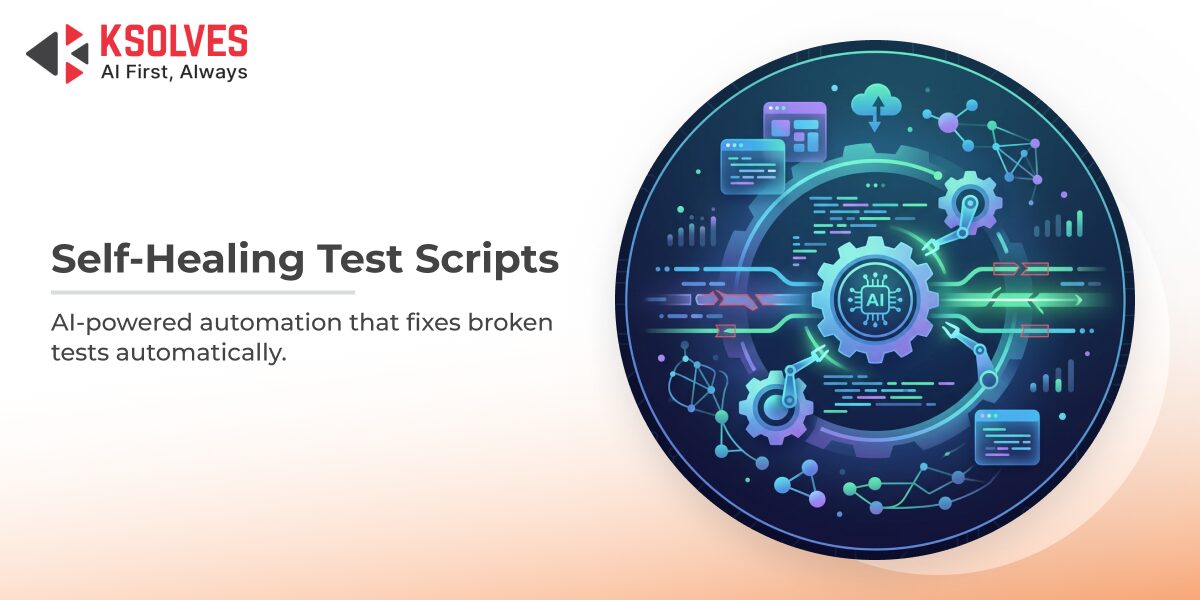
Broken test scripts at 2 AM. A UI button was renamed overnight. A CI/CD pipeline stalled because a locator changed. Every QA engineer knows this story. Traditional test automation promised speed, but delivered a different problem: the relentless burden of script maintenance. Now, AI-powered self-healing test scripts are rewriting that story. By automatically detecting, adapting, and repairing broken tests without human intervention, self-healing automation is turning fragile test suites into resilient, self-sustaining assets.
This blog explores how self-healing technology works, why it matters for modern software teams, and how organizations can operationalize it for maximum impact.
The Hidden Cost of Brittle Test Scripts
Test automation was supposed to free QA teams. Instead, many teams spend the majority of their bandwidth maintaining scripts rather than expanding test coverage or exploring new functionality. The root cause is predictable: automated tests are tightly coupled to UI element identifiers. When developers rename a button, restructure a form, or shift a layout, those identifiers break, and the scripts fail.
This signals a decisive shift from reactive maintenance to proactive, intelligent automation.
What Are Self-Healing Test Scripts?
Self-healing test scripts are AI-powered automated tests that can identify when an application change has caused a test failure and autonomously repair themselves without manual intervention. Instead of flagging a failure and waiting for a developer to investigate, the framework works through a repeatable cycle:
- Detects that a UI element is missing or has changed
- Analyzes the current UI using AI algorithms to identify the most likely matching element
- Adapts by updating the test script dynamically with the corrected locator
- Validates the fix by re-executing the test to confirm accuracy
- Learns from each correction to improve future predictions
This approach treats test scripts not as static files to be maintained, but as living artifacts that evolve alongside the application.
How AI Makes Self-Healing Possible
The intelligence behind self-healing comes from multiple AI and machine learning techniques working in layers.
Multi-Attribute Element Matching
This moves beyond brittle single-locator strategies. Instead of relying solely on an XPath or CSS selector, the framework captures multiple element attributes such as ID, name, visible text, relative position, and visual context. When one attribute changes, the system uses the remaining signals to locate the correct element. Evaluating which test management tools support this kind of AI-assisted element mapping is a useful next step before adopting self-healing at scale.
Semantic Understanding
This allows the AI to interpret the purpose of a UI element, not just its technical identifier. If a “Buy Now” button is renamed “Purchase,” a semantically aware model recognizes the functional equivalence and maps the test action accordingly.
Continuous Learning Loops
These ensure the system improves with every run. Each correction feeds back into the model, sharpening its ability to predict future changes and reduce false positives over time.
Build a Test Automation Framework That Adapts With You
Real-World Impact: Where Self-Healing Delivers Value
Consider an e-commerce platform that releases multiple UI updates per sprint. Without self-healing, each release risks breaking dozens of regression tests, forcing engineers to manually inspect and patch scripts before the suite can run.
With self-healing automation, those corrections happen silently during test execution, logs capture the changes for review, and the pipeline continues uninterrupted.
The benefits compound quickly across the software delivery lifecycle:
- Reduced maintenance overhead: QA teams reclaim hours previously lost to script debugging and locator updates.
- Faster release cycles: CI/CD pipelines remain stable even through frequent UI changes, enabling continuous delivery without quality gates becoming bottlenecks.
- Broader test coverage: Engineers freed from maintenance can build new test scenarios and cover previously untested edge cases.
- Improved test reliability: Flaky tests caused by unstable locators are systematically eliminated, increasing confidence in test results.
Teams without in-house bandwidth to build this expertise can also hire dedicated QA testers through Ksolves to accelerate the transition.
Why This Matters for Agile and DevOps Teams
In Agile environments, application code changes with every sprint. In DevOps pipelines, tests run multiple times per day. Traditional test automation was never designed for this pace. Self-healing scripts are purpose-built for it.
Accelerate Your Testing with Ksolves Software Automation Services
If your team is spending more time fixing tests than writing them, that is a signal worth acting on. Ksolves Software Automation Services help enterprises design and implement intelligent test automation frameworks that include self-healing capabilities tailored to your application stack. From AI-powered locator strategies to full CI/CD integration, Ksolves brings the technical depth and hands-on expertise to transform your testing operations into a competitive advantage. Whether you are modernizing an existing Selenium suite or building a new automation architecture from the ground up, the team at Ksolves delivers frameworks that scale with your product and adapt to change without breaking.
Conclusion
Self-healing test scripts represent a fundamental shift in how software teams think about test automation. The goal is no longer simply to automate test execution; it is to build automation that sustains itself. By combining multi-attribute matching, semantic AI, and continuous learning, self-healing frameworks eliminate the maintenance drag that undermines so many automation investments. For teams committed to quality at speed, this technology is not a future consideration. It is a present-day necessity.
Ready to Build a Test Automation Strategy That Heals Itself?
Frequently Asked Questions
What is a self-healing test script?
A self-healing test script is an AI-powered automated test that detects when a UI change breaks its original locator and automatically updates itself to match the new element, without a developer needing to rewrite the script. It relies on techniques like multi-attribute matching and semantic understanding to find the right element even after a rename or layout shift. This keeps regression suites running instead of failing on cosmetic changes. Ksolves builds self-healing frameworks as part of its Software Automation Testing Services.
What happens if I don’t use self-healing test automation?
Without self-healing, every UI change, such as a renamed button or a shifted layout, breaks the locators your tests depend on, forcing QA teams to manually inspect and patch scripts before releases can proceed. This maintenance burden compounds over time, often consuming more engineering hours than writing new tests. Teams typically see slower release cycles, lower test coverage, and rising flaky-test rates as a result.
How do self-healing test scripts actually repair themselves?
The framework follows a five-step cycle: it detects a missing or changed UI element, analyzes the current page with AI to find the closest match, updates the script’s locator, re-runs the test to confirm the fix, and logs the correction to improve future predictions. This turns each failure into a learning event rather than a blocked pipeline. Ksolves’ Test Automation Services implement this cycle end-to-end, from framework design to CI/CD integration.
How is self-healing test automation different from traditional test automation?
Traditional test automation relies on a single, brittle locator like an XPath or CSS selector, so any UI change breaks the test until a person fixes it. Self-healing automation instead captures multiple attributes per element, such as ID, text, position, and visual context, so the system can recover on its own when one attribute changes. The result is fewer false failures and less manual maintenance without sacrificing test coverage.
When should a team adopt self-healing test automation?
Self-healing automation delivers the most value once a team is running frequent releases, such as multiple UI updates per sprint, and already has an established regression suite that is costly to maintain manually. Teams still building their first automation framework often benefit more from getting solid test design and coverage in place first. Most organizations see a meaningful drop in maintenance overhead within the first few release cycles after adoption.
Who can help implement self-healing test automation?
Providers offering AI-driven test automation frameworks, including vendors who specialize in multi-attribute element matching and CI/CD integration, can implement self-healing capabilities. Ksolves is one such provider, delivering intelligent test automation frameworks with self-healing built in, whether modernizing an existing Selenium suite or architecting a new automation strategy from scratch. Look for a partner with a track record of measurable outcomes, such as documented test coverage improvements.
Does self-healing test automation reduce QA costs?
Yes, by eliminating the manual locator-fixing cycle, self-healing automation reduces the engineering hours QA teams spend on script maintenance, freeing that capacity for building new test coverage instead. Organizations implementing AI-driven regression testing have reported outcomes like 90% functional test coverage alongside a meaningful reduction in manual testing effort. The upfront investment in a self-healing framework typically pays back through fewer release delays and less firefighting.
Still have questions about building a self-healing test automation strategy? Contact our team.




































Author
About the Author Editorial Team The Ksolves Editorial Team includes certified Salesforce experts, Big Data engineers, AI/ML specialists, Zoho consultants, and experienced technology writers focused on delivering clear, actionable insights for modern businesses. With hands-on experience across Salesforce, Big Data platforms, AI/ML solutions, application development, software testing, and Zoho ERP/CRM, the team publishes practical guides, real-world use cases, and industry updates that support smarter decisions and faster growth. Every article is created to solve business challenges, guide technology adoption, and keep organizations aligned with evolving digital ecosystems.
Share with