



Agentforce and Model Context Protocol (MCP): The Future of Enterprise AI Integration
Agentforce
5 MIN READ
August 10, 2026

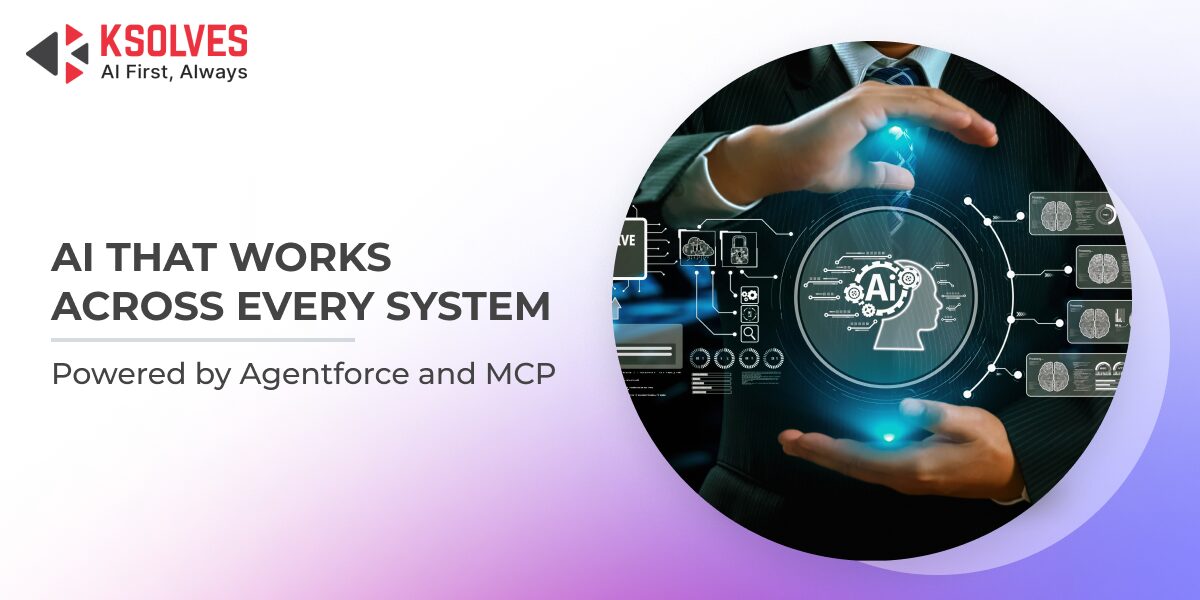
Agentforce, Salesforce’s autonomous AI agent platform, has crossed a major milestone. With over 12,000 enterprise customers on board since its general availability in October 2025, the platform is delivering real, measurable outcomes. Reddit, for example, cut case resolution time by 84% and deflected 46% of service cases using Agentforce agents.
But the most exciting shift is not just what Agentforce can do. It is how it does it. The secret ingredient? Model Context Protocol (MCP).
This blog covers what MCP is, how it works within the Agentforce architecture, the security framework that governs it, and what this combination means for enterprises looking to scale AI across their entire tool stack.
What Is Model Context Protocol (MCP)?
Think of MCP as the USB-C of AI: a universal connector that lets AI agents plug into any external system without custom wiring for every integration. Formally, MCP is an open standard originally developed by Anthropic in November 2024 and now governed by the Linux Foundation’s Agentic AI Foundation. It defines a standardized way for AI models to discover available tools, execute functions, and retrieve data from external sources through a single, well-defined handshake.
Before MCP existed, connecting an AI agent to an external system was a bespoke engineering project every single time. Want your Agentforce agent to pull data from a data warehouse? Write custom Apex callouts. Connect to GitHub? Configure Named Credentials. Integrate with Jira? Define External Services schemas manually. Each connection was its own island.
MCP changes that entirely. Any MCP-compliant system can talk to any MCP-compliant agent: instantly, securely, and without custom code. The urgency to adopt such standards is clear: according to a Harvard Business Review Analytic Services report based on a survey of 603 business and technology leaders, 86% of organizations plan to increase their investment in agentic AI over the next two years, yet only 6% currently trust AI agents to autonomously handle core business processes. That gap between ambition and readiness is precisely what MCP is designed to close.
How MCP Works: The Three-Tier Architecture
MCP follows a clean three-tier client-server model built on JSON-RPC 2.0:
1. MCP Host
The user-facing AI platform that runs the large language model and acts as the security broker. In Agentforce, this role is played by the Atlas Reasoning Engine, which orchestrates agent logic and enforces the Einstein Trust Layer. Getting these guardrails right often requires experienced Salesforce consulting services that understand both the platform and your industry’s compliance requirements.
2. MCP Client
Middleware within the host that maintains stateful sessions with individual MCP servers. Agentforce’s native MCP client, in Beta since January 2026, handles session management, authentication handshakes, and tool invocations automatically.
3. MCP Server
The external system’s standardized interface that exposes its tools, data resources, and prompt templates via discoverable schemas. This could be a pre-built Salesforce MCP server, a third-party server listed on AgentExchange, or a custom server your team builds on platforms like Heroku. Building and maintaining a custom MCP server still calls for solid Salesforce integration expertise, especially when it needs to respect existing data models and permissions.
Each MCP server exposes three types of capabilities:
- Actions: Tasks the agent can invoke on your behalf
- Resources: Structured data and content that the agent can read
- Prompts: Reusable workflow templates for common scenarios
Agentforce and MCP: A Game-Changing Integration
Native MCP client support launched in Agentforce Pilot in July 2025 and entered Beta in January 2026. The implications are significant. With MCP, Agentforce agents can now connect to Snowflake, Slack, GitHub, Jira, custom databases, and hundreds more external systems through a standardized interface that requires zero custom code. Instead of building integrations one by one, your agents discover available tools automatically, understand their schemas, and invoke them within the same trust boundary that protects your Salesforce data.
Here is a real-world example of what this unlocks:
An Agentforce sales agent, mid-conversation with a customer, queries Snowflake for real-time pipeline analytics, pulls the latest opportunity notes from Salesforce CRM, generates an invoice through a PayPal MCP server, and triggers a Slack notification to the account team. All in one seamless flow. No custom integrations. No context-switching. No manual work.
That is the Agentforce and MCP promise, and it is already happening in production environments.
The Security Story: Einstein Trust Layer and MCP
This is where Salesforce’s architecture earns its stripes. The Einstein Trust Layer governs every interaction, even across MCP connections. It enforces:
- Zero data retention with third-party LLM providers
- Toxicity detection and hallucination mitigation on all outputs
- Configurable guardrails for regulated industries
- Existing permission models respected across all tool invocations
Even when Agentforce connects to external APIs through MCP, data flows through Salesforce’s infrastructure. Your security controls, audit logs, and compliance posture remain intact. Business-level policies, such as flagging invoices above $10,000 for human review, can be enforced through natural language instructions on the MCP server.
Discovering MCP Tools: AgentExchange
Salesforce’s AgentExchange marketplace is the curated catalog where you find vetted, certified MCP servers ready for enterprise deployment. Think of it as an app store, but for AI agent capabilities.
Partners like MuleSoft are already building pre-built MCP connectors across categories, including analytics platforms, ticketing systems, communication tools, and cloud databases. And if your team needs something custom, Heroku provides managed infrastructure with built-in DevOps to host your own MCP servers, connecting back to Agentforce via AppLink.
The result: faster time-to-value, lower integration overhead, and a growing ecosystem of trusted, interoperable AI capabilities.
Real Business Impact: What This Means for Your Organization
The Agentforce and MCP combination is not just a technical upgrade but a fundamental shift in how enterprises operate AI at scale.
| Who It Affects | What Changes |
|---|---|
| IT and Architecture Teams | Dramatically reduced integration complexity. A connection that previously required weeks of custom development can now be deployed from AgentExchange in hours. That kind of speed depends on having the right Salesforce implementation services partner to configure the connection correctly the first time. |
| Business Operations | AI agents that truly work across your entire tool stack, not just within Salesforce. Cross-system workflows become automated, consistent, and auditable. |
| Leaders | Governance does not take a back seat to capability. Every tool connection, data access, and agent action is logged, controlled, and compliance-ready through the Einstein Trust Layer. |
Where Things Are Headed
MCP has already achieved broad industry adoption. OpenAI, Google, and Microsoft have all embraced it, positioning it as the de facto standard for agentic interoperability. Salesforce is investing heavily here, with MCP support integrated across Agentforce, MuleSoft, Heroku, and Slack, which is developing its own MCP server.
As the open-source MCP ecosystem matures, expect the catalog of compatible servers to grow rapidly, lowering the barrier for even more sophisticated cross-system automation.
The enterprises that build their AI foundations on connected, standards-based architectures today will be the ones with a meaningful competitive edge tomorrow. Agentforce and MCP together represent exactly that kind of foundational investment.
Partner with Ksolves for Expert Agentforce Implementation
Deploying Agentforce successfully requires more than turning on a platform. It demands a deep understanding of your business processes, integration landscape, and governance requirements. That is where Ksolves comes in.
As a specialized Salesforce Summit Partner and an AI-first company, Ksolves offers end-to-end Salesforce Agentforce Consulting Services, covering everything from strategy and architecture through implementation and ongoing optimization.
Whether you are looking to connect your first MCP server, automate cross-system workflows, or scale agent deployments across your enterprise, the Ksolves team brings the technical depth and practical experience to get you there faster and with lower risk.
Ready to Connect Agentforce to Your Tool Stack?
Getting Started
If you are already a Salesforce customer, the path forward is clear:
- Explore AgentExchange for pre-built MCP servers that connect to the systems you already use.
- Audit your integration landscape to identify where current custom code could be replaced by MCP-standard connectors.
- Pilot an Agentforce agent using at least one external MCP connection to see the productivity gains firsthand.
- Upskill your team: Salesforce’s Agentforce certifications and MCP documentation are a strong starting point.
The future of enterprise AI is not a single, monolithic system that knows everything. It is an intelligent agent ecosystem, connected through open standards, governed by enterprise-grade trust, and capable of taking meaningful action across your entire business. Agentforce and MCP are making that future real, starting right now. For a realistic sense of scope, this breakdown of the Agentforce implementation timeline walks through each stage from pilot to rollout.
Conclusion
Agentforce and MCP are not just another technology pairing. They represent a structural shift in how enterprise AI gets built and deployed.
Together, they give organizations a foundation to move from isolated AI experiments to connected, cross-system automation at scale. The enterprises that invest in this foundation today will be significantly better positioned to compete tomorrow. The tools are ready. The standard is set. The only question is how quickly your organization moves.
Ready to implement? Connect with the Ksolves Agentforce Consulting Services team and take the first step toward a connected, AI-powered enterprise, or send us your query at [email protected].
Take the First Step Toward a Connected, AI-Powered Enterprise
FAQs
What is Model Context Protocol (MCP) in Agentforce?
Model Context Protocol (MCP) is an open standard that lets Agentforce agents discover and use tools from external systems through one standardized connection instead of custom code for each integration. It was originally developed by Anthropic and is now governed by the Linux Foundation’s Agentic AI Foundation. Within Agentforce, MCP support is handled natively by the platform’s MCP client, currently in Beta.
What happens if I connect Agentforce to an external system without using MCP?
Without MCP, each connection has to be built as a one-off integration — custom Apex callouts, manually configured Named Credentials, or hand-built External Services schemas depending on the system. This means slower rollouts, higher maintenance overhead, and integration logic that has to be rebuilt every time you add a new tool. Ksolves’ Salesforce integration teams typically see this custom-build approach take weeks per connection compared to hours through an MCP-standard connector.
How do I connect an Agentforce agent to a new MCP server?
Start by checking Salesforce’s AgentExchange marketplace for a pre-built, certified MCP server for the system you need. If nothing certified exists, your team (or a partner like Ksolves) can build a custom MCP server, often hosted on Heroku, and connect it back to Agentforce via AppLink. Once connected, the agent automatically discovers the server’s available actions, resources, and prompt templates without additional custom coding.
Is MCP different from a traditional Salesforce API integration?
Yes — a traditional integration is built point-to-point for one specific system and has to be re-engineered for the next one, while MCP defines a single standardized handshake that any compliant system and any compliant AI agent can use interchangeably. In practice, MCP reduces integration work from a custom engineering project to a configuration task. Traditional API-led integration approaches, like those Ksolves delivers through Salesforce MuleSoft, still matter for connecting the underlying data layer that MCP servers expose.
When did Agentforce get native MCP support?
Native MCP client support launched in Agentforce Pilot in July 2025 and moved into Beta in January 2026. Enterprise adoption is moving quickly: a Harvard Business Review Analytic Services survey found 86% of organizations plan to increase agentic AI investment over the next two years, even though only 6% currently trust AI agents to run core processes autonomously.
Who builds and hosts MCP servers for Agentforce?
MCP servers come from three sources: Salesforce’s own pre-built servers, third-party servers listed on AgentExchange from partners like MuleSoft, or custom servers your team builds and hosts, often on Heroku. As a Salesforce Summit Partner, Ksolves builds and configures custom MCP servers for clients who need connections beyond what’s available on AgentExchange today.
Does adding MCP servers put Salesforce data security at risk?
No — even when Agentforce connects to an external system through MCP, all data still flows through Salesforce’s infrastructure and is governed by the Einstein Trust Layer, which enforces zero data retention with third-party LLMs, toxicity and hallucination checks, and your existing permission model. Business-level policies, such as flagging invoices above a certain amount for human review, can also be enforced directly through natural-language instructions on the MCP server. Contact our team to discuss governance requirements for your specific compliance needs.
Still have questions? Contact our team.































Author
About the Author Editorial Team The Ksolves Editorial Team includes certified Salesforce experts, Big Data engineers, AI/ML specialists, Zoho consultants, and experienced technology writers focused on delivering clear, actionable insights for modern businesses. With hands-on experience across Salesforce, Big Data platforms, AI/ML solutions, application development, software testing, and Zoho ERP/CRM, the team publishes practical guides, real-world use cases, and industry updates that support smarter decisions and faster growth. Every article is created to solve business challenges, guide technology adoption, and keep organizations aligned with evolving digital ecosystems.
Share with