

 Apache Hudi
 5 MIN READ


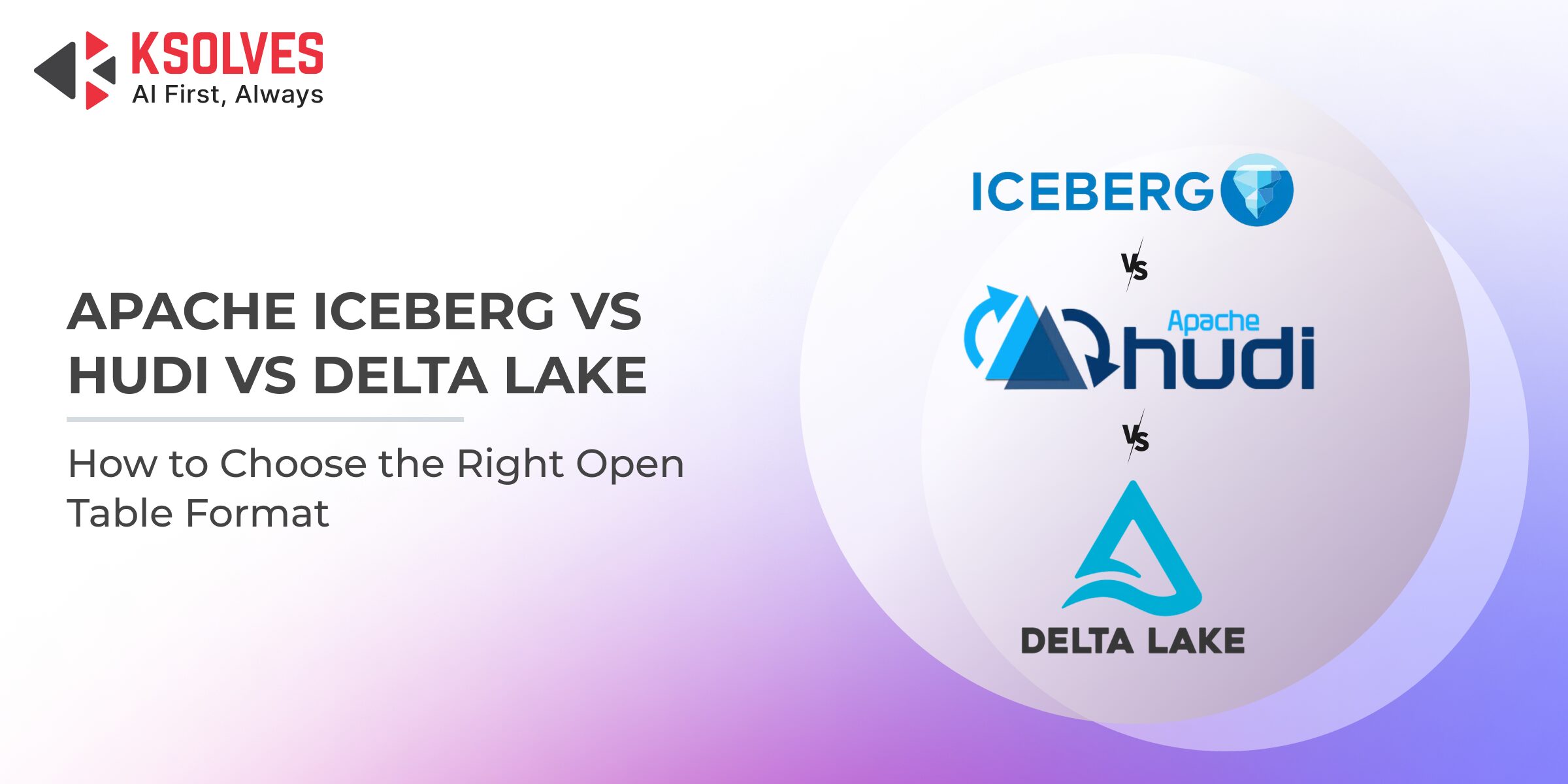
This is the question our Big Data experts hear at the start of almost every consulting session. And it is a fair one. All three are open source, all sit on top of cloud storage, and on a feature checklist today, they look nearly identical.
That surface similarity is exactly what makes the decision hard.
The difference between Apache Iceberg, Apache Hudi, and Delta Lake lies not in what they do, but in what problem each one was built to solve, and what that means for your specific workload. Because the format in which your data is stored is not a low-level technical detail.
It determines how fast your queries run, how reliably your pipelines write, how quickly your team can act on fresh data, and how much of your engineering capacity goes toward maintaining the system versus building on top of it.
The Problems Open Table Formats Solve
Before comparing the three formats, it helps to understand what problem they are all solving and where in the data journey they actually sit.
Consider a company collecting data from multiple sources: transactions, user activity, inventory updates, and third-party feeds. That data arrives continuously and lands in cloud storage such as Amazon S3, Google Cloud Storage, or Azure Data Lake. Storage at this stage is cheap and scalable, but structurally blind. It holds the data. It cannot organise it, version it, or protect it from a failed write.
Open table formats sit at this exact point in the stack, between raw storage and the query layer. They do not replace the storage underneath or the processing engines above. They add the layer that makes raw files behave like a proper database table: queryable, versioned, and safe to write to.
Without this layer, every data platform hits the same three problems at scale:
- Atomic Transactions: When a write operation fails midway, raw lakes have no mechanism to roll back. The table is left in a partially updated state with no clean recovery path.
- Consistent Updates: Reads running during an active write can return incomplete or conflicting results. In environments with concurrent pipelines writing to the same tables, this creates data integrity problems that are difficult to diagnose.
- Metadata Scalability: As tables grow into thousands of partitions and billions of files, the metadata layer that tracks all of it becomes a bottleneck. Query planning slows down. Object store API limits become a real constraint.
Apache Iceberg, Apache Hudi, and Delta Lake each address all three. The difference is in which one they were built to solve first, and that priority shapes how each format behaves under your specific workload.
Apache Iceberg vs Apache Hudi vs Delta Lake: Feature Comparison at a Glance
| Apache Iceberg | Apache Hudi | Delta Lake | |
|---|---|---|---|
| Built by | Netflix | Uber | Databricks |
| Core strength | Scale and multi-engine compatibility | Real-time record-level updates | ACID reliability and ease of adoption |
| Write modes | Copy-on-Write | Copy-on-Write and Merge-on-Read | Copy-on-Write (Deletion Vectors in progress) |
| ACID transactions | Yes | Yes | Yes |
| Time travel | Yes | Yes | Yes |
| Schema evolution | Yes, including partition evolution | Yes | Yes |
| Metadata management | Hierarchical snapshot metadata, efficient at scale | LSM-based metadata table, fastest lookups at scale | Parquet transaction log checkpoints |
| Concurrency control | Optimistic concurrency control | Optimistic, multi-version, and non-blocking concurrency control | Optimistic concurrency control |
| CDC and streaming | Incremental appends only | Full CDC, including updates and deletes | Change Data Feed (available in open source since v2) |
| Managed ingestion | No native tool | DeltaStreamer (built-in, open source) | Autoloader (Databricks proprietary) |
| Tool integration | Broadest: Spark, Flink, Trino, Hive, Snowflake, Athena, BigQuery, and more | Good: Spark, Flink, Hive, Presto, Trino | Strong within Databricks; growing outside it |
| Platform lock-in risk | Low | Low | Higher |
| Best for | Large-scale analytics, multi-cloud, multi-engine environments | Real-time pipelines, CDC, streaming, update-heavy workloads | Databricks-native teams, data reliability, ease of adoption |
For architecture guidance on which format fits your stack, or to get hands-on support across any of the three, see Ksolves Apache Iceberg, Apache Hudi, and Delta Lake consulting and support services.
Apache Iceberg
Apache Iceberg is an open table format designed to bring the reliability and performance of traditional database tables to data lakes. Built by Netflix to handle analytics at a scale most tools could not sustain, Iceberg has since become one of the most broadly adopted open table formats in the industry.
How Iceberg Works
Iceberg works by maintaining a precise metadata layer on top of the files in your storage. Every table in Iceberg has a snapshot: a detailed record of exactly which files make up that table at any given point in time, including the schema, partitioning structure, and file locations. Queries consult this snapshot first and read only the files they actually need, rather than scanning everything. Iceberg arranges this snapshot metadata hierarchically, meaning large tables can be updated efficiently without the overhead growing proportionally with data volume.
What Iceberg Enables
Multiple pipelines can read and write simultaneously with full transactional consistency. Errors can be corrected by rolling back to a previous snapshot. Data can be queried exactly as it existed at any past point in time — what the industry refers to as time travel. Schema changes and partition changes can be applied to a live table without rewriting existing data.
Must read – Iceberg Ahead: Exploring the Basics of Apache Iceberg for Data Management
Apache Hudi
Apache Hudi is an open table format built by Uber and open-sourced in 2017 to solve a problem batch processing could not: data that changes by the second. Uber needed driver locations, trip status, and surge pricing changes reflected in their analytical tables within minutes, not the following morning. Hudi was built specifically for that.
How Hudi Works
Hudi works through record-level indexing. Every record in a Hudi table has a unique key. When an update arrives, Hudi uses its index to locate exactly which file contains that record and applies the change without touching anything else. This makes upserts efficient at scale regardless of how large the underlying files are.
Apache Hudi Write Modes
Hudi gives teams a choice of two storage layouts depending on their workload:
- Copy-on-Write: Updates rewrite the affected file in full. Reads are fast because files are always clean. The right choice when data is read far more frequently than it is updated.
- Merge-on-Read: Updates are written to a separate log file and merged at query time. Writes are fast, files stay lean, and compaction runs in the background. The right choice when data is updating constantly and write latency matters most.
What Hudi Enables
The record-level architecture gives Hudi native support for Change Data Capture and incremental queries, surfacing every insert, update, and delete as a queryable stream rather than requiring a full table re-read. DeltaStreamer, Hudi’s built-in open source ingestion utility, connects to Kafka, JDBC, DFS, and database changelogs without requiring any proprietary platform.
Delta Lake
Delta Lake is an open table format developed by Databricks and released as open source in 2019. The problem it was built to fix was specific: pipelines that failed mid-write left tables in a broken state with no clean path to recovery. Traditional databases had solved this decades earlier with ACID transactions. Data lakes had no equivalent. Delta Lake brought that guarantee to cloud storage.
How Delta Lake Works
Delta Lake introduces a transaction log: a structured, ordered record of every operation performed on a table, stored as JSON files alongside the data. Every read and write consults this log. If a write operation fails at any point, the table remains in its last clean state. Nothing partial is ever committed.
What Delta Lake Enables
Schema enforcement validates incoming data against the table’s defined schema before any write happens. Data that does not conform is rejected at the write layer, not discovered in a dashboard after the fact. The transaction log also supports version-based time travel and gives teams a complete audit trail of every change. Of the three formats, Delta Lake has the smoothest adoption path for teams coming from a SQL and data warehouse background.
Platform and Ecosystem Compatibility
For organisations running more than one query engine, more than one cloud, or both, platform compatibility is not a secondary consideration. It determines whether your chosen format works across your existing stack or forces you to rebuild around it.
Iceberg has the broadest compatibility of the three. Every major cloud platform — AWS, Google Cloud, and Azure — supports it natively. Every major query engine, including Spark, Flink, Trino, Hive, Dremio, Athena, BigQuery, and Snowflake, reads and writes Iceberg without translation layers or workarounds. For organisations that use a mix of tools, or that want the option to change their query engine without changing their data format, Iceberg is the format least likely to create compatibility friction.
Hudi has strong compatibility with Spark and Flink, which covers the majority of data engineering workloads. Presto and Trino support reads. AWS Glue, EMR, Dataproc, and Databricks support Hudi in production. The compatibility footprint is solid for teams running standard pipeline architectures. Where Hudi falls short relative to Iceberg is in read-write support across a wider range of query engines; several platforms that support Iceberg for both reads and writes support Hudi for reads only.
Delta Lake’s compatibility is a story of deep integration inside Databricks and more complexity outside it. Spark integration is native and deep. Trino, Snowflake, and Athena have growing support. The full performance stack — including auto-compaction and auto-optimise — is available out of the box within Databricks. Teams running Delta Lake outside Databricks need to manage more of the maintenance layer manually and will find compatibility with some query engines still maturing.
Update Performance and Data Freshness
This is the dimension where the three formats diverge most sharply in production, and where the choice has the most direct impact on business operations.
Iceberg and Delta Lake are both primarily Copy-on-Write formats. When a record is updated, the file containing it is rewritten in full. This keeps files clean and reads fast, but it means write operations are proportionally more expensive as file sizes grow. For workloads where data is appended frequently and individual records change rarely — historical analytics, compliance archives, and reporting tables — this tradeoff is acceptable. For workloads where records change constantly, it creates write amplification that compounds with data volume.
Hudi was built by Uber specifically to solve this. Its Merge-on-Read mode writes updates to a separate log file and merges at query time, which means individual record changes are cheap regardless of how large the underlying files are. Compaction runs asynchronously in the background, keeping the base files clean without blocking writes. The result is write throughput and data freshness that the other two formats cannot match for update-heavy workloads. Companies like Uber, Walmart, and Robinhood run Hudi precisely because their data changes at a rate and volume where Copy-on-Write architectures create unacceptable latency or cost.
Delta Lake is developing Deletion Vectors as a step toward more efficient updates, but this remains a work in progress and does not yet offer the full Merge-on-Read capability that Hudi has provided since 2017.
For teams where data freshness is a business requirement rather than a nice-to-have, this dimension alone often determines the choice.
Operational Overhead
Platform compatibility and update performance are easy to evaluate before deployment. Operational overhead is what teams discover three months into production, and it is where the real cost of a format choice accumulates.
Apache Hudi: Best for Teams Running Complex Streaming Pipelines
- Compaction, clustering, file sizing, and cleaning run as managed background processes
- Configurable to run synchronously or asynchronously, depending on workload
- DeltaStreamer handles continuous ingestion from Kafka, databases, and other sources out of the box
- Operational experience is closer to a managed database than a raw file format
Delta Lake: Best for Teams Already on Databricks
- Auto-compaction, auto-optimise, and predictive I/O handle maintenance automatically at the platform level
- The least operationally demanding option for Databricks teams
- Teams not on Databricks need to manage these processes manually and should factor in additional overhead during evaluation
Apache Iceberg: Best for Teams That Prioritise Platform Independence
- Compaction, snapshot expiry, and orphan file cleanup are manual operations
- More engineering responsibility, but full control over tooling choices regardless of cloud platform
- Preferred by organisations with mature data engineering practices and multi-cloud architectures
Before committing to a format, it helps to understand how open table format selection fits into the broader data pipeline architecture — storage tier design, partition strategy, ingestion framework choice, and orchestration are all covered in our overview of top data engineering services for big data pipelines.
Vendor Neutrality and Long-Term Risk
For a business owner making an infrastructure decision that will be in production for five or more years, vendor neutrality is not an abstract principle. It is a concrete risk factor.
Iceberg and Hudi are both Apache Software Foundation projects. The Apache governance model means no single company controls the roadmap, the licensing, or the future of the format. Netflix, Uber, Apple, LinkedIn, and dozens of other organisations contribute to both projects. If any one contributor were to change direction or cease participation, the projects would continue. The code, the licensing terms, and the governance structure are locked in permanently under the ASF.
Delta Lake sits under the Linux Foundation rather than Apache, which provides similar governance protections. The practical difference is that Databricks, as the creator and primary contributor, has a significantly larger influence over Delta Lake’s direction than Netflix or Uber have over Iceberg or Hudi, respectively.
Databricks has consistently contributed Delta Lake improvements to the open source project, but the tightest performance features — auto-optimise, predictive I/O, and parts of the concurrency stack — remain proprietary to the Databricks platform. Organisations choosing Delta Lake are making a bet that Databricks’ open source commitments will continue, which is a reasonable bet but a dependency worth naming.
Use Cases: Which Format Fits Your Situation
Feature comparisons tell you what each format can do. Use cases tell you where each one actually belongs.
Apache Hudi: Real-Time Operations and Streaming Pipelines
Any business where data changes faster than a nightly batch job requires a format built for continuous updates. Logistics, fintech, food delivery, ride-hailing: these are businesses where the gap between a real-world event and its appearance in an analytical table has a direct operational cost. When Uber built Hudi, the use case was exactly this. Driver locations, trip status, and surge pricing signals were changing by the second across millions of concurrent records.
The same pattern appears across industries. Robinhood uses Hudi with Kafka-based CDC pipelines to keep data lake tables in sync with production databases in near real time. Walmart uses Hudi’s Merge-on-Read tables to reduce ingestion latency and support GDPR deletion workflows without custom tooling. For any organisation where data freshness has a measurable business cost, Hudi is the format designed for that problem.
Apache Iceberg: Large-Scale Analytics Across Multiple Platforms
Organisations managing petabytes of historical data need a format that queries efficiently at scale without full file scans, handles schema changes safely on live tables, and works consistently across whatever combination of cloud platforms and query engines the organisation uses.
This is the Iceberg use case. Netflix built it because their analytics infrastructure was tracking viewing behaviour, recommendation performance, and streaming quality signals across hundreds of millions of users, and the existing tools could not keep up with the scale. The format Ksolves deployed for a major Middle East retailer follows the same pattern: an on-premises open data lakehouse on Iceberg, Trino, and Flink on Red Hat OpenShift, replacing SAP BW without touching existing Power BI reports.
Read the Full Case Study – Designed an AI-Ready Open Data Lakehouse on Red Hat OpenShift for a Major Middle East Retailer
For organisations running across AWS, GCP, and Azure simultaneously — or using Spark for ingestion, Trino for ad hoc queries, and Flink for streaming writes against the same tables — Iceberg’s multi-engine compatibility is what makes that architecture possible without format translation overhead.
Delta Lake: Data Quality-Critical Pipelines
Finance, healthcare, supply chain, and any domain where a corrupted table has immediate downstream consequences need a format where data quality is enforced at the write layer, not discovered after the fact. Delta Lake was built for exactly this. ACID transactions and schema enforcement solve both sides of that problem: writes either complete fully or do not happen at all, and data that does not match the expected structure is rejected before it enters the table. For teams migrating from a traditional data warehouse, Delta Lake’s SQL-first behaviour and schema validation also reduce the retraining overhead significantly.
How to Choose: Apache Iceberg vs Hudi vs Delta Lake
The right format depends on what your data infrastructure is actually trying to solve. This section distills that into a practical decision framework.
Choose Apache Iceberg If
- Your data volumes are large and still growing: Iceberg’s hierarchical metadata architecture was built specifically for tables that slow down traditional tools. If query performance is degrading as data accumulates, or if your pipelines are scanning more data than they should, Iceberg addresses that problem at the architecture level.
- You run across more than one cloud platform or query engine: If your stack includes a combination of Spark, Trino, Flink, Athena, Snowflake, or BigQuery, Iceberg is the format that works consistently across all of them without translation layers. It is also the right choice if you want the flexibility to change query engines later without re-platforming your data.
- You need reliable point-in-time data history: Compliance reporting, financial audits, regulatory requirements, debugging pipeline issues — any use case that requires querying data as it existed at a specific past timestamp is well served by Iceberg’s snapshot-based versioning.
- Avoiding vendor lock-in is a strategic priority: Iceberg is the most portable of the three formats. It sits under the Apache Software Foundation with no single company controlling its roadmap, and it has the broadest adoption across cloud platforms.
Choose Apache Hudi If
- Your data changes constantly, and overnight is too late: If your business needs a record that changed five minutes ago to already be reflected in your analytical tables, Hudi’s Merge-on-Read architecture handles that efficiently. This is what Hudi was designed for from the start.
- You are running Change Data Capture pipelines: Hudi supports full CDC, including inserts, updates, and deletes from source databases in near real time. Iceberg supports incremental reads for appends only. Delta Lake added Change Data Feed in version 2.0, but it remains less mature than Hudi’s CDC capability.
- Write throughput and ingestion latency matter as much as read performance: Hudi’s two storage modes let teams choose the right tradeoff for their workload. Merge-on-Read keeps writes fast regardless of underlying file size. Copy-on-Write optimises for read performance when updates are less frequent.
- You want managed ingestion without proprietary tooling: DeltaStreamer supports Kafka, JDBC, DFS, and database changelogs out of the box. Delta Lake’s equivalent, Autoloader, is Databricks-proprietary. Iceberg has no native ingestion utility.
Choose Delta Lake If
- Your team is already on Databricks: Delta Lake is native to Databricks. The integration depth, tooling, documentation, and platform-level automation — auto-compaction, auto-optimise, predictive I/O — are unmatched within that ecosystem.
- Pipeline failures have caused recurring data quality problems: Delta Lake’s ACID transaction log means a failed write leaves nothing behind. Schema enforcement prevents non-conforming data from entering the table before it can cause downstream issues.
- You want the fastest adoption path: Of the three formats, Delta Lake has the lowest barrier to entry for teams with a SQL and data warehouse background. The Databricks tooling handles much of the operational complexity, and the documentation and community support are mature.
- You are migrating from a Databricks-native architecture: If your existing pipelines, notebooks, and workflows are already built on Databricks and Spark, Delta Lake is the path of least resistance.
Open Table Format Adoption Trends
The three-format landscape is not consolidating into one winner. Each format is strengthening in its area of founding advantage while the ecosystem builds tooling to make them interoperable.
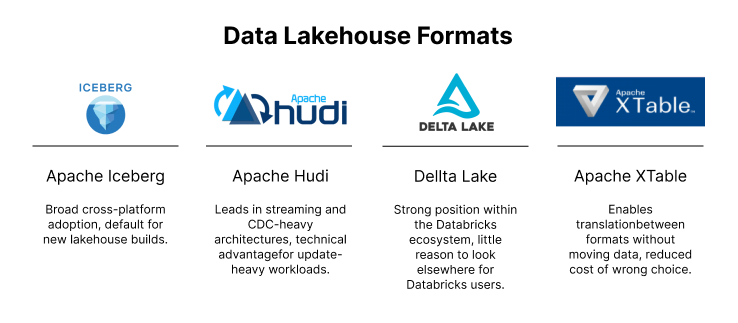
- Apache Iceberg has the broadest cross-platform adoption. All three major cloud providers — AWS, Google Cloud, and Microsoft Azure — now offer native Iceberg support. Planned adoption continues to outpace Delta Lake, according to the Dremio State of Data Lakehouse 2024 survey of 500 data leaders. A fourth format, Apache Paimon, is gaining ground with Flink-first teams because its LSM-based design handles high-frequency streaming upserts natively, and teams adopting it can lean on Apache Paimon support for compaction tuning and catalog setup.
- Delta Lake still holds the largest installed base. Delta Lake is used by over 60% of Fortune 500 companies, largely through Databricks. Microsoft Fabric uses Delta as its native default.
- Apache Hudi holds a strong but narrower position, with major production deployments at Uber, Amazon, Walmart, and Robinhood — organisations with demanding streaming and CDC workloads.
Are These Formats Converging?
The broader direction is convergence. Hudi 1.0 added native Iceberg format output. Databricks has proposed that Delta 5.0 share Iceberg’s metadata structure. Apache XTable, currently in incubation under the ASF, already translates metadata between all three formats without moving data, though it does not yet support all table configurations.
Working With These Formats in Production
Choosing between Apache Iceberg, Apache Hudi, and Delta Lake is one decision. Implementing the format correctly — schema design, pipeline integration, performance tuning, storage configuration, ingestion architecture, and ongoing table management — is where most projects encounter friction and where the cost of getting it wrong compounds over time.
Ksolves has delivered lakehouse architectures across all three formats, working with Spark, Flink, NiFi, and Kafka pipelines across cloud and on-premises environments. From initial architecture assessment through to production deployment and 24×7 operational support, our Big Data engineering teams work across the full stack.
If your team is evaluating options, has already decided and needs an implementation partner, or is running into performance or reliability issues with an existing lakehouse deployment, that is the conversation to have.
Conclusion
Apache Iceberg, Apache Hudi, and Delta Lake each solve the same fundamental problem from a different starting point. The right choice is not about which format is technically superior in every dimension. It is about which one was built for the problem you are actually trying to solve.
Large data volumes across multiple platforms point to Iceberg. Constant record-level updates and real-time freshness points to Hudi. Pipeline reliability and Databricks-native workflows point to Delta Lake.
The industry is moving toward interoperability, which means the long-term cost of choosing any of these three formats is lower than it has ever been. The cost of choosing the wrong one for your specific workload, however, remains real.


 Anil Kushwaha