



The Complete Guide to Odoo ERP for Additive Manufacturing Businesses
Odoo
5 MIN READ
June 11, 2026

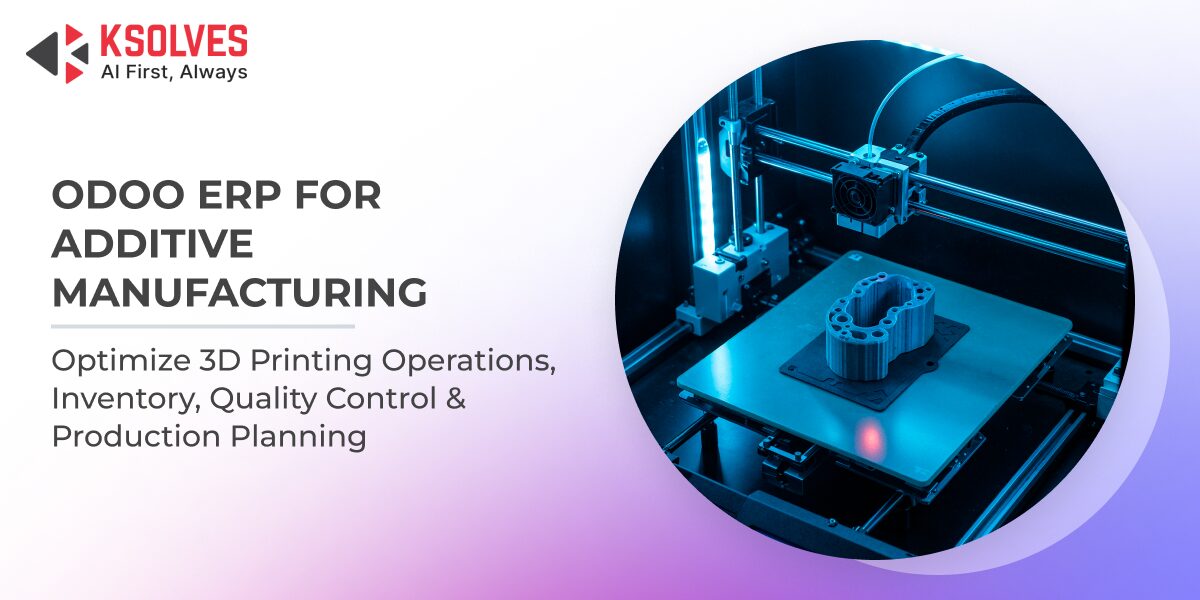
Additive manufacturing has evolved far beyond rapid prototyping. Today, manufacturers across aerospace, automotive, healthcare, industrial equipment, and consumer goods rely on 3D printing technologies to produce customized, high-performance components with greater speed and flexibility.
However, as operations scale, managing engineering revisions, production schedules, material traceability, quality requirements, inventory, and costs becomes increasingly complex. Many businesses struggle with disconnected systems that limit visibility and create inefficiencies across the manufacturing lifecycle.
To unlock the full potential of additive manufacturing, organizations need a connected platform that brings together engineering, production, inventory, quality, procurement, and finance in one place.
In this blog, we’ll explore the unique challenges of additive manufacturing, how Odoo ERP supports end-to-end operations, the key modules involved, and the benefits of implementing a unified ERP system for long-term growth.
Understanding Additive Manufacturing
Additive manufacturing, commonly known as 3D printing, is a production process that builds parts layer by layer directly from a digital design file. Unlike traditional subtractive manufacturing methods, which remove material from a solid block, additive manufacturing creates components by adding material only where it is needed.
This approach enables manufacturers to produce complex geometries, lightweight structures, and highly customized products with minimal material waste. As a result, additive manufacturing has become increasingly popular across industries such as aerospace, automotive, healthcare, industrial equipment, and consumer products.
The technology is particularly valuable for rapid prototyping, low-volume production, custom part manufacturing, tooling, and on-demand production. However, its flexibility also introduces unique operational challenges, including frequent design revisions, complex production scheduling, material traceability requirements, quality control demands, and accurate cost management.
As additive manufacturing operations expand, managing these interconnected processes requires a robust system that can provide visibility, coordination, and control across the entire business.
Key Challenges of Additive Manufacturing
While additive manufacturing offers unmatched flexibility, design freedom, and customization capabilities, it also introduces operational complexities that traditional manufacturing environments rarely encounter. Unlike high-volume production models, additive manufacturing often involves custom projects, evolving design requirements, specialized materials, and stringent quality standards.
As businesses scale their additive manufacturing operations, maintaining visibility and control across engineering, production, inventory, quality, and financial processes becomes increasingly challenging.
1. High-Mix, Low-Volume Production
Additive manufacturing is inherently geared toward customization. Rather than producing thousands of identical units, manufacturers often manage numerous unique projects simultaneously, each with its own design specifications, materials, production parameters, and delivery requirements.
This high-mix, low-volume environment makes production planning more dynamic and resource-intensive, requiring greater coordination across teams and systems.
2. Complex Engineering-to-Production Workflows
Engineering changes are a constant reality in additive manufacturing. Design iterations, customer-driven modifications, and performance enhancements frequently occur throughout the product lifecycle.
Managing CAD files, revision histories, approval workflows, and production-ready versions can quickly become complicated without a centralized system. Poor revision control can result in production errors, rework, delayed deliveries, and increased operational costs.
3. Material Management and Traceability
Additive manufacturing relies on specialized raw materials, including metal powders, polymer powders, resins, filaments, and composite materials. Each material may have specific storage, handling, and compliance requirements.
Manufacturers must accurately track:
- Material consumption.
- Batch and lot numbers.
- Inventory availability.
- Material shelf life.
- Supplier information.
4. Production Scheduling and Machine Utilization
The profitability of additive manufacturing operations depends heavily on effective machine utilization. Manufacturers must carefully balance production workloads while considering machine availability, build times, maintenance schedules, post-processing activities, and delivery commitments.
Even minor scheduling inefficiencies can lead to idle equipment, production bottlenecks, missed deadlines, and reduced throughput.
5. Quality Control and Compliance Requirements
For industries such as aerospace, automotive, medical devices, and industrial manufacturing, quality assurance is non-negotiable. Manufacturers must maintain detailed records throughout the production process to demonstrate consistency, traceability, and compliance.
This often includes tracking:
- Material batches.
- Build parameters.
- Engineering revisions.
- Inspection and testing results.
- Production history.
Managing this documentation manually can be time-consuming and prone to errors.
6. Costing and Profitability Visibility
Calculating the true cost of an additively manufactured component is far more complex than simply accounting for raw materials. Businesses must also consider machine operating costs, labor, post-processing activities, quality inspections, and overhead expenses.
How Odoo ERP Supports the Complete Additive Manufacturing Lifecycle
Successful additive manufacturing requires far more than managing printers and production jobs. From the moment a customer inquiry arrives to the final delivery of a finished component, multiple teams, processes, and data points must work together seamlessly.
Odoo ERP connects every stage of this journey within a single platform, enabling manufacturers to improve collaboration, enhance visibility, and operate with greater efficiency.
1. Lead and Opportunity Management
Every manufacturing project begins with a customer requirement. Whether it’s a prototype, a custom component, or a production order, capturing and managing opportunities effectively is essential for business growth.
With Odoo CRM and Sales, additive manufacturers can centralize customer inquiries, manage RFQs, track project requirements, and maintain a complete history of customer interactions. Sales teams gain better visibility into opportunities while engineering and production teams receive the information they need to assess feasibility and prepare for execution.
2. Quotation and Project Cost Estimation
Accurate quoting can be challenging in additive manufacturing due to varying material requirements, machine runtimes, labor inputs, and post-processing activities. Relying on spreadsheets often leads to inconsistencies and margin erosion.
Odoo helps manufacturers standardize quotation processes by enabling more accurate cost estimation and faster quote generation. Businesses can account for material consumption, machine utilization, labor costs, and additional processing requirements, ensuring pricing remains competitive while protecting profitability.
3. Engineering and Product Data Management
Design changes are an inherent part of additive manufacturing. Customer feedback, performance improvements, and engineering refinements often result in multiple design iterations before production begins.
Odoo PLM provides a centralized environment for managing CAD files, engineering documents, revision histories, and change requests. By maintaining clear approval workflows and version control, manufacturers can ensure production teams always work from the latest approved design, reducing the risk of costly errors and rework.
4. Production Planning and Scheduling
Printer availability and production capacity directly influence throughput and customer delivery timelines. As order volumes increase, manually coordinating production schedules becomes increasingly difficult.
With Odoo Manufacturing and Planning, businesses can create production schedules, allocate jobs across available machines, monitor resource availability, and balance workloads more effectively. This visibility helps manufacturers maximize equipment utilization while maintaining delivery commitments.
Also Read: How Odoo ERP Streamlines Manufacturing: From Raw Materials to Delivery
5. Material and Inventory Management
The availability of the right materials at the right time is critical to maintaining uninterrupted production. Additive manufacturing materials often require strict tracking due to quality, compliance, or performance considerations.
Odoo Inventory provides real-time visibility into stock levels, material movement, batch information, and warehouse operations. Automated replenishment rules and inventory tracking capabilities help manufacturers avoid stock shortages, reduce excess inventory, and maintain complete material traceability throughout the production process.
6. Shop Floor Execution
Once production begins, maintaining visibility into work order progress becomes essential for operational control and decision-making.
Odoo’s manufacturing capabilities enable teams to digitally manage work orders, track production status, record material consumption, and capture shop floor activities in real time. This reduces dependency on manual paperwork while providing managers with accurate production insights as work progresses.
7. Quality Control and Compliance
For many additive manufacturing businesses, product quality is a key competitive advantage. Industries such as aerospace, healthcare, and automotive often require rigorous inspection processes and detailed production records.
Odoo Quality allows manufacturers to integrate quality checks directly into production workflows. Inspection plans, testing procedures, non-conformance tracking, and audit documentation can all be managed within the system, helping organizations maintain consistency, improve traceability, and support compliance requirements.
8. Procurement and Supplier Management
A reliable supply chain is essential for maintaining production continuity. Delays in raw material procurement can quickly disrupt manufacturing schedules and impact customer commitments.
Odoo Purchase streamlines procurement by automating purchasing workflows, tracking supplier performance, and providing visibility into material requirements. This enables manufacturers to maintain optimal inventory levels while building stronger supplier relationships.
9. Delivery and Customer Fulfillment
The manufacturing process doesn’t end when production is complete. Efficient shipping and fulfillment are equally important to ensuring customer satisfaction.
Odoo helps manufacturers manage delivery operations, generate shipping documentation, track outbound orders, and monitor fulfillment performance. This ensures finished products reach customers on time while providing greater transparency throughout the delivery process.
10. Financial Management and Profitability Tracking
One of the greatest advantages of an integrated ERP platform is the ability to connect operational activities directly with financial outcomes.
With Odoo Accounting, manufacturers can automate invoicing, monitor cash flow, analyze production costs, and evaluate profitability at the project, product, or customer level. Because sales, inventory, purchasing, manufacturing, and finance operate within the same system, decision-makers gain access to accurate, real-time insights that support smarter business decisions and sustainable growth.
Key Benefits of Odoo ERP for Additive Manufacturing Businesses
For additive manufacturers, operational success depends on how effectively engineering, production, inventory, quality, and financial processes work together. Odoo ERP provides a connected platform that helps businesses improve efficiency, gain greater visibility, and scale with confidence.
- Improved Operational Visibility
Odoo centralizes data across departments, providing real-time visibility into engineering changes, production schedules, inventory levels, quality metrics, and financial performance. This enables faster, more informed decision-making at every stage of the manufacturing lifecycle. - Faster Order-to-Delivery Cycles
By connecting sales, engineering, production, procurement, and fulfillment processes, Odoo reduces manual handoffs and workflow delays. This helps manufacturers accelerate project execution and improve customer responsiveness. - Enhanced Material Traceability
Odoo enables complete tracking of material consumption, lot and batch information, inventory movement, and stock availability. This improves inventory accuracy while supporting quality assurance and compliance requirements. - Higher Machine Utilization
With integrated planning and scheduling tools, manufacturers can allocate jobs more efficiently, balance workloads, and minimize equipment downtime. The result is improved throughput and better utilization of valuable additive manufacturing assets. - Stronger Quality Management
Quality checks, inspection records, non-conformance tracking, and audit documentation can all be managed within a single system. This helps ensure consistent product quality while supporting industry compliance standards. - Better Cost Control and Profitability
By connecting manufacturing, procurement, inventory, and accounting data, Odoo provides greater visibility into production costs and project profitability. Businesses can make more accurate pricing decisions and protect margins as they grow. - Scalable Growth Infrastructure
Whether expanding production capacity, adding facilities, or entering new markets, Odoo’s modular architecture allows manufacturers to scale operations without introducing disconnected systems or operational silos.
How AI Enhances Additive Manufacturing Operations with Odoo
As additive manufacturing becomes more complex, the ability to turn operational data into actionable insights is becoming a key competitive advantage. By combining AI capabilities with Odoo ERP, manufacturers can move beyond reactive decision-making and adopt a more intelligent, data-driven approach to managing operations.
- Smarter Demand and Material Planning
AI-powered analytics can identify historical demand patterns, project trends, and consumption behaviors to help businesses forecast material requirements more accurately. This enables better procurement planning while reducing the risk of stock shortages and excess inventory. - Intelligent Production Insights
By analyzing production data, machine utilization, and workflow performance, AI can help identify bottlenecks, capacity constraints, and inefficiencies. These insights allow manufacturers to optimize scheduling, improve throughput, and maximize equipment utilization. - Automated Reporting and Analytics
Generating operational and executive reports manually can be time-consuming. AI helps automate reporting by transforming complex data into meaningful summaries, allowing teams to spend less time compiling reports and more time acting on insights. - Inventory Optimization
AI-driven analytics provide deeper visibility into inventory movement, consumption rates, and replenishment requirements. This helps manufacturers maintain optimal stock levels while minimizing carrying costs and material waste. - Faster, More Informed Decision-Making
With solutions like Dashboard Ninja with AI, decision-makers can access real-time insights through intuitive dashboards and AI-powered analysis. This enables leadership teams to identify trends, monitor performance, and make strategic decisions with greater confidence.
Also Read: Create AI-Powered Manufacturing Dashboards in Odoo
Signs Your Additive Manufacturing Business Has Outgrown Spreadsheets and Legacy Systems
Many additive manufacturing companies begin with spreadsheets and standalone tools to manage operations. While these systems may work in the early stages, they often become barriers to growth as production volumes, customer demands, and operational complexity increase.
If your business is experiencing any of the following challenges, it may be time to consider a unified ERP platform:
- Production schedules are managed through spreadsheets and manual updates.
- Engineering revisions are difficult to track and frequently cause errors or rework.
- Machine capacity and production status lack real-time visibility.
- Inventory discrepancies impact production planning and material availability.
- Calculating accurate job costs and profitability requires significant manual effort.
- Customer deliveries are delayed due to disconnected workflows.
- Reporting depends on compiling data from multiple systems.
- Teams operate in silos with limited cross-functional visibility.
Why Choose Ksolves for Odoo ERP Implementation in Additive Manufacturing?
Implementing Odoo ERP for additive manufacturing is not just about deploying software; it’s about creating a connected operational ecosystem that aligns with the unique demands of custom production, engineering-driven workflows, material traceability, quality compliance, and cost control.
At Ksolves, an AI-first Odoo development company, we combine deep Odoo expertise with a practical understanding of modern manufacturing operations to deliver solutions that drive measurable business outcomes.
What sets Ksolves apart?
- Industry-Focused Odoo Expertise: Extensive experience implementing Odoo for manufacturing businesses with complex operational requirements.
- AI-First Implementation Approach: Leveraging AI to accelerate implementation, improve process visibility, and enable smarter decision-making.
- Customized Workflow Design: Tailoring Odoo to support your specific production processes, engineering workflows, quality requirements, and business goals.
- Seamless System Integrations: Connecting Odoo with third-party applications, manufacturing technologies, and business-critical systems to ensure uninterrupted data flow.
- Scalable Architecture for Future Growth: Designing solutions that can support expanding production capacity, new facilities, additional product lines, and evolving business needs.
- End-to-End Support and Optimization: From consultation and implementation to training, enhancement, and ongoing support, we help maximize the long-term value of your ERP investment.
Our goal is simple: to build an Odoo ecosystem that reflects how your additive manufacturing business operates today while providing the flexibility and intelligence needed to support future growth.
Final Words
As additive manufacturing operations grow, managing engineering, production, inventory, quality, and financial processes through disconnected systems becomes increasingly difficult. A unified platform is essential for maintaining efficiency, traceability, and profitability.
Ready to Scale Your Additive Manufacturing Operations with Odoo ERP?
Partner with Ksolves to streamline operations, improve visibility, and unlock the full potential of your additive manufacturing business with Odoo ERP.

































AUTHOR
Odoo
Share with