



Test Scenario vs Test Case in Scalable QA: Design, Mapping, and Automation Strategy
QA
5 MIN READ
June 22, 2026

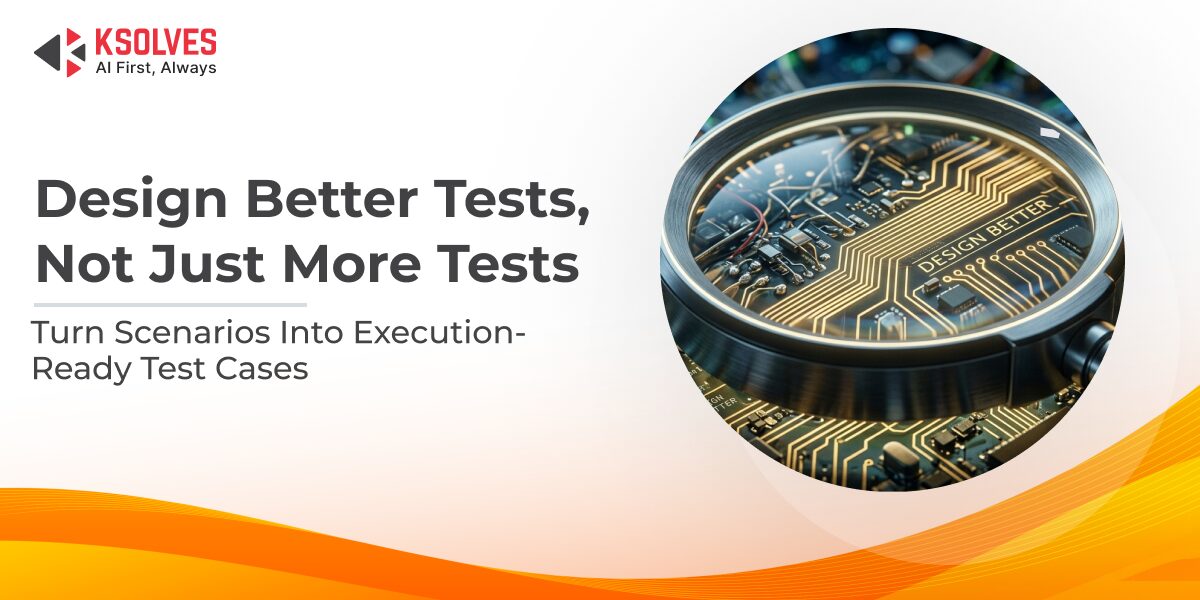
In modern software delivery, quality assurance is no longer limited to defect detection. It is responsible for ensuring requirement traceability, functional coverage, and predictable releases. Two core QA artifacts drive this process: test scenarios and test cases.
Despite their importance, these terms are often misused interchangeably, leading to poor coverage mapping, redundant test execution, and inefficient automation strategies. This becomes especially problematic in complex systems such as ERP platforms, distributed applications, and regulated enterprise software.
This blog explains test scenarios vs test cases from a technical QA perspective, using precise definitions, execution-level examples, and scenario-to-test-case mappings to help teams design scalable and maintainable test assets.
What Is a Test Scenario? A High-Level QA Design Artifact
Technical Definition
A test scenario is a high-level validation objective that defines what functionality or business flow needs to be tested. It is derived directly from business requirements, functional specifications, or user journeys.
Test scenarios do not contain test steps or test data. Their purpose is to ensure that all critical system behaviors are identified and covered during test planning.
Key Characteristics of Test Scenarios
- Requirement-driven rather than UI-driven
- Covers end-to-end functional flows
- Used for test coverage estimation and planning
- Low maintenance compared to test cases
Examples of Test Scenarios
| Scenario ID | Module | Test Scenario Description |
|---|---|---|
| TS-AUTH-01 | Authentication | Validate user login with registered credentials |
| TS-PAY-03 | Payments | Validate payment authorization using the payment gateway |
| TS-INV-07 | Inventory | Validate stock update after order placement |
What Is a Test Case? An Executable Validation Unit
Technical Definition
A test case is a detailed, executable set of instructions designed to validate a specific condition within a test scenario. It defines how the system should be tested and what outcome is expected.
Test cases are used during test execution and form the foundation for manual and automated testing.
Core Components of a Test Case
| Field | Description |
|---|---|
| Test Case ID | Unique identifier |
| Scenario ID | Parent test scenario |
| Preconditions | Required system state |
| Test Steps | Step-by-step execution instructions |
| Test Data | Input values |
| Expected Result | System behavior after execution |
Test Scenario vs Test Case: Technical Comparison
Understanding the difference between test scenarios and test cases is essential for designing an effective QA strategy.
| Parameter | Test Scenario | Test Case |
|---|---|---|
| Level | High-level | Low-level |
| Focus | What to test | How to test |
| Derived From | Business requirements | Test scenarios |
| Test Data | Not defined | Explicit |
| Executable | No | Yes |
| Volume | Limited | High |
| Maintenance Effort | Low | High |
A single test scenario can produce multiple test cases that cover positive, negative, boundary, and error-handling paths. Scenarios ensure coverage, while test cases ensure verification.
How Test Scenarios and Test Cases Fit into Agile and Automation
Agile Testing Context
- Test scenarios align with epics and user stories
- Used during backlog grooming and sprint planning
- Help estimate QA effort early in the sprint cycle
Automation Testing Context
- Test scenarios define automation scope
- Test cases translate directly into automated scripts
- Stable, data-driven test cases are ideal for CI/CD pipelines
Best practice is to avoid automating test scenarios and focus on automating reusable, high-value test cases derived from them.
Build Scalable Test Assets with Ksolves Quality Assurance Services
Designing effective test scenarios and maintaining high-quality test cases requires domain expertise, strong test design practices, and scalable QA processes. With Quality Assurance Services from Ksolves, organizations gain access to structured test strategy design, detailed test case engineering, and automation-ready frameworks.
Our QA teams help enterprises improve test coverage, reduce defect leakage, and accelerate release cycles across web, mobile, ERP, and cloud-native applications.
Conclusion
Test scenarios and test cases play distinct and critical roles in the software testing lifecycle. Test scenarios help QA teams define functional scope and ensure complete requirement coverage, while test cases provide the execution-level precision required to validate system behavior across multiple conditions and data sets. When structured correctly, this combination improves traceability, reduces redundancy, and strengthens overall test effectiveness.
At Ksolves, we apply proven test design methodologies to create scalable test scenarios and execution-ready test cases aligned with business requirements and delivery timelines. Through our Quality Assurance Services, we help organizations implement structured QA processes, improve defect detection, and deliver reliable software across complex enterprise systems with confidence.
Frequently Asked Questions
What is the difference between a test scenario and a test case in software testing?
Can a single test scenario produce multiple test cases?
Why is confusing test scenarios with test cases a problem in agile QA?
Should test scenarios or test cases be automated in a CI/CD pipeline?
How do test scenarios support requirement traceability in regulated enterprise software?
How does Ksolves help organizations design structured test scenarios and test cases?
Ksolves provides end-to-end Quality Assurance services that include structured test strategy design, detailed test case engineering, and automation-ready QA frameworks tailored to web, mobile, ERP, and cloud-native applications. Our QA teams work from business requirements to create traceable test scenario libraries and executable test cases aligned with Agile sprint cadence and CI/CD delivery workflows. Organizations working with Ksolves have achieved 90% functional test coverage and a 50% reduction in manual testing effort through AI-driven regression testing frameworks.































Author
About the Author Editorial Team The Ksolves Editorial Team includes certified Salesforce experts, Big Data engineers, AI/ML specialists, Zoho consultants, and experienced technology writers focused on delivering clear, actionable insights for modern businesses. With hands-on experience across Salesforce, Big Data platforms, AI/ML solutions, application development, software testing, and Zoho ERP/CRM, the team publishes practical guides, real-world use cases, and industry updates that support smarter decisions and faster growth. Every article is created to solve business challenges, guide technology adoption, and keep organizations aligned with evolving digital ecosystems.
Share with