



Synthetic Data and LLM Fine-Tuning Tools: From Scale AI to Unsloth, What Enterprises Need to Know
AI
5 MIN READ
June 1, 2026

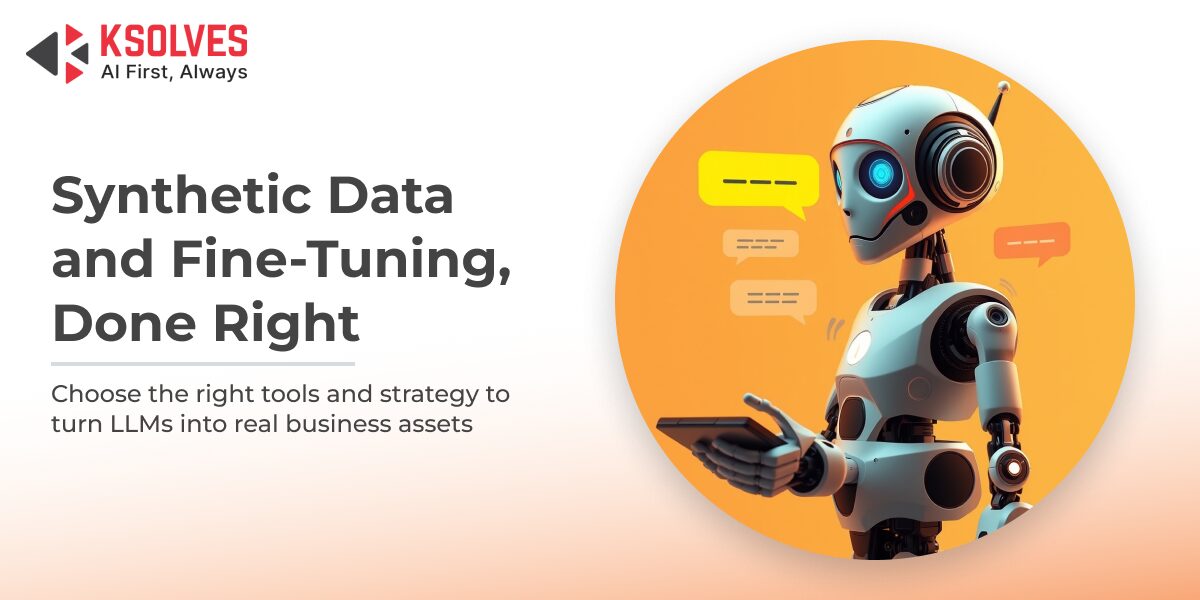
Picking the right tools for synthetic data generation and model fine-tuning is one of the most consequential decisions in any enterprise AI build. Yet most teams approach it backward: they choose a tool first and discover its constraints later. Scale AI for labeling. Unsloth for efficient fine-tuning. Argilla for annotation. LlamaFactory for training. The landscape is dense, fast-moving, and easy to get lost in.
What separates teams that ship production-ready, fine-tuned models from those stuck in perpetual experimentation is not access to the best tools. It is understanding which part of the pipeline each tool solves, and how synthetic data and fine-tuning work together as a strategy rather than two separate workstreams.
This blog hence maps the key platforms across both layers, explains what each does well and where each falls short, and gives practitioners a framework for making the right call.
Why Synthetic Data and Fine-Tuning Have Become Enterprise Priorities
The urgency behind this tooling decision is backed by hard numbers. According to Gartner, by 2024, 60% of data used in AI and analytics projects would be synthetically generated, up from just 1% in 2021. That is not a gradual shift. It is a structural transformation in how AI systems are trained and adapted. Reinforcing this, IT Sloan Management Review highlights that teams at MIT demonstrated no significant performance difference between models trained on high-quality synthetic data versus real data, provided the synthetic generation is properly governed and curated.
The implications for enterprises are direct. Real-world data is expensive to acquire, slow to label, legally constrained in regulated industries, and often too sparse to cover edge cases that matter in production. Synthetic data solves the supply problem. Fine-tuning solves the alignment problem. Together, they are the fastest path from a capable foundation model to a business-specific AI system that actually performs.
The Synthetic Data Layer: What It Is and Why Quality Is Everything
Synthetic data for AI is not about generating fake information. It is about generating statistically representative, domain-accurate, and label-rich training examples that models need, but real-world collections cannot efficiently provide.
For fine-tuning, the synthetic data that matters most is instruction data: question-answer pairs, task demonstrations, reasoning chains, and edge-case examples that shape how a model responds to your specific domain. The quality of this data determines the ceiling of what fine-tuning can achieve. A model fine-tuned on 500 carefully constructed, domain-specific synthetic examples will consistently outperform one trained on 5,000 noisy, generic examples scraped from the web.
Three failure modes define low-quality synthetic data pipelines:
- Distributional collapse: synthetic data that clusters around common patterns and leaves the model unable to handle edge cases
- Format inconsistency: instruction pairs that vary in structure, making it harder for the model to generalize a response style
- Label hallucination: synthetic answers that are fluent but factually incorrect, which the model then learns to replicate
Governance and curation are not optional steps in synthetic data pipelines. They are the primary quality controls.
The Fine-Tuning Layer: Making Foundation Models Work for You
Fine-tuning is the process of continuing to train a pretrained model on a smaller, task-specific dataset to align its behavior with a particular domain, format, or capability. It is not retraining from scratch. It is targeted adaptation.
The two dominant techniques in production fine-tuning today are Supervised Fine-Tuning (SFT) and Parameter-Efficient Fine-Tuning methods such as LoRA and QLoRA. SFT trains the model on labeled instruction-response pairs. LoRA and QLoRA achieve similar results by training only a small set of adapter weights rather than the full model, dramatically reducing compute and memory requirements without meaningful loss in output quality.
This distinction matters when choosing tools. Teams working on a tight compute budget or with a single-GPU setup need efficiency-first options. Teams handling enterprise-scale multi-task fine-tuning across multiple model families need orchestration and reproducibility above all else.
Mapping the Landscape: Key Tools and What They Actually Do
Scale AI
Scale AI operates primarily at the data layer. Its core strengths are high-throughput human annotation, quality-controlled labeling pipelines, and, increasingly, AI-assisted data generation that combines model outputs with human review. For enterprises that need large volumes of labeled data for supervised fine-tuning and have the budget to match, Scale AI offers infrastructure that is difficult to replicate internally. Its RLHF pipeline tooling is particularly mature for teams working on preference learning and alignment. The constraint is cost: Scale AI is built for organizations working at scale, not for teams needing to move fast with limited resources.
Unsloth
Unsloth is purpose-built for efficient fine-tuning of open-source models. Its core value proposition is speed and memory efficiency. Unsloth achieves 2x to 5x faster fine-tuning runs than standard implementations and significantly reduces VRAM usage, making LoRA and QLoRA fine-tuning practical on consumer-grade hardware. For teams fine-tuning Llama, Mistral, Qwen, or Gemma models on limited compute, Unsloth removes the primary bottleneck. It integrates directly with Hugging Face’s transformers and PEFT libraries, so it fits naturally into existing workflows. The limitation is breadth: Unsloth is a fine-tuning efficiency tool, not a full MLOps platform.
Argilla
Argilla is a data-centric platform for annotation, human feedback collection, and dataset curation. Where Scale AI targets enterprise volume, Argilla targets teams that want to own their labeling pipeline with full visibility and control. It works particularly well for collaboratively building instruction datasets and for collecting preference feedback for RLHF without a third-party dependency. The open-source version is freely deployable and highly customizable.
LlamaFactory
LlamaFactory is a unified framework for fine-tuning and evaluating large language models across multiple training methods: SFT, DPO, PPO, and ORPO. It supports over 100 model architectures and provides a web UI for low-code fine-tuning experiments. For teams looking to experiment quickly with methods and models without writing custom training loops, LlamaFactory significantly reduces friction.
Gretel and Mostly AI
On the structured synthetic data side, Gretel and Mostly AI specialize in generating tabular and text synthetic datasets that preserve statistical relationships in real data while removing privacy risk. Both are relevant for enterprises in regulated industries such as financial services and healthcare, where real training data is constrained by compliance requirements.
How Ksolves Helps You Build the Right Synthetic Data and Fine-Tuning Pipeline
Navigating this landscape efficiently requires more than tool familiarity. It requires architectural judgment about which combination of tools serves your specific use case, what data strategy enables fine-tuning at your scale, and how to build a pipeline that remains maintainable as models and methods evolve. As a trusted artificial intelligence company, Ksolves works with enterprises to design end-to-end fine-tuning pipelines: from synthetic data strategy and instruction dataset construction through to model evaluation, deployment, and continuous improvement.
Whether you are fine-tuning an open-source model for internal knowledge retrieval, building a domain-specific assistant, or operationalizing preference-trained models for customer-facing applications, Ksolves brings the technical depth and production experience to build pipelines that scale beyond proof of concept.
Conclusion
The synthetic data and fine-tuning landscape is wide, and the right toolset depends entirely on your use case, compute constraints, and data strategy. Scale AI and Unsloth solve very different problems, and the teams that win are those who understand where each fits rather than treating the landscape as a single category. The underlying principle is constant: high-quality, curated training data is the multiplier. Fine-tuning is the mechanism. Together, they make foundation models business assets.
Ready to build a production-grade fine-tuning pipeline tailored to your use case? Connect with Ksolves today or send us your query at [email protected].

































Author
About the Author Editorial Team The Ksolves Editorial Team includes certified Salesforce experts, Big Data engineers, AI/ML specialists, Zoho consultants, and experienced technology writers focused on delivering clear, actionable insights for modern businesses. With hands-on experience across Salesforce, Big Data platforms, AI/ML solutions, application development, software testing, and Zoho ERP/CRM, the team publishes practical guides, real-world use cases, and industry updates that support smarter decisions and faster growth. Every article is created to solve business challenges, guide technology adoption, and keep organizations aligned with evolving digital ecosystems.
Share with