



Why ERP Implementations Fail to Eliminate Spreadsheet Dependency
ERPNext
5 MIN READ
August 4, 2026

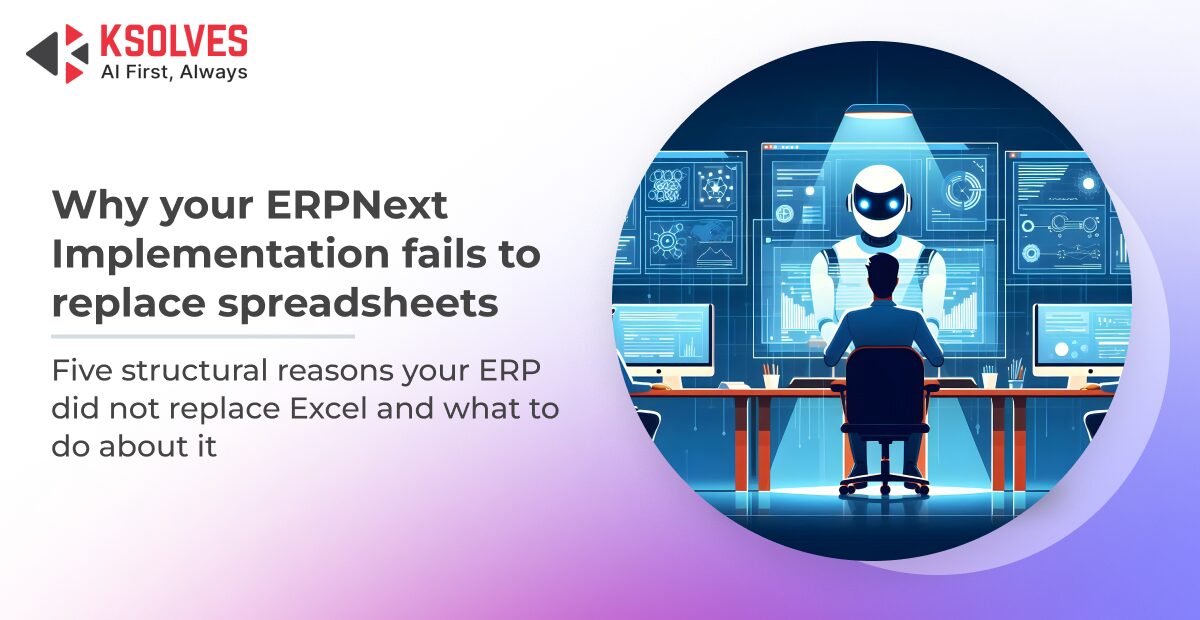
When two systems run in parallel, both doing the same job, the one that scales tends to lose to the one that feels familiar. Six months after an ERP implementation, that is a situation finance teams, supply chain leads, and HR managers know well. The ERP is live, the project is formally closed, and somewhere in the organization, a spreadsheet is quietly handling the work the ERP was supposed to take over. According to AutoRek’s 2025 annual payments survey, spreadsheets remain integral to financial operations in 90% of organizations, a figure that holds even in businesses that have already invested in enterprise systems. That level of persistence is one reason the ERP implementation failure rate gets discussed more in terms of unmet workflow coverage than in terms of failed go-lives.
The reasons behind this pattern are structural, and they show up across industries regardless of which ERP platform was implemented. This blog covers the specific ERP implementation challenges that keep spreadsheets alive after go-live, which business functions are most affected, and what a methodical fix actually looks like.
Why Do ERP Implementations Fail to Replace Spreadsheets?
ERP implementation failure is less often a crashed go-live and more often a system that technically works but cannot answer the specific questions the business runs on daily. Users build those answers outside the ERP, in the tool they already know. The spreadsheet fills a gap the ERP left open: a report in the wrong format, a workflow configured for the vendor’s template rather than the actual process, a data migration that left years of vendor history behind. Each gap gets filled with a workaround; the workaround gets shared, and it becomes load-bearing infrastructure nobody wants to touch.
The ERP holds the official data. The spreadsheet holds the data people actually trust. That split is what makes spreadsheet dependency so persistent: the parallel system is not just familiar, it is often more accurate for the specific task than the ERP, because the ERP was never fully configured for that task in the first place.
Spreadsheet dependency is a symptom of gaps in implementation scope, data quality, configuration depth, and adoption planning. The fix has to address those gaps directly. Whether the original rollout was run in-house or through an ERP implementation services partner, the remediation path is the same: close the specific gap, not the symptom.
Suggested Read: ERPNext vs Tally: Complete Comparison for Growing Businesses
What Are the Most Common ERP Implementation Challenges That Lead to Spreadsheet Dependency?
ERP implementation challenges that drive spreadsheet reversion tend to fall into five categories. Each one is a project-stage decision that looked reasonable at the time and became a structural problem after go-live. Understanding where these ERP implementation failure points sit in the project lifecycle is the starting point for preventing them.
Incomplete ERP Data Migration Challenges
Data migration typically gets scoped as a technical task: extract from the legacy system, transform to match the new schema, load into the ERP. The quality problem gets underestimated at every stage. Legacy fields do not map cleanly to ERP field structures, lookup tables carry missing or inconsistent values, and item codes from the old system frequently get renamed without updating the open transactions that reference them. Under go-live pressure, data quality gaps get logged and deferred to a post-go-live cleanup that rarely fully happens.
After launch, the consequences are specific: Users find the ERP is missing three years of vendor payment history that the old system held. The customer master has duplicate entries because the deduplication step was skipped. Purchase orders reference item codes that no longer exist in the new schema. For any task that requires historical context, the ERP becomes unreliable, and the legacy spreadsheet or file stays active as the reference. The longer it stays active, the more it diverges from the ERP as new transactions accumulate in one system but not the other.
The ERP data migration challenges that create post-go-live spreadsheet dependency are almost always visible during the migration phase itself. They appear as exceptions, unmapped fields, and validation errors. They get deferred rather than resolved because fixing them properly requires time that the go-live schedule does not allow. Organizations that treat data quality as a go-live gate, with defined completeness criteria that must be passed before the cutover runs, close this gap before it becomes permanent.
ERP Customization Problems
Every ERP ships with a process model built around how the majority of its customer base operates. When a business has pricing logic, approval chains, or intercompany workflows that deviate from that model, the system needs to be configured to accommodate them. In practice, customization scope gets reduced during implementation to protect timeline and cost, workflows that were supposed to be configured get deferred to phase two, and users are told the workaround is temporary.
The temporary workaround becomes the process. The phase-two configuration never gets prioritized once the implementation vendor has moved on and the internal project team has disbanded.
ERP customization problems are fundamentally scoping problems. Implementations that do not invest enough time mapping actual business workflows before configuration begins produce a system that fits the vendor’s process model better than the client’s. The specific workflow gaps where spreadsheets re-emerge most consistently include:
- Multi-level approval chains that the standard workflow engine cannot replicate without custom configuration
- Pricing and discount structures are too complex for the default pricing module, particularly in businesses with customer-specific or volume-based pricing
- Reporting dimensions: the ERP chart of accounts was not set up to capture them, because the account structure was copied from the legacy system without redesign
- Intercompany transactions in organizations with multiple entities, where the ERP’s intercompany module was not scoped into the implementation
This is precisely where a scoping conversation with an ERP implementation services provider, before configuration begins rather than after, would have caught the gap.
ERP Change Management and User Adoption
Most ERP change management programs deliver training under a different name. Users get shown how to complete transactions in the new system, but the reasoning behind process redesign, what the ERP makes possible that the old system did not, and how individual roles connect to the broader workflow rarely get addressed in a structured way.
When the pressure of daily work returns after training ends, users revert to the process they know. ERP user adoption problems are less about resistance to new software and more about the absence of a genuine reason to change how work gets done, not just which system it gets done in. A user who was trained to enter a purchase order in the ERP but was never shown how the ERP’s approval workflow connects to the payment run has no functional reason to prefer the ERP over the spreadsheet process they already understand.
Effective change management for ERP requires:
- Defining the specific behavioral changes required from each user group, not just the transactions they need to learn
- Communicating the business case for those changes in terms that connect to the user’s daily work, not to the organization’s IT strategy
- Building accountability structures that make the new behavior easier than the old one, including removing access to legacy tools where the ERP fully covers the workflow
- Starting the program months before go-live, with key users involved in configuration decisions, not introduced to the system for the first time in a training session
Organizations that run this as a governance and communication program rather than a training schedule see materially better ERP user adoption outcomes and significantly lower rates of post-go-live spreadsheet reversion.
ERP Reporting Gaps
If the standard ERP reports do not match what managers need to run their operations, those managers build the views themselves in Excel immediately after go-live, often within the first week. Reporting requirements get gathered in discovery, a set of standard reports gets identified, and the assumption is that remaining requirements can be handled ad hoc through the ERP’s report builder. The ad hoc reports become recurring manual processes. Someone takes ownership of them, adds columns over time, and embeds them in a spreadsheet with formulas and macros that other people depend on, but nobody fully understands or can maintain.
The Excel vs. ERP tension in reporting is specific: Excel can be reshaped in minutes to match exactly what a manager needs for a given analysis. ERP reporting typically requires a developer, a formal request, and a turnaround window. Until the ERP can answer the operational questions that matter faster than a spreadsheet can, the spreadsheet stays in the workflow regardless of what the ERP policy says.
Reports that cannot be delivered in the ERP at launch should be built before users start looking for alternatives, not added to a phase-two backlog that gets deprioritized after go-live. Once a spreadsheet report is embedded in someone’s weekly process, it is operationally very difficult to retire, even when the ERP equivalent eventually gets built.
Shadow IT and ERP Spreadsheet Dependency
Shadow IT in an ERP environment is the collection of tools, files, and workarounds that accumulate at the edges of the system because the ERP is too rigid or too slow to handle the full workflow. As Diginomica notes, shadow IT typically fills the specific blanks left by ERP systems in reporting, specialized modelling, and data capture from external sources, and spreadsheet proliferation continues unabated despite significant investment in enterprise systems. The gap is structural, not behavioral.
Common patterns include:
- A procurement team managing vendor relationships in a spreadsheet because the ERP vendor module requires multiple sequential approval steps for a routine reorder that previously took one email
- A supply chain team is tracking shipment status in a shared file because the ERP has no live integration with the logistics provider, so the data has to be entered manually anyway
- An HR team maintains a parallel compensation tracker because the payroll module was not implemented in phase one, and the workaround has now been running for two years
The shadow IT ERP pattern shows up in nearly every function eventually, not just the ones listed above. The ERP’s view of the business becomes progressively less complete, the gap between what the system shows and what is actually happening widens, and by the time leadership recognizes the ERP spreadsheet dependency problem, the shadow systems have been running for years with workflows built around them that are difficult to unwind.
Suggested Read: Key Phases of an ERP Implementation Plan
Which Business Functions Retain the Highest ERP Spreadsheet Dependency After Go-Live?
Certain business functions are more prone to post-implementation spreadsheet reversion than others, and the reasons are specific to how those functions operate. Understanding where ERP implementation failure tends to concentrate helps organizations prioritize their remediation effort.
Finance and Accounting
Reconciliation, compliance reporting, and period-end close are the areas where spreadsheets survive longest in finance. ERP reporting is typically built around accounting period logic, with standard outputs structured for the auditor rather than for the finance manager who needs to cut the same data by cost center, project, and entity simultaneously. When those views are not available natively, finance teams build them in Excel. Regulatory reporting compounds the problem: a compliance team preparing for an external audit or filing frequently finds the ERP cannot produce the exact line-item format required, so a transformation spreadsheet gets built between the ERP export and the final output. That spreadsheet becomes part of the close process.
Manufacturing and Supply Chain
Production planning and inventory management are high-friction areas because ERP planning modules model the ideal production flow: a clean bill of materials, confirmed supplier lead times, and no mid-cycle exceptions. Real manufacturing environments involve engineering change orders mid-run, partial supplier deliveries, and informal arrangements with preferred vendors that exist outside the purchase order system. Planners build Excel-based scheduling tools because the ERP planning module requires the data to be clean and structured in ways the shop floor does not operate. The spreadsheet handles the exceptions; the ERP handles what was planned.
HR and Payroll
Headcount planning, compensation analysis, and workforce reporting are frequently manual in organizations that implemented an ERP without the full HR module. Even where the module exists, teams maintain parallel trackers for restructuring scenarios and salary benchmarking because the ERP does not support the kind of ad hoc modelling that planning work requires. A Strada Global poll of 271 companies across 42 countries found that 51% are still relying on spreadsheets to process payroll, with the most commonly cited reasons being lack of system integration, migration cost concerns, and doubt that an automated system can handle their payroll’s complexity. All three of those reasons are implementation gaps, not software limitations.
Suggested Read: Open Source Payroll Software: A Complete Guide to the ERPNext HR and Payroll Module
IT and Operations
IT service management and operational process tracking are areas where ERP rigidity generates workarounds consistently. Service requests that should flow through the ERP get tracked in spreadsheets or informal tools because the ERP workflow requires approvals or data entry steps that add time without adding value for a team trying to resolve an issue quickly. Organizations that extend ERP configuration to cover IT service requests and operational tickets, instead of treating those workflows as out of scope, see lower rates of shadow IT and spreadsheet dependency in operational functions because the workflows are designed for the operational context rather than adapted from a financial system.
How Do ERP Implementation Consultants Diagnose and Fix Post-Go-Live Spreadsheet Dependency?
Fixing spreadsheet dependency in an existing ERP environment is a diagnostic exercise before it is a configuration exercise. Many of the challenges of ERP implementation that resurface after go-live trace back to one of four gap categories: data completeness, configuration depth, reporting coverage, and adoption. A structured diagnostic typically surfaces a small number of high-impact gaps. In most cases, the spreadsheets that matter most to the business trace back to two or three specific failures in the original implementation scope, not a broad systemic problem. That means the fix is targeted.
The most common findings in a post-go-live ERP audit:
| Gap category | What it looks like | What the fix requires |
| Data migration | Historical records missing; duplicates in master data; unmapped legacy fields | Complete the deferred migration; run deduplication on affected masters; validate against the legacy system |
| Configuration | Workflows left at vendor defaults; approval chains missing; pricing logic handled outside the ERP | Map the actual business process; configure or reconfigure the affected module; test against real transactions |
| Reporting | Key operational reports not in the ERP; finance running period-close in Excel | Build the missing reports before removing the spreadsheet alternative; involve the end user in sign-off |
| Adoption | Teams trained on clicks, not on process logic; no accountability for ERP use | Redesign the change program around behavioral outcomes; tie ERP usage to existing performance processes |
Ksolves works with organizations at this stage across manufacturing, financial services, and distribution. The engagement typically starts with a two-to-four week audit that maps every active spreadsheet or parallel tool back to its root cause in the ERP implementation. From there, the remediation is scoped by impact: the gaps driving the most manual effort and data risk get addressed first. Ksolves has built out deferred data migrations, reconfigured module setups that were never completed, and rebuilt reporting layers that should have been delivered at go-live, without requiring a full reimplementation.
The goal is to make the ERP the faster, more reliable option for the specific tasks where spreadsheets have stayed. When that threshold is crossed for a given workflow, the spreadsheet retires on its own.
Conclusion
The ERP implementation challenges that produce spreadsheet dependency are predictable: data migration scoped as a technical task, customization deferred to protect timeline, change management delivered as training, reporting requirements parked in a phase-two backlog, and shadow workflows left to accumulate around ERP rigidity. These failure points show up consistently across industries and platforms, and they share a common characteristic: they were decisions made during the implementation that looked reasonable at the time and became structural problems after go-live.
Organizations that close the gap treat these as business problems with a defined remediation path.
If your ERPNext Implementation Services engagement closed, but the parallel systems are still running, that is where the conversation should start.
ERPNext Services — Talk to the Ksolves ERP team
Frequently Asked Questions
Why do employees go back to spreadsheets after an ERP implementation?
The most common reason is that the ERP was not fully configured for the workflows those employees actually run. When the system cannot answer the questions they need answered, or cannot do so quickly, the spreadsheet fills the gap. It is a rational response to a configuration or scoping problem, not a change management failure on its own.
What is ERP spreadsheet dependency and why does it matter?
ERP spreadsheet dependency is the condition where critical business data and processes continue to run in Excel or similar tools after an ERP has gone live. It matters because it creates two versions of business reality: what the ERP shows and what the spreadsheets show. Decisions made on ERP data that is incomplete or out of sync with the spreadsheet version introduce errors that compound over reporting periods.
Can ERP user adoption problems be fixed after go-live?
Yes, but the approach is different from a pre-go-live change program. Post-go-live adoption work starts with identifying which specific workflows users have not moved to the ERP and why, then addresses the root cause for each. If the gap is a missing configuration, fix the configuration first before running the adoption program. This is standard ERP change management practice, just applied after go-live instead of before it. Training users to use a workflow that does not match their actual process will not produce sustained adoption.
What are the most common ERP data migration challenges that cause spreadsheet reversion?
The most common are: incomplete transfer of historical transaction records, master data quality issues such as duplicate customer or supplier records, and field mapping gaps where legacy data did not have a clean destination in the new ERP schema. Each of these leaves the ERP unreliable for tasks requiring historical context, which keeps the legacy file in use as a reference.
How long does it take to fix post-go-live spreadsheet dependency?
It depends on how many gap categories are involved and how deeply the shadow systems are embedded. A targeted remediation addressing one or two high-impact gaps can show results in four to eight weeks. A broader engagement covering data migration, configuration, reporting, and adoption typically runs three to six months. In either case, the work is substantially faster than a reimplementation and does not require the business to go through another go-live cycle.
































AUTHOR
ERPNext
Ankit Shridhar is an ERP Consultant at Ksolves India Limited with over 18 years of experience in ERP consulting, business transformation, and enterprise solution delivery. He specializes in implementing and optimizing enterprise resource planning solutions that streamline operations across Sales, Purchase, Inventory, Manufacturing, CRM, HR, and Finance. With expertise in ERP strategy, business process optimization, AI-enabled consulting, and digital transformation, Ankit has successfully led complex enterprise projects from requirements analysis and solution design to deployment and post-implementation support.
Share with