

 Odoo
 5 MIN READ


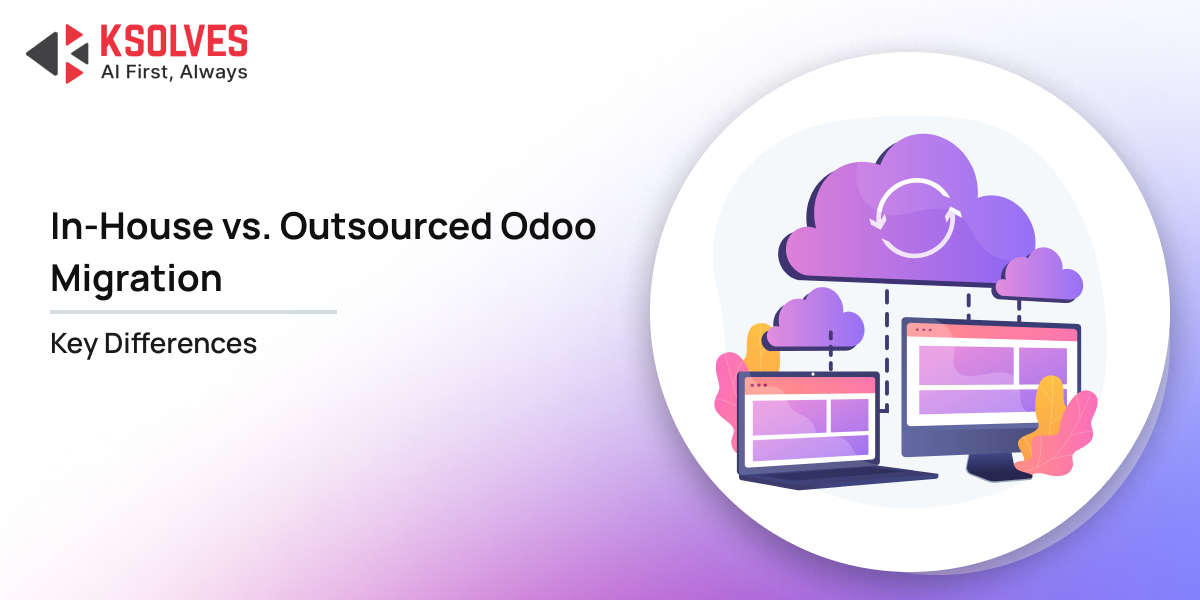
An Odoo migration can be handled by your internal IT team or entrusted to an external Odoo migration partner. But choosing the wrong approach can cost more than the migration budget. It can lead to extended timelines, compatibility issues, data inconsistencies, and disruptions to daily operations.
So, should you build an in-house Odoo migration team or outsource the project to specialists? The answer depends on your existing Odoo expertise, system complexity, available resources, and migration goals.
Let’s compare both approaches to help you make a practical, cost-effective decision.
Quick Answer:
Choose in-house Odoo migration if you have experienced Odoo developers, sufficient resources, and a relatively straightforward migration. Choose outsourced Odoo migration if your project involves complex customizations, multiple integrations, large datasets, or limited internal expertise. Outsourcing provides specialized skills and dedicated resources, while in-house migration offers greater direct control.
In-House vs. Outsourced Odoo Migration: Quick Comparison
| Comparison Factor | In-House Odoo Migration | Outsourced Odoo Migration |
|---|---|---|
| Expertise | Depends on internal Odoo knowledge | Access to specialized Odoo consultants |
| Cost | Internal salaries, training, and infrastructure | Partner fees and additional service costs |
| Project control | Direct control over execution | Shared control with the migration partner |
| Migration timeline | Depends on internal availability and experience | Dedicated migration resources can accelerate execution |
| Customization | Handled by internal developers | Managed by experienced Odoo developers |
| Data security | Data remains under internal management | Requires secure data-sharing arrangements |
| Testing | Depends on internal QA capabilities | Structured testing and validation processes |
| Post-migration support | Managed internally | Can be included in the service agreement |
What is In-House Odoo Migration?
In-house Odoo migration means managing the entire migration process using your organization’s internal IT team, ERP specialists, and developers.
Your team takes responsibility for assessing the existing system, preparing data, updating custom modules, managing integrations, testing functionality, and deploying the migrated Odoo environment.
Advantages of In-House Odoo Migration
- Greater project control: Your team directly manages migration decisions, priorities, and execution.
- Internal business knowledge: Employees already understand your workflows, operational requirements, and existing ERP configuration.
- Direct communication: Business stakeholders and technical teams can coordinate without depending on an external partner.
- Internal data management: Your organization retains direct control over migration activities and data access.
Challenges of In-House Odoo Migration
- Limited Odoo expertise: Your developers may understand general ERP systems but lack experience with Odoo’s migration framework and version-specific changes.
- Resource constraints: Migration can divert developers, IT administrators, and business analysts from their regular responsibilities.
- Longer migration timelines: Identifying compatibility issues, fixing custom modules, and resolving integration problems can take longer without specialized experience.
- Testing responsibilities: Your internal team must independently manage functional testing, data validation, and performance checks.
- Ongoing maintenance: Your organization remains responsible for resolving migration-related issues after deployment.
In-house migration may appear less expensive because you do not pay an external service provider. However, the actual cost of Odoo migration also includes employee hours, training, infrastructure, troubleshooting, and potential delays.
What is Outsourced Odoo Migration?
Outsourced Odoo migration involves hiring an external Odoo migration partner or specialized consultant to plan and execute the migration.
The partner evaluates your existing ERP environment, identifies technical dependencies, prepares migration strategies, handles data transfers, updates customizations, and validates the new environment.
Depending on the agreement, the partner can also manage deployment, employee training, and post-migration support.
Advantages of Outsourcing Odoo Migration
- Access to specialized expertise: Work with professionals experienced in Odoo versions, migration scripts, custom modules, and integrations.
- Dedicated migration resources: A specialized team can focus on migration without competing with your organization’s regular IT priorities.
- Structured project management: Defined migration phases, milestones, testing procedures, and deployment plans improve coordination.
- Reduced technical risks: Experienced consultants can identify compatibility issues, data inconsistencies, and integration dependencies early.
- Post-migration assistance: You can receive technical support to resolve issues and stabilize the new environment.
Challenges of Outsourcing Odoo Migration
- Partner selection: Choosing an inexperienced provider can lead to migration delays, incomplete data transfers, or compatibility problems.
- Additional service costs: Outsourcing requires a defined budget for consulting, development, migration, and support.
- Communication dependencies: Your internal team must coordinate with the partner to clarify workflows and business requirements.
- Data-sharing considerations: You need appropriate access controls, confidentiality agreements, and secure data-transfer practices.
Outsourcing does not eliminate your organization’s involvement. Your internal stakeholders still need to provide business context, validate migrated data, approve workflows, and participate in testing.
Also Read: Offshore Odoo Development by Experienced Developers
In-House vs. Outsourced Odoo Migration: Key Factors to Consider
Choosing between in-house and outsourced ERP migration requires evaluating your current system, internal capabilities, and business requirements. Consider these factors before making a decision.
1. Complexity of Your Existing Odoo Environment
A standard Odoo setup with minimal customizations may be manageable for an experienced internal team.
However, businesses using custom modules, third-party applications, complex workflows, and multiple integrations may need specialized migration expertise.
2. Internal Odoo Migration Team Requirements
Successful in-house migration requires more than general IT support. You may need:
- Odoo technical consultants familiar with version changes.
- Python developers to update custom modules.
- Database specialists to manage data migration.
- QA engineers to validate functionality and data accuracy.
- Project managers to coordinate migration activities.
If these resources are unavailable, hiring an Odoo migration consultant or outsourcing the project may be more practical.
3. Cost of Odoo Migration
The cost of Odoo migration depends on the complexity of your existing system, data volume, customizations, integrations, and required support.
With in-house migration, expenses include employee salaries, training, infrastructure, and additional development hours. With outsourced migration, the primary expenses include consulting fees, development costs, migration services, and support packages.
The important consideration is not just the initial cost but the total cost of completing the migration successfully.
For a detailed breakdown, read our guide on Odoo Migration Cost: Key Factors Affecting Budget.
4. Migration Timeline and Business Continuity
Your migration approach should account for how much time your business can allocate to the project without affecting regular operations.
An internal team managing migration alongside existing responsibilities may face scheduling challenges. An outsourced team can dedicate resources to migration planning, development, testing, and deployment.
Both approaches require a proper downtime strategy, data backups, and a rollback plan.
5. Data Security and Compliance
Regardless of your chosen approach, sensitive business information must remain protected throughout migration.
For in-house migration, your organization manages access and security internally. With outsourcing, you must establish secure data-sharing arrangements, role-based access, confidentiality agreements, and clear data-handling responsibilities.
When Should You Choose In-House Odoo Migration?
In-house migration can be the right choice when your organization already has the technical capabilities and resources to manage the project.
Consider this approach when:
- You have an experienced internal Odoo development and administration team.
- Your existing ERP environment has limited customizations and integrations.
- Your migration scope is relatively straightforward.
- Your team understands the existing database structure and business workflows.
- You have sufficient time and resources for migration, testing, and troubleshooting.
- Your organization wants to maintain direct control over every technical activity.
Example: A business running a relatively standard Odoo environment with a small number of custom modules may be able to manage a version upgrade internally, provided its team understands the technical changes involved.
However, having an IT team does not automatically mean having the expertise required for Odoo migration. Evaluate your team’s actual experience before taking responsibility for the entire project.
When Should You Outsource Odoo Migration?
Outsourcing Odoo migration becomes a more practical option when the project requires specialized expertise, dedicated resources, or extensive technical work. Consider Odoo migration outsourcing when:
- You are migrating across major Odoo versions: Version changes may affect custom modules, APIs, dependencies, and existing workflows.
- Your ERP has extensive customizations: Custom modules may require code updates, compatibility checks, and redevelopment.
- You are moving from another ERP: Migrating from SAP, Microsoft Dynamics, or another ERP requires careful data mapping and workflow alignment.
- Your internal team lacks Odoo expertise: An experienced migration partner can provide the technical resources your organization does not have.
- You need to minimize operational disruption: Structured migration planning, testing, and deployment can help reduce business interruptions.
- You need ongoing technical support: An external partner can assist with post-migration issues and system optimization.
Example: A manufacturing company moving from SAP to Odoo may need to migrate years of transactional data, customer records, inventory information, financial records, and customized business workflows. Such a project may require specialized ERP migration experience that goes beyond the capabilities of a general IT team.
For complex migration requirements, working with an experienced Odoo migration partner can help manage technical dependencies and reduce execution risks.
How to Choose the Right Odoo Migration Partner
If you decide to outsource, selecting the right partner is as important as choosing the migration approach itself.
Evaluate potential Odoo migration partners based on these criteria:
- Odoo expertise: Check their experience with different Odoo versions, migration frameworks, and technical requirements.
- Custom module experience: Ensure they can assess, update, and migrate custom modules without disrupting critical workflows.
- Data migration capabilities: Ask how they handle data mapping, cleansing, validation, and migration accuracy.
- Integration expertise: Verify their ability to manage third-party applications, APIs, and external system dependencies.
- Testing methodology: Understand how they conduct functional, integration, and user acceptance testing.
- Project management: Look for clear milestones, timelines, communication processes, and defined responsibilities.
- Post-migration support: Confirm the availability of technical assistance after deployment.
Before finalizing a partner, ask for relevant migration experience, project references, and a clear breakdown of the proposed scope and costs.
How Ksolves Helps with Odoo Migration
Choosing between in-house and outsourced migration ultimately depends on the expertise available within your organization and the complexity of your ERP environment.
As an Odoo Gold Partner, Ksolves provides Odoo Migration Services to help businesses transition to newer Odoo versions or migrate from other ERP platforms.
Our migration approach covers:
- Migration assessment: Evaluate your existing Odoo environment, customizations, data, and integration requirements.
- Data migration: Transfer relevant business information while maintaining data consistency and accuracy.
- Custom module migration: Update custom modules to align with the target Odoo version.
- Integration handling: Address compatibility requirements across connected applications and systems.
- Testing and validation: Verify migrated data, business workflows, and system functionality.
- Deployment and support: Assist with go-live activities and post-migration technical requirements.
Whether you need to upgrade your existing Odoo environment or transition from another ERP, Ksolves helps you plan and execute the migration based on your business requirements.
Conclusion
There is no one-size-fits-all approach to Odoo migration. In-house migration offers greater control when you have the right technical expertise, resources, and time. Outsourcing, on the other hand, provides access to specialized Odoo knowledge, dedicated migration teams, and structured execution for complex projects.
Before deciding, evaluate your existing ERP environment, internal capabilities, migration budget, and long-term support requirements. If your team lacks the necessary experience or the migration involves significant technical complexity, partnering with an experienced Odoo migration provider can be a more practical investment.
Frequently Asked Questions
1. Is it better to migrate Odoo in-house or outsource it?
In-house migration is suitable for businesses with experienced Odoo developers and manageable migration requirements. Outsourcing is generally better for complex migrations involving custom modules, integrations, large datasets, or limited internal expertise.
2. How much does outsourced Odoo migration cost?
The cost of outsourced Odoo migration depends on the source and target versions, data volume, customizations, integrations, and project complexity. A migration assessment helps determine the scope and estimated budget.
3. What team is required for in-house Odoo migration?
An in-house Odoo migration team typically includes Odoo technical consultants, Python developers, database specialists, QA engineers, and a project manager.
4. What are the risks of managing an Odoo migration without an expert?
Common Odoo migration risks include data inconsistencies, broken custom modules, integration failures, workflow disruptions, unexpected downtime, and compatibility issues.
5. Can an Odoo migration partner migrate custom modules?
Yes. An experienced Odoo migration partner can assess existing custom modules, identify compatibility issues, update code, and test functionality against the target Odoo version.
6. When should a business outsource ERP migration?
Businesses should consider outsourcing ERP migration when they lack specialized technical expertise, have complex customizations, need to migrate large datasets, or want dedicated resources to manage the migration.
7. How can businesses reduce Odoo migration risks?
Businesses can reduce migration risks through proper assessment, data backups, compatibility checks, staged migration, comprehensive testing, data validation, and a clearly defined deployment and rollback plan.