



Top Challenges in Zoho Implementation and How AI Solves Them
Zoho
5 MIN READ
May 29, 2026

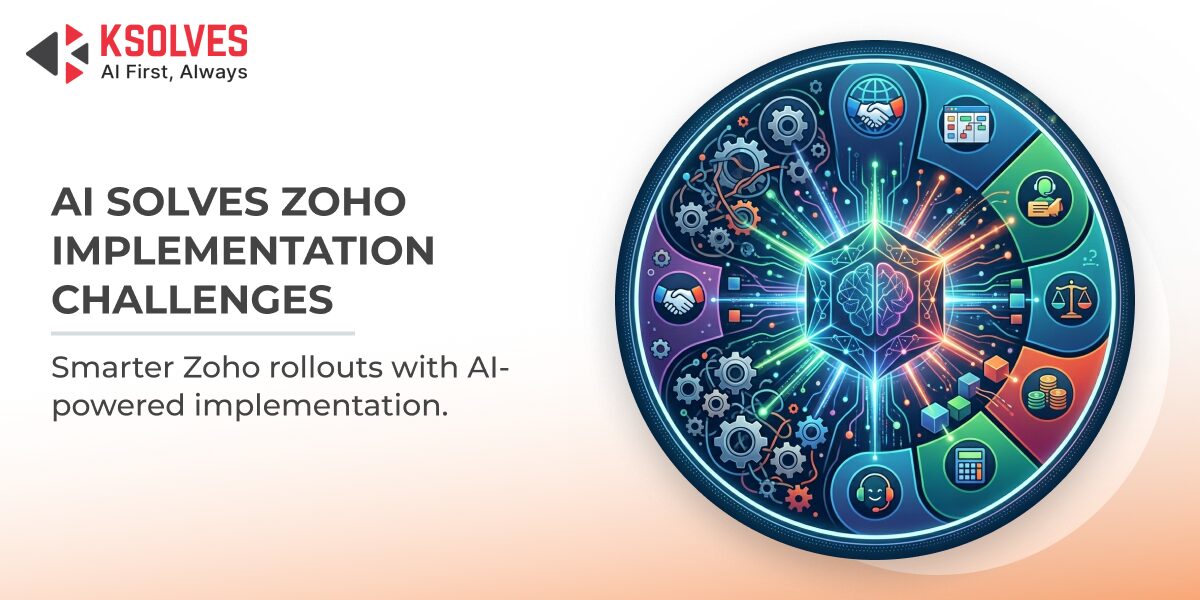
Zoho promises a unified business ecosystem. What it does not always advertise is how much can go wrong before you ever reach that promise. Bad data, undertrained teams, disconnected legacy systems, and workflows built for spreadsheets rather than a 50-app platform are the real reasons most Zoho projects stall or fail outright. The software itself is rarely the problem. The implementation is. The good news is that AI has fundamentally changed what is possible during a Zoho rollout, turning challenges that once took weeks to diagnose into problems that get caught and corrected before they cost you.
This blog covers the five most common Zoho implementation challenges and the specific ways AI is solving each one.
The Scope of the Problem
According to a McKinsey report on digital transformation, roughly 70% of large-scale technology implementations fail to meet their original objectives. The reasons are rarely technical limitations of the platform itself. They are almost always process, people, and data-related. Zoho One’s ecosystem of 50-plus integrated apps amplifies both the opportunity and the complexity. Getting the implementation right from the start is the difference between a system that runs your business and one your team quietly stops using.
Challenge 1: Messy Data Migration
Moving data from legacy CRMs, spreadsheets, or disconnected databases into Zoho is often the first major obstacle. Records are duplicated, fields are mismatched, date formats conflict, and customer histories are spread across multiple export files. A single migration error can corrupt records that took years to build.
How AI Solves It
AI-powered data profiling tools can scan incoming datasets before migration begins, flag duplicates, identify field mismatches, and automatically suggest mapping rules. Instead of a consultant manually reviewing thousands of rows, AI surfaces anomalies in seconds. Tools built on Zoho’s APIs, combined with intelligent data transformation pipelines, reduce migration time significantly while maintaining accuracy across every record.
Challenge 2: Low User Adoption
Zoho can automate entire departments, but only if the people in those departments use it. Resistance to change is one of the most consistent and costly challenges in any ERP or CRM rollout. Teams default to familiar habits, and an underused system delivers zero ROI regardless of how well it was configured.
How AI Solves It
AI-driven onboarding tools can personalize training paths based on each user’s role, behavior, and usage patterns within the platform. Zia, Zoho’s built-in AI assistant, can proactively surface relevant features to users as they need them, reducing the learning curve without requiring additional training sessions. AI-powered usage analytics can also alert implementation teams when adoption is declining in specific departments, before it becomes a systemic problem.
Challenge 3: Integration Failures with Third-Party Systems
Businesses rarely run on Zoho alone. Accounting tools, shipping platforms, marketing automation, e-commerce backends, and legacy ERP systems all need to connect cleanly. Integration failures create data silos, broken handoffs, and the exact inefficiencies Zoho was implemented to eliminate.
How AI Solves It
AI-assisted integration mapping can analyze your existing system landscape and recommend the most stable and efficient connection paths across your stack. With Zoho MCP now enabling AI agents to act directly across Zoho apps and 300-plus third-party tools via Zoho Flow, many of the manual integration steps that previously required custom development can now be handled by intelligent agents operating on natural language instructions.
Challenge 4: Over-Customization Without a Clear Strategy
Zoho’s flexibility is one of its greatest selling points. It is also a trap. Businesses frequently over-customize the platform during implementation, building fields, workflows, and layouts that reflect their current process rather than an optimized future state. The result is a bloated system that is difficult to maintain, slow to update, and resistant to scaling.
How AI Solves It
AI-based process analysis tools can audit existing workflows before configuration begins, identifying redundancy and bottlenecks that should be resolved before they are replicated in Zoho. AI configuration assistants can also recommend which native Zoho features satisfy a requirement without custom builds, reducing technical debt from day one.
Challenge 5: Poor Post-Implementation Optimization
Many businesses treat the go-live date as the finish line. In reality, it is the starting point. Workflows that looked correct in planning often reveal inefficiencies once real data flows through them. Without ongoing optimization, the platform slowly drifts away from the business’s needs.
How AI Solves It
Zoho Analytics, powered by Zia, continuously monitors pipeline health, workflow performance, and operational metrics. It automatically surfaces anomalies, flags where deals are stalling, identifies support queues that build up undetected, and predicts cash flow gaps before they become critical. Zia Agents, launched at ZohoDay 2025, now offer pre-built roles, including Account Manager, SDR, HR, Customer Support, and IT Help Desk, enabling automated responses to recurring operational patterns without additional configuration.
How Ksolves Helps You Avoid These Pitfalls with Expert Zoho Implementation Services
The challenges above are predictable. They are also preventable with the right partner in place before the project starts. Ksolves, an AI-First company, delivers end-to-end Zoho implementation services designed around how your business actually operates, not a generic deployment template.
Our team maps your existing processes, cleans and migrates your data with precision, configures Zoho modules to your specific workflows, and integrates your full technology stack without creating new silos. We apply AI-accelerated delivery methods to reduce configuration cycles, identify issues early, and ensure adoption is built into the rollout from week one. Businesses that partner with Ksolves for Zoho implementation consistently avoid the post-go-live corrections that derail most projects.
Conclusion
Zoho implementation challenges are not signs that the platform is wrong for your business. They are signs that implementation requires the same strategic investment as the software itself. Data migration, user adoption, integration stability, customization discipline, and ongoing optimization are all solvable problems. AI is now solving many of them faster and more accurately than manual approaches ever could. The businesses that get this right treat implementation as a foundational project, not a technical checklist.
If you are also planning a Zoho rollout or recovering from one that missed the mark, contact Ksolves to get it built correctly from the ground up, or send us your query at [email protected].






























Author
About the Author Editorial Team The Ksolves Editorial Team includes certified Salesforce experts, Big Data engineers, AI/ML specialists, Zoho consultants, and experienced technology writers focused on delivering clear, actionable insights for modern businesses. With hands-on experience across Salesforce, Big Data platforms, AI/ML solutions, application development, software testing, and Zoho ERP/CRM, the team publishes practical guides, real-world use cases, and industry updates that support smarter decisions and faster growth. Every article is created to solve business challenges, guide technology adoption, and keep organizations aligned with evolving digital ecosystems.
Share with